
.png)


A business decides it wants a WhatsApp chatbot. It starts looking up pricing and suddenly every platform is showing a different number. One says WhatsApp conversations cost less than ₹1. Another says chatbot plans start at ₹2,999 a month. Then an agency comes in quoting lakhs for setup. At that point, most businesses have no idea what they are actually paying for anymore.
The confusion happens because WhatsApp chatbot pricing is not one single cost. There are three separate layers involved, and most providers only talk about one of them upfront. There is Meta’s conversation pricing, then the BSP platform fee, and then the actual chatbot setup or development cost depending on how complex the automation is.
Once you separate these layers properly, the pricing starts making a lot more sense.
What Makes Up WhatsApp Chatbot Pricing
Most businesses think WhatsApp chatbot pricing is just what Meta charges for conversations. That is usually where the confusion starts.
In reality, there are three separate layers of cost sitting underneath every WhatsApp chatbot, and most providers only talk about the one that makes their pricing look cheaper.
The first is Meta’s conversation charges. WhatsApp charges per conversation, not per message, and the rate depends on whether the conversation is marketing, utility, authentication, or service.
The second is the BSP platform fee. Businesses access the API through a provider like helo.ai, which charges a monthly platform cost for the dashboard, automation, broadcasts, analytics, integrations, and support infrastructure.
The third is the chatbot itself. This is where pricing varies the most. A simple appointment booking bot costs very differently from a fully automated AI chatbot connected to CRMs, payment systems, and multiple workflows.
Most pricing confusion happens because businesses compare only one layer. One platform shows low API rates but charges extra for automation. Another bundle setup into a bigger monthly plan. Unless all three layers are looked at together, the numbers rarely add up properly.
Layer 1: Meta’s WhatsApp API Conversation Charges
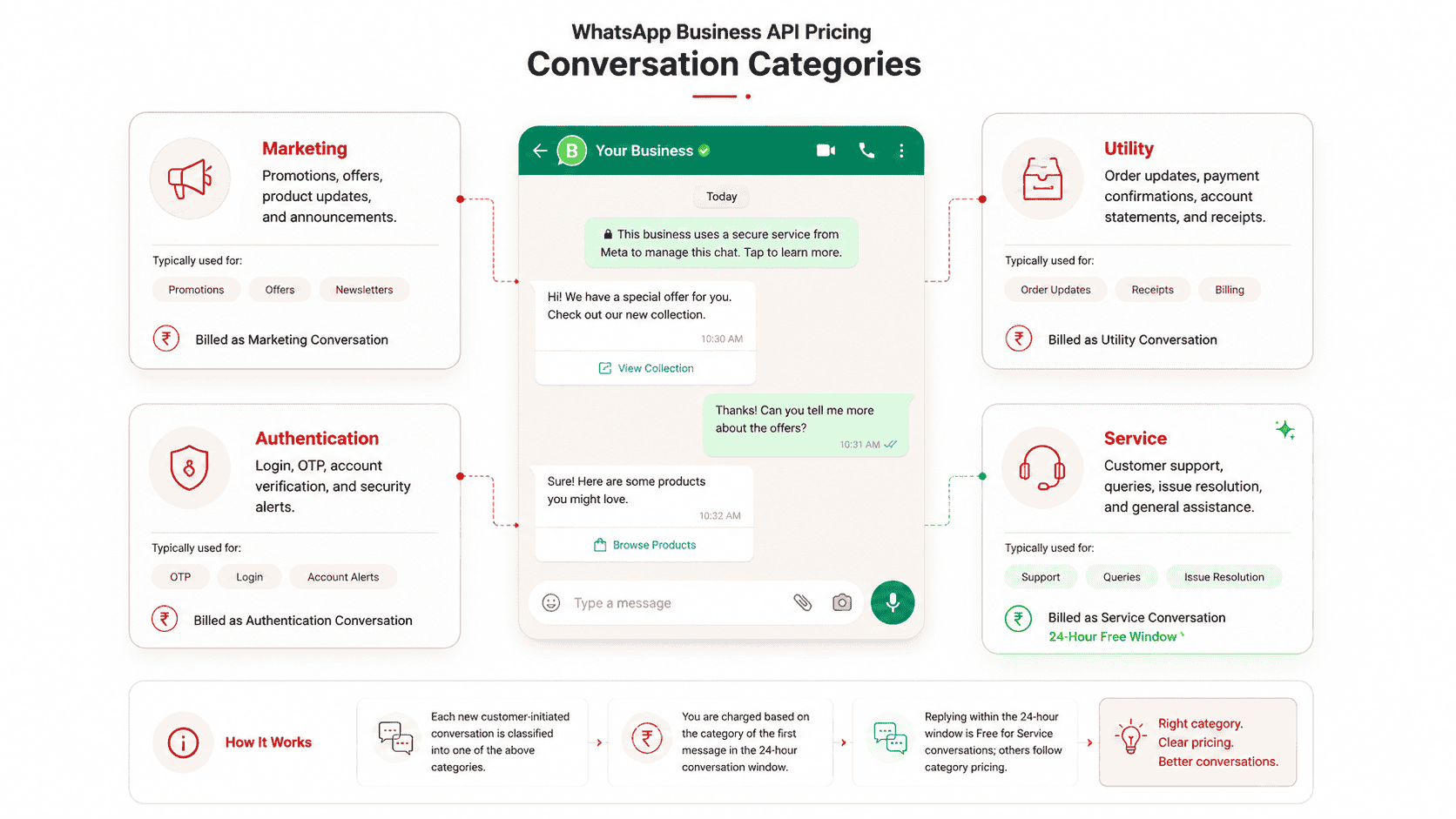
The first layer is Meta’s own conversation pricing.
WhatsApp does not charge businesses per message. It charges per conversation. So once a conversation starts, businesses can send multiple messages inside that 24-hour window without getting charged separately for every reply.
Meta divides conversations into four categories: marketing, utility, authentication, and service. Marketing conversations are promotional, things like offers, broadcasts, campaign notifications. Utility conversations cover order confirmations, appointment reminders, payment updates, delivery tracking, and support replies. Authentication is OTPs and verification codes. Service conversations are started by the customer and stay free for the first 24 hours.
In India, marketing conversations cost roughly ₹0.58 to ₹0.80 per conversation, with utility and authentication cheaper still. Meta updates these rates periodically, so it is always worth checking the official pricing page before planning campaigns.
This is also where a lot of businesses misunderstand WhatsApp pricing. They see Meta’s rates online and assume that is the total chatbot cost. It is not. This is only the API conversation layer. The BSP platform fee and the chatbot setup cost still sit on top of it.
For the full breakdown, our WhatsApp Business API Pricing India guide covers everything in detail.
Layer 2: BSP Platform Fee
The BSP is basically what makes the WhatsApp API usable for businesses. Without one, a company would have to build the dashboard, automation system, integrations, analytics, template management, everything on its own. Most businesses obviously do not want to do that.
So instead, they work with a BSP like helo.ai that already provides the infrastructure layer on top of the API.
This is the second layer of WhatsApp chatbot pricing.
BSPs usually charge a monthly platform fee for things like automation builders, broadcasts, CRM integrations, analytics, support, template management, and conversation handling. Some platforms keep it as a flat monthly subscription. Others price based on users, active agents, conversations, or feature access.
In India, the pricing can start from a few thousand rupees a month for smaller businesses and go much higher for enterprises handling large conversation volumes and complex automation workflows.
The cost usually depends on three things more than anything else:
- how complex the automation is,
- how many conversations the business handles,
- and how deeply the chatbot needs to integrate with other systems.
One important thing businesses should always check is whether the BSP adds markup on top of Meta’s conversation pricing. Some platforms do. Some do not. It is always better to ask for a proper cost breakdown upfront so the Meta charges and platform fees are clearly separated.
Platforms like helo.ai charge Meta’s rates as they are, without adding hidden markup on top.
Layer 3: Chatbot Setup and Development Cost
This is the part most businesses underestimate.
The chatbot setup cost depends entirely on how complex the automation needs to be. A simple rule-based bot costs very differently from a fully integrated enterprise AI chatbot.
At the basic level are rule-based bots. These follow fixed flows and predefined replies. Things like salon bookings, restaurant ordering, appointment scheduling, or FAQs usually fall into this category. They are quicker and cheaper to build because the journeys are structured.
Then come AI-powered chatbots. These can understand customer intent more naturally instead of depending only on buttons and fixed replies. Businesses usually use them for customer support, lead qualification, multilingual conversations, and more dynamic workflows. Naturally, the cost also goes higher here.
And then there are enterprise chatbots. These are connected to CRMs, payment gateways, ticketing systems, ERPs, logistics platforms, and internal databases. They also include analytics, human handoff, escalation logic, compliance workflows, and 24/7 automation.
Usually, the pricing depends on how many workflows need to be built, how many integrations are involved, and how advanced the automation needs to be. That is why chatbot setup costs can range from a simple monthly fee to large enterprise implementation budgets.
WhatsApp Chatbot Pricing for Small Business vs Enterprise
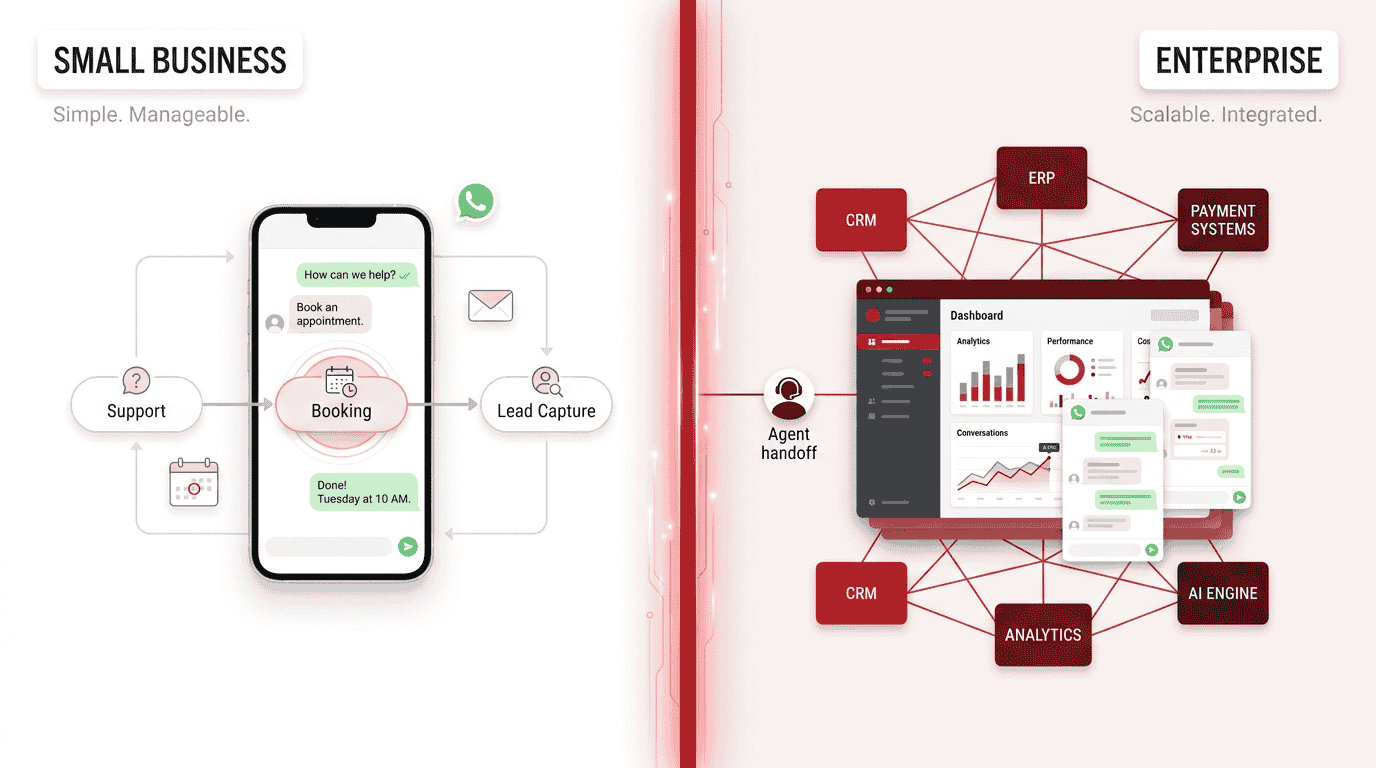
The same chatbot does not work for a five-person D2C brand and a large private bank. Naturally, the pricing changes too.
For small businesses, the setup is usually much simpler:
- Basic workflows: for lead capture, support, bookings, or orders
- Simple integrations: usually payment links or a CRM connection
- Lower setup complexity: fewer flows and less automation overall
For most small businesses in India:
- Monthly costs usually range between ₹3,000 and ₹15,000
- Setup costs usually range from ₹15,000 to ₹50,000
Enterprise chatbot setups are much more complex:
- Multiple workflows running across teams and departments
- Deep integrations with CRMs, ERPs, payment systems, and support tools
- Advanced automation including multilingual support, analytics, compliance, and human-agent handoff
Because of this:
- Monthly costs can range from ₹50,000 to several lakhs
- Setup costs usually start above ₹1 lakh
The pricing gap is not random. There is a huge difference between automating a few repetitive tasks and managing customer communication at enterprise scale.
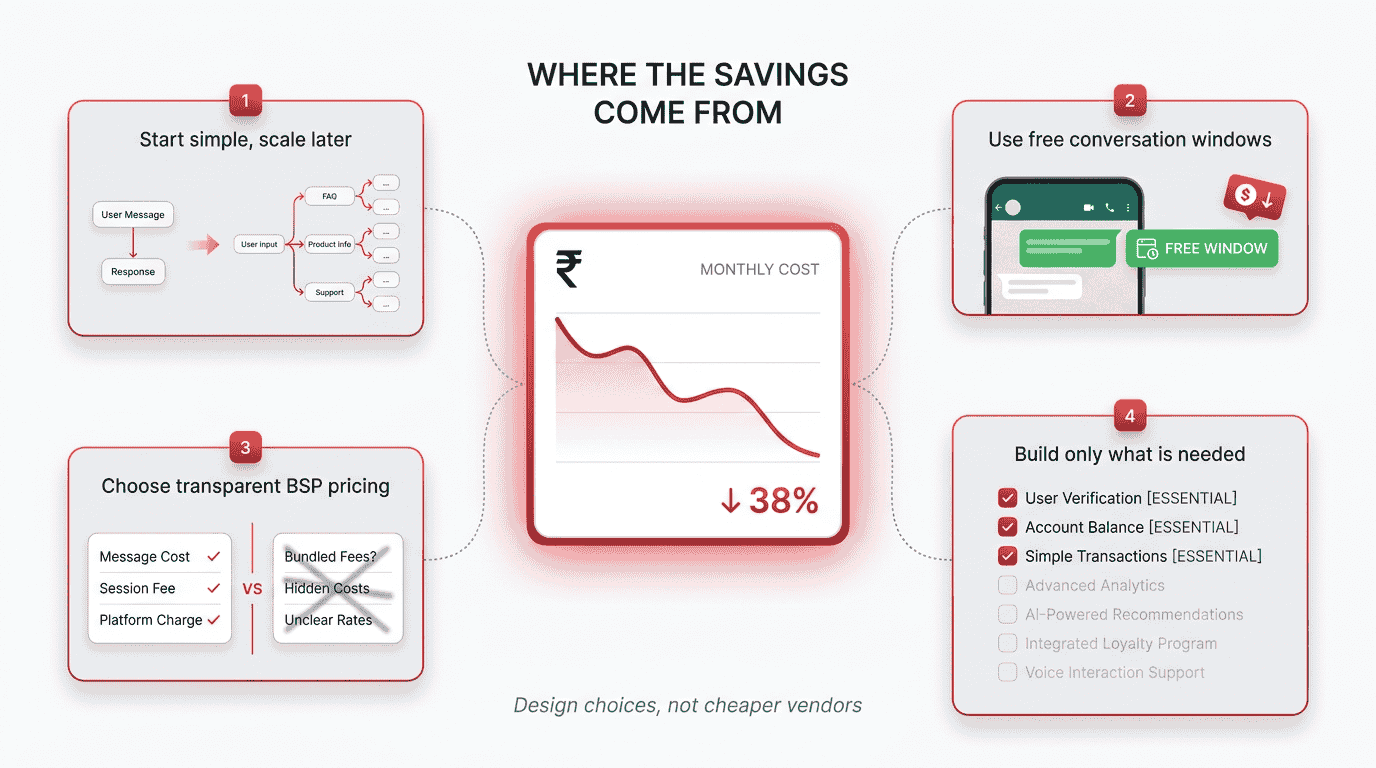
How to Reduce Your WhatsApp Chatbot Costs
Most businesses end up spending more on WhatsApp chatbots than they actually need to, usually because of decisions made too early in the process.
Start simple, scale up: Building a heavy custom bot for use cases that might come up later is one of the fastest ways to overspend. It is almost always cheaper to start with the flows that genuinely matter, and add new ones as the business grows into them.
Use the free conversation windows: When a customer messages first, the next 24 hours of service conversations are free. When a customer comes in through a Click to WhatsApp ad, a 72-hour free window opens for every type of message. Designing flows that pull customers in inbound, instead of pushing messages outbound, brings the monthly bill down noticeably.
Choose a BSP that is upfront about pricing. Some BSPs add markup on Meta's rates without saying so clearly, and at scale, that adds up fast. Always ask for a clean breakdown of what goes to Meta and what goes to the BSP.
Build only what the business actually needs: Multilingual support, voice integration, advanced AI flows. These are useful when there is a real reason for them. They are an expensive line item when they are added just in case.
FAQs
How much does a WhatsApp chatbot cost in India?
A simple rule-based chatbot usually costs between ₹15,000 and ₹50,000 to set up, with monthly costs between ₹3,000 and ₹15,000 depending on volume. AI-powered and enterprise bots cost significantly more because the automation and integrations become more complex.
Is a WhatsApp chatbot free?
No. The WhatsApp Business App is free, but a real chatbot runs on the WhatsApp Business API, which is paid. Businesses usually pay Meta’s conversation charges, the BSP platform fee, and the chatbot setup cost separately.
What is the cheapest WhatsApp chatbot setup for a small business?
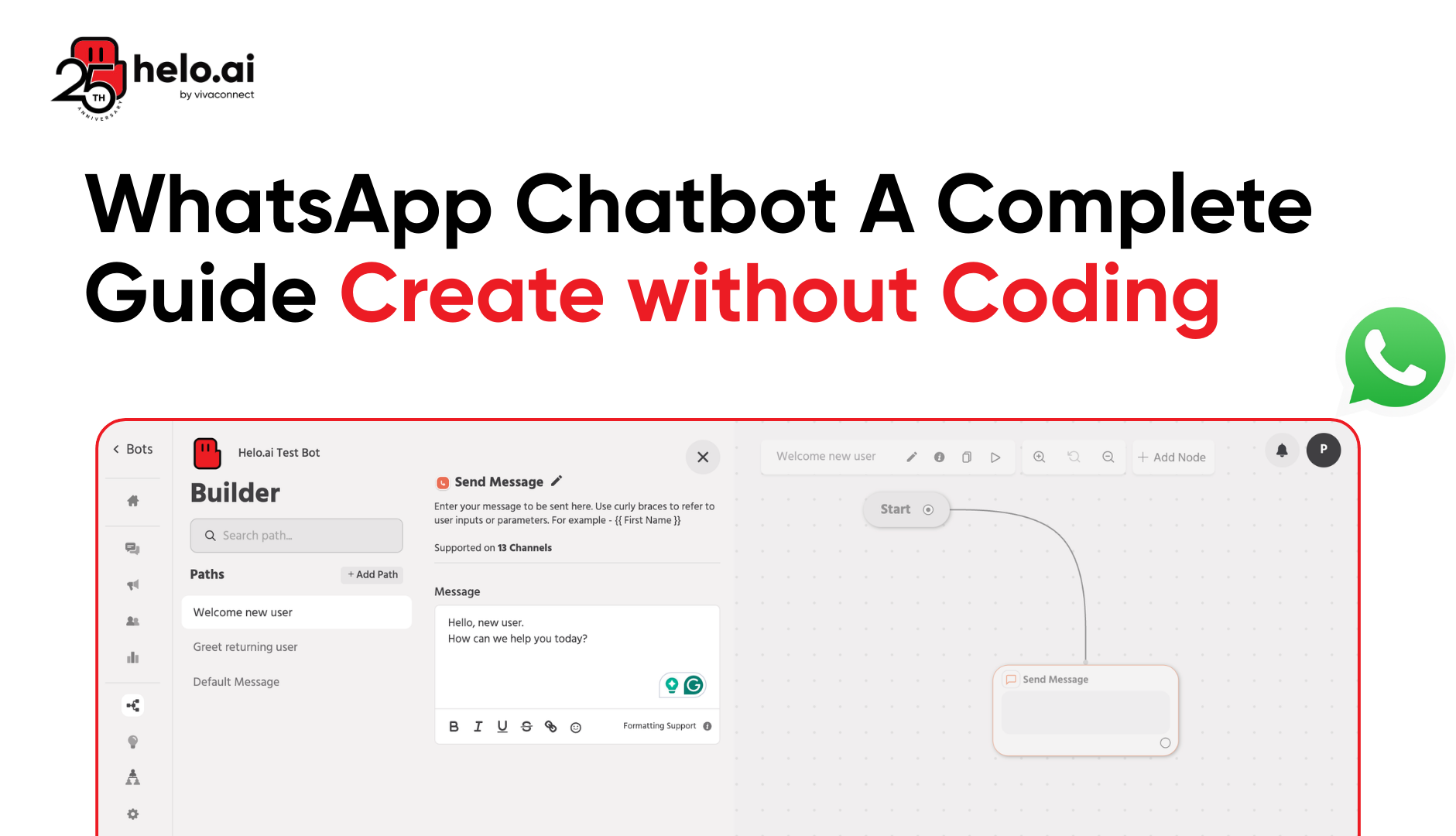
Usually a simple rule-based bot built on a no-code BSP platform like helo.ai. Businesses can start with basic support, booking, or lead capture flows and scale later as volume grows.
How are WhatsApp chatbots priced for enterprises?
Enterprise chatbots cost more because they usually involve multiple workflows, CRM and ERP integrations, analytics, compliance systems, multilingual support, and human-agent handoff. Monthly costs can range from ₹50,000 to several lakhs depending on complexity.
Are there hidden costs in WhatsApp chatbot pricing?
Sometimes. Some BSPs add markup on top of Meta’s conversation pricing. Integration work, advanced automation, analytics, or custom setup can also increase the total cost. Always ask for a complete pricing breakdown upfront.
Can a WhatsApp chatbot pay for itself?
For many businesses, yes. A good chatbot reduces support workload, improves response speed, captures leads, and recovers lost conversions. At scale, the cost usually justifies itself fairly quickly.
Conclusion
WhatsApp chatbot pricing starts making sense once the costs are separated properly. Every business is usually paying for three things: Meta’s conversation charges, the BSP platform fee, and the chatbot setup itself. The actual cost depends on how complex the automation needs to be and how deeply the chatbot connects with the business operations.
For some businesses, a simple support or lead capture bot is enough. Others need large-scale automation connected to CRMs, payment systems, support teams, and multiple workflows. The important thing is to build for what the business actually needs right now, instead of overbuilding too early.
Platforms like helo.ai help businesses manage this entire setup through chatbot automation, integrations, broadcasts, and scalable WhatsApp communication infrastructure.