


Landing pages used to sit at the centre of digital conversion. A user clicked an ad, filled out a form, waited for a callback, and somewhere between the click and the conversation, most businesses lost the lead.
This behaviour is changing.
Customers today are far more likely to message a business than fill out a long form or wait for an email response. They want answers fast, not a form to fill. That shift is one of the biggest reasons Click-to-WhatsApp ads are growing fast.
Instead of sending users to a landing page, Click to WhatsApp ads open a WhatsApp conversation directly from Facebook or Instagram. And that changes more than just the destination. It changes where the conversion happens.
The ad is no longer the conversion point. The conversation is.
This is also where many businesses get WhatsApp ads wrong. Most guides focus on setup, targeting, and creatives, but the real difference often comes after the click. Slow replies, weak opening messages, poor qualification flows, and broken follow-ups can hurt conversion rates even when the ad performs well.
In this guide, we'll cover how Click-to-WhatsApp ads work, how to set them up, what they cost, where businesses struggle, and how to build WhatsApp campaigns that actually convert.
What Are Click to WhatsApp Ads and Why They Work
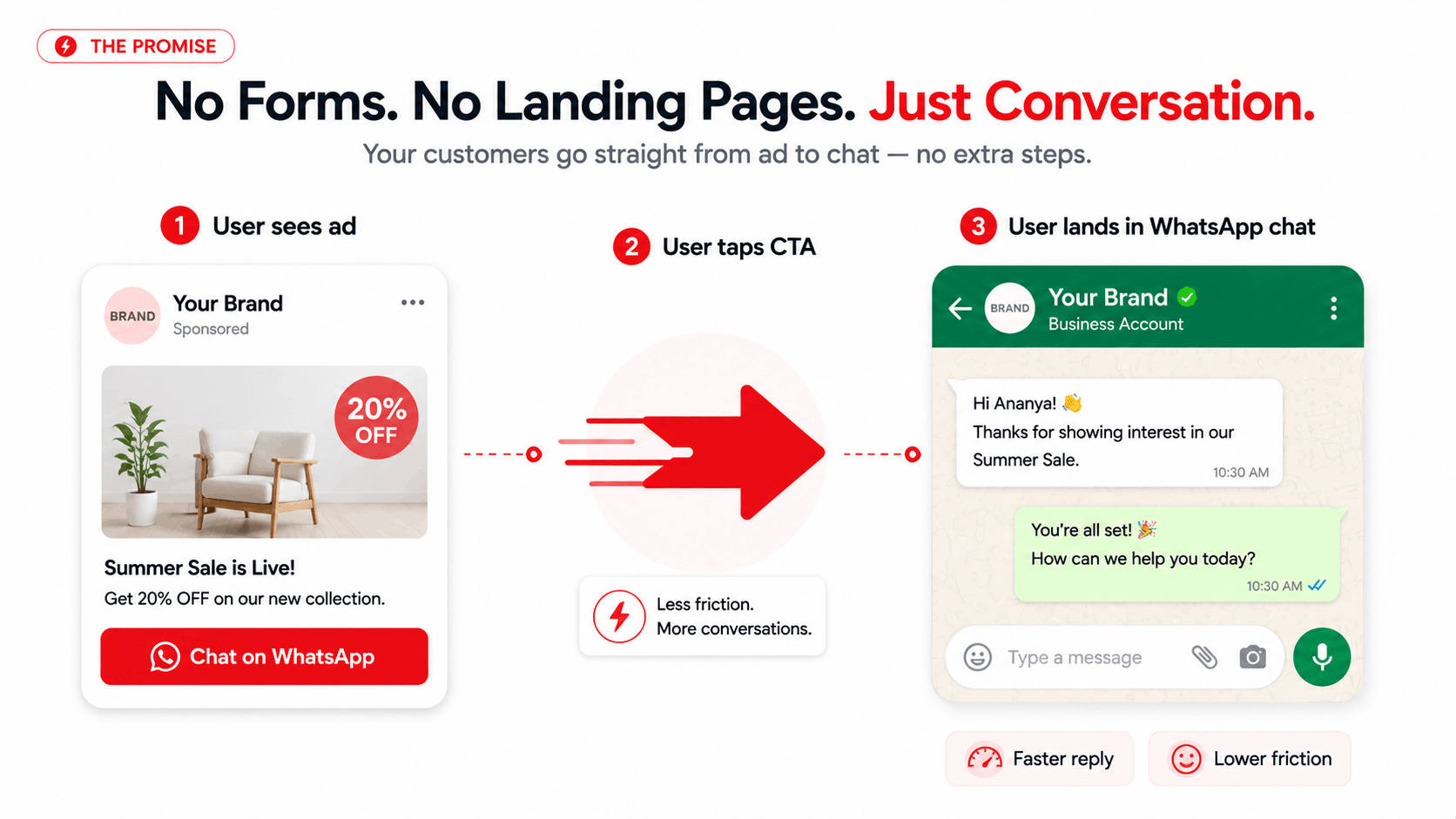
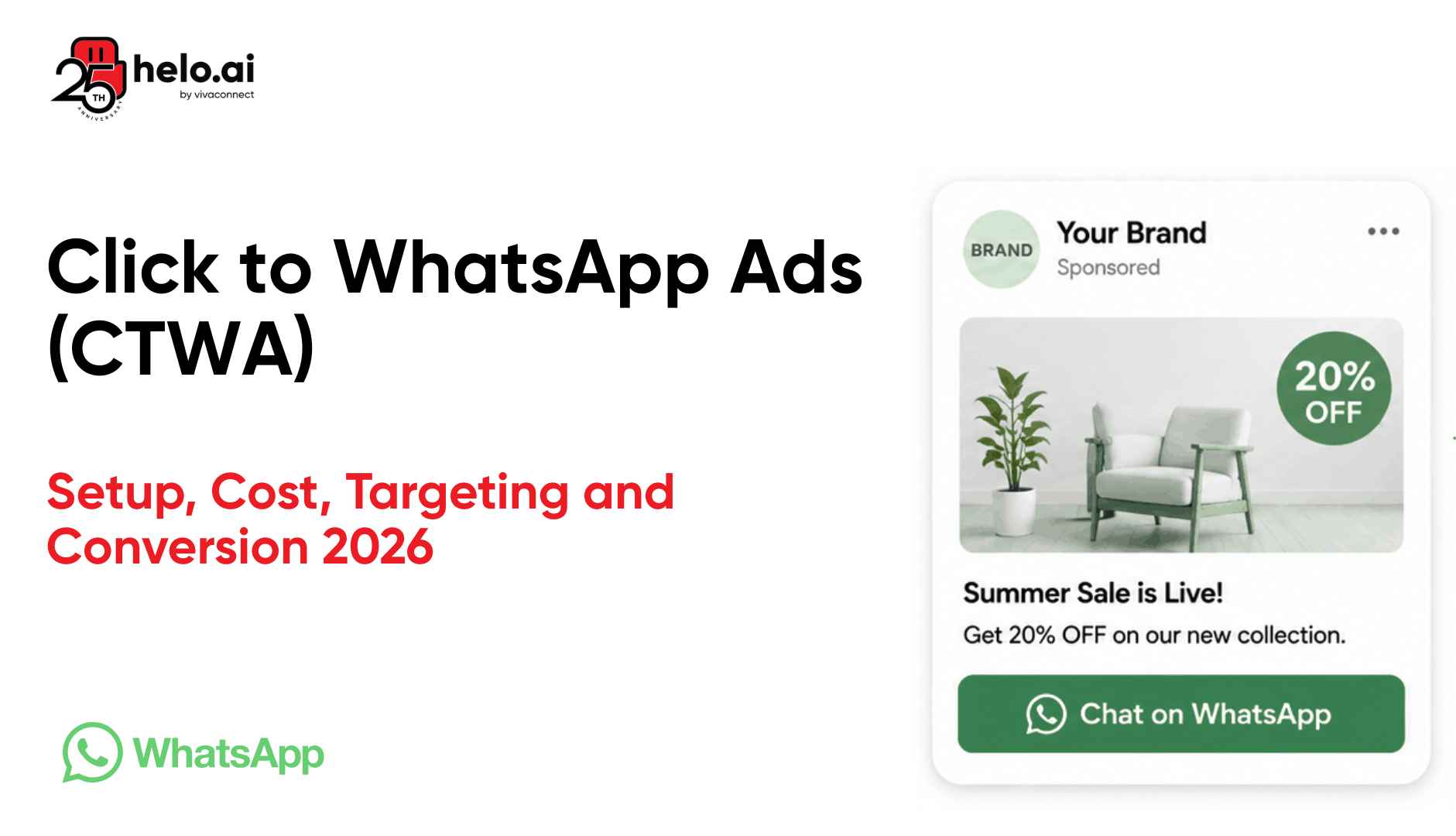
Click to WhatsApp ads are ads that take users directly from Facebook or Instagram into a WhatsApp conversation with a business. Instead of sending customers to a website or asking them to fill out a long form, the ad opens a direct chat where the conversation can start instantly.
This helps reduce friction in the customer journey. People are far more likely to send a quick message than wait for a page to load, fill out their details, and wait for a callback. The interaction feels faster, more natural, and more personal from the start.
Mechanically, the process is simple. A user sees the ad on Meta platforms, taps the CTA button, and WhatsApp opens with a pre-filled message or prompt. From there, the business can continue the conversation through a sales agent, chatbot, or automated workflow.
The reason Click to WhatsApp ads work so well is because WhatsApp is already a highly active channel for users. According to Meta, WhatsApp delivers a 98 percent open rate, with most messages read within minutes. Businesses can personalise interactions based on user intent, responses, and behaviour making it easier to segment leads, qualify users faster, and move customers through the funnel without losing momentum between the click and the conversation.
How CTWA Actually Works: The Full Conversation Funnel
Most businesses think Click to WhatsApp ads end at the click. Someone sees the ad, taps it, lands in WhatsApp, done. But that’s not really where the campaign works or fails.
The real conversion happens inside the chat.
A typical Click to WhatsApp ad funnel starts when a user sees an ad on Facebook or Instagram and clicks the CTA. Instead of going to a landing page, WhatsApp opens directly with a pre-filled message or conversation starter.
And from there, everything depends on how the conversation is handled.
The opening reply matters a lot more than most businesses think. If the response is slow, generic, or feels disconnected from the ad, users drop off quickly. But when the flow is smooth, quick replies, relevant questions, proper qualification, clear next steps the conversation keeps moving naturally.
This is why strong WhatsApp ad campaigns are usually built around routing, automation, and follow-ups, not just creatives and targeting. Some businesses route chats directly to agents. Others use bots to qualify leads first and then hand over high-intent users to sales teams.
The follow-up layer matters too. Once the 24-hour WhatsApp conversation window closes, businesses need approved templates to restart conversations and continue nurturing leads.
That’s the part most businesses miss. The ad gets the click. The chat gets the conversion.
Also Read: How to Build WhatsApp Sales Funnel
How to Set Up Click to WhatsApp Ads: Step by Step
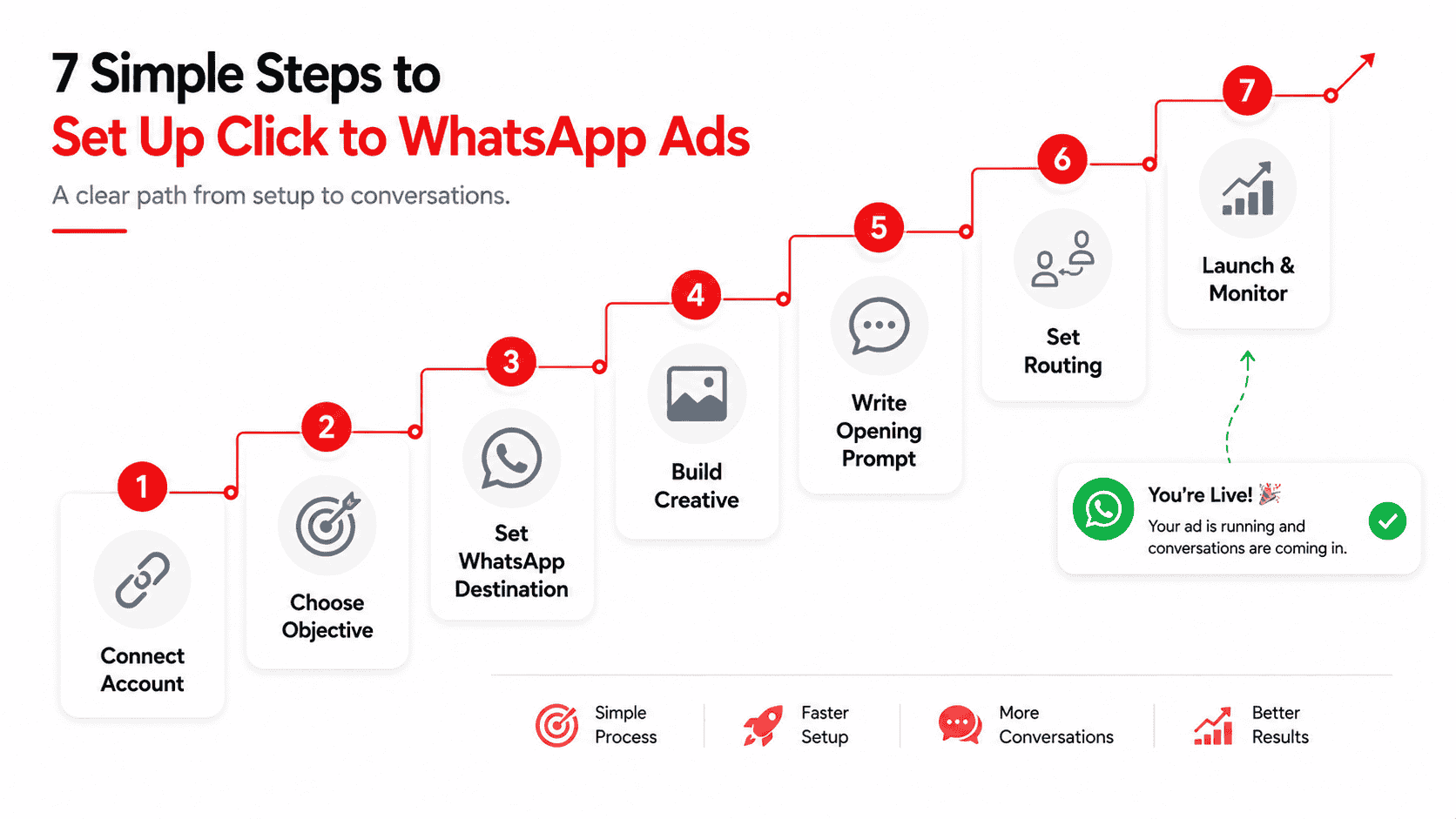
Setting up Click to WhatsApp ads through Meta Ads Manager is straightforward. The harder part is building the conversation flow behind the ad. Because with CTWA campaigns, the ad only starts the journey. The chat is where conversion actually happens.
Here's how to create a WhatsApp advertisement step by step:
1. Connect your WhatsApp Business account Link your WhatsApp Business number to your Facebook Page through Meta Business Manager. This allows Facebook and Instagram ads to open directly into a WhatsApp chat.
2. Choose your campaign objective Inside Meta Ads Manager, create a new campaign and select an objective like Engagement or Leads depending on what you want the campaign to drive.
3. Select WhatsApp as the destination Under messaging apps, choose WhatsApp as the destination. This makes your Facebook ads click to WhatsApp instead of redirecting users to a landing page or lead form.
4. Create the ad creative Set up the copy, visuals, CTA, and offer. But remember the ad should prepare users for the conversation ahead, not just generate clicks.
5. Write the opening message This is one of the most important parts of the funnel. Add a pre-filled message or opening prompt that feels contextual, clear, and easy to respond to.
6. Set up routing and follow-ups Decide what happens after the first message. Will chats go to an agent, chatbot, or automated workflow? Once the 24-hour conversation window closes, you will need pre-approved WhatsApp message templates to restart the conversation and continue nurturing leads. This step is what separates campaigns that convert from ones that just generate clicks.
7. Launch and monitor conversations Once the campaign goes live, do not just track CTRs or CPCs. Track conversation quality, response times, drop-offs, and how many chats actually turn into qualified leads.
WhatsApp Business App vs API: Which Do You Actually Need
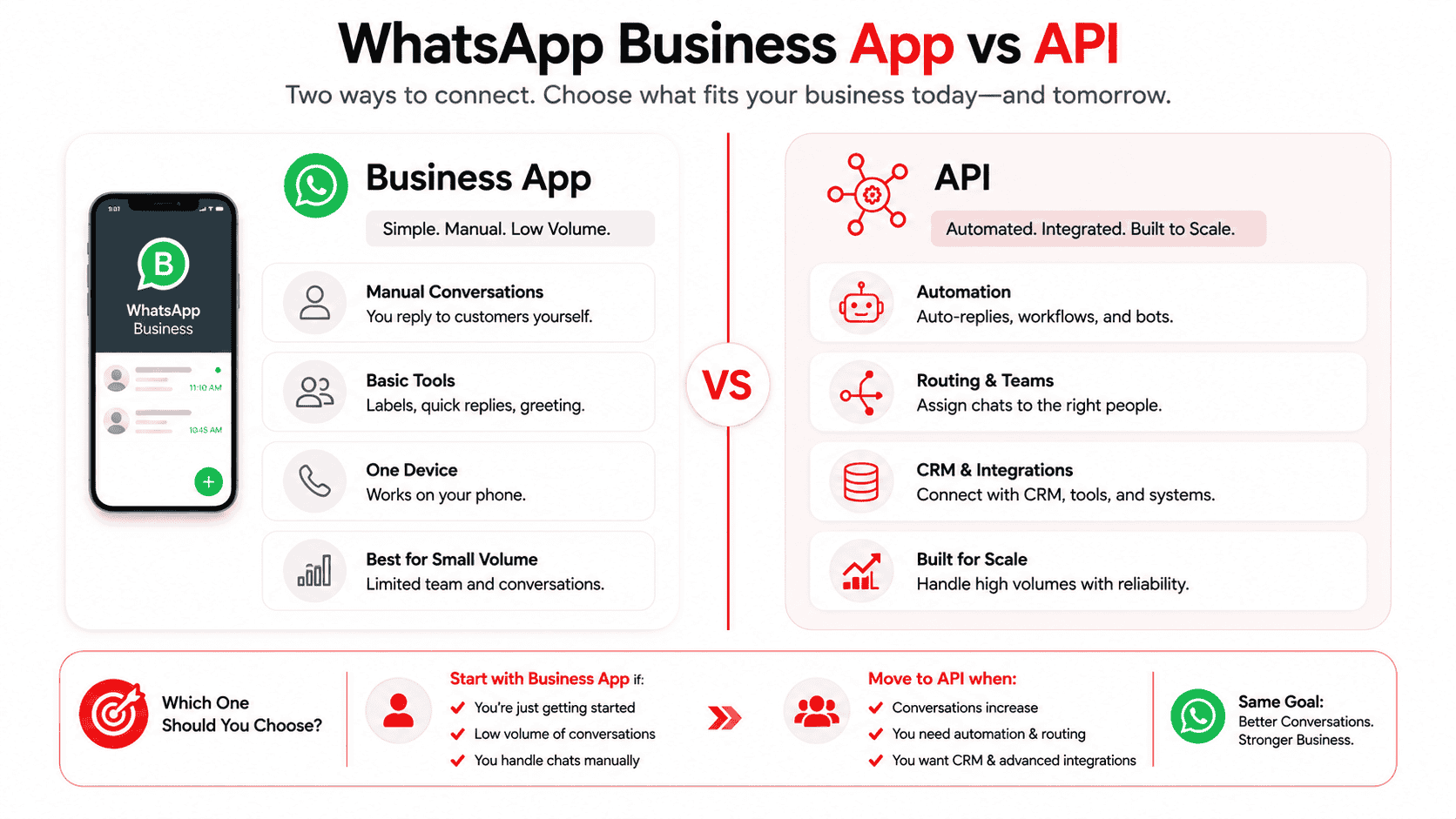
A lot of businesses start advertising on WhatsApp Business using the regular WhatsApp Business App. And for small volumes, that works fine. You can reply manually, manage conversations yourself, and handle leads directly from your phone.
The problem starts when Click to WhatsApp campaigns begin generating conversations at scale.
This is usually where businesses realise the App was never built for high-volume lead management. Response times slow down, follow-ups become manual, chats get missed, and there’s no proper system behind the conversations.
What breaks first is rarely the ads. It’s the operations behind them.
The WhatsApp Business App has limitations that become difficult to manage once campaigns grow: no automation, no CRM integration, and no structured way to manage conversations across a team. That usually means missed leads, slower responses, inconsistent follow-ups, and no visibility into what’s actually converting.
That’s where the WhatsApp Business API becomes important.
The API is designed for businesses running conversations at scale. It supports automation, chatbots, CRM integrations, shared team inboxes, lead routing, analytics, and structured follow-up systems. More importantly, it allows businesses to treat WhatsApp like a proper conversion channel instead of just another inbox.
If you’re running Facebook ads click to WhatsApp consistently and generating meaningful lead volume, staying on the App too long usually creates more operational problems than it solves. The API is what turns WhatsApp from a messaging tool into a scalable conversion system.
Read the Complete Comparison: WhatsApp Business App vs API
Click to WhatsApp Ads Cost and Pricing in India 2026
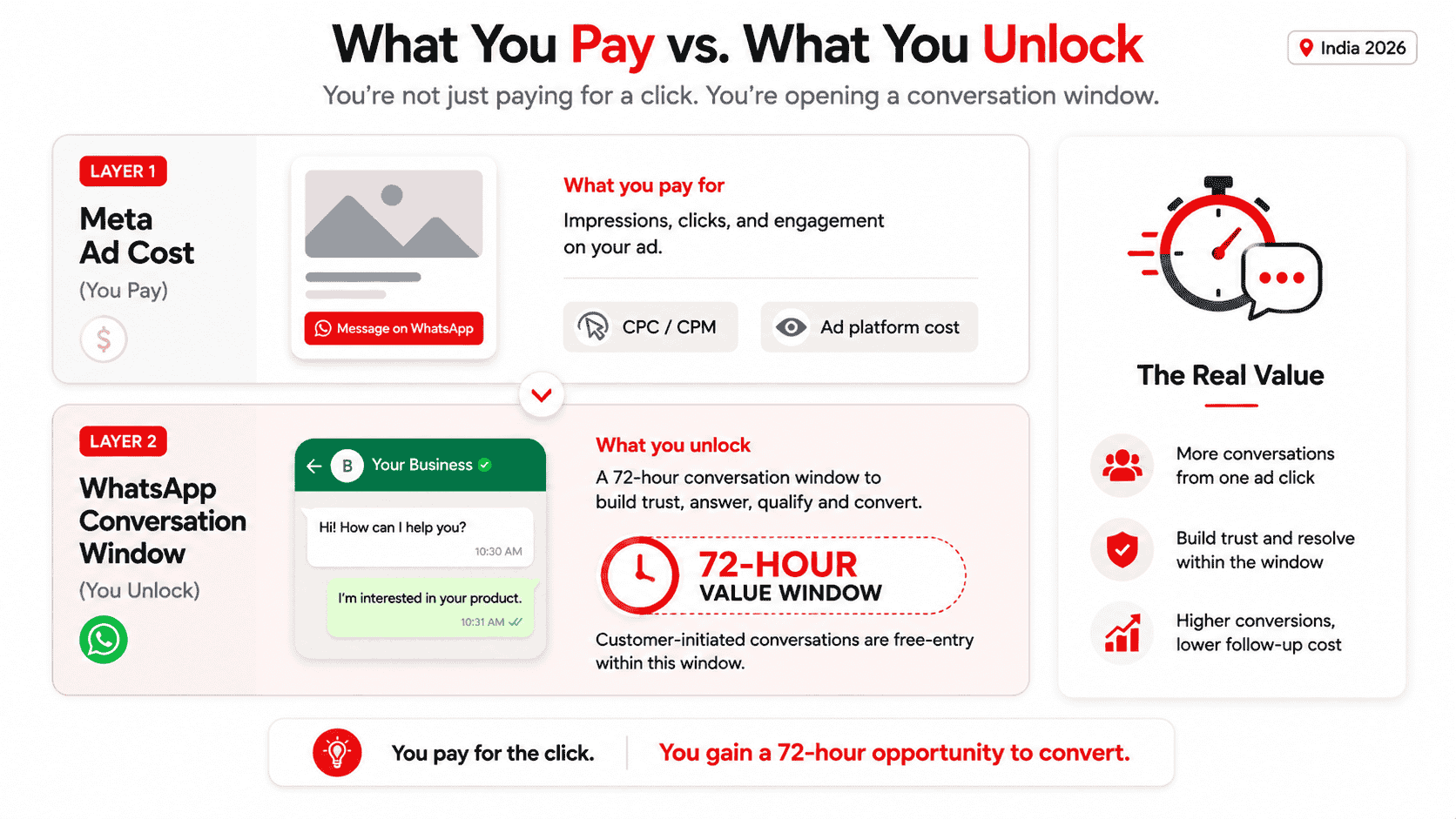
The cost of running Click to WhatsApp ads usually has two parts the ad spend itself, and the WhatsApp conversation cost after the click.
The first part works like any other Meta campaign. Your CPCs and CPMs depend on industry, targeting, competition, and creatives. In India, sectors like BFSI, education, and real estate usually see higher costs compared to local retail or D2C campaigns.
But the more important part and the one most businesses don’t fully understand, is the WhatsApp conversation window.
When a user clicks on your WhatsApp ad and you reply within 24 hours, WhatsApp opens a 72-hour free entry point conversation window. During this period, businesses can send messages, follow-ups, reminders, product details, and even marketing communication without additional WhatsApp conversation charges.
This is one of the biggest cost advantages of CTWA campaigns.
Most businesses think they’re only paying for the click. But the real value comes from what happens after the click. You’re not just generating a lead you’re opening an active conversation window where qualification, follow-ups, objection handling, and conversion can all happen without extra messaging costs.
That’s also why response speed matters so much. The faster the conversation starts, the more value businesses get from the window. Slow replies don’t just hurt conversion rates. They waste the economics of the funnel too.
For a deeper cost breakdown, see our guide to WhatsApp Business API pricing in India
Targeting and Creative Strategy That Actually Converts
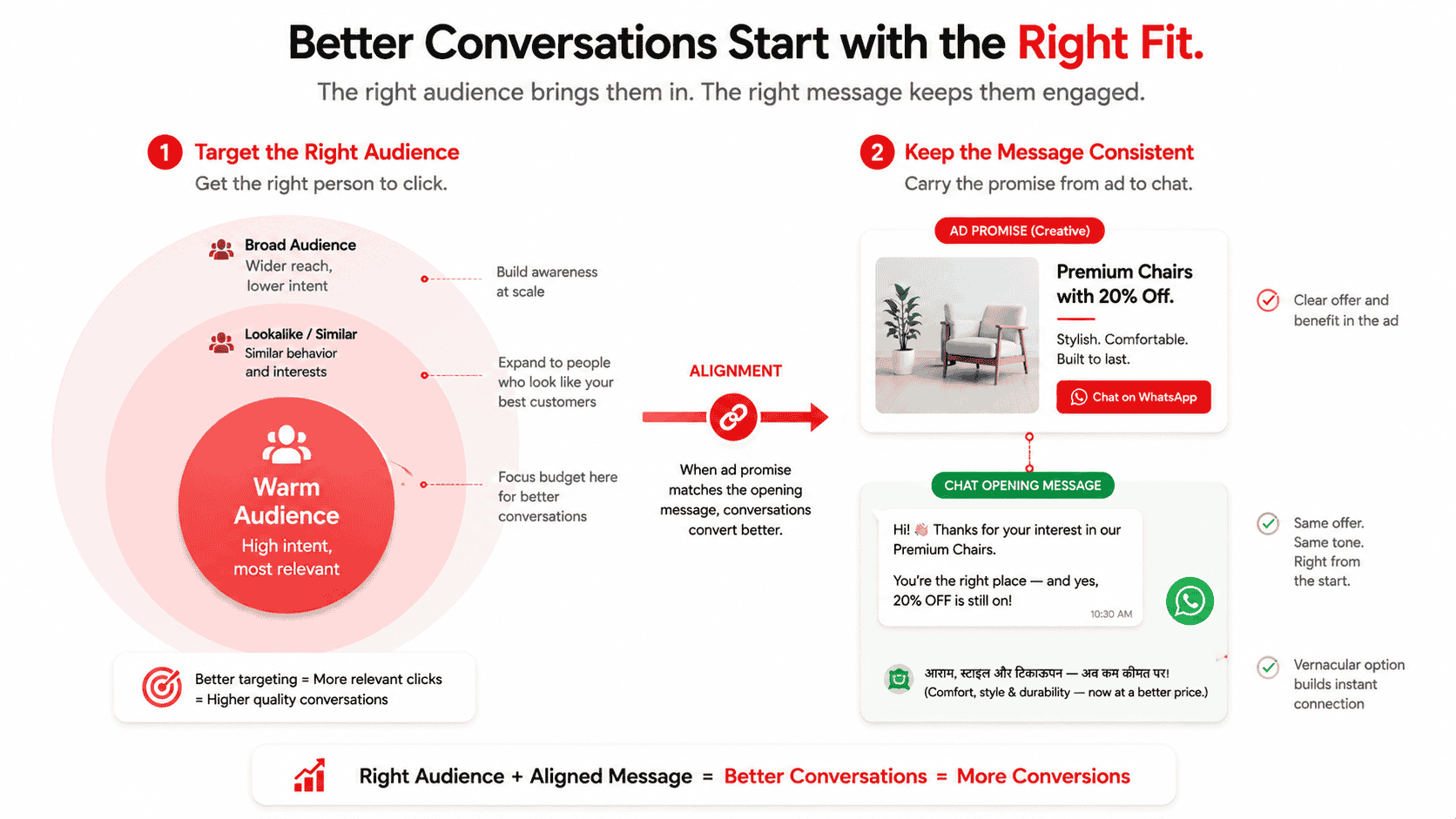
A lot of businesses think the job is done once users click on the ad and land in WhatsApp. But with CTWA campaigns, the targeting and creatives decide how the conversation performs before it even starts.
Custom audiences from your CRM, retargeting website visitors, and lookalike audiences usually perform far better than broad targeting because the user already knows the brand or has shown intent earlier.
This becomes even more important in categories like:
- BFSI
- Education
- Healthcare
- Real estate
Warmer audiences almost always lead to better conversations because users already have some level of context before entering the chat.
With regular Meta ads, the creative’s job is mostly to get the click.
With Click to WhatsApp ads, the creative also sets up the conversation.
If the ad feels informative but the chat opens with a generic sales message, the drop-off happens immediately. The user clicked expecting continuity. Instead, the conversation feels disconnected.
That’s usually where momentum breaks.
The pre-filled message matters too.
Most brands still leave it at a simple:
“Hi”
But the opening prompt is part of the funnel itself. A more contextual opening message usually performs much better because users already know what to ask next or how to continue the conversation.
For Indian audiences, vernacular creatives and regional targeting can make a massive difference.
Ads usually perform better when:
- the language feels familiar
- the tone feels local
- the examples feel relevant
- the format feels mobile-first
Especially outside metro audiences, local familiarity usually performs better than polished ad language that sounds too generic.
Videos usually work well when the product or service needs explanation.
But for direct-response CTWA campaigns, image ads and carousels often convert better because they get users into the conversation faster.
Why Your Click to WhatsApp Ads Are Not Converting And How to Fix It
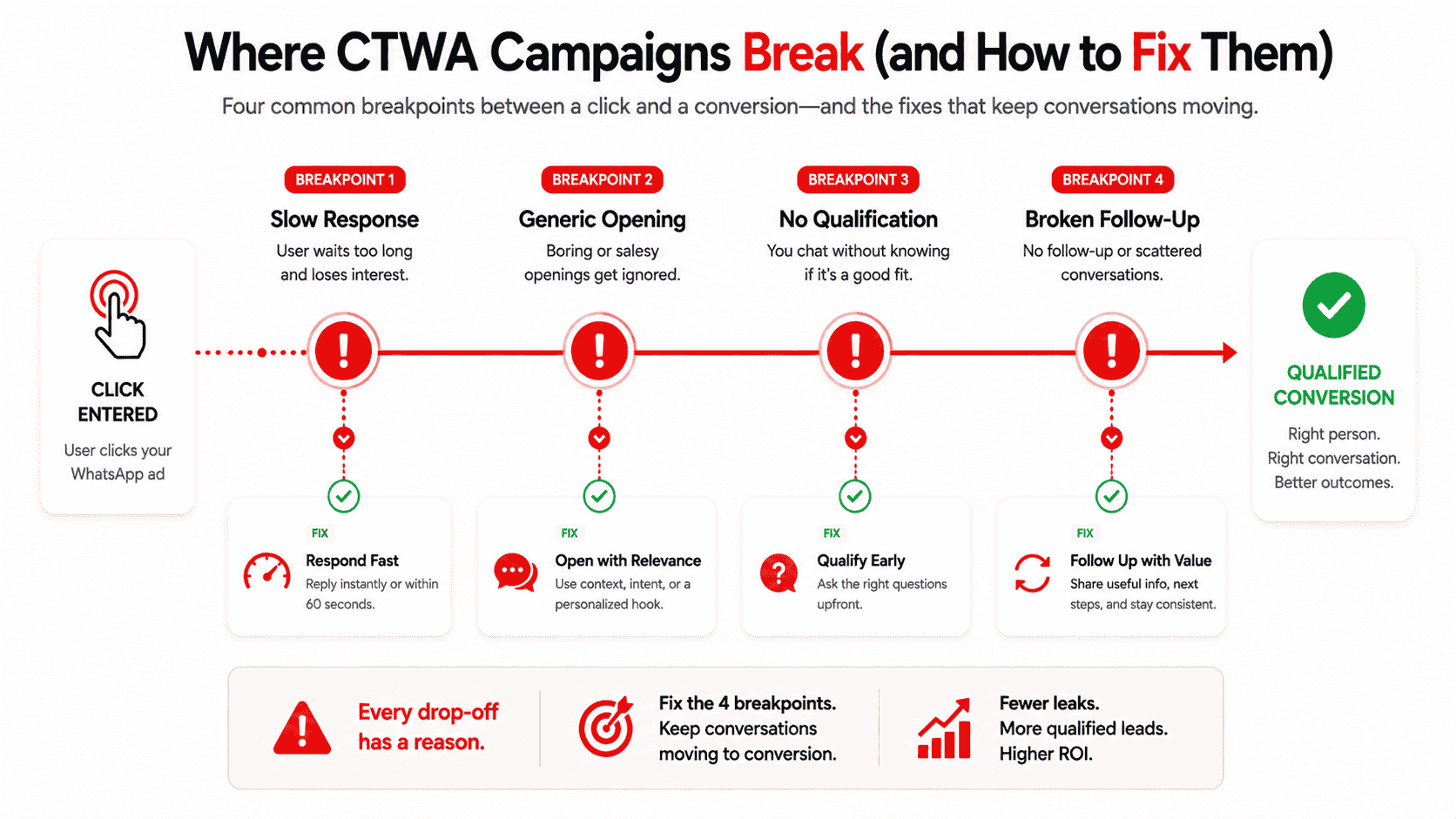
Most businesses think their Click to WhatsApp ads are failing because of targeting or creatives. But most drop-offs happen after the click.
The ad gets users into WhatsApp. The conversation decides whether they convert.
The first big problem is response time. People clicking on WhatsApp ads expect immediacy. If replies take too long, the momentum disappears quickly and the conversation goes cold before it even starts.
Then comes the opening message. A user clicks on a very specific ad and lands in a chat that says, “Hi, how can we help you?” The context breaks instantly. The opening message should feel like a continuation of the ad, not a restart.
A lot of businesses also skip qualification completely. Which means sales teams suddenly end up handling conversations that were never filtered properly in the first place. Strong CTWA campaigns usually qualify intent early before routing chats further.
Routing itself becomes another issue at scale. Users land with the wrong team, wait too long for responses, or keep getting transferred between agents. That friction adds up fast inside messaging.
Then the 24-hour window closes and the follow-up system breaks completely because there are no approved templates or structured re-engagement flows in place.
And finally, one of the biggest problems is that the ad and the chat feel disconnected from each other. The user clicks expecting one thing and lands in a conversation that feels generic or sales-heavy.
That’s where most CTWA campaigns actually fail. Not at the ad level. Inside the conversation itself.
CTWA for Indian Enterprises — TRAI, DLT and BFSI Context
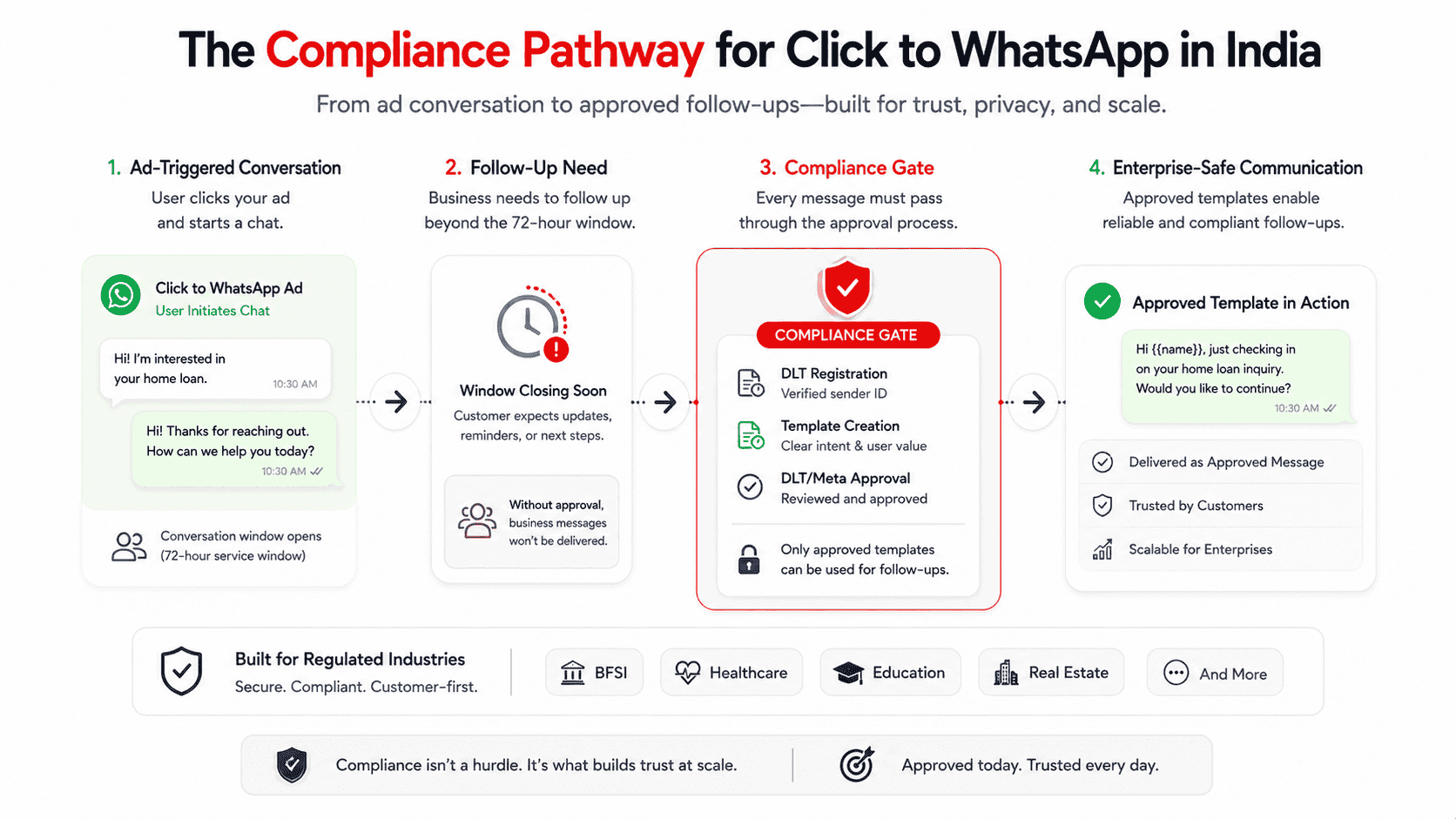
For Indian enterprises, WhatsApp for advertising comes with a layer most global CTWA guides barely talk about, compliance.
In India, TRAI regulates commercial business messaging across channels like SMS, RCS, and WhatsApp. Which means businesses can't just scale messaging workflows without the right approvals and registrations in place.
That's where DLT comes in.
DLT, or Distributed Ledger Technology, is the compliance framework businesses use for commercial messaging in India. In practice, this means registering your business, sender IDs, and message templates before sending communication at scale.
This becomes important in Click to WhatsApp campaigns once the 24-hour conversation window closes.
A user may click on the ad and start the conversation freely. But the moment a business wants to follow up later with reminders, updates, offers, or re-engagement messages, approved templates start becoming important, especially in regulated sectors.
This is also why CTWA has become particularly valuable for BFSI in India.
A lot of BFSI journeys are already conversation-heavy. The difference is that users now expect these interactions to happen faster and more naturally inside messaging platforms instead of disconnected forms, IVRs, or callback chains.
That's also why the operational side matters so much here. The businesses scaling CTWA successfully are usually the ones treating WhatsApp like a proper communication system, not just another campaign channel.
FAQs
Are Click to WhatsApp ads better than landing page ads?
For a lot of businesses, yes. CTWA campaigns remove a big part of the friction because users go directly into a conversation instead of filling out forms and waiting for callbacks. The conversion journey feels faster and more natural.
What is the conversion rate of Click to WhatsApp ads?
There’s no standard number because it depends heavily on the industry, targeting, response speed, and how the conversation is handled after the click. Two businesses can run the same ad and get completely different results based on the chat flow alone.
Do I need WhatsApp Business API to run Click to WhatsApp ads?
No. You can start with the WhatsApp Business App itself. But once conversations start scaling, most businesses move to the API because the App is not built for automation, routing, CRM integrations, or structured follow-ups.
Are WhatsApp ads cheaper than Facebook lead ads?
In many cases, yes. Especially because CTWA campaigns reduce drop-offs between the click and the conversation. But the real advantage comes when businesses respond quickly and handle conversations properly after the click.
What type of creatives work best for WhatsApp ads?
Short vertical video tends to win, ideally 9:16 and under 15 seconds, with a hook in the first three seconds. Single-image ads and carousels work well when the offer is clear or the product needs to show variants. The format that consistently underperforms is the polished brand film. CTWA rewards clarity over production value.
How do I improve WhatsApp ad conversion rate?
Start with the conversation, not the ad. Cut first-response time to under two minutes. Rewrite the opening message so it directly references the ad the user just clicked. Add a short qualification flow before agents step in. And set up template messages for follow-ups after the 24-hour window closes. These four changes lift conversion more reliably than any creative test.
Are WhatsApp ads good for B2B lead generation?
Yes, especially when the sale already depends on a conversation. Demo bookings, consultations, RFQs, and high-ticket B2B sales fit naturally into CTWA because the format mirrors how those deals actually close. Where it struggles is fully self-serve products, where a free trial signup converts faster than a chat could.
Can I use chatbots with WhatsApp ads?
Yes, and once chat volume grows, you should. A chatbot protects response time when several users arrive at once. The pattern that works best is bot-then-agent: the bot handles the first reply, captures basic information, and qualifies the lead, while the agent steps in only when the lead matches the sales criteria. The handover should carry full context so the user never has to repeat themselves.
Why are my Click to WhatsApp ads not converting?
In most cases, the ad is not the problem. The chat is. Four things tend to break first: a first-response time longer than five minutes, a generic opening message that ignores the ad context, no qualification before a human agent steps in, and no template-based follow-up after the 24-hour window closes. Fixing these almost always moves conversion more than changing the ad creative.

.png&w=828&q=75)