


Customer acquisition costs across global fintech have crossed historic highs, KYC drop-offs hover around 60%, and digital servicing budgets keep climbing. If you're sitting in a strategy meeting trying to fix any of these without breaking the budget, the WhatsApp Business API for fintech is probably already on the table. The question isn't whether it works — over 2.78 billion people use WhatsApp globally, and most major banks, NBFCs, and lending platforms are already deep into deployment. The real question is: how do you build the business case, choose the right vendor, and stay compliant while moving fast? This guide is built for exactly that conversation.
The Fintech Communication Problem No One Wants to Talk About
Email and SMS are not delivering the engagement numbers your CFO was promised five years ago. Meanwhile, your customer is replying to friends on WhatsApp three times before th5ey finish reading your "Important Account Update" email.
Here's what's broken:
- Email open rates for financial services have dropped below 18%
- SMS has become a graveyard of OTPs and ignored alerts
- Outbound calls see sub-5% pickup, with rising call-center costs
- Mobile apps struggle with 60-70% drop-off between download and first transaction
This isn't a marketing channel problem — it's an infrastructure mismatch. The fintechs solving it aren't adding another channel; they're rebuilding their entire customer communication stack around where the user actually is.
Why WhatsApp Business API Has Become Critical Fintech Infrastructure
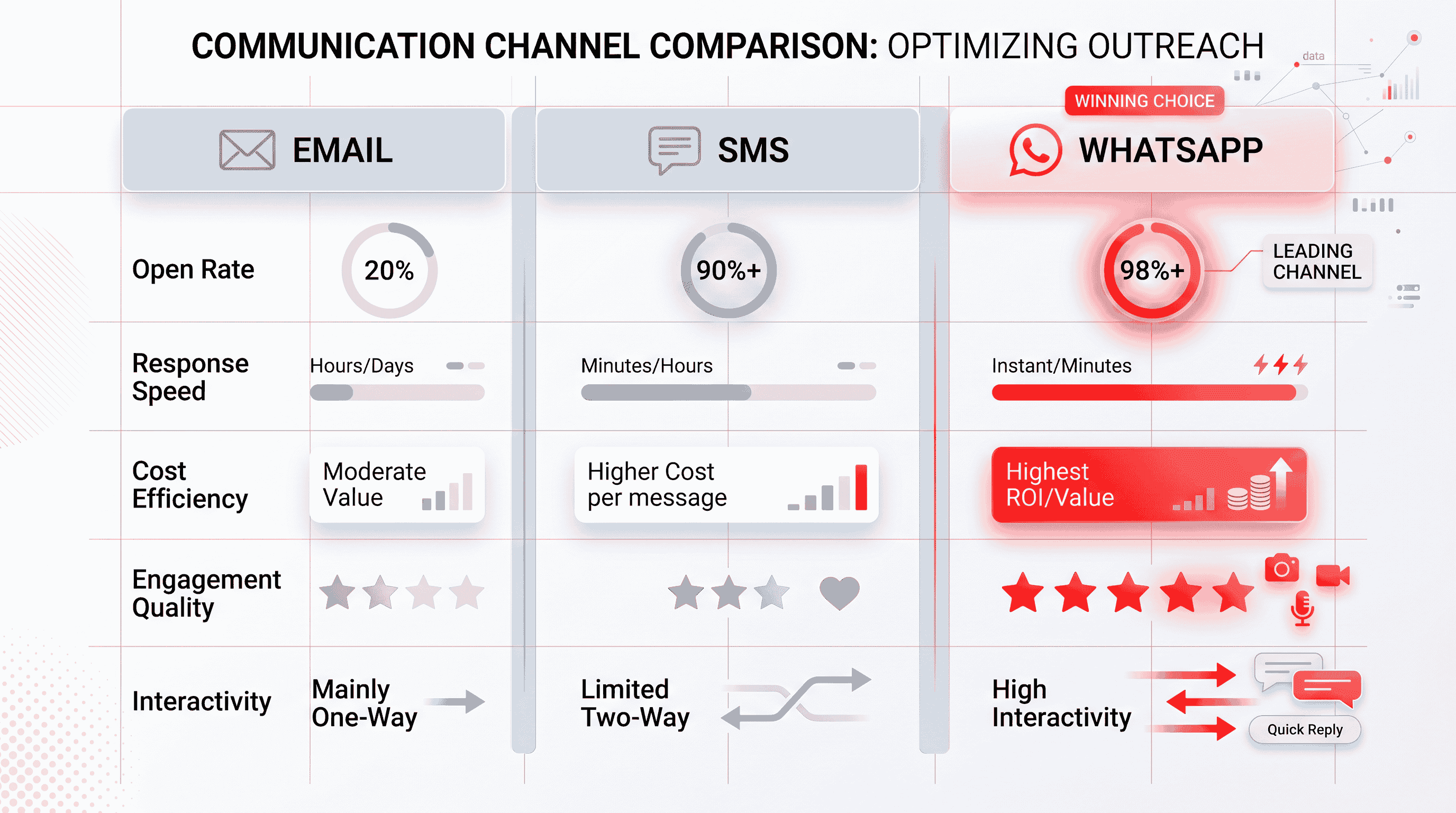
WhatsApp Business API is not the same as the WhatsApp Business app. The app is for small businesses. The API is enterprise infrastructure — capable of handling automation, multi-agent inboxes, AI chatbots, deep CRM and core-banking integrations, and the message volumes a regulated financial institution actually runs.
Three numbers explain why fintech leaders are moving fast:
- 95%+ open rates versus ~18% on email
- Sub-90-second response times versus hours on traditional channels
- Significantly lower cost per delivered message than telco SMS, at higher conversion
When you stack these together, WhatsApp banking solutions stop being a "nice channel" and start being the cheapest, fastest, and most reliable way to talk to a customer.
High-ROI Use Cases of WhatsApp Business API in Fintech
The use cases below aren't theory. They're the ones moving real metrics inside live enterprise deployments.
Digital KYC and Onboarding Without the Drop-Off
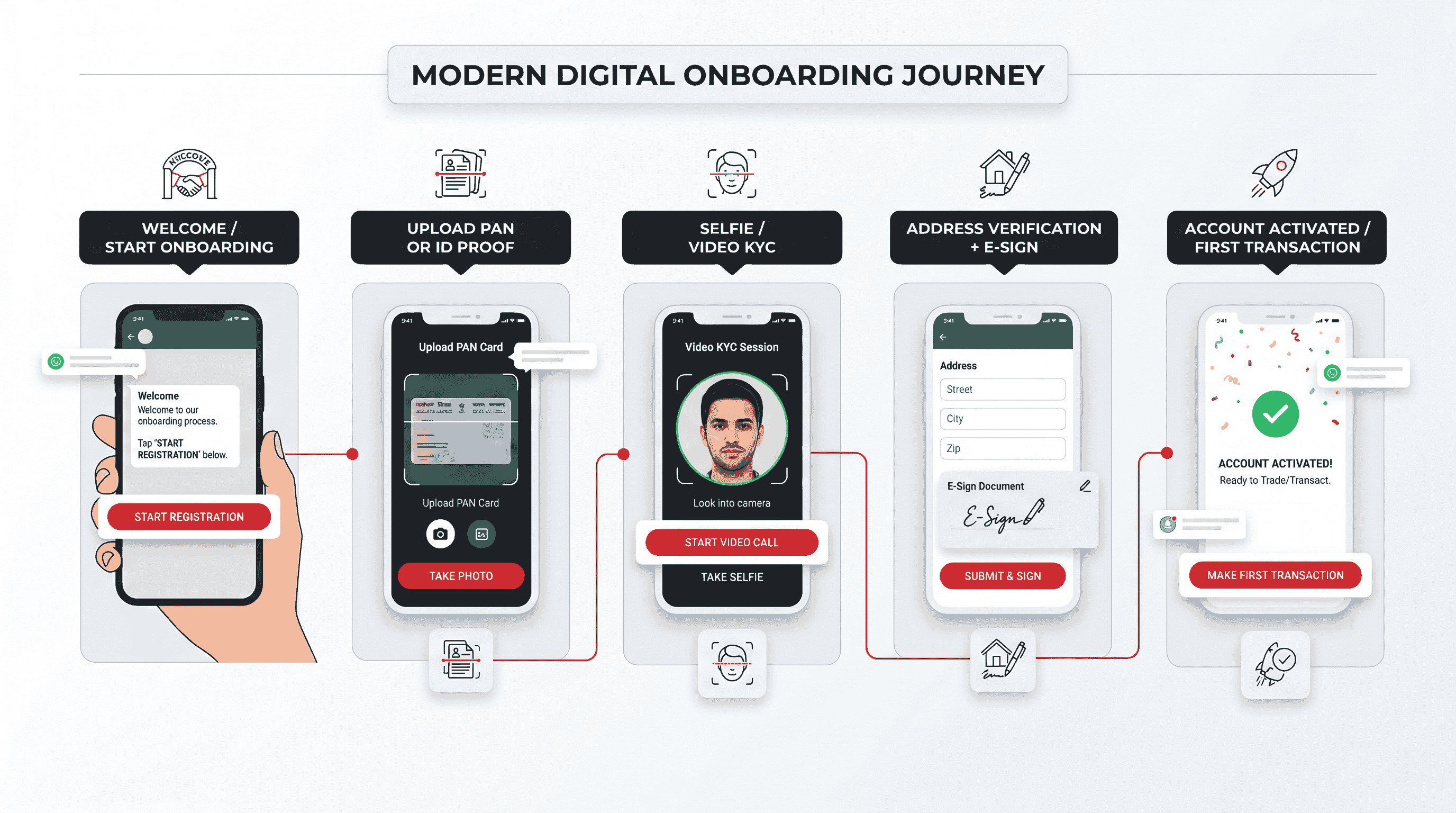
Onboarding is where most fintechs bleed. With WhatsApp Flows, customers can complete the entire journey inside the chat window:
- Document upload (PAN, ID, address proof)
- Video KYC and selfie verification
- Address verification and e-sign
- Account funding and first transaction
The result: onboarding completion rates climbing from ~40% to 70-80%. Multiply that against your CAC and the ROI conversation almost writes itself.
Read: How to Calculate WhatsApp Marketing ROI
Real-Time Transaction Alerts and Fraud Containment
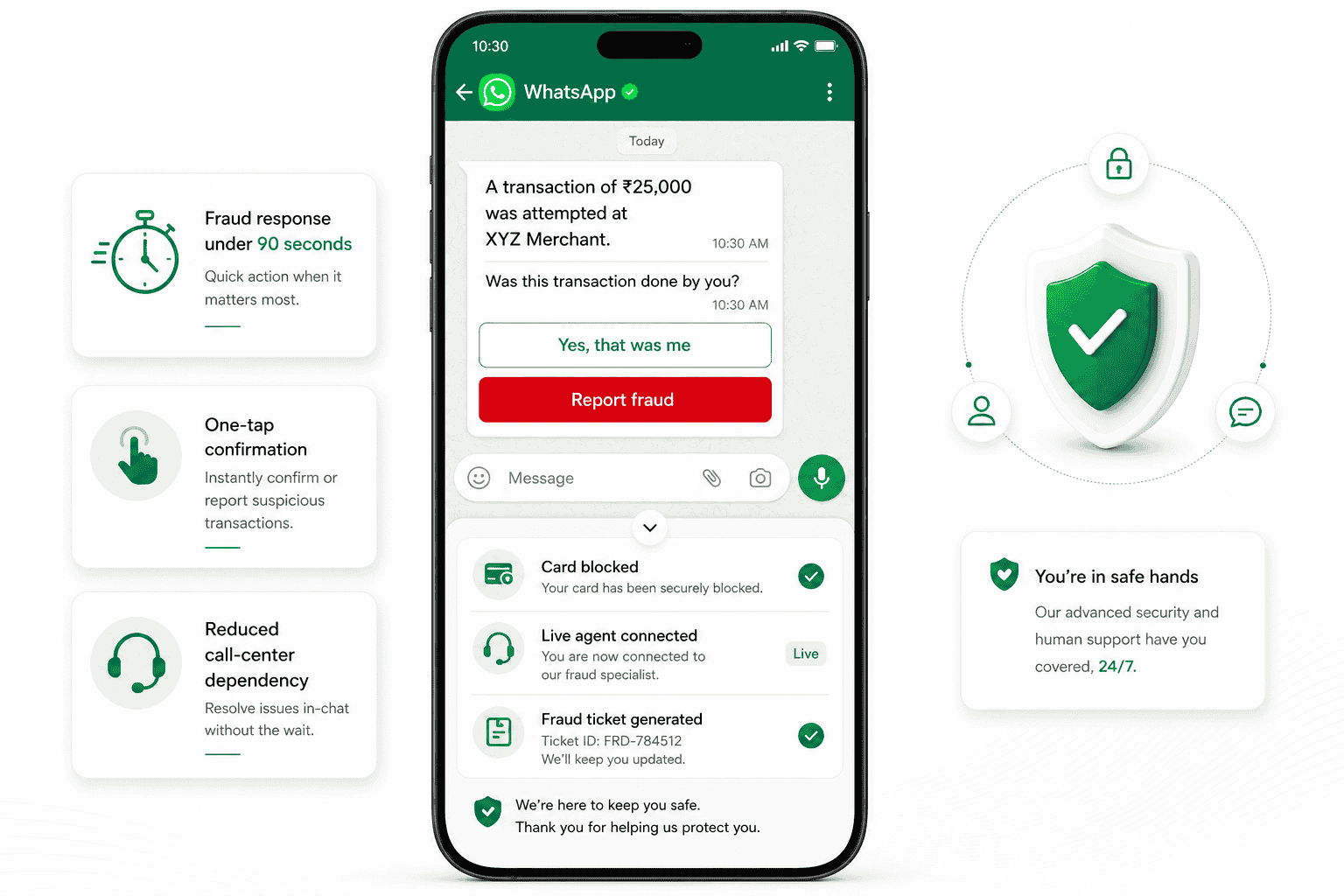
This is where WhatsApp API for financial services outperforms everything else. Instead of an SMS alert that gets ignored, you send a rich, interactive message with two buttons — "Yes, that was me" or "Report fraud." One tap freezes the card. Another routes the customer to a live agent.
What changes:
- Fraud response time drops from hours to under 90 seconds
- Card-block latency moves from call-center queues to a single tap
- Customer trust improves measurably in NPS surveys
In a category where every minute equals real exposure, this is loss prevention with a measurable P&L impact.
Loan Collections and EMI Recovery That Actually Convert
Collections is the most expensive, most-regulated, and most-hated function in lending. WhatsApp shifts the dynamic completely.
A typical automated workflow:
- 3 days before due date — gentle reminder with embedded payment link
- On due date — payment confirmation or soft follow-up
- Post-miss — "Need to reschedule? Tap here" with restructuring options
- Final stage — human agent handover, only after automation is exhausted
Lenders running this flow report 25-35% improvement in on-time recovery, lower collection cost per ₹100 crore book, and significantly fewer regulatory complaints — because the tone stays firm but never coercive.
Multilingual AI Chatbots for the Next Billion Users
The next wave of fintech customers across emerging markets — India, Southeast Asia, Latin America, Africa — isn't transacting in English. They're transacting in Hindi, Tamil, Bahasa, Portuguese, Swahili, and dozens of regional languages.
AI-powered multilingual bots on WhatsApp can:
- Resolve 70-80% of routine queries (balance, statement, EMI date) without human handoff
- Serve customers in their native language at zero incremental headcount cost
- Drop cost-to-serve by 30-50% compared to call-center routing
Your support team focuses on edge cases. Your CFO focuses on the savings.
Compliance & Security: The Non-Negotiables
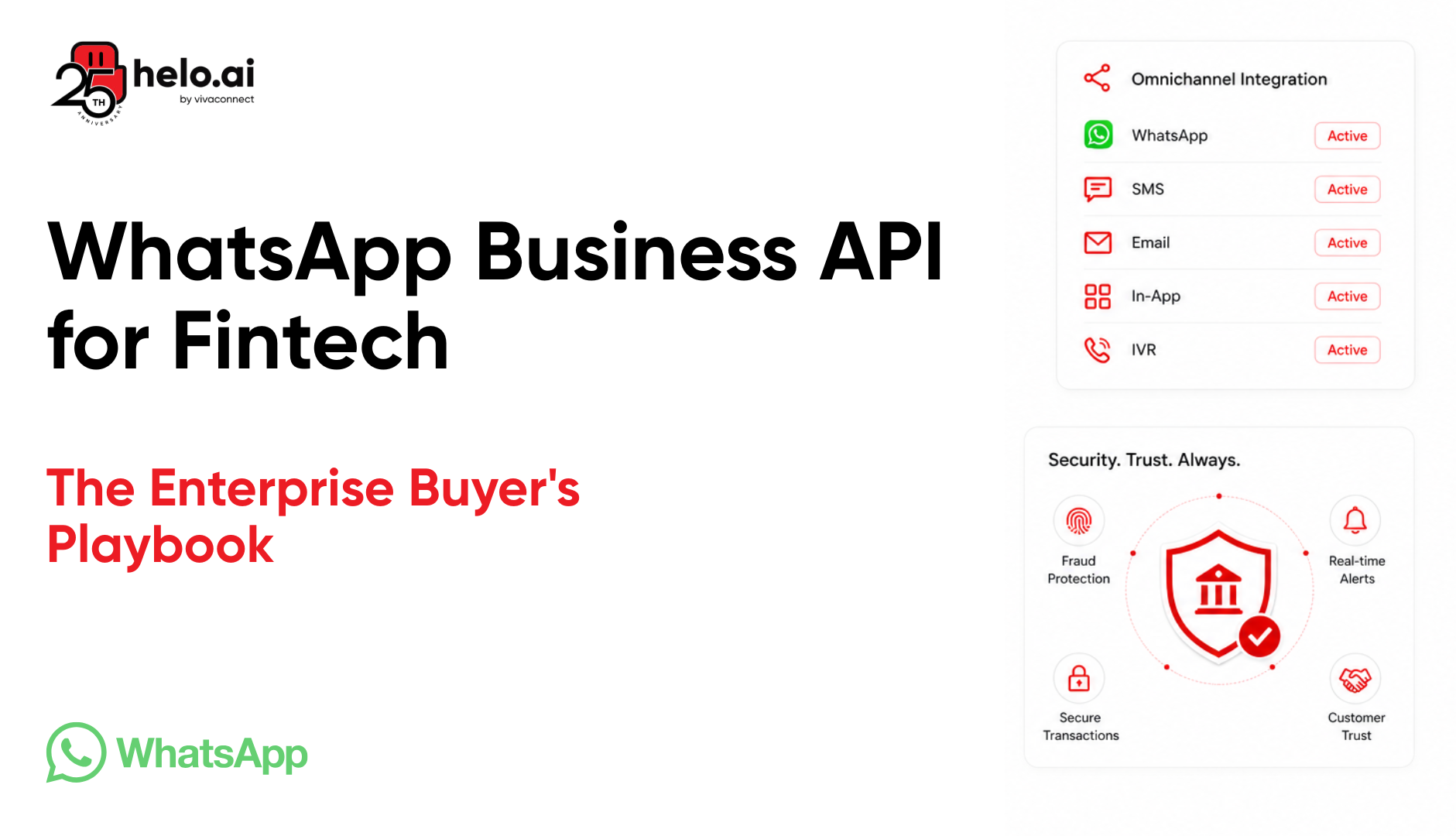
Here's where most WhatsApp API for fintech content goes silent. You're not running an e-commerce store — you're operating under multiple regulatory frameworks at once. Depending on your geography, this could include GDPR, PCI-DSS, SOC 2, ISO 27001, and regional financial-services rules from RBI, MAS, FCA, or the OCC.
Any deployment for a regulated fintech must support:
- End-to-end encryption on all messages in transit
- Data localization options aligned with regional regulators
- Consent management with full audit trails for opt-in and opt-out
- Role-based access control for internal teams
- Authentication templates (not utility) for OTPs and security codes
- Explicit opt-in records for marketing messages that survive audit review
When shortlisting vendors, this is the layer to interrogate hardest. A consumer-grade BSP cannot service a regulated fintech — the gap will surface in your first audit.
What WhatsApp API Actually Costs Fintechs in 2026
Meta moved to a per-message pricing model in July 2025. The current structure (verify on Meta's official rate card) breaks down into three categories:
- Marketing messages — promotional, the most expensive category
- Utility messages — transactional updates (cheaper, often 80-90% lower than marketing)
- Authentication messages — OTPs and login codes (lowest cost per business outcome)
Three cost levers fintech leaders should know:
- Service replies are free within a 24-hour customer-initiated window — the single biggest lever for support cost reduction
- Click-to-WhatsApp ads open a 72-hour free messaging window — powerful for acquisition campaigns
- Volume discount tiers apply automatically as monthly volume crosses thresholds
For most enterprise fintechs, total cost lands materially lower than equivalent SMS spend, at 5x the engagement.
How to Evaluate a WhatsApp Business API Provider for Fintech
Most BSPs are built for D2C and e-commerce. The shortlist for fintech is much smaller. When you're in vendor evaluation, ask:
- Is the vendor an official Meta Business Solution Provider with a clean compliance record?
- Do they integrate natively with your core banking system, LOS, LMS, or CRM?
- Can they support WhatsApp Flows and rich interactive templates?
- Do they offer omnichannel fallback (RCS, SMS, voice) when WhatsApp fails?
- Is their compliance framework built for regulated industries, or bolted on?
- Do they have live deployments at banks or fintechs of your scale?
If the answer to any of these is unclear, the vendor isn't ready for a regulated fintech deployment.
Why helo.ai Is Built for Regulated Industries
helo.ai is an AI-powered omnichannel CPaaS platform that unifies WhatsApp, RCS, SMS, Email, and Voice into a single communication stack — purpose-built for enterprises in regulated sectors. Smart routing means when a WhatsApp message fails to deliver or a customer hasn't engaged in 24 hours, the conversation falls back automatically to RCS or SMS without losing thread context.
What sets helo.ai apart:
- Omnichannel-native architecture — not WhatsApp with channels bolted on
- AI-driven multilingual chatbots built for emerging-market customer bases
- Compliance frameworks aligned with global financial-services regulations
- Live enterprise deployments at clients including Kotak Mahindra Bank and Bajaj Finance
- Deep integrations with core banking, CRM, and lending platforms
Built for the way fintech actually operates — at scale, under regulation, across channels.
Conclusion
The fintechs winning in 2026 aren't the ones with the prettiest apps — they're the ones who rebuilt customer communication around where the user already is. The WhatsApp Business API for fintech has crossed the threshold from "interesting marketing channel" to "core infrastructure," and the gap between leaders and laggards is widening every quarter. If you're evaluating vendors, the right question isn't "should we adopt WhatsApp?" — it's "which partner can deploy this fast enough, compliantly enough, and at the scale we actually need?" Talk to the helo.ai team, see live fintech deployments, and walk into your next leadership meeting with a business case your CFO will sign off on.
FAQs
1. Is WhatsApp Business API safe for handling financial transactions?
Yes. The API uses end-to-end encryption, supports two-factor authentication, and aligns with major frameworks including GDPR, ISO 27001, SOC 2, and PCI-DSS-adjacent controls. Pair it with a regulated-industry-focused BSP for the contact masking, audit trails, and consent management financial regulators require.
2. How can fintech businesses use WhatsApp for lead generation?
Click-to-WhatsApp ads on Meta platforms, QR codes on websites and physical locations, and pre-qualification chatbots can capture and qualify leads in a single conversation — typically doubling conversion rates compared to landing-page funnels while reducing CAC by 20-30%.
3. Can I run end-to-end KYC verification on WhatsApp?
Yes. Using WhatsApp Flows, customers complete document uploads, video KYC, and e-sign without leaving the chat. Fintechs that have made the switch report 30-40% reductions in KYC drop-off and significantly faster time-to-first-transaction.
4. What does WhatsApp Business API actually cost for an enterprise fintech in 2026?
Pricing is per delivered template message, varying by category (marketing, utility, authentication) and recipient country. Service replies inside the 24-hour customer-initiated window are free. For most enterprise fintechs, total spend is materially lower than equivalent SMS volumes at substantially higher engagement.
5. How is WhatsApp Business API different from the WhatsApp Business app?
The app caps at one device, supports 256-contact broadcasts, and offers no automation — fine for a small business. The API has no broadcast cap and supports full automation, multi-agent inboxes, AI chatbots, CRM and core-banking integrations, and the message volumes a fintech actually runs.