

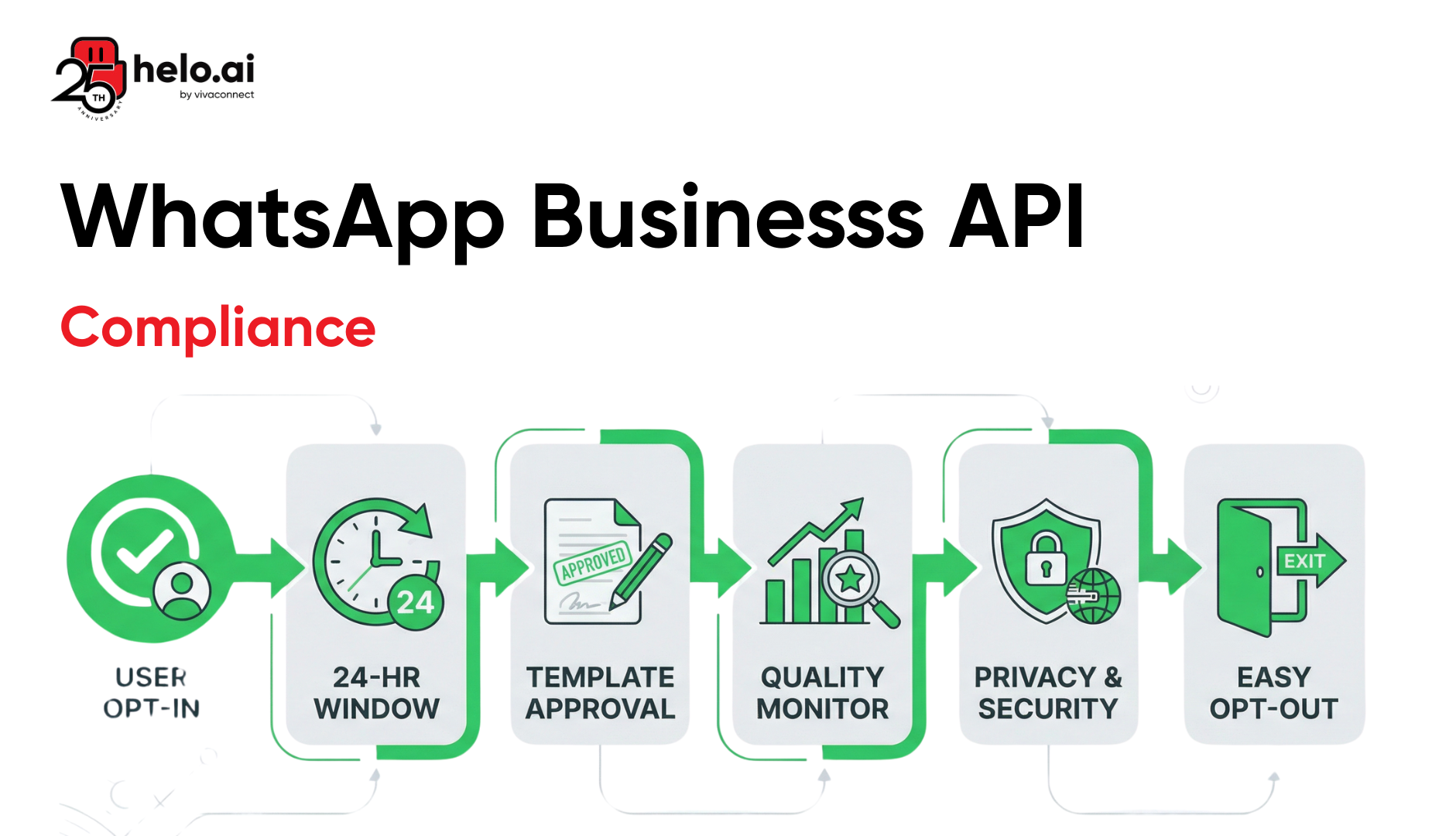


WhatsApp API compliance refers to following Meta’s official policies, opt-in requirements, message template guidelines, and data protection standards when using the WhatsApp Business API. In simple terms, it ensures that businesses send messages only to users who have given explicit consent, use approved message templates, respect the 24-hour messaging window, and handle customer data responsibly.
As WhatsApp continues to tighten enforcement, non-compliance can lead to template rejections, reduced messaging limits, or even permanent account suspension. This guide explains what WhatsApp API compliance means, why it matters for businesses, the exact rules you must follow, and how to stay compliant as policies evolve in 2026 and beyond.
What is WhatsApp API Compliance?
WhatsApp API compliance means following Meta’s policies, opt-in rules, and data protection laws when sending business messages on WhatsApp.
Platform Policies – Meta's Business API guidelines for message templates, opt-ins, and user experience.
Legal Requirements – Data protection laws like GDPR, DPDP Act, and CCPA that govern how you collect and use customer data.
Regional Regulations – Country-specific messaging laws, including telecom opt-in mandates and consumer protection rules.
Meta’s Business API guidelines for message templates, opt-ins, and user experience.
If you want to understand how these rules impact costs, check our detailed breakdown of WhatsApp API pricing.
WhatsApp Business App vs WhatsApp Business API
The WhatsApp Business App is for small businesses managing conversations manually from a phone. The Business API is for enterprises needing automation, CRM integration, and high-volume messaging. The API requires strict compliance because it enables programmatic communication at scale.
👉Recommended Read: WhatsApp Business API vs WhatsApp Business App |
What Compliance Protects
Compliance protects three things: user privacy, message deliverability, and your business account.
Without it, you risk:
- Account suspension
- Blocked messages
- Legal penalties
Why WhatsApp API Compliance Matters for Businesses
WhatsApp was initially a personal messaging service. People on WhatsApp are using WhatsApp for personal communication, with businesses using it as an advertising medium like social media platforms. This can affect the personal life of the user, as well as how they perceive WhatsApp as a platform, which can also change, resulting in a major drop in its user base. Thus, it is very important to regulate businesses on WhatsApp to prevent spamming and respect user privacy.
Here are some reasons why compliance in WhatsApp API matters:
1. Protects Customer Data & Privacy
Businesses now operate under multiple data protection frameworks globally. Violations can result in penalties ranging from hundreds of thousands to hundreds of millions in fines, depending on the jurisdiction. Compliance ensures you handle customer data lawfully collecting only what's needed, storing it securely, and deleting it when required.
2. Reduces Risk of Account Suspension
Meta monitors every WhatsApp Business API account through a quality rating system. Low ratings trigger restrictions: reduced messaging limits, template pauses, and in severe cases, permanent bans. Compliance keeps your quality score high and your account active.
3. Improves Template Approval Rates
Meta reviews every message template before you can use it. Non-compliant templates get rejected, delaying campaigns by days. Understanding approval criteria means faster rollouts and fewer rejections.
4. Protects Brand Reputation
One data breach or compliance failure can damage years of trust. Customers expect businesses to respect their privacy. Compliance shows you take that responsibility seriously.
Core WhatsApp API Compliance Rules You Must Follow
Now that we know why consistency in WhatsApp business API is important, let’s understand the core rules that will create the foundation of maintaining WhatsApp compliance for any business.
1. Customer Opt-In Requirements
What counts as a valid opt-in?
Explicit, documented consent before sending any WhatsApp message. This means:
- Users must actively choose to receive messages (no pre-checked boxes)
- Consent must be specific to WhatsApp (SMS opt-ins don't count)
- Users must know what message types they'll receive (transactional, promotional, etc.)
- Consent must be freely given (not bundled with other terms)
How to collect and store consent
Common collection methods include:
- Website forms with clear WhatsApp opt-in checkboxes
- Click-to-WhatsApp ads on Facebook/Instagram
- QR codes displayed in physical stores or marketing materials
- SMS with consent links
- Customer service calls (with recorded verbal consent)
- App registration flows
Also Read: How to Collect WhatsApp Opt-in
You must maintain timestamped records of every opt-in. Store the consent source, date, user action, and IP address. This documentation proves compliance during audits.
Opt-in vs Opt-out
Opt-in requires permission before messaging. Opt-out assumes permission unless users unsubscribe. WhatsApp Business API only allows opt-in. You cannot message users who haven't explicitly consented, even if they're existing customers.
Regional telecom authorities in many countries mandate Do Not Disturb (DND) compliance for commercial messaging. While WhatsApp operates independently from traditional telecom networks, respecting user preferences aligns with both regulatory expectations and customer trust.
2. Approved Message Template Guidelines
What message templates are allowed
Every business-initiated message on WhatsApp requires a pre-approved template. Meta categorises templates into four types:
- Marketing – Promotional offers, product launches, seasonal campaigns. These cost the most and face stricter approval standards.
- Utility – Order confirmations, shipping updates, appointment reminders. Mid-tier pricing, easier approval.
- Authentication – OTP codes, login verification, password resets. Lower cost, streamlined approval for security-related messages.
- Service – Responses to customer inquiries within 24 hours. Free when replying to user messages.
How the approval process works
For WhatsApp message template approval, submit templates through your Business Solution Provider (BSP) or Meta's Business Manager. Approval typically takes 30 minutes to 48 hours, though complex templates can take longer.
Meta's AI reviews templates for policy compliance. From April 2025, Meta automatically categorises templates based on content. You can request a review if the auto-category seems wrong, but you have 60 days to do so.
Common reasons templates get rejected
- Variables placed at the start or end of messages
- Generic placeholders like "Dear Customer" without context
- Promotional language in utility templates
- Policy violations (misleading claims, inappropriate content)
- Too similar to existing approved templates
- Missing required opt-out language
Templates also have quality ratings based on user engagement. Low-quality templates (high block rates, low response rates) get paused or disabled automatically.
3. Respecting the 24-Hour Customer Response Window
WhatsApp gives businesses 24 hours to respond to any customer message with free-form text. Within this window, you can reply naturally without templates. After 24 hours, you must use an approved template, and Meta charges per message.
This rule changes your messaging strategy. Quick responses cost nothing. Delayed responses require template fees. Customer service teams prioritise answering within the window to reduce costs.
Since November 2024, service conversations (replies within 24 hours) are free, making fast response times even more valuable.
4. Business Profile & Accurate Identification
Your WhatsApp Business profile must reflect your actual registered business name. Meta verifies this against your legal documentation during account setup and re-verifies it as you scale.
Display name inconsistencies cause approval delays. If your display name differs from your legal name, you need strong justification—typically because you operate under a well-known brand name.
Customers trust verified business accounts. The green checkmark signals Meta has confirmed your identity, which improves message open rates and engagement.
5. Protecting Customer Data & Privacy Compliance
Data Protection Act (DPDP) 2023
The Digital Personal Data Protection Act became operational in November 2025, with full compliance required by May 2027. The law applies to businesses processing digital personal data of citizens even if you're based outside the jurisdiction.
Key requirements:
- Consent must be free, specific, informed, and unambiguous. Pre-checked boxes and bundled consents violate DPDP standards.
- Purpose limitation – Collect data only for stated purposes. Using WhatsApp data for email marketing without separate consent violates this principle.
- Data minimisation – Request only the data you actually need. Don't collect addresses if you're only sending order confirmations.
- Storage limitation – Retain data only as long as necessary. Define retention periods and auto-delete old data.
- Breach notification – Report all data breaches to the Data Protection Board and affected users within 72 hours.
- Verifiable parental consent – For users under 16, obtain verified consent from parents or guardians before processing their data.
Penalties can reach significant amounts per violation, making data protection compliance critical for any business operating in covered jurisdictions.
GDPR for European Customers
If you have European customers, GDPR applies. This means:
- Using EU-based Business Solution Providers for EU customer data
- Data Processing Agreements (DPAs) with your BSP
- Clear privacy policies accessible from WhatsApp messages
- Right to deletion and data portability
- No data transfers outside the EU without adequate safeguards
GDPR violations can cost up to €20 million or 4% of global annual revenue.
CCPA for California
California's Consumer Privacy Act requires businesses to disclose data collection practices and honour opt-out requests. If you serve California customers, maintain compliant privacy notices and opt-out mechanisms.
Regional Privacy Laws
Other regions have their own requirements. Brazil's LGPD, Canada's PIPEDA, Singapore's PDPA, and similar frameworks in other countries all impose data protection obligations. If you operate internationally, map which laws apply to your user base.
Legal & Regulatory Requirements for WhatsApp API Compliance
Meta's Policy Compliance
Meta's Commerce Policy and Business Policy govern all WhatsApp Business API usage. Key restrictions:
- No adult content or services
- No weapons, tobacco, or controlled substances
- No misleading health claims
- No gambling (in most regions)
- No counterfeit goods
- No services that violate local laws
Violating these policies results in immediate account restrictions, regardless of local legal compliance.
Regional Laws & Telecom Regulations
Telecom Authority Opt-In Compliance
Telecom regulators in many countries mandate opt-in consent for commercial communication. While WhatsApp messages don't require traditional telecom registration systems (like DLT for SMS), the underlying consent principles still apply to commercial messaging.
Businesses must:
- Obtain explicit consent before messaging
- Maintain consent records
- Honour opt-out requests immediately
- Respect DND preferences for promotional content
Information Technology & Data Security Acts
Many jurisdictions have enacted laws requiring reasonable security practices for sensitive personal data. Businesses must implement technical and organisational measures to prevent unauthorised access, disclosure, or data breaches.
Do Not Disturb (DND) Compliance
National Do Not Disturb registries in various countries block promotional calls and SMS to registered numbers. While WhatsApp operates separately from traditional telecom networks, respecting user preferences aligns with regulatory expectations and customer trust.
Industry-Specific Regulations
Banking and financial services must comply with central bank guidelines on customer communication and data security. Healthcare providers must follow patient data confidentiality rules. E-commerce platforms must adhere to consumer protection requirements for transparent communication.
Messaging Consent and Cross-Channel Rules
Telecom Registration Context
In some markets, SMS messaging requires registration with distributed ledger technology (DLT) systems or similar frameworks that verify business identity, message templates, and user consent before delivery.
WhatsApp doesn't use these telecom registration systems, but Meta's template approval system serves a similar purpose—verifying business legitimacy and message compliance before delivery.
Cross-Channel Consent
SMS consent doesn't transfer to WhatsApp. Email consent doesn't transfer to WhatsApp. Each channel requires separate, explicit permission. Many businesses make this mistake, assuming existing customer databases can receive WhatsApp messages without additional consent.
WhatsApp Businesss API Compliance Checklist
Use this checklist to verify your WhatsApp Business API setup:
✔ Collect & record opt-ins – Explicit consent documented with timestamps and sources
✔ Use only approved templates – Every business-initiated message uses Meta-approved templates
✔ Maintain accurate business info – Display name matches legal documentation
✔ Monitor messaging quality score – Track user engagement and block rates
✔ Protect & store customer data – Encryption, access controls, retention policies in place
✔ Respect all regional laws – DPDP, TRAI, GDPR compliance depending on your markets
✔ Implement breach response – 72-hour notification procedures ready
✔ Train your team – Everyone handling customer data understands compliance requirements
✔ Document everything – Consent logs, template approvals, policy updates, all recorded
✔ Regular audits – Quarterly compliance reviews to catch issues early
Best Practices for Staying Compliant
Systems to Manage Opt-Ins and Opt-Outs
Build centralised consent management systems. Track every opt-in with:
- User phone number
- Consent date and time
- Source (website, QR code, ad, etc.)
- Message categories authorized
- IP address or device ID
- Consent method (checkbox, verbal, SMS)
Make opt-outs instant. When users text "STOP" or click unsubscribe, remove them from messaging lists immediately. Data protection regulations require honouring withdrawal requests without delay.
Audit Trails and Logs for Compliance Records
Maintain detailed logs of:
- All message sends (template used, recipient, timestamp)
- Template approvals and rejections
- User consent events
- Opt-out requests
- Data access and modifications
- Breach incidents and responses
These logs prove compliance during regulatory investigations. Data protection authorities require businesses to maintain records that can be presented during audits.
Regular Policy Updates and Staff Training
Meta updates WhatsApp policies regularly. The July 2025 pricing change, April 2025 auto-categorisation, and January 2026 AI chatbot restrictions all happened within months of each other.
Subscribe to Meta's developer updates. Review policy changes quarterly. Train customer service, marketing, and IT teams on new requirements.
Using Approved WhatsApp API Providers (BSPs)
Business Solution Providers simplify compliance. Good BSPs offer features like pre-compliance template reviews, consent management tools, and GDPR-compliant infrastructure.
To make the right choice, it's worth comparing the best WhatsApp API providers based on pricing, features, and compliance capabilities.
- Pre-compliance template reviews before Meta submission
- Consent management tools
- GDPR-compliant data hosting options
- Template performance analytics
- Automatic policy violation detection
- Integration with CRM and customer databases
Helo.ai provides compliance-first infrastructure for businesses globally. Templates go through pre-approval checks, consent workflows are built into the platform, and regional compliance requirements come standard.
Common Compliance Challenges and How to Avoid Them
We understand that the challenges are inevitable. We have listed down some of the most common and most occurred challenges below, along with their solutions.
1. Misunderstanding Opt-In Rules
Challenge: Businesses assume existing customer relationships allow WhatsApp messaging.
Solution: Treat WhatsApp as a new channel requiring fresh consent. Even if someone bought from you before, you need explicit permission to message them on WhatsApp.
2. Improper Data Handling
Challenge: Storing WhatsApp chat data on unsecured servers or sharing it with third parties without consent.
Solution: Implement encryption for data at rest and in transit. Limit access to customer data on a need-to-know basis. Never share WhatsApp numbers with marketing partners without explicit user consent for that specific purpose.
3. Template Rejection Pitfalls
Challenge: Templates get rejected repeatedly, delaying campaigns.
Solution: Study Meta's approval criteria. Avoid variables at message start/end. Be specific about content—"Order #{{1}} shipped" works better than "Your item is ready." Test templates at low volume before scaling.
4. Evolving Law Updates
Challenge: Keeping up with changing regulations in multiple jurisdictions.
Solution: Assign compliance ownership to someone on your team. Set quarterly review cycles. Use BSPs that monitor regulatory changes and update their platforms automatically.
Tools & Solutions to Help with Compliance
BSP Platforms & Automation Tools
Modern BSPs offer:
- Template libraries – Pre-approved templates for common use cases
- Compliance dashboards – Real-time monitoring of quality scores and policy violations
- Automated workflows – Triggered messages based on customer actions, all template-compliant
- Multi-region support – GDPR, DPDP, CCPA compliance built into infrastructure
Consent Management Systems
Standalone consent platforms integrate with WhatsApp APIs:
- Enterprise consent management platforms
- Custom consent dashboards
- CRM-integrated consent tracking
Many jurisdictions now require consent managers to register with data protection authorities. These registered managers help businesses collect, manage, and track consent across channels.
CRM/Helpdesk Integration
Integrating WhatsApp with your CRM ensures:
- Customer conversation history in one place
- Automated opt-in status checks before sending
- Personalised messages using CRM data
- Service ticket creation from WhatsApp inquiries
Popular integrations include Salesforce, Zoho, Freshdesk, and HubSpot.
Compliance Reporting & Alerts
Set up automated alerts for:
- Template rejections
- Quality score drops
- Unusual opt-out spikes
- Potential policy violations
- Data breach detection
These early warnings let you fix issues before they become account restrictions.
Future of WhatsApp API Compliance (2026 & Beyond)
1. Evolving Policies & AI Regulations
January 2026: AI Chatbot Restrictions
Meta banned general-purpose AI chatbots (ChatGPT-style) from WhatsApp Business API. Only task-specific automation is allowed order tracking, appointment scheduling, and FAQ responses.
This affects businesses using third-party AI platforms. You'll need to ensure your chatbot handles specific workflows, not open-ended conversations.
Beyond 2026: Tighter AI Governance
Expect more restrictions on AI-generated content, deepfakes, and automated personalisation. Regulations are moving toward requiring disclosure when users interact with AI, not humans.
2. Expected Changes in Compliance
Data Protection Framework Implementation
Many jurisdictions have multi-year compliance timelines for new data protection laws. Businesses operating globally need to track these deadlines and ensure they meet requirements across all markets.
By 2027, most major markets will require:
- Complete data mapping and inventories
- Automated consent management
- Rapid breach notification systems (typically 72 hours)
- Verifiable parental consent for minors
- Data Processing Agreements with vendors
Data protection authorities will begin enforcement actions after the grace periods end. Penalties vary by jurisdiction but can be substantial relative to company size and revenue.
Global Privacy Law Convergence
As privacy laws converge globally, expect cross-border data transfer requirements to tighten. Businesses operating in multiple regions will need unified compliance frameworks that satisfy requirements in major markets simultaneously.
Template Auto-Categorization Evolution
Meta will likely expand AI-driven template categorisation, making manual category selection less reliable. Pricing will increasingly depend on message content, not your declared category.
3. Long-Term Success Strategies
Privacy-First Design
Build compliance into product development from day one. Don't add privacy features as an afterthought. Design messaging flows that collect minimal data, respect user preferences by default, and make opt-outs easy.
Transparent Communication
Be upfront about data usage. Tell customers what you collect, why, and how long you keep it. This transparency builds trust and reduces opt-out rates.
Compliance as Competitive Advantage
As regulations tighten, compliant businesses will differentiate themselves. Customers increasingly choose companies that respect their privacy. Use compliance as a marketing message demonstrate your commitment to protecting customer data.
Frequently Asked Questions
What happens if I don't comply with WhatsApp API policies?
Meta implements tiered penalties: messaging limits are reduced, templates are paused, quality rating drops, and ultimately, account suspension or permanent bans. You also risk legal penalties under various data protection laws, which can range from thousands to millions in fines depending on jurisdiction and violation severity.
Can I send promotional messages to users who haven't opted in?
No. WhatsApp Business API requires explicit opt-in for all messages. Sending to non-consented users violates both Meta's policies and regional laws governing commercial communication and data protection.
How often should I audit compliance?
Quarterly audits catch issues before they become violations. Review opt-in records, template performance, data storage practices, and policy updates every 90 days. After major regulatory changes or policy updates, conduct immediate audits.
Do I need special registration for WhatsApp messaging?
Requirements vary by market. While WhatsApp doesn't require traditional telecom registration (like DLT systems for SMS), you still need business verification with Meta and must comply with all applicable data protection and commercial messaging laws in your operating regions.
What's the difference between major data protection laws?
Different jurisdictions have enacted similar but distinct privacy frameworks. European GDPR focuses heavily on data subject rights and cross-border transfers. Frameworks in other regions may emphasise different aspects like consent management, breach notification timelines, or parental consent verification. The core principles—consent, purpose limitation, data minimisation—remain consistent across most modern privacy laws.
Can I use WhatsApp numbers collected through other channels?
No. Each communication channel requires separate, explicit consent. Opt-ins for SMS, email, or phone calls don't authorise WhatsApp messaging. You must obtain fresh, WhatsApp-specific consent before messaging those users.
How do I get parental consent for minors?
Many data protection laws require verifiable parental consent for users under 16 or 18 (depending on jurisdiction). Verification methods include existing information matching, details provided by parents, virtual tokens from authorised entities, or government-backed digital identity services.
What if my template gets categorised incorrectly?
You have 60 days to request a category review. Submit your case through Meta's Business Manager, explaining why the template should be in a different category. If rejected, you'll pay the rates associated with Meta's assigned category.
How long should I retain WhatsApp conversation data?
Only as long as necessary for the stated purpose. Data protection laws require storage limitation define retention policies based on business needs, then auto-delete. Most businesses retain 6-12 months for service purposes, then archive or delete in accordance with legal requirements and business needs.
What should I do if I discover a data breach?
Immediately notify the relevant data protection authority and affected users. Most jurisdictions require notification within 72 hours. Include breach details, timing, affected data, consequences, and mitigation measures. Failure to report promptly can result in additional penalties.
Conclusion
Following WhatsApp API compliance is no longer optional for businesses that want long-term messaging success.
WhatsApp API compliance isn't a one-time setup. It's an ongoing commitment to user privacy, platform policies, and regional regulations.
The stakes in 2026 are higher than ever. Data protection laws are becoming operational globally, Meta's policies are tightening, and customers expect businesses to protect their data. Compliance violations don't just risk account restrictions—they threaten your entire customer communication infrastructure.
Smart businesses treat compliance as a foundation, not a burden. The right systems, processes, and partners make it manageable.
Start with the basics: get proper opt-ins, use approved templates, and protect customer data. Then build toward full compliance with applicable regulations. The businesses that invest in


-1.png&w=828&q=75)

.jpeg&w=96&q=75)