



When a business wants to use WhatsApp for marketing and staying in touch with their customers at scale, they cannot do it like an individual user. They need the WhatsApp Business API.
The WhatsApp Business API helps businesses send thousands of messages, automate them, and integrate them with their CRM. Businesses have to pay for this and the pricing system is often misunderstood.
With open rates as high as 98% and click-through rates between 45% and 60%, WhatsApp has become one of the most effective marketing channels available. But a lot of businesses miss out on fully understanding the cost structure, and that ends up costing them way more than it should.
Businesses either underestimate the costs and never work toward reducing them, or they simply do not know how to. Both ways, it ends up costing more than it should.
Here, we break down WhatsApp Business API pricing in India, including WhatsApp API cost, per-message pricing, and conversation charges, so you clearly understand what you’ll pay and what works best for your business.
The Two Layers of WhatsApp API Cost
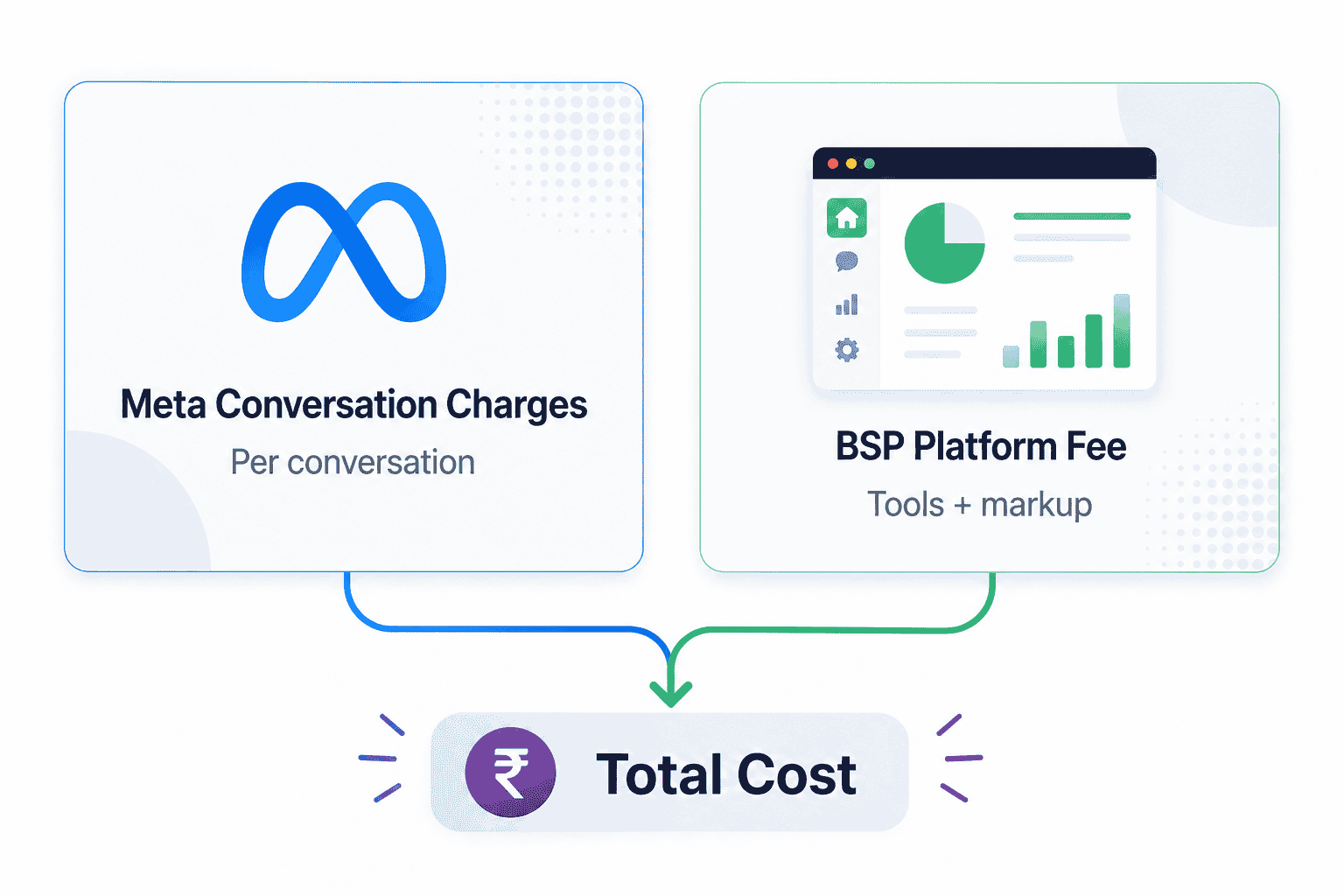
There are actually two layers of cost when setting up a WhatsApp Business API. Both combined determine how much your business pays for messaging, forming the overall WhatsApp API pricing model in India.
Layer 1: Meta's Conversation Charges Meta, the parent company of WhatsApp, charges every business a certain amount for API access. This price varies from country to country. India is one of the biggest WhatsApp markets in the world, so Meta's rates here are among the cheapest. WhatsApp charges per conversation, not per message. This is a key difference businesses need to understand. A conversation is a 24-hour window between a business and a customer. There is a single payment for as many messages as you share within that window.
Layer 2: BSP Platform Fee Companies like Helo.ai are called Business Solution Providers. They are the ones that provide the software interface, the dashboard, the templates, and the automation tools. They have a partnership with Meta and bridge the gap between Meta and businesses. These companies charge a platform fee for their services. Some providers also add a markup on top of Meta's conversation charges — sometimes 10 to 25% extra. This costs businesses significantly more per conversation than they realise.
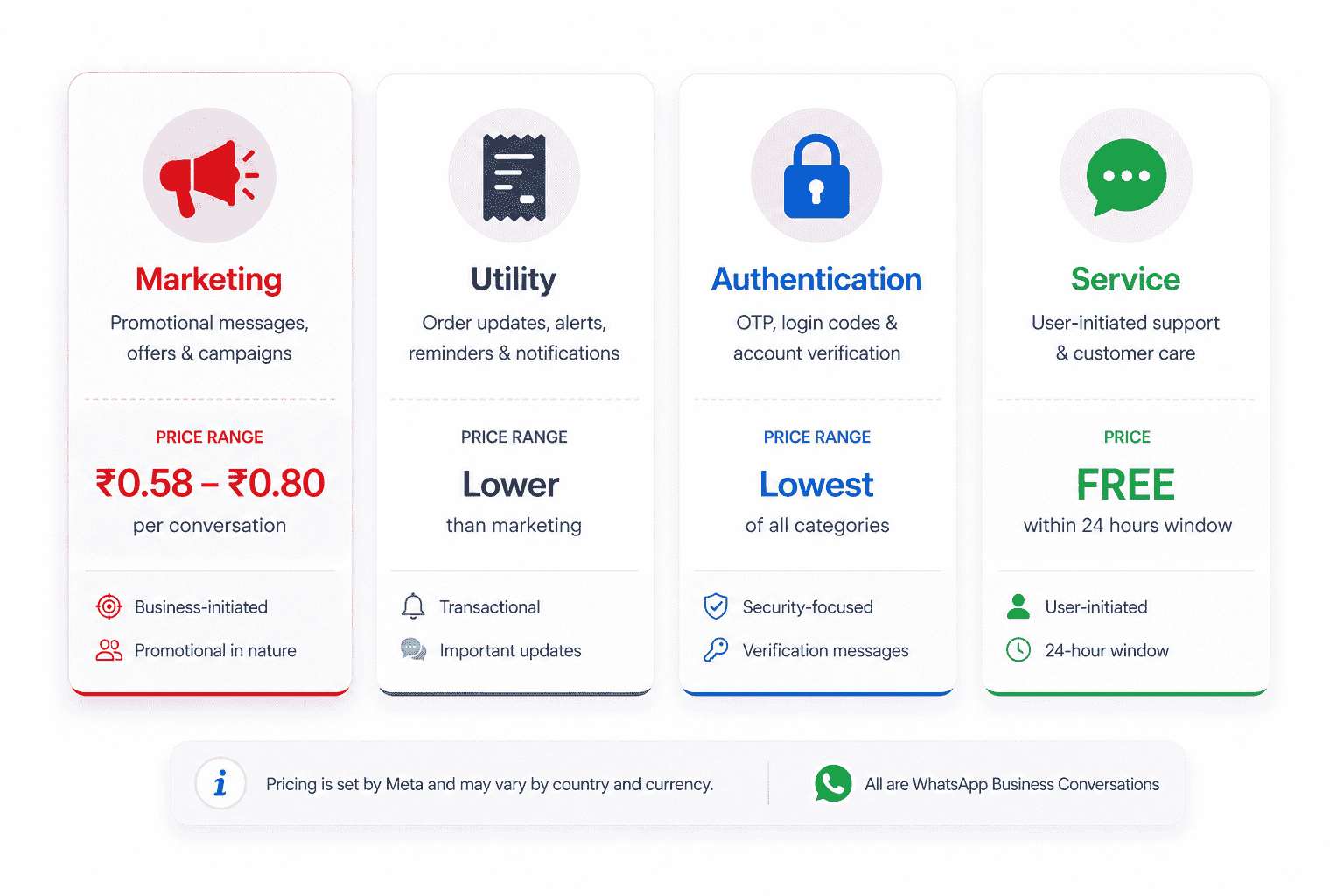
The Four Types of WhatsApp Conversations and How They Are Priced
The Free Windows: Where Businesses Save Money
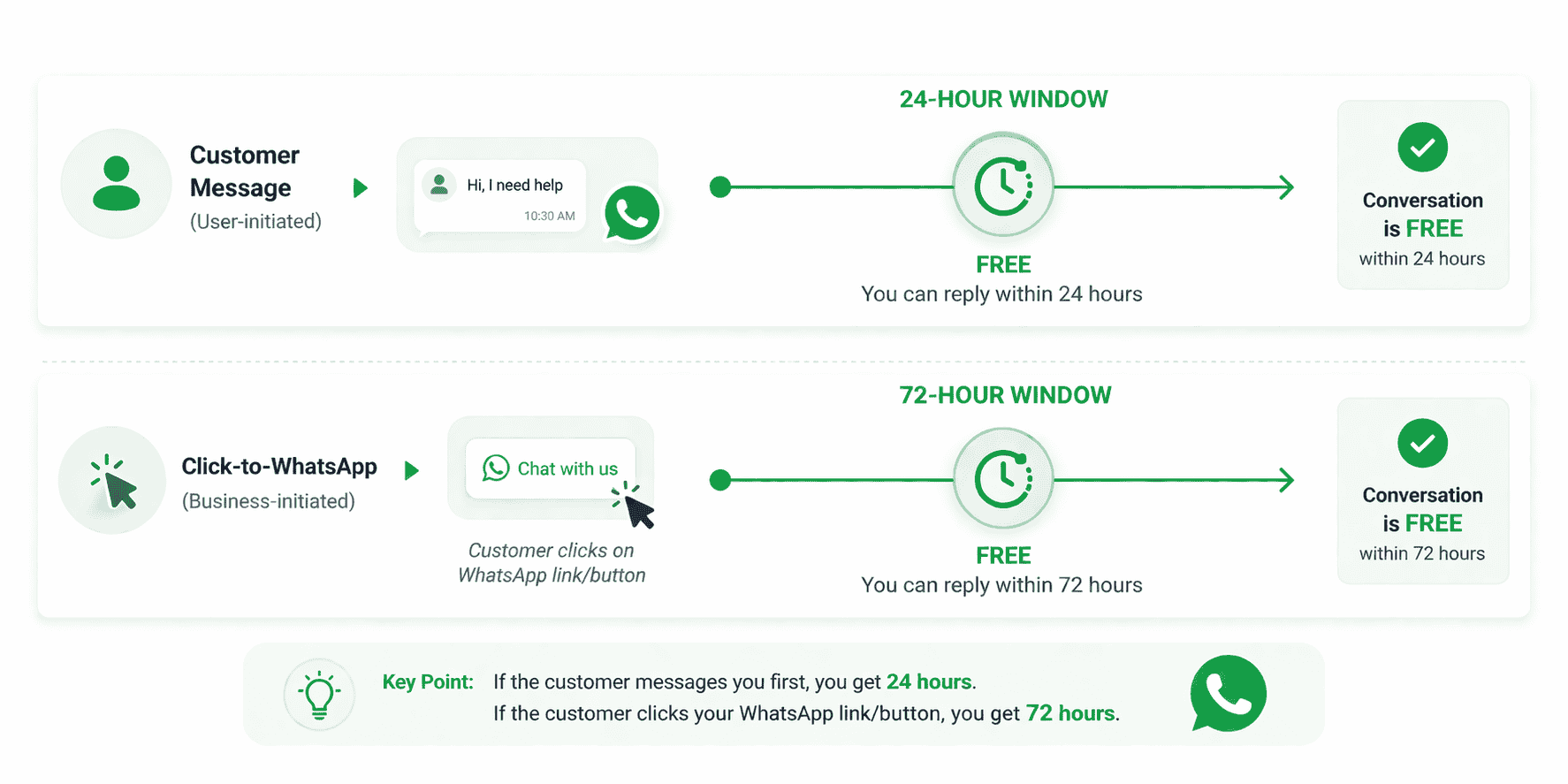
There are two free conversation windows available for businesses that understand how to use them. Used well, they can help you strategise your WhatsApp messages and cut significant costs.
Customer Service Window: When a customer messages your business first, a 24-hour window opens. All your replies within this window are free. This applies to service and utility conversations, not marketing messages. Timely replies help you exchange as many messages as possible within the 24-hour window.
Free Entry Point Window: This window opens when a customer reaches you through a Click to WhatsApp ad on Facebook or Instagram. If you respond within 24 hours, a 72-hour free window starts. During this time, you can send any type of message, including marketing, at no cost. Most businesses don't know this exists and miss out on a major cost-saving opportunity every time they run these campaigns.
WhatsApp API Pricing in India: What Does It Actually Cost?
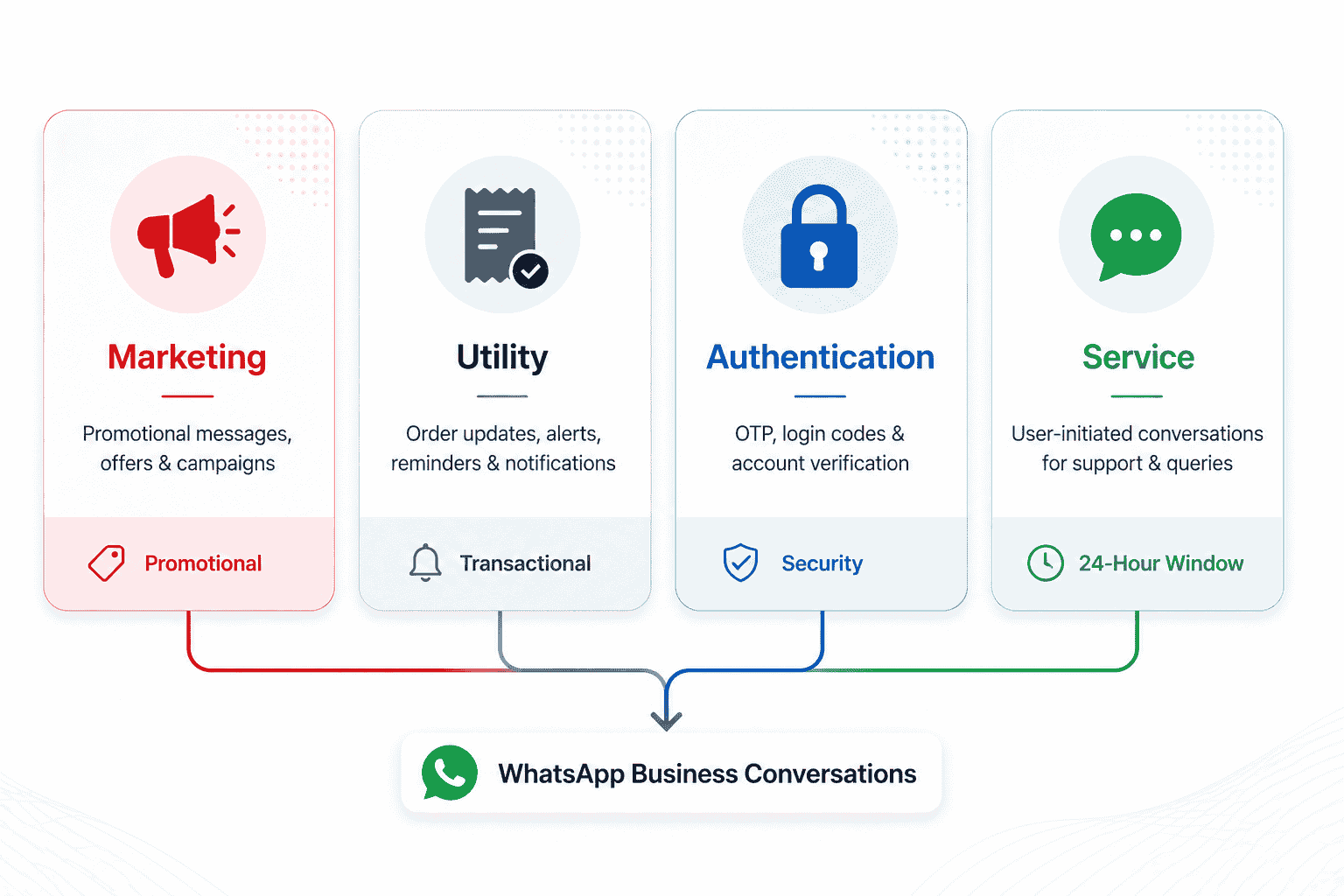
In India, WhatsApp API pricing is among the cheapest globally. If a business plans its messages well, it can get a strong ROI by maximising revenue and cutting per-conversation costs.
If your business sends a promotional message it costs around 0.58 to 0.80 rupees per conversation. For utility and authentication messages it is cheaper still. In fact, service messages are free within the window.
The rates keep changing and you need to track them on Meta's official pricing page. There are also volume-based discounts that can be very beneficial if used properly. These apply to utility and authentication conversations so the more of these conversations you have in a month, the cheaper they get. Also remember, this count resets every month.
How to Calculate Your Monthly WhatsApp API Cost
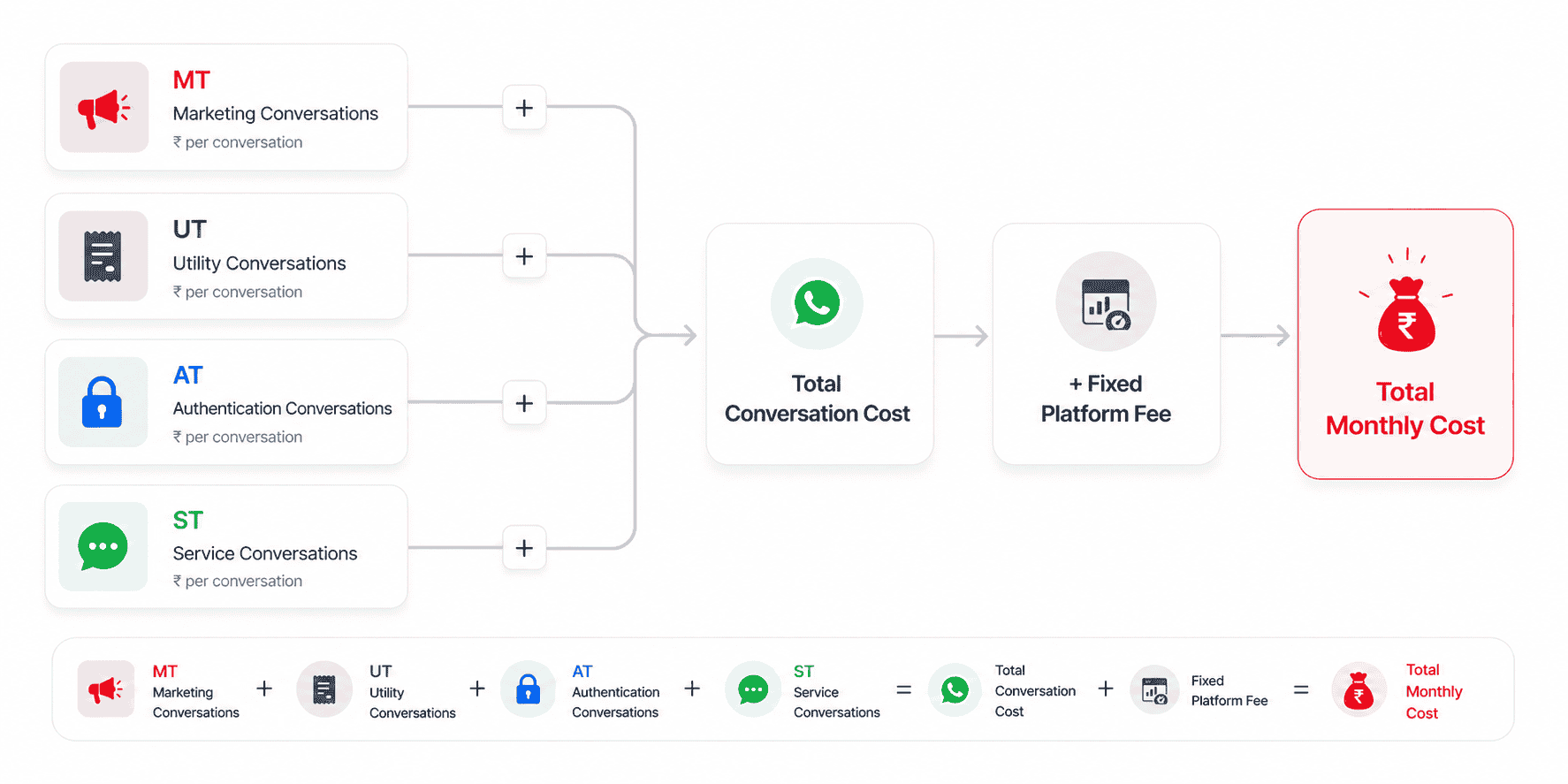
Now that we have gotten an idea of the different conversation types and free windows, let's look at a clear formula to calculate how much the WhatsApp API will cost your business every month.
Step 1: Count the number of conversations per month based on type. Categorise every conversation among the four types, marketing, utility, authentication, and service.
Step 2: Apply Meta's pricing for India to each conversation type.
Step 3: Check if any conversations fall under the free windows and subtract those from the total.
Step 4: Add your BSP's monthly platform fee to get your total cost.
For example, if your business sends 1,000 marketing conversations in India at 0.70 rupees each, that is 700 rupees in Meta charges. Add your BSP platform fee on top and that is your monthly WhatsApp API cost.
While calculating costs, always check your BSP's platform fee and make sure they are not adding a markup on Meta's pricing. As mentioned earlier, some companies do this. If your business is unaware, you could end up paying significantly more than you should.
How to Reduce Your WhatsApp API Costs
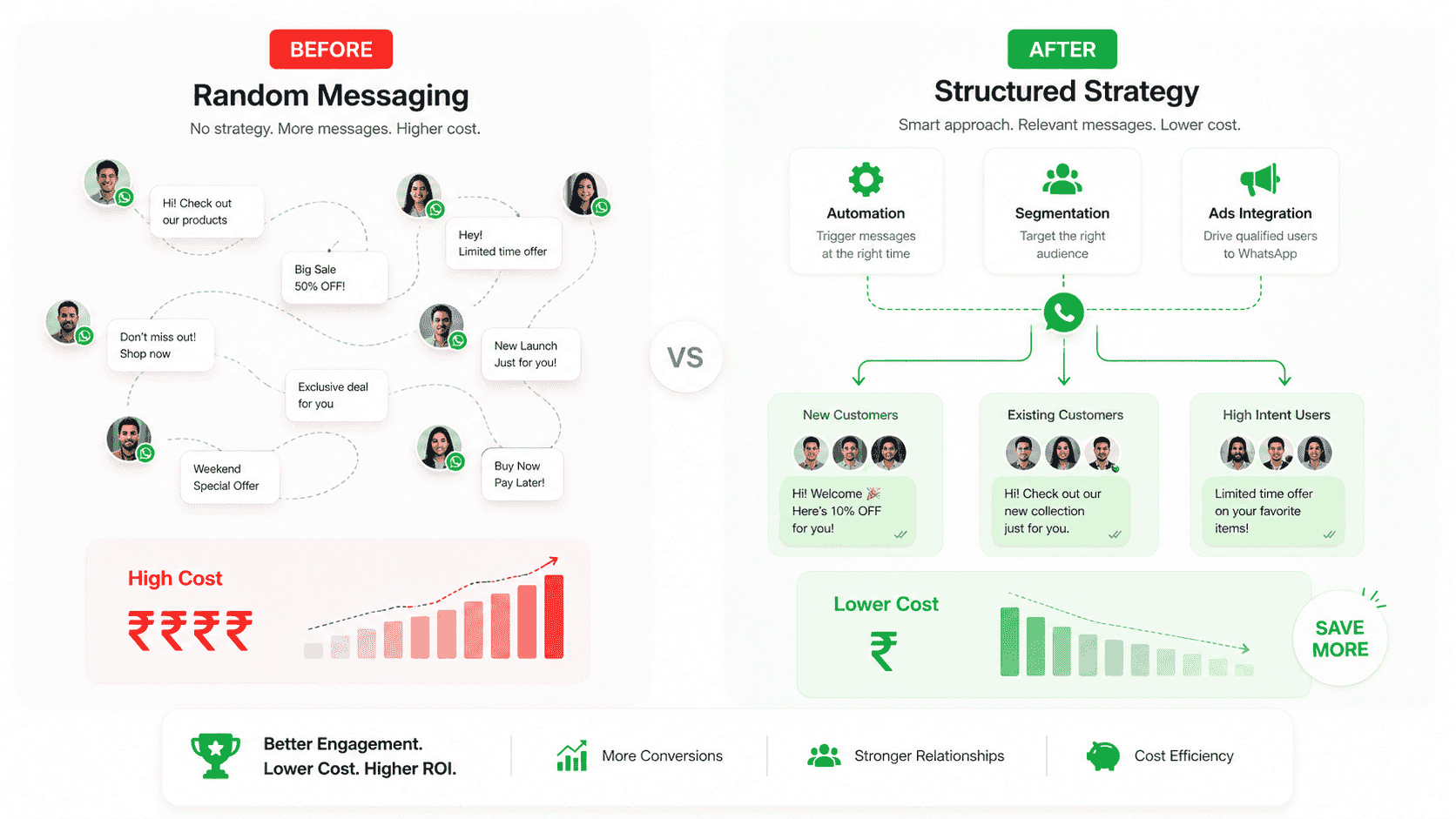
As a business sending thousands of messages every month, working toward reducing your WhatsApp API cost is essential. Here are some effective strategies:
Get customers to message first: When customers message you first, the free conversation window opens for 24 hours and you can send as many utility or service messages for free. Bring customers to you This approach works best when combined with WhatsApp lead generation strategies through strong branding, social media and well-placed CTAs that direct them to WhatsApp. This is one of the most effective ways to cut API costs.
Use Click to WhatsApp ads: If you add links on Facebook and Instagram that bring customers directly to WhatsApp, a 72-hour free window opens for all message types including marketing. The only condition is your business must respond within the first 24 hours. This is where automation becomes extremely useful, especially when you use WhatsApp automation to respond instantly at scale.
Segment your audience: Segment your audience properly Tools like WhatsApp Flows can help automate segmentation and reduce unnecessary message costs. Know what type of messages to send to which segment. Marketing messages cost the most so send them only to leads with strong conversion potential. Also segment based on timing to maximise free windows and minimise unnecessary charges.
Choose a BSP with transparent pricing: Not all BSPs charge the same. Some add a markup of 10 to 25% on top of Meta's official rates without clearly disclosing it. Before signing up with any BSP, ask for a full breakdown of their pricing. Choose one that charges Meta's rates directly with no hidden markup. Platforms like Helo.ai are upfront about costs and give enterprises full visibility into what they are paying for.
FAQs
Q1: How much does WhatsApp Business API cost in India in 2026?
There is no fixed monthly cost. You pay based on conversations, what type of messages you send and how customers interact with them. On top of this, your platform or BSP may charge a setup or subscription fee.
Q2: How does WhatsApp API pricing work in India?
WhatsApp charges per conversation, not per message. A conversation is a 24 hour window and pricing depends on whether it is marketing, utility, authentication, or service. The category you trigger decides the cost.
Q3: What is the cost of sending 1000 WhatsApp messages in India?
It depends on the type of messages. Marketing conversations cost more, while utility and authentication are cheaper. Roughly, it can range between ₹300 to ₹1,000 for 1000 conversations.
Q4: Is WhatsApp API cheaper than SMS in India?
On a per message level, not always. But overall, it often is. Higher open and response rates mean you need fewer messages to get results, which reduces the effective cost.
Q5: What is the difference between WhatsApp Business App and WhatsApp API pricing?
The WhatsApp Business App is free and built for small businesses with limited scale. The API is paid and designed for automation, integrations, and high volume messaging. Pricing comes in when you move to scale.
Q6: Are there hidden charges in WhatsApp Business API pricing?
Meta pricing is transparent, but your provider might add costs. These can include setup fees, platform subscriptions, automation tools, or integrations. You need to look at the full cost, not just messaging.
Businesses need to invest time in understanding WhatsApp API pricing. It is a necessary purchase for any business wishing to message customers at scale. A BSP has to be chosen carefully, as they are your direct partner with Meta and their pricing structure affects your costs significantly. Helo.ai helps enterprises navigate this with transparent pricing, enterprise-grade infrastructure and full support from setup to scale.

.png&w=828&q=75)
-1.png&w=828&q=75)