


If you run logistics operations at scale, you already know where the money leaks — it's not in fuel, fleet, or warehousing. It's in the conversations that never happen on time. A customer doesn't get a delivery update, calls support, the support agent calls the driver, the driver misses the call, the delivery fails, the package goes back to the warehouse, and a $3 shipment just cost you $15. The WhatsApp API for logistics has emerged as the most direct fix for this exact problem turning silent operational events into instant, two-way conversations with the people who matter.
This guide isn't another listicle of 20 features. It's a breakdown of the four hidden cost centers WhatsApp attacks directly, what real implementation looks like, and how to choose a partner who understands logistics, not just messaging.
The Four Hidden Costs Quietly Eating Your Logistics Margins
Most logistics dashboards track the obvious metrics — on-time delivery, cost per shipment, fleet utilization. But the costs that actually compress margins are usually invisible:
- WISMO ("Where Is My Order?") support load — often 60-70% of your inbound support volume
- Failed first-attempt deliveries — every redelivery doubles your last-mile cost on that shipment
- Driver coordination friction — phone calls, missed calls, status updates entered hours late
- Post-delivery silence — no review, no feedback, no path back to the customer
The companies winning in 2026 aren't running better fleets. They're attacking these four cost centers directly. Let's break each one down.
Cost Center #1: The WISMO Call Avalanche
A typical e-commerce logistics operation receives one inbound "where is my order" inquiry for every 4-6 shipments. At enterprise scale, that's millions of conversations a year, each costing $2-5 in agent time.
WhatsApp Business API kills this cost by making the WISMO conversation entirely automated:
- Proactive status updates — order placed → packed → dispatched → out for delivery → delivered, each pushed automatically as system events trigger them
- Self-service tracking — customer types "track 12345" or taps a button, AI bot returns live status with location pin
- Estimated delivery windows — narrow ETA windows (e.g., "between 2-4pm") instead of full-day promises
- Two-way exception handling — customer can flag "I'm not home" and trigger a reschedule without speaking to anyone
Logistics operations running this report 60-80% drops in inbound WISMO tickets within the first quarter. That's a direct, measurable reduction in support headcount per million shipments.
Also Read: WhatsApp for Customer Support: Benefits, Setup & Real Use Cases
Cost Center #2: Failed First-Attempt Deliveries
This is the most expensive failure mode in last-mile logistics. Industry benchmarks put first-attempt failure rates at 8-15% — and every failure means the package goes back to the hub, gets reloaded the next day, and adds 60-100% more cost on that single shipment. Some studies put the global cost of failed deliveries in the billions annually.
Here's where WhatsApp wins:
- Pre-delivery confirmation — a message goes out 1-2 hours before arrival: "Your package arrives between 2-4pm. Will you be available?" with Yes/Reschedule buttons
- Address verification on the fly — buyer can correct or update the delivery address inside the chat before the driver leaves the hub
- Drop-off instructions — "Leave with security guard" or "Call before arrival" can be captured directly from the customer
- Live driver ETA — when the driver is 10 minutes away, an automated message goes out with the option to confirm
Operators running this flow consistently see first-attempt success rates climb from ~88% to 95%+. For a company doing 1 million shipments a month, that's 70,000 fewer redeliveries — and the cost savings are not subtle.
Cost Center #3: Driver Coordination Chaos
Most blogs about WhatsApp API for delivery skip this entirely — but it's where some of the biggest gains live.
Drivers are usually managed through phone calls, SMS, or a separate app most of them don't open. WhatsApp changes the dynamic completely because drivers already live on it.
What a well-designed driver-side WhatsApp deployment looks like:
- Daily route push — driver receives the day's manifest with pickup and drop locations as a clickable list
- Live status reporting — driver taps "Picked up", "Out for delivery", "Delivered" buttons; status updates flow into the TMS instantly
- Proof of delivery (POD) — driver uploads a photo of the package at the door or a digital signature directly into the chat
- Exception reporting — damaged package, customer not available, wrong address — flagged in real time with photo evidence
- Two-way support — driver messages dispatch when stuck, gets help without leaving the route
The downstream impact: dispatch teams shrink, status accuracy improves dramatically, and disputes drop because every event is photo-documented.
Cost Center #4: The Post-Delivery Experience Gap
Most logistics communication ends the moment the package is delivered. That's a missed opportunity worth real money.
A short post-delivery WhatsApp sequence can:
- Confirm successful delivery with the POD photo — eliminates "I never received it" disputes
- Capture instant feedback — one-tap rating (1-5 stars) inside the chat, with an open reply if rating is low
- Surface complaints early — damaged package or wrong item flagged within minutes, not days
- Drive review and referral — directing satisfied customers to public review platforms while sentiment is still high
For 3PLs and last-mile providers, this turns the final touchpoint into a feedback engine that improves NPS and reduces dispute volume — both of which are measurable line items in the next contract negotiation with your shipper clients.
What "Real-Time Tracking on WhatsApp" Actually Looks Like
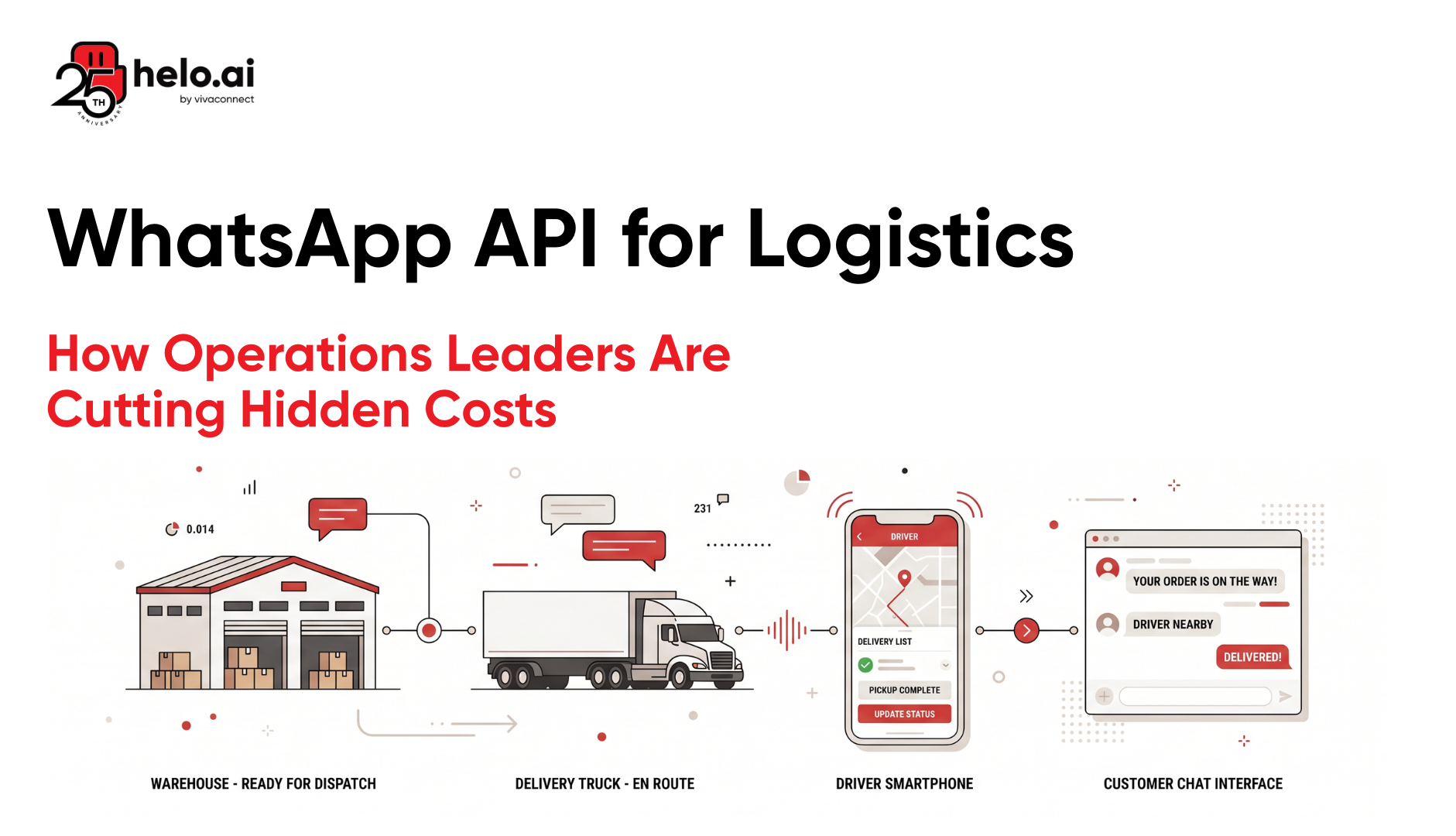
When logistics teams ask "how does WhatsApp delivery tracking actually work?", the answer is simpler than most vendors make it sound. Three layers stitch together to make it real.
The Customer-Facing Flow
Every operational event in your TMS triggers a corresponding WhatsApp message:
- Order confirmed → utility template with order summary
- Out for delivery → live tracking link plus narrow ETA window
- Driver 10 mins away → push notification with driver name and vehicle
- Delivered → POD photo plus rating request
- Failed delivery → instant reschedule flow
The customer never has to open an app, click a link, or remember a tracking number.
The Driver-Facing Flow
A separate WhatsApp number (or chatbot identity) serves drivers:
- Manifest delivery in the morning
- Status update buttons throughout the day
- POD photo uploads at each drop
- Exception flags with auto-routing to dispatch
This eliminates the need for drivers to learn another app — they're already fluent in WhatsApp.
The Operations Dashboard
Behind the messaging layer, your team sees:
- Real-time view of every active shipment and conversation
- Auto-flagged exceptions (delays, complaints, address issues) routed to specific agents
- Performance analytics: WISMO volume, first-attempt success rates, average resolution time, NPS by route
The integration with your TMS, OMS, or CRM is what makes the difference between a messaging tool and an operational nervous system.
Compliance, Security & Data Sovereignty in Logistics Messaging
Logistics handles addresses, phone numbers, identity proofs, and increasingly — payment confirmations. That's PII at scale. Depending on your geography, this could include GDPR, CCPA, or regional data protection laws.
Any deployment for an enterprise logistics operation must support:
- End-to-end encryption on all messages and uploaded files
- Data localization options aligned with the regions you operate in
- Consent management with audit trails for opt-in
- Role-based access so a dispatcher in one city can't see another city's conversations
- Retention controls for how long shipment-linked conversations are stored
A consumer-grade WhatsApp BSP usually fails on at least three of these. For enterprise logistics, this layer is non-negotiable.
Read Complete
What Most Logistics Teams Get Wrong During Implementation
Watching enterprise rollouts, three mistakes show up repeatedly:
- Treating WhatsApp as a notification channel — sending one-way alerts and ignoring two-way capability defeats the entire point. The ROI is in the conversation, not the broadcast.
- Skipping the driver side — customer-only deployments leave 50% of the value on the table
- No fallback strategy — when WhatsApp delivery fails (yes, it happens), there's no SMS or RCS backup, and the customer falls into a black hole
- Generic templates — using the same "Your order is out for delivery" message every competitor uses, instead of branded, contextual messaging that builds preference
Avoiding these is mostly a matter of choosing the right implementation partner — one who has actually rolled this out for logistics, not just for D2C brands.
Choosing a WhatsApp API Partner That Understands Logistics
Logistics has different demands than e-commerce. High-volume status updates, driver-side workflows, real-time TMS integration, and zero tolerance for downtime. When you're evaluating vendors:
- Are they an official Meta Business Solution Provider?
- Do they integrate natively with TMS, OMS, and ERP systems — or only with Shopify-style backends?
- Can they support both customer and driver workflows on the same platform?
- Do they offer omnichannel fallback (RCS, SMS, voice) when WhatsApp delivery fails?
- Can they handle your peak load (festival/sale events) without throttling?
- Do they have live deployments at logistics or e-commerce operations of your scale?
If even two of these are unclear, the vendor isn't ready for a logistics deployment.
Also Read: Best WhatsApp API Provider in 2026
Why helo.ai Is Built for Logistics Operations
helo.ai is an AI-powered omnichannel CPaaS platform that unifies WhatsApp, RCS, SMS, Email, and Voice into a single communication stack — purpose-built for high-volume operations. Smart routing means when a WhatsApp message fails to deliver, the system automatically falls back to RCS or SMS without breaking thread context.
What sets helo.ai apart for logistics:
- Omnichannel fallback architecture — critical when delivery messages can't afford to fail
- TMS, OMS, and ERP integrations — designed for operational systems, not just marketing tools
- Multilingual AI chatbots for international and regional customer bases
- Both customer-side and driver-side workflows in one platform
- Compliance frameworks aligned with global data protection standards
- Enterprise scale with live deployments handling millions of conversations per month
Built for the way logistics actually operates — at scale, across geographies, and across every event in the shipment lifecycle.
Conclusion
The logistics companies winning in 2026 aren't the ones with the biggest fleets — they're the ones who turned every operational event into a conversation, killed WISMO support load, recovered failed deliveries, and turned the post-delivery moment into a feedback engine. The WhatsApp API for logistics isn't a marketing tool. It's operational infrastructure. The question isn't
"should we adopt WhatsApp for delivery tracking?" — it's "which partner can deploy this fast enough, integrate deeply enough with our TMS, and at the scale our operations actually run at?" Talk to the helo.ai team, see live logistics deployments, and walk into your next ops review with a measurable cost reduction plan.
FAQs
1. How does WhatsApp API for delivery tracking actually work in real time?
Your TMS or OMS triggers events (order confirmed, dispatched, out for delivery, delivered) that automatically fire WhatsApp template messages to the customer. Two-way buttons let customers reschedule, confirm, or flag issues — all without leaving the chat.
2. Can WhatsApp API reduce failed delivery rates?
Yes, significantly. Pre-delivery confirmation messages, address verification, and live ETA updates typically cut first-attempt failure rates from 10-15% down to under 5% — directly reducing redelivery costs.
3. Is WhatsApp API for logistics secure for handling customer addresses and PII?
Yes. The API uses end-to-end encryption and aligns with GDPR, ISO 27001, and other major data protection frameworks. Pair with an enterprise BSP for data localization, consent management, and role-based access.
4. Can drivers also use WhatsApp API, or is it only customer-facing?
Drivers are one of the highest-ROI use cases. They can receive route manifests, update delivery status, upload proof of delivery photos, and flag exceptions — all from the WhatsApp they already use daily. No new app required.
5. How is WhatsApp API different from sending SMS delivery updates?
SMS is one-way, has lower open rates, and doesn't support rich media or interactive buttons. WhatsApp API enables two-way conversations, live tracking links, POD photos, and reschedule flows — turning a notification into an interactive operations layer.