


You need apps that talk, text and video-chat without fuss. Yet building that magic from scratch can feel like herding cats in a phone store. The result? Missed messages, unhappy users, and nights spent wrestling code. Luckily, there’s a shortcut. It’s called CPaaS, and by the time you hit the last line of this guide you’ll know how it works, which features matter, and where to start. If you’re eager to jump straight to the juicy part, check out our quick list of core APIs.
Key takeaways
- CPaaS stands for Communications Platform as a Service and plugs real-time voice, SMS, video and more into any software.
- Developers use simple APIs rather than building telecom infrastructure from the ground up.
- Businesses boost customer experience while cutting time-to-market and cost.
- CPaaS and UCaaS overlap, yet they solve different problems: one is for embedding, the other for full-suite collaboration.
- Top use cases include two-factor authentication, chatbots, telehealth, embedded contact centres, and logistics updates.
- The CPaaS market keeps expanding as 5G, AI, and IoT create fresh ways to interact.
- Alternatives exist, but they usually demand bigger budgets and longer rollouts.
What is CPaaS? CPaaS meaning
CPaaS (Communications Platform as a Service) is a cloud-based platform that enables businesses to embed voice, SMS, video, and messaging APIs directly into applications without building telecom infrastructure. It allows developers to launch real-time communications faster, scale globally, and pay only for usage.
CPaaS Market Size, Growth & Industry Trends
The global CPaaS market is expanding rapidly as businesses shift toward cloud communications.
- The CPaaS market size is projected to exceed $40–50 billion by 2029, growing at a double-digit CAGR.
- Analysts estimate a compound annual growth rate (CAGR) of 25–30% over the next five years.
- Adoption is driven by digital transformation, mobile-first customers, and API-first development models.
How does CPaaS work?
You’ve got the app, you’ve got the users, but how do you get them to talk, text, or video chat without spending years negotiating with phone companies?
The magic word is abstraction. CPaaS providers handle all the messy, expensive telecom hardware and carrier contracts, then wrap it all up in a simple cloud service.
Here is the three-step flow that brings CPaaS to life:
CPaaS Architecture Explained
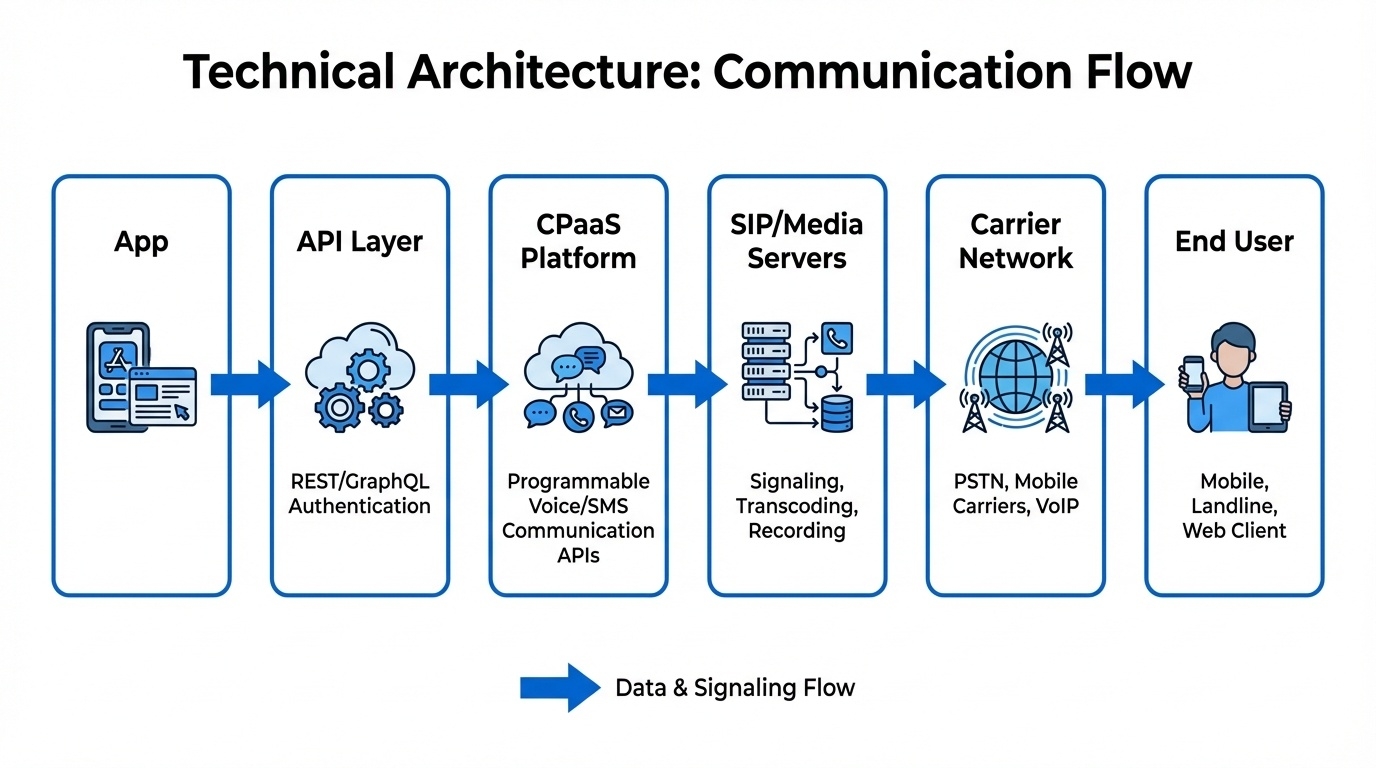
Understanding CPaaS architecture helps clarify how programmable communication works at scale.
1. API Layer
The API layer exposes REST APIs and SDKs that developers integrate into applications. These APIs control voice calls, SMS delivery, video sessions, authentication, and messaging workflows.
2. SIP Trunking
Session Initiation Protocol (SIP) trunking connects cloud platforms to traditional telephone networks (PSTN). It enables global voice connectivity without physical telecom hardware.
3. Media Servers
Media servers process real-time communication streams. They handle:
- Voice routing
- Video encoding/decoding
- Recording
- IVR logic
4. Carrier Interconnect
CPaaS providers maintain direct relationships with global telecom carriers to ensure message deliverability, compliance, and redundancy routing.
5. WebRTC Support
WebRTC enables browser-based voice and video without plugins. It powers:
- Telehealth consultations
- In-app video support
- Embedded meetings
Step 1: The API Call Initiating Programmable Communication
This is where your software leverages the "Platform as a Service." Instead of complex telecom code, you use a simple API request to start any communication event.
- Developer Focus: You integrate the provider's REST API endpoints or WebSocket SDKs into your application. This is the standardized interface for all functions: voice, SMS, or video.
- The Trigger: Your application logic sends a standard HTTP request to the CPaaS platform. This request contains the core data: the destination (phone number, user ID) and the content (message text, call parameters).
Step 2: Intelligent Routing – The CPaaS Platform Engine
The provider's engine takes your simple instruction and instantly executes the complex global logistics required for guaranteed delivery and quality.
- Protocol Translation: The CPaaS layer automatically converts your lightweight HTTP request into the necessary telecom protocols (like SIP and SS7) required by traditional networks.
- Optimal Pathfinding: The routing engine assesses its global network, including carrier connections and media servers, to determine the fastest, most cost-effective, and most reliable route. This engine handles failover routing to ensure messages and calls are delivered even if a primary path fails.
- Scalability Assurance: The infrastructure automatically scales capacity for every channel, ensuring that traffic spikes (e.g., millions of concurrent OTPs or flash sale alerts) are handled without performance degradation. This is crucial for high-volume CPaaS solutions.
Step 3: Delivery Confirmation Closing the Real-Time Feedback Loop
Communication is not complete until your application knows the outcome. This final step provides the necessary data for a seamless user experience.
- Successful Delivery: The communication event is executed (the text is sent, the voice call connects).
- Webhooks and Feedback: The platform sends instant delivery receipts and call status updates back to your application using webhooks. This real-time feedback loop allows your app to guide the user (e.g., "Verification code sent") or trigger the next action.
-1.png)
CPaaS features and communications APIs
Every CPaaS menu is slightly different, yet most share a core set of channels and functions.
1.Programmable voice
Add click-to-call, support lines, and simple IVR menus right inside your app. Customers talk to you without switching tools, and your team gets call recordings and history for coaching and QA. Roll out numbers in the countries you serve and keep conversations compliant.
2.SMS & MMS messaging
Send time-critical texts for OTPs, alerts, reminders, and promos. Messages land fast and get seen; when a picture or PDF explains it better, use MMS. Choose the right sender type per country and track delivery so you know every update gets through.
3.Video SDKs
Bring face-to-face into your product 1:1 sessions, small groups, or scheduled consultations with screen share and recordings when needed. Ideal for telehealth, onboarding, and premium support, all in the browser or your mobile app.
4.Multichannel chat
Meet customers where they already are: WhatsApp, RCS, Facebook Messenger, Apple/Google business messages, or your own in-app chat. Keep the thread intact across devices, use rich replies (buttons, lists), and fall back to SMS if a channel isn’t available.
5.Authentication APIs
Secure logins and high-risk actions with SMS or voice OTP, number verification, and optional SIM-swap checks. Cut fraud without adding friction, and keep pass/fail visibility so product and risk teams can tune the journey.
6.Number masking
Let two parties call or text through a temporary proxy number perfect for marketplaces, deliveries, and healthcare. Personal numbers stay private, sessions expire automatically, and you keep a clean audit trail.
7.AI-powered features
Make every conversation easier to handle with live transcription, translation, sentiment/intent, smart routing, and post-call/chat summaries. Teams resolve issues faster, customers get the right help, and leaders get searchable insights without building custom ML.
Benefits of CPaaS
So why are developers, product managers, and even business leaders warming up to CPaaS? Because it makes communications feel less like a headache and more like a shortcut.
1. Faster Time to Market with CPaaS
Instead of spending months negotiating carrier contracts and setting up servers, a developer can launch a working prototype in days. Need SMS alerts in your app by Friday? CPaaS makes that realistic. Fast experiments mean you can test features with real customers before sinking big budgets into them.
2. CPaaS Cost Savings vs. Traditional Telecom
Buying phone switches, SIP trunks, and global carrier connections used to cost a fortune. With CPaaS, you only pay for what you use whether that’s a handful of video minutes or millions of text messages. Start small, scale later, and skip the CapEx.
3. Global Reach Through CPaaS APIs
A local coffee shop and a global marketplace have very different needs, but CPaaS levels the playing field. APIs connect to carriers worldwide, automatically reroute messages if one path fails, and make sure your calls or texts reach the recipient—whether they’re across town or across the ocean.
4. Scalability Without Hardware Headaches
Traffic spikes don’t wait for you to install new hardware. With CPaaS, you can go from ten users to ten million without adding a single box in a data centre. The infrastructure flexes automatically, so your app doesn’t choke just because you went viral on launch day.
5. Flexible Communication Channels for Every Customer
Not every customer wants a phone call. Some prefer a WhatsApp ping, others a quick text, and some a secure video chat. CPaaS lets you mix and match channels to match real user behaviour without bolting together five different tools.
6. Built-in Compliance and Security with CPaaS
Rules like GDPR, HIPAA, and 10DLC can be intimidating. Most CPaaS providers bake compliance into their platforms, offering features like region-specific data storage, encryption, and built-in registration flows. Instead of wading through regulations, you focus on building features your users love.
5 CPaaS use cases
It’s one thing to read about APIs in theory but the magic clicks when you see how they fit into daily life. Here are five practical ways companies are already putting CPaaS to work:
1. Two-factor authentication (2FA)
You’ve probably had a code texted to you before logging into your bank or shopping app. That’s CPaaS in action. Instead of building custom telecom connections, businesses just plug in an API that sends secure one-time passwords by SMS or voice. It keeps accounts safe, gives users confidence, and takes minutes not months to roll out.
2. Smarter customer support
No one enjoys being put on hold. With CPaaS, retailers and service providers can drop chatbots into channels like WhatsApp or Facebook Messenger to answer simple questions instantly. And when an issue needs a human touch, the same chat thread hands off to a live agent no app switching, no “please call this number.” Customers stay happy, agents stay efficient.
3. Telehealth made simple
Healthcare doesn’t always require a clinic visit. Thanks to CPaaS, hospitals and local practices can host secure video consultations right inside their patient portals. Doctors can share test results, send appointment reminders, or check in with patients through encrypted messaging. The result? Faster care and less waiting around for everyone involved.
4. Real-time delivery updates
Waiting for a package is less stressful when you know exactly where it is. CPaaS powers those “your order is on the way” texts, complete with live tracking links and temporary phone numbers to call your driver. It keeps personal numbers private and ensures you don’t miss that crucial delivery window.
5. Contact centres without the clutter
Instead of bouncing between tabs and tools, customer service teams can work inside a single CRM that’s boosted with CPaaS. Voice calls, video support, and even screen sharing live right inside the software they already use. Meanwhile, the provider handles the messy stuff—call routing, compliance, and recording so agents can focus on helping customers.
CPaaS vs. UCaaS What's the difference?
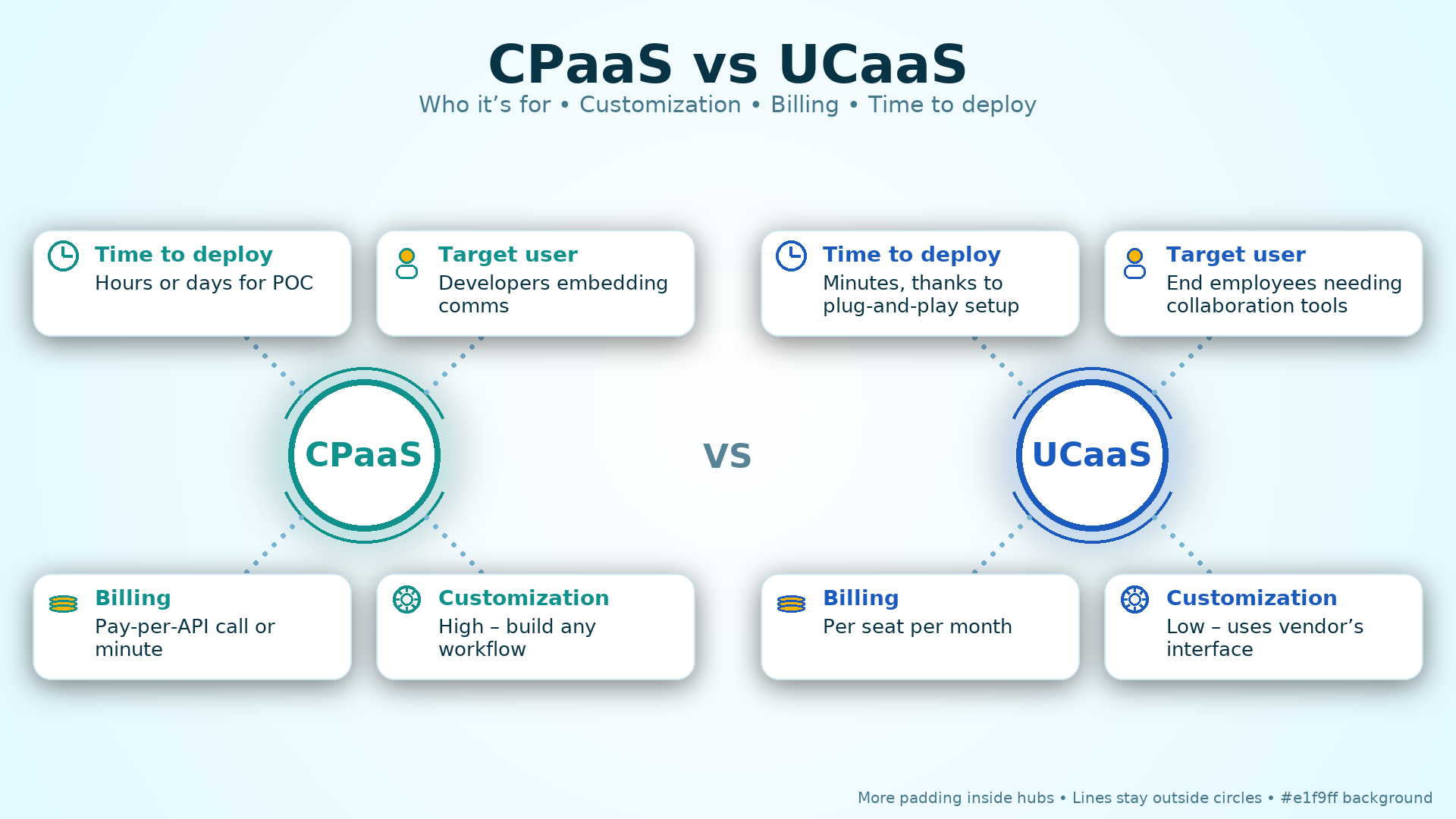
Unified Communications as a Service (UCaaS) also lives in the cloud, yet its purpose is different. While CPaaS offers building block`s, UCaaS ships a ready-to-use suite phones, meetings, chat all integrated out of the box. Let’s compare them side by side.
Feature | CPaaS | UCaaS |
Target user | Developers embedding comms | End employees needing collaboration tools |
Customization level | High – build any workflow | Low – uses vendor’s interface |
Typical billing | Pay-per-API call or minute | Per seat per month |
Time to deploy | Hours or days for POC | Minutes, thanks to plug-and-play setup |
What does the CPaaS provider market look like?
The CpaaS Market has ballooned as companies race to add real-time communications. Analysts project double-digit compound growth through 2028, powered by 5G, IoT, and AI. Players range from pure-play start-ups to telecom giants and cloud hyperscalers.
A typical provider invests in global carrier relations, elastic SIP backbones, and developer-first tooling. Market leaders also offer analytics dashboards, compliance wizardry, and round-the-clock support because developers rarely ship at 9-to-5.
What is a CPaaS provider?
Think of a CPaaS provider as a communications concierge. They connect you to mobile carriers, PSTN gateways, and media servers, then wrap that complexity in a friendly API. Good providers hide the messy bits number regulations, fail-over routing, codec negotiation so your team can focus on product flow, not packet flow.
Alternatives to CPaaS
Your choices don’t stop at CPaaS. Below is a snapshot of common alternatives and why they might (or might not) fit.
- On-premise SIP trunking – Full control, yet heavy on CapEx and maintenance.
- Hosted PBX – Quick to order but limited to voice and basic messaging.
- UCaaS – Great for internal comms, less flexible for customer-facing apps.
- No-code integrations – Speedy, though harder to fine-tune edge cases.
- Point solutions – Example: standalone SMS gateway; good for one job, not omnichannel growth.
FAQs about CPaaS
Is CPaaS only for big tech firms?
No. Small e-commerce shops use CPaaS for order updates, and local clinics use it for telehealth. The pay-as-you-go model scales both up and down.
Do I need deep telecom knowledge?
Basic HTTP skills get you started. The heavy telecom lifting lives in the provider’s cloud.
Can CPaaS handle regulatory rules like GDPR or HIPAA?
Many platforms offer region-specific data residency and encryption features to satisfy strict rules. Always double-check before you integrate.
How does CPaaS pricing work?
Most vendors charge per message, minute, or video participant. Some offer committed-use discounts once volumes rise.
Are there CPaaS solutions examples I can explore?
Yes: multi-factor authentication for banks, WhatsApp support bots for airlines, and embedded voice in driver marketplace apps are classic CpaaS solutions examples.
What are core CPaaS APIs
What are the benefits of CPaaS?
Faster time-to-market, pay-as-you-go costs, global reach, flexible channels, and built-in security/compliance features.
CPaaS vs UCaaS what's the difference?
CPaaS offers embeddable APIs for customer-facing apps; UCaaS is a turnkey suite for employee collaboration with per-seat licensing.

.jpg&w=828&q=75)


.jpeg&w=96&q=75)