



On a rainy evening in Mumbai, Rina received a call from her ban three days too late. Her credit card payment was overdue, and the late fee had already been charged. But this wasn’t a failure of the banking system, it was a failure of the customer experience. In a digital-first world, customers expect messages on their terms, through channels they trust, and in moments that matter.
These moments show a growing problem in the financial industry. Banks must link simple transaction messages with meaningful customer engagement. As consumers become more mobile-centric and behavior-driven, banks must find new ways to deliver messages that feel timely, personalized, and consistent across every touchpoint without adding complexity
What Is Customer Experience in Digital Banking?
Customer experience in banking isn’t just about completing transactions it’s about every interaction, start to finish. From onboarding to issue resolution, every touchpoint must be fast, personalized, and trustworthy. The tone of a chatbot, the timing of a message, and the clarity of an app interface all shape how customers feel. Get it right, and you build loyalty. Get it wrong, and you lose them.
Why CX Matters in Banking
CX isn’t optional, it's what keeps customers from leaving. In a crowded market where products are nearly identical, experience is the differentiator. When service is fast, helpful, and personalized, customers stay. When it’s slow or frustrating, they leave.
- Only 3% of companies are truly customer‑obsessed but those that are see 41% faster revenue growth, 49% higher profits, and 51% better customer retention compared to the rest
- Nearly 9 out of 10 banking customers say experience is as important or even more important than the bank’s actual products or services
- A single poor digital experience is enough to make over 50% of customers consider switching their bank
10 Proven Strategies to Improve Customer Experience in Banking
1.Frictionless Onboarding: Make the First Experience Count
The first interaction affects how customers see things. Banks need to make onboarding quick and easy on mobile devices. They should use biometric KYC, check documents in real time, and not need a lot of manual input. Use guided flows that change based on how users act, and add 2FA without stopping progress. When onboarding is easy to understand, fewer people leave and more people buy.
2.Conversational Strategy: Creating Meaningful Dialogue Across Digital Touchpoints
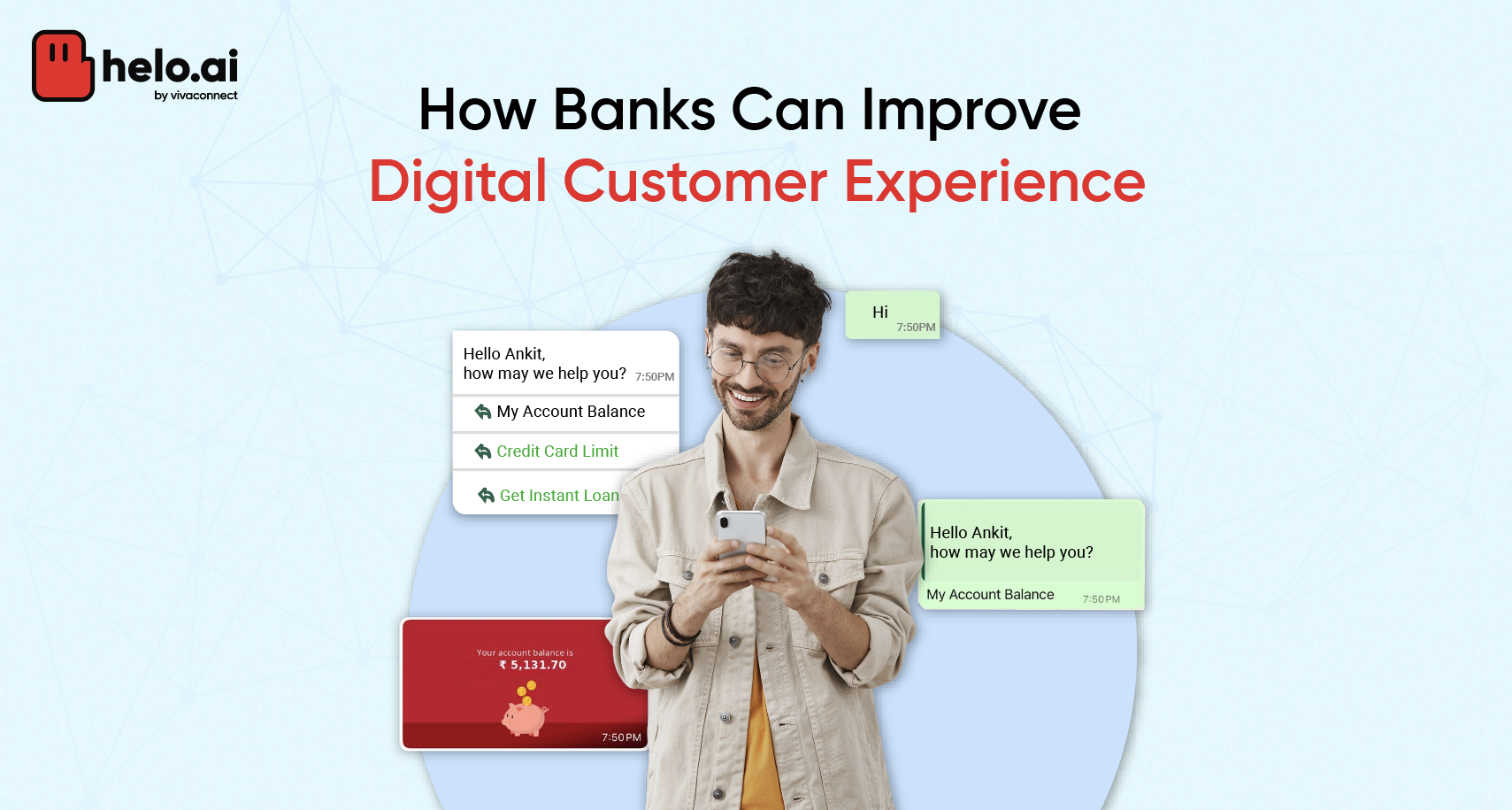
People expect conversational banking now, not just as a new idea. Use AI-powered chatbots to do things like check balances, send out fraud alerts, or FAQs Then, if you need empathy, send it to a human agent. You can add pictures, buttons, and dynamic text to your WhatsApp and RCS campaigns with Helo.ai. This turns conversations into actions. Interacting in real time builds trust. Contextual handoffs stop people from getting angry.
3.Personalization at Scale: Speak to One, Serve Thousands
Gone are the days of one-size-fits-all messages. Use AI to analyze user behavior and segment customers into micro-cohorts. Then, deliver content tailored to spending patterns, savings goals, or loan eligibility. From dynamic SMS to personalized WhatsApp nudges, every message should feel like it was crafted for that individual because it was.
4.Omnichannel Integration: Build Seamless Journeys That Feel Effortless
Customers switch between devices and platforms constantly and banks must follow. A secure chat on mobile should pick up where a voice call left off. An email confirmation should align with WhatsApp notifications. With Helo Broadcast, banks can manage communications across SMS, RCS, WhatsApp with one dashboard ensuring no channel is left behind and no message is repeated.
Many banks confuse the two approaches read more about omnichannel vs multichannel in digital banking to avoid costly mistakes.
5.GenAI & Real-Time Decisions: Anticipate Needs Before They Arise
lets banks respond in real time and in context based on past interactions and sentiment analysis. When someone looks up loan rates, give them a personalized EMI plan right away. A smart nudge can help someone get back on track if they stop onboarding in the middle. AI that doesn't just react as it predicts makes outreach 52% smarter.
6.IVR to Digital Deflection: Modernize Call Centers with Intelligent Routing
Traditional IVR systems frustrate users with endless options. Replace them with smart digital deflection where calls automatically offer to switch users to WhatsApp or SMS for faster resolution. These transitions reduce costs, free up agents, and shorten wait times. A simple message like “Want to continue this conversation on WhatsApp?” can be the CX breakthrough customers crave.
7.Proactive Banking: Engaging Customers Before They Even Ask
Send reminders before payments are due. Offer credit when usage peaks. Celebrate milestones like birthdays with financial tips or exclusive offers. By using event triggers transactions, dates, behaviors banks can surprise and delight users, creating moments that foster loyalty and reduce churn.
8.Customer Support Excellence: Human + AI = Happiness at Scale
AI can handle up to 80% of basic queries but it’s human support that wins hearts. Equip agents with full context via CRM integrations so they resolve issues faster. Use AI to suggest best next actions and reduce average handling time. The result? More empathy, less repetition, and higher CSAT.
9.Security & Trust UX: Build Confidence Into Every Click
Great CX must be secure. Use biometric logins, seamless 2FA flows, consent prompts, and encryption without compromising speed. Trust is the invisible layer that enables users to act freely and come back again.
10.Accessibility & Inclusive Design: Banking Should Work for Everyone
From larger text sizes to voice-access features, inclusive design ensures banking is accessible to all users regardless of age, ability, or tech literacy. Design with empathy and watch engagement multiply.
Benefits of Better Customer Service in Banking
In banking, great customer service is no longer just a nice thing to have; it's what customers expect and what banks use to build loyalty, grow, and stay ahead of the competition. The best banks have changed how they help customers. They changed it from a cost center to a way to beat the competition. This change will help the brand and profits in the long run.
Higher Customer Retention
Customers don't stay for the best prices; they stay for how they feel. When a bank consistently offers smart, easy-to-use, and responsive digital service, it builds a strong emotional bond. This connection turns into loyalty that lasts longer than competitors' offers, making customers who trust the business with more products, data, and advocacy. Customers who are emotionally involved with their bank are three times more likely to tell others about it.
Boosted Revenue & Conversions
When banks stop using generic marketing and start talking to people one-on-one, they get a lot more people to sign up. AI-driven personalization shows you the right financial products at the right time. For instance, it gives you a micro-loan when your balance is low. It encourages a fixed deposit when your salary goes up. These contextual nudges can boost conversion rates by 30–50% while also increasing engagement and the chance to sell more.
Cost Efficiency
Automating repetitive customer queries through Ai Chatbots, smart routing, and AI-driven support not only speeds up resolution it reduces support costs by more than three times. Banks can save agent time by automating balance inquiries and KYC status updates. They can use human support for important, emotional interactions that need empathy.
Positive Brand Perception
In a world where social media and online reviews shape how people think, a smooth digital banking experience can be your best marketing tool. Customers tell others about their good experiences when they have any problems, get help quickly, and talk to someone directly. This makes them brand ambassadors, which builds trust and affects acquisition.
Measuring CX: KPIs, Dashboards & ROI That Matter
Improving CX is only valuable when it’s measurable. Leading banks use real-time dashboards. These track many key performance indicators across digital channels. This lets teams fix customer experience problems before they get worse.
NPS (Net Promoter Score): Loyalty & Advocacy Score
This tells you how likely a customer is to tell others about the bank. A high NPS means that people feel strongly about your brand and will stick with it for a long time. It's a standard for brand love.
CSAT (Customer Satisfaction Score): Real-Time Sentiment at Touchpoints
This score is based on certain actions, like filling out a loan application or talking to customer service. It helps find specific problems or successes along the way for the customer.
CES (Customer Effort Score): How Easy Was That?
This strong metric asks how much work the customer had to do to fix their problem. Less effort means more satisfaction, less churn, and more repeat use.
Churn Rate: How Many Leave and Why
Keep track of attrition and see how it relates to points in the user journey where people leave. Use this with sentiment analytics to find hidden patterns of dissatisfaction.
Adoption & Containment: How Well Is Digital Performing?
Count how many customers start and finish tasks online without needing to talk to a human or go to a branch. High containment means a good self-service user experience.
Cost-to-Serve: Driving Efficiency Without Sacrificing Quality
Know how much each interaction costs and how much you can save by using automation, digital deflection, or smarter outreach. When low cost-to-serve and high satisfaction are combined, it means an optimized experience.
Channel Deep-Dive: WhatsApp & RCS for Banking Experiences That Stick
Instead of waiting for users to open an app, modern banking goes to them where they are. WhatsApp and RCS are becoming the most popular ways for banks to talk to each other in a safe, two-way way that keeps people interested.
- WhatsApp is great for account notifications, KYC alerts, fraud warnings, and interactive product promotions because it has end-to-end encryption, verified business accounts, and a trusted reach.
- RCS is an improved version of SMS that helps banks give customers immersive experiences by supporting rich media, read receipts, quick-reply buttons, and carousel messages.
Banks can ensure reliability with failover to SMS, guaranteeing message delivery even when users aren’t online. Add IVR deflection, and calls can be transitioned into text-based support flows, reducing wait times and boosting satisfaction.
Reference Architecture: Your Stack for Seamless Digital CX
To deliver consistent and scalable digital banking experiences, banks need a tightly integrated system. Here’s the CX infrastructure that banks need:
- Core Banking System: is the foundation for managing accounts, transactions, and customer data. To allow for real-time updates, this needs to interface with front-end systems.
- Customer Data Platform (CDP): Creates unified customer profiles for improved targeting and personalization by centralizing data from all touchpoints, including web, apps, chatbots, and voice.
- CPaaS Layer: Helo.ai and other Communications Platform as a Service offer APIs for sending and receiving messages via RCS, WhatsApp, SMS, and voice from a single platform.
- AI & GenAI Layer: Uses behavior-based logic to produce tailored responses at scale, recommend actions, and convey more intelligent messages.
- The Compliance & Consent Layer: oversees encryption, audit trails, opt-ins, data privacy compliance (such as GDPR, RBI, etc.), and other matters to maintain transparency and confidence.
Use-Case Library by Journey Stage: Blueprint for Success
Banks must build CX strategies around key customer journey stages. Here’s a bank-wide playbook:
- Onboarding: Use WhatsApp to help users through KYC with automated document collection, instant approvals and friendly reminders.
- Servicing: Use WhatsApp to send real-time updates on your balance, reminders for your EMI, and alerts about activity on your account.
- Collections: Use AI-powered chatbots to talk to customers in a way that shows you care. These chatbots can offer flexible repayment plans and connect customers with real people if they need help.
- Lending: Use a chatbot to send personalized, pre-approved offers based on a user's profile, along with instant approval and calculator tools.
- Wealth Management: Use secure, dynamic messaging to send information about stock movements, mutual funds, or SIP status.
- MSME Banking: Send small businesses messages about their credit eligibility and product offers, along with easy links to apply or talk to a relationship manager.
Build vs Buy + Here is the plan to implement the solution. Your Path to CX Maturity
Deciding between building a digital CX platform or buying one depends on speed, scalability, and in-house capability.
Build
- Pros: Full customization, internal control
- Cons: High cost, long time to market, constant maintenance
- Best for: Banks with dedicated tech teams and a clear long-term product vision
Buy Enterprise AI Messaging Platform
- Pros: Fast implementation, reduced complexity, proven scalability
- Cons: Less customization (depending on vendor)
- Best for: Banks looking to move quickly and reduce risk
Helo Broadcast offers a strong, enterprise-ready platform. It supports AI-powered messaging across SMS, RCS, WhatsApp, Voice, and Email from one central console.
Here is the plan to implement the solution.
- Define CX vision and priority journeys
- Pilot with one customer journey (e.g., onboarding)
- Integrate Helo.ai APIs with CRM and banking systems
- Train agents and AI, launch channel campaigns
- Measure, iterate, and expand journey coverage
Challenges & How to Overcome Them: From Legacy to Leading-Edge
Modernizing banking CX isn’t without obstacles. But with the right strategy, every challenge is solvable and scalable.
Siloed Systems: Break Down Data Walls for Unified CX
Legacy systems often store data in separate silos, with CRM, core banking, mobile apps, and call centers all working on their own. This makes it hard to give people experiences that are real-time and tailored to them.
Solution: Use a Customer Data Platform (CDP) to bring together data from different places. Connect with real-time APIs and middleware to make sure that every interaction between an app, a bot, or a branch comes from the same source of truth.
Fragmented Teams: Align Departments with Shared CX Goals
Often, marketing, product, and service teams operate with different goals and disconnected tools leading to inconsistent experiences and missed insights.
Solution: Create cross-functional CX squads focused on shared metrics like NPS, resolution time, and engagement. Use collaboration dashboards and shared goals to align efforts.
Outdated Technology: Innovate Without Replacing Everything
Older systems can be costly and difficult to change, but a full core banking replacement is not always necessary.
Solution: Banks can use a composable approach instead of completely changing their old core systems, which can be costly, time-consuming, and risky. CPaaS, or "Communications Platform as a Service," is a flexible layer that connects old systems to new digital features.
Banks can add advanced messaging channels like RCS, WhatsApp, SMS, and Voice with Helo.ai. They can also use AI to make things more personal, automate tasks, and find the best route. Banks can launch products faster with this modular setup. It cuts down on IT costs and makes upgrades easier.
Banks can make big changes without stopping their main business. This method has a big effect and is not very risky. It helps banks keep up with the times and stay competitive in a digital world that changes quickly.
Banks today must choose the right communication channel learn the difference between RCS and SMS to see which best supports customer engagement
Security Concerns: Make Trust the Default, Not the Exception
Customers fear fraud, data misuse, and privacy breaches. If they don’t trust the channel, they won’t engage.
Use end-to-end encryption. Use visible consent protocols. Use multi-factor authentication. Provide clear privacy messages. Build trust into every interaction, especially in messaging and self-service flows.
FAQs
What does customer experience mean in banking?
It’s all about how people feel when they interact with their bank from opening an account to getting help with a problem. Whether it's chatting with a support bot, checking balances on an app, or receiving a payment reminder, every moment shapes the overall experience. Good CX makes banking feel easy, helpful, and even enjoyable.
Why is customer experience such a big deal in digital banking?
Because it’s what sets one bank apart from another. Most banks offer similar products, but not all deliver smooth, personalized service. Customers are more likely to stay loyal and even recommend their bank when the experience is fast, clear, and feels tailored to them. And the data backs it up: better CX means higher profits, stronger loyalty, and lower churn.
What’s the best way for banks to improve digital CX?
Start by making everything easy. Make onboarding quick, send reminders at the right time, and let customers reach you through the channels they already use like chat or messaging apps. Using smart tech like AI can also help personalize service and speed things up, so customers don’t feel like just another number.
How are WhatsApp and RCS useful for banking?
They’re game changers. With WhatsApp and RCS, banks can send secure messages, updates, or even let customers respond and complete tasks directly in the chat. It’s faster than email, more flexible than SMS, and it meets customers where they are on their phones.
Can AI really handle customer support?
Absolutely for the basics. AI can take care of balance checks, transaction queries, reminders, and more. In fact, it’s been shown to handle up to 80% of routine questions. But for more complex or sensitive issues, human agents still play a key role especially when empathy matters.
How do digital banks create smooth, connected experiences?
They connect the dots behind the scenes. That means using systems that pull customer data into one place and making sure all channels apps, chat, voice are in sync. So whether someone starts a conversation in a chatbot or a call, they won’t have to repeat themselves. That consistency builds trust.
What are the big CX trends in banking for 2025?
Expect more “super apps” that do it all, smarter personalization through AI, and fast, human-like responses from chatbots. Messaging apps like WhatsApp will become even more central, and small business banking will get a digital upgrade too. It’s all about speed, relevance, and flexibility.
What should banks track to know if their CX is working?
Here are a few key metrics:
- NPS – Are customers likely to recommend your bank?
- CSAT – Are they satisfied after specific interactions?
- CES – Was it easy for them to get something done?
- Churn rate – Are you keeping or losing customers?
- Containment and adoption – Are digital tools doing their job?
- Cost-to-serve – Are you handling queries efficiently?
Is it safe to use messaging apps for banking?
Yes, as long as they’re properly set up. Apps like WhatsApp and RCS offer end-to-end encryption and strong security features. When combined with proper consent and data protection, they’re a safe and reliable way to connect with customers.
What is customer experience in banking?
Customer experience in banking is how people feel every time they interact with their bank online or offline. It's not just about getting things done; it’s about how smooth, helpful, and personalized those interactions are. Whether someone is opening an account, making a transfer, or reaching out for help, every step adds up to define how good or frustrating the experience is.
How can banks improve customer experience?
Start by listening to customers. Make it easy for them to get started, solve problems quickly, and feel recognized. That means faster onboarding, fewer steps, smarter communication, and support that’s available when and where they need it. Personal touches like remembering preferences or sending timely reminders go a long way in making customers feel valued.
How can banks improve digital banking?
To improve digital banking, banks need to think like tech companies. That means user-friendly apps, fast response times, secure messaging, and AI that helps customers before they even ask. It also means making sure the experience is consistent across channels—whether someone is using a chatbot, email, or mobile app, it should feel seamless.




.jpeg&w=96&q=75)