


There are two kinds of WhatsApp campaign running in the world right now. The first kind drives 8-15% conversion rates, recovers abandoned revenue, and builds a customer relationship that compounds. The second kind gets muted, blocked, flagged, and quietly destroys a brand's WhatsApp quality rating in three sends — turning the most powerful channel in marketing into a dead one. The difference isn't the platform. It isn't even the offer. It's the architecture of the campaign itself. This guide breaks down what separates the two — the anatomy of campaigns that work, the death spiral that kills the ones that don't, six campaign types that consistently outperform, what they actually cost, and five original templates you can pull straight into your next send.
Why WhatsApp Campaigns Outperform Email and SMS
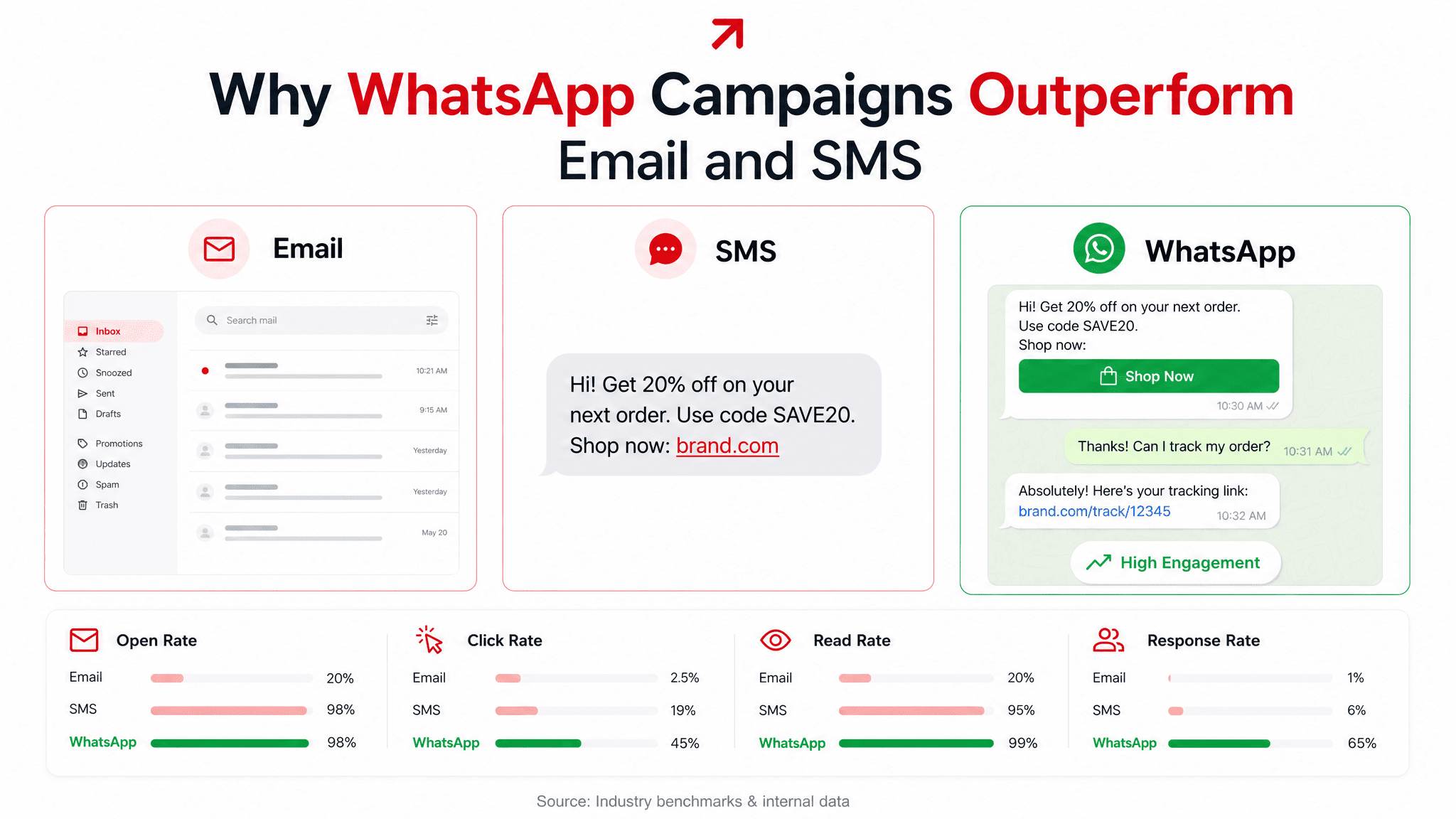
Most teams approach WhatsApp the way they approached email five years ago bigger list, bigger send, bigger spray. Then they're surprised when conversions disappear and Meta downgrades their quality rating.
WhatsApp doesn't reward volume. It rewards relevance. The platform's entire economics — pricing, deliverability, quality rating, even template approval are built around discouraging spray-and-pray and rewarding signal-rich sends.
The teams getting it right have shifted three things:
- From broadcast-first to segment-first thinking
- From promotional templates to conversational templates
- From send-and-forget to respond-and-route workflows
Until those three shifts happen, no amount of clever campaign ideas will move the needle.
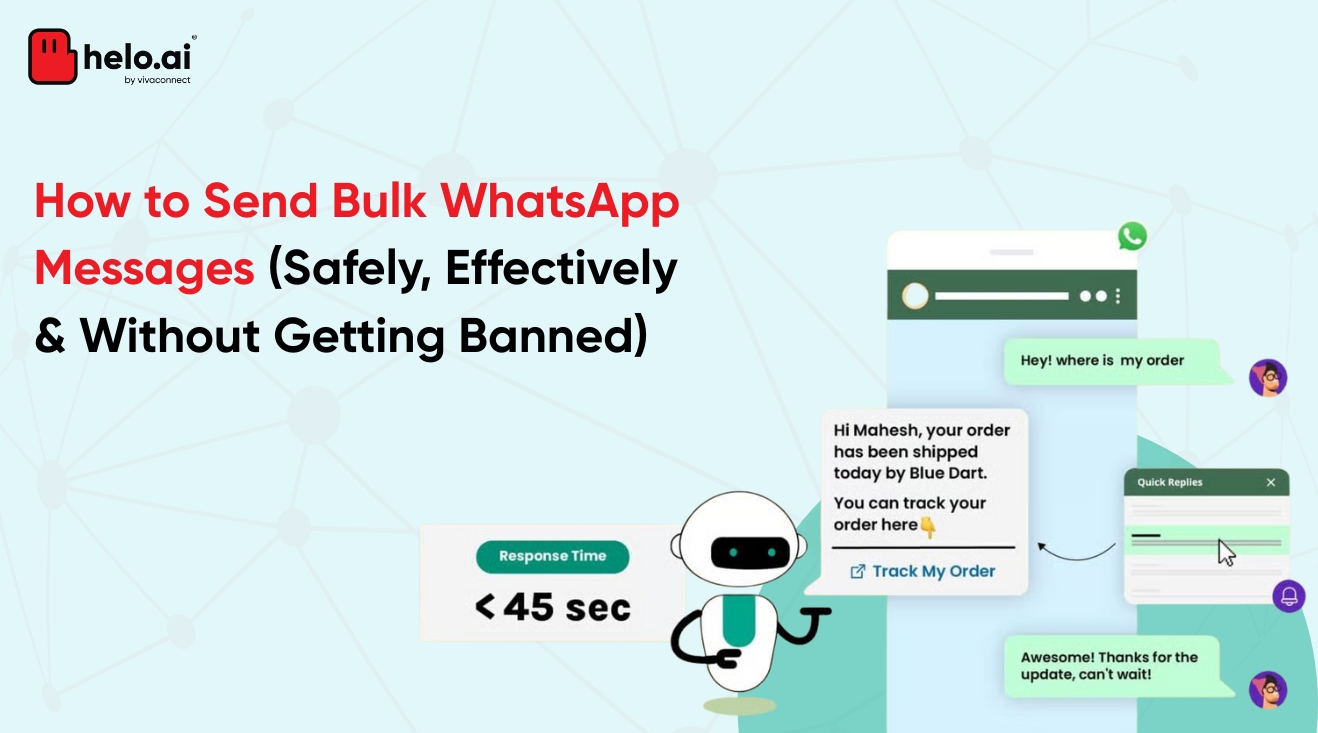
If your team is still thinking in terms of list size and send volume, this guide on how to send bulk WhatsApp messages explains the operational difference between scale and spam.
How to Create a WhatsApp Campaign Step by Step
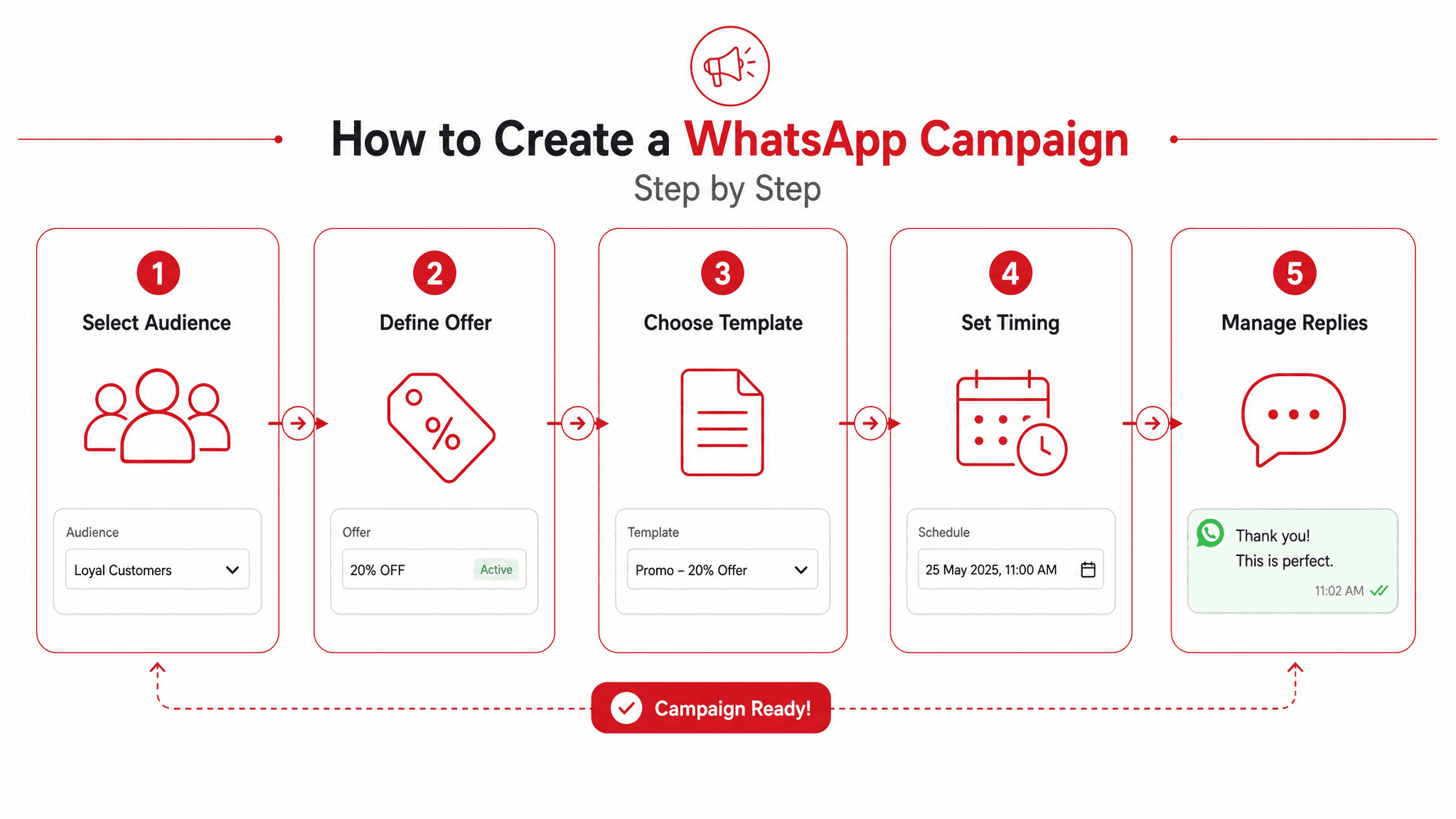
Every successful WhatsApp campaign has the same five layers stacked correctly. Skip a layer and the whole thing collapses.
Step 1: Build Your Opt-In Audience
Who you're sending to matters more than what you're sending. The single highest-leverage decision in a WhatsApp campaign is segmentation and it's the layer most teams shortcut.
A campaign sent to 100,000 generic contacts will almost always underperform the same campaign sent to 10,000 segmented contacts. Better segments include: high-intent browsers, recent purchasers, cart abandoners, lapsed customers, VIPs, category-specific buyers, and engaged subscribers (those who replied to a previous message).
Step 2: Define Your Offer and Goal
The offer has to earn the message. WhatsApp users tolerate roughly one promotional interruption a week before they mute or block. That means every send has to be visibly worth the interruption.
Strong offer characteristics: time-bound, segment-specific, exclusive (not available elsewhere), and concrete in value. "Limited-time" is weak. "48-hour early access for VIP customers" is strong.
Step 3: Choose the Right WhatsApp Campaign Template
WhatsApp campaigns must use pre-approved message templates, and the template category dictates both cost and rules. Marketing templates allow promotional content but cost more. Utility templates are cheaper but can't carry promotional copy. Authentication templates are for OTPs only.
The most common template failures: too long (over 1,024 characters loses readability), too generic (no personalization variables), too promotional in a utility template (gets reclassified or rejected), and missing a clear CTA button.
Step 4: Plan the Send Time and Frequency
Timing matters more on WhatsApp than on any other channel because the message lands directly in the same inbox where the recipient talks to friends and family. A poorly-timed send doesn't just get ignored — it triggers an emotional reaction.
Best practice: send during waking hours in the recipient's timezone, avoid sleep hours and meal times, and never send the same template twice within 14 days. Volume matters too — most enterprise teams cap WhatsApp sends to one campaign per opted-in customer per week.
Step 5: Set Up Replies and Automation
This is where most enterprise WhatsApp deployments quietly fail. A campaign goes out, customers reply with questions, and the inbox sits unmonitored. Reply rates on WhatsApp campaigns are 5-10x higher than email — and an unanswered reply is a converted customer walking away.
Every WhatsApp campaign needs a response infrastructure: chatbot for FAQ-tier responses, smart routing to human agents for high-intent replies, and a 24-hour response SLA at minimum.
How to Avoid Getting Muted or Blocked on WhatsApp
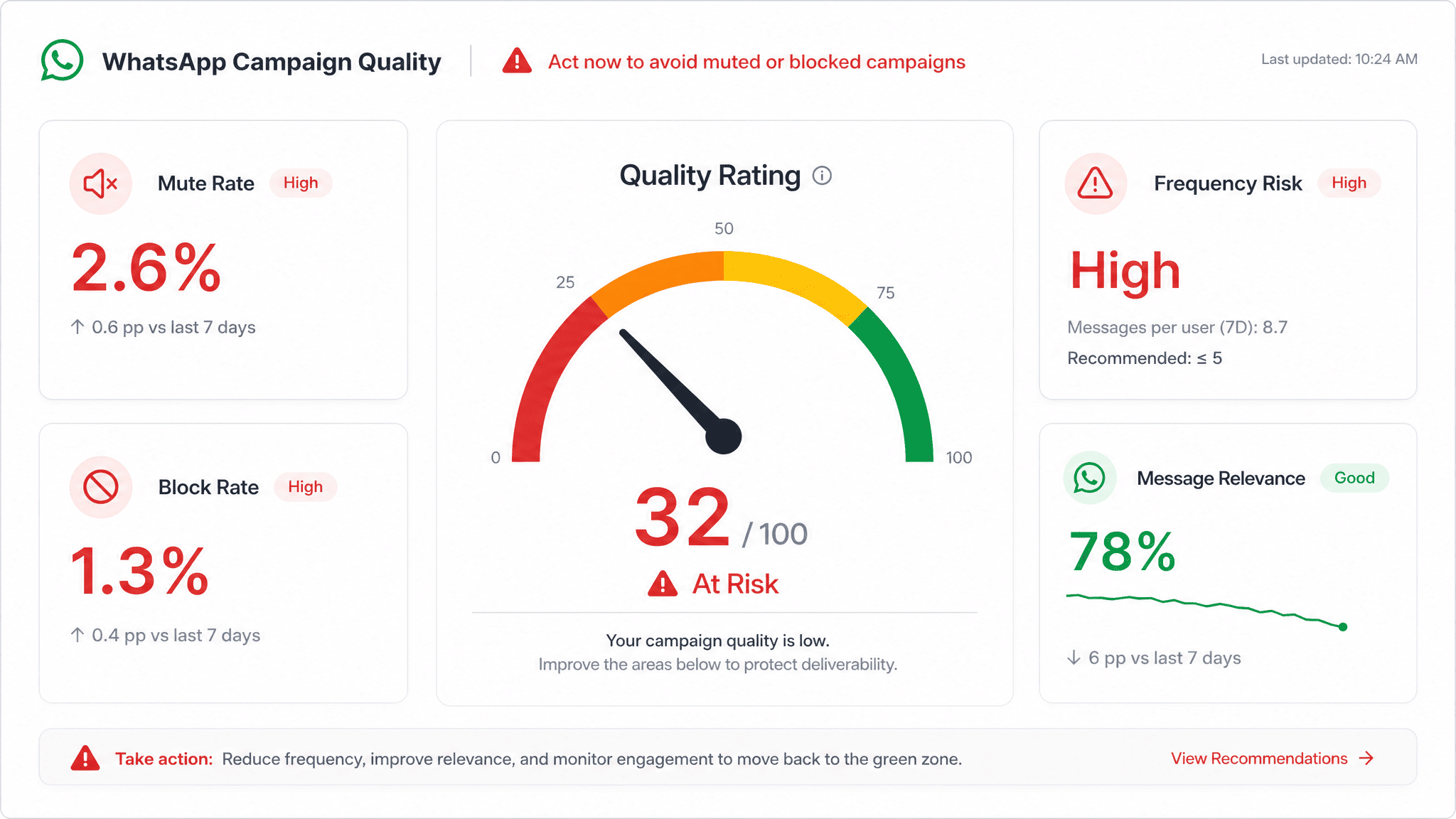
This is the section every enterprise WhatsApp guide skips, and it's the single biggest risk in the channel.
Every WhatsApp Business API number has a hidden quality rating maintained by Meta, classified as Green (high), Yellow (medium), or Red (low).
The rating is influenced by: block rate, mute rate, report rate, and message engagement. Once you fall to Red, your messaging limit gets capped — sometimes overnight — and your account can be suspended.
What pushes a number into Red:
- Sending to non-opted-in contacts
- Sending too frequently to the same audience
- Generic "Hi customer, check out our offers" templates
- Promotional sends through a utility template
- Sending at inappropriate hours
- Lack of clear opt-out instructions
The fix is structural, not tactical. Volume caps, tight segmentation, frequency throttling, and embedded opt-out language in every marketing template. Once a number falls to Red, recovery takes weeks of reduced sending — campaign budgets effectively burn while the number recovers.
Six WhatsApp Campaign Types That Consistently Outperform
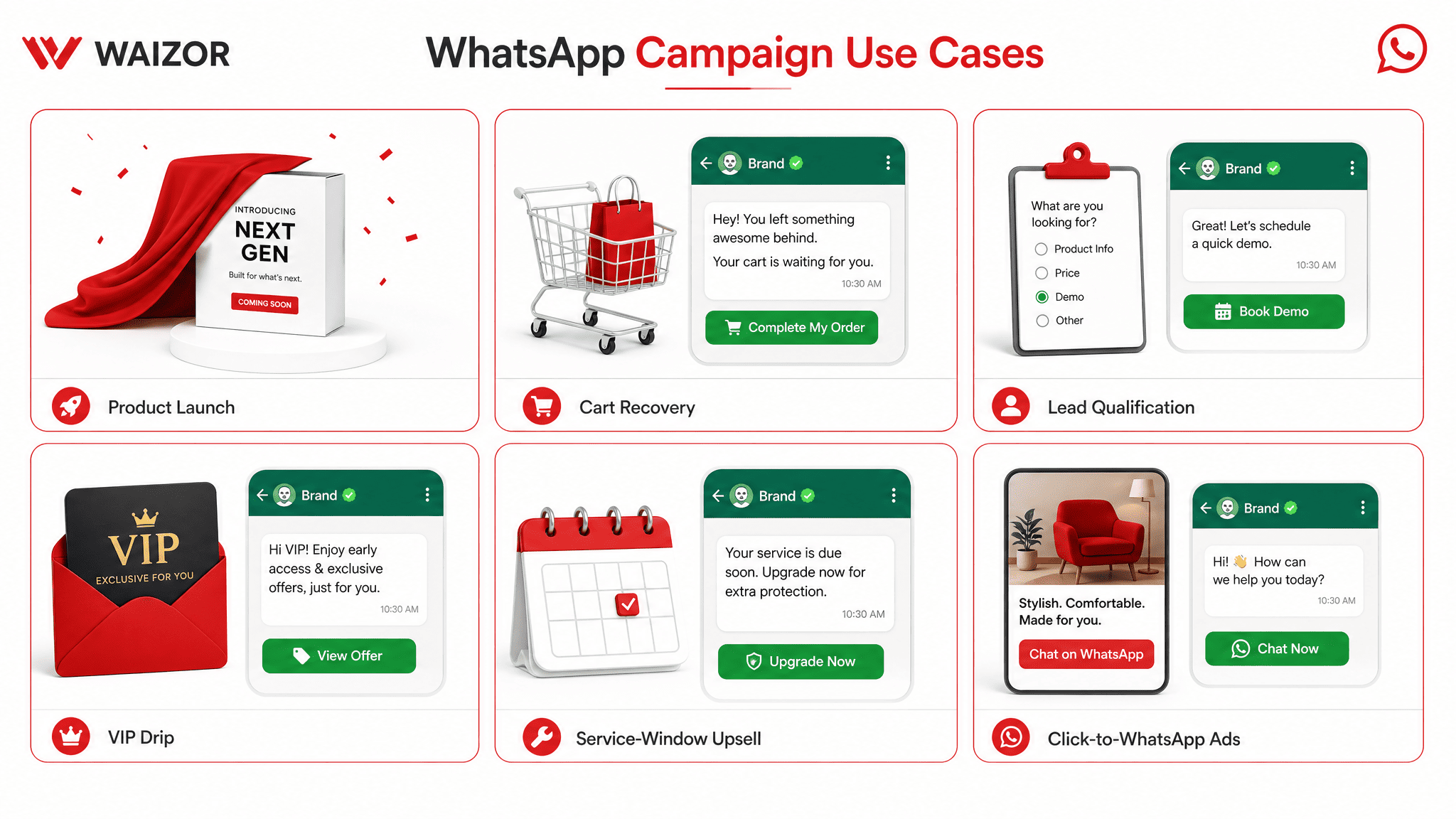
Skip the "50 campaign ideas" lists you've seen elsewhere. These six campaign types account for the majority of measurable WhatsApp ROI in enterprise deployments.
Product Launch Campaign Ideas
Best for: new product/service launches to opted-in audiences.
The structure: a tease 7 days before launch ("Something new is coming for VIPs"), early access 48 hours before public launch, public launch send, and a 24-hour reminder for non-converters. Conversion rates on this structure consistently land 3-5x higher than single-send launch broadcasts.
Cart Abandonment and Re-Engagement Campaigns
Best for: e-commerce, fintech, EdTech, any business with funnel drop-off.
WhatsApp's open rates make it the highest-ROI recovery channel ever built. Cart abandonment recovery on WhatsApp consistently delivers 25-45% recovery rates versus 5-10% on email. The trick is timing: send within 1-3 hours of abandonment, not 24 hours later.
Lead Qualification Campaigns for High-Ticket Sales
Best for: high-ticket sales (real estate, B2B software, financial products).
Instead of broadcasting "Book a demo," send a conversational opener: "Are you looking for [X]? Tell us your top priority and we'll send you the right options." The reply opens a 24-hour service window during which all your messages are free, and an AI bot can qualify the lead in real time.
Recommended Read: WhatsApp Lead Generation Strategies to Capture & Convert
VIP Drip Campaigns for Customer Loyalty
Best for: loyalty programs, premium customer segments.
A VIP drip is a series of 4-6 messages over 30-60 days exclusively to your top customers — early access, behind-the-scenes content, exclusive offers. The objective isn't immediate conversion; it's building a high-engagement segment with a 90%+ read rate that becomes the highest-converting audience in your entire CRM.
Upsell Campaigns Inside the Customer Service Window
Best for: any business with active customer support volume.
When a customer contacts your support team, a 24-hour free messaging window opens. Inside that window, you can send a relevant cross-sell or upsell — "Since you asked about X, here's the matching Y" — at zero messaging cost. This is the most cost-efficient WhatsApp campaign that exists, and almost no one runs it.
Click-to-WhatsApp Ad Campaigns for Lead Generation
Best for: lead generation, event marketing, app installs.
Click-to-WhatsApp ads on Meta platforms open a 72-hour free messaging window. A well-architected campaign drops the entire cost of acquisition messaging to zero, while WhatsApp engagement converts at multiples of landing-page funnels.
What a WhatsApp Campaign Actually Costs in 2026
Meta moved to per-delivered-message pricing on July 1, 2025, with rate revisions in January and April 2026. The current cost structure (verify on Meta's pricing page):
- Marketing messages — range from roughly $0.0094 in India to over $0.124 in Germany. Most expensive category, no volume discounts.
- Utility messages — typically 80-95% cheaper than marketing, with volume discounts
- Authentication messages — lowest cost per delivery, with volume discounts
- Service replies — free within the 24-hour customer-initiated window
For a campaign targeting 100,000 opted-in customers in India with marketing-category messages, total Meta cost lands around $940-1,200 plus BSP platform fees. The same campaign in Germany would cost over $11,000.
WhatsApp Campaign Cost Per Conversion Explained
Cost-per-message is the wrong metric. Cost-per-conversion is the right one.
A poorly-architected campaign that hits 1% conversion at $0.01 per message costs $1 per conversion. A well-architected campaign that hits 8% conversion at the same $0.01 message cost? $0.125 per conversion. That's an 8x difference at identical message spend.
The levers that actually move cost-per-outcome: tighter segmentation, better templates, smarter timing, and architecting around free messaging windows. Those four levers separate enterprises that scale WhatsApp from those who give up after three quarters.
Five Original WhatsApp Campaign Templates You Can Steal
Skip the recycled "Hi {name}, check out our offers" templates floating around every other blog. These five are built around the campaign anatomy above.
Template 1 — VIP Early Access "Hi {{name}}, you're on our VIP list — and the new {{product_category}} drops 48 hours early just for you. Tap below to shop the collection before everyone else. [Shop VIP Access]"
Template 2 — Conversational Lead Qualification "Hi {{name}}, quick question — are you looking at {{property_type}} for end-use or investment? Reply with one word and we'll send the right options. (Takes 10 seconds.)"
Template 3 — Cart Recovery with Personalization "{{name}}, you left {{product_name}} in your cart 2 hours ago. We held it for you, but stock is moving fast. Complete your order in 30 seconds. [Resume Order]"
Template 4 — Re-engagement with a Concrete Hook "Hi {{name}}, it's been a while since we last connected. We've added 3 features you specifically asked about — want a 60-second video walkthrough? Reply YES and we'll send it."
Template 5 — Service-Window Upsell "Glad we could help with {{recent_query}}. Since you're working on {{related_topic}}, our {{related_product}} might save you {{specific_outcome}}. Want a 5-minute overview? [Yes, send it]"
Each one is segment-specific, time-bound, conversational, and built to drive a reply — not just a click.
The Opt-In Problem (and How to Solve It Before You Spend a Rupee on Sends)
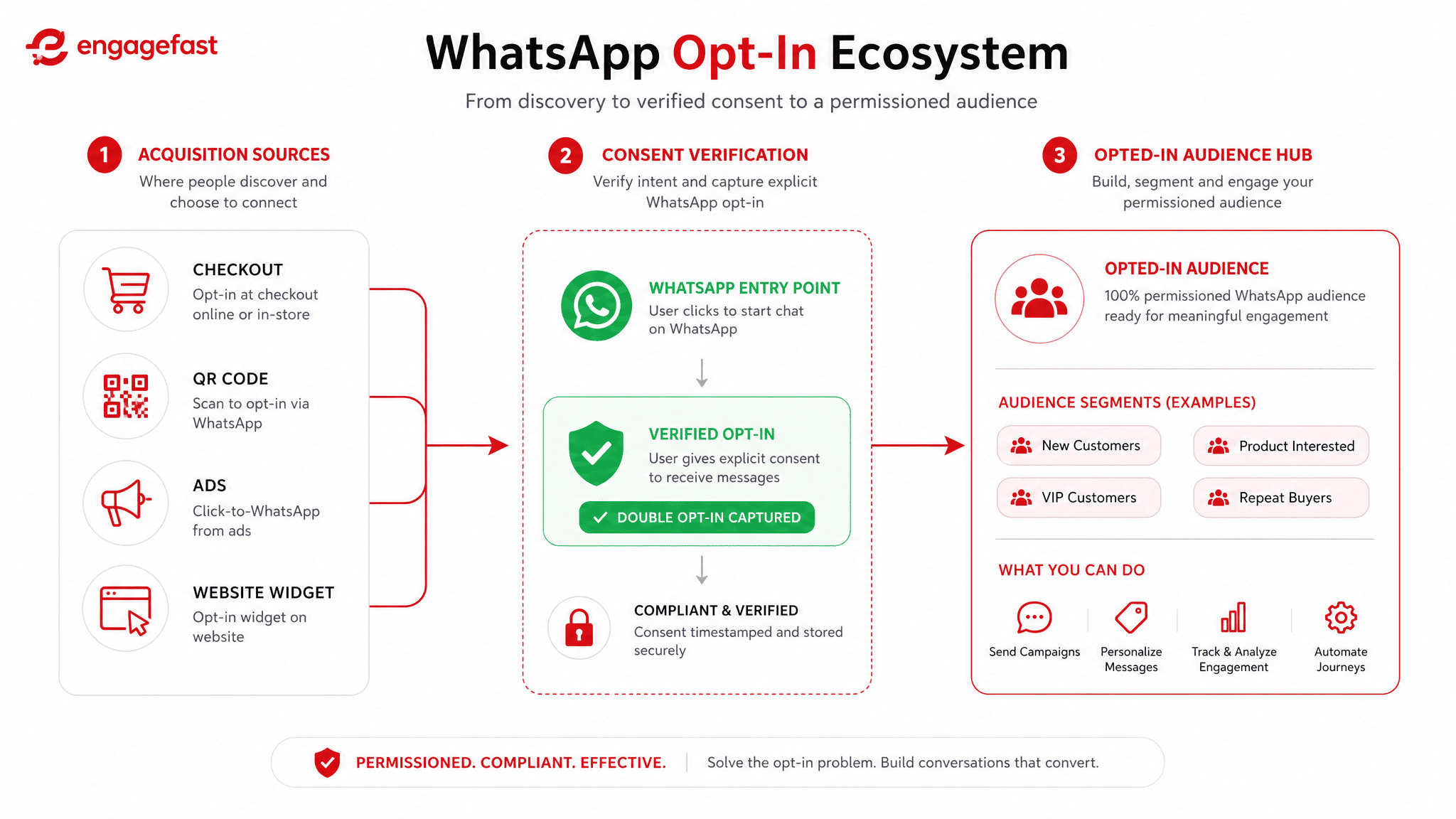
A campaign without an opted-in list is wasted spend at best, a quality-rating disaster at worst. Yet most enterprises start running campaigns before they've architected opt-in capture.
The highest-yield opt-in points:
- Checkout flow — single checkbox at order confirmation, with a clear value statement ("Get order updates and exclusive drops on WhatsApp")
- QR codes — on packaging, in stores, on receipts, leading to a click-to-chat link
- Click-to-WhatsApp ads — opt-in is automatic when the customer initiates the chat
- Website chat widget — capture email and WhatsApp consent in the same flow
- Existing channels — email and SMS subscribers can be migrated with a one-click consent flow
A 50,000-strong opted-in list will outperform a 500,000 unconsented list every single time, at a fraction of the cost and zero quality-rating risk.
Choosing a Platform Built for Campaigns That Convert
The BSP market is crowded with tools built for D2C marketing volumes. Enterprise campaign infrastructure has different demands. Questions that matter:
- Are they an official Meta Business Solution Provider?
- Do they support advanced segmentation (behavioral, transactional, lifecycle)?
- Can they handle template management, approval workflows, and policy-check pre-submission?
- Do they monitor and protect quality rating proactively?
- Do they offer omnichannel fallback (RCS, SMS, email, voice) when WhatsApp delivery fails?
- Do they integrate natively with your CRM, CDP, and commerce stack?
- Can they handle peak-event traffic without throttling?
If the answer to two or more is unclear, the platform won't sustain enterprise campaign volumes.
If you're comparing vendors more broadly, this roundup of WhatsApp marketing software can help frame the evaluation beyond feature checklists.
Why helo.ai Is Built for High-Performance Campaigns
helo.ai is an AI-powered omnichannel CPaaS platform that unifies WhatsApp, RCS, SMS, Email, and Voice in a single stack — purpose-built for enterprises running campaigns at scale. Smart routing automatically falls back to the most reliable channel when WhatsApp delivery fails, so a campaign launch never goes silent.
What sets helo.ai apart for campaigns:
- Advanced segmentation engine — behavioral, transactional, and lifecycle segments out of the box
- AI-powered template optimization — pre-submission policy checks reduce rejection rates
- Quality rating monitoring — proactive alerts before a number falls to Yellow or Red
- Omnichannel orchestration — a single campaign across WhatsApp, RCS, SMS, and email with unified analytics
- Compliance frameworks aligned with global data protection standards
- Enterprise scale with live deployments running campaigns to millions of opted-in customers
Built for the way enterprise campaigns actually run — segmented, personalized, omnichannel, and measurable.
Conclusion
The brands winning on WhatsApp aren't running cleverer campaigns they're running better-architected ones. Tighter segments, sharper offers, smarter templates, response-ready workflows, and an obsessive eye on quality rating. The difference between a campaign that converts at 8% and one that gets muted is rarely the creative. It's the structure underneath. If you're evaluating platforms, the question isn't "what should we send?" — it's "which partner can architect this so every send compounds the value of the next one?" Talk to the helo.ai team, see live high-performance campaign deployments, and walk into your next planning cycle with a campaign engine that actually scales.
FAQs
1. How do you create a WhatsApp campaign that doesn't get muted?
Three rules: send only to opted-in contacts, segment tightly so every message is relevant, and cap frequency to no more than one campaign per customer per week. Add clear opt-out language in every marketing template, and monitor block/mute rates after every send to catch problems before quality rating drops.
2. What are the best WhatsApp campaign ideas for high conversion?
The six that consistently outperform: VIP early-access launches, cart and drop-off recovery, conversational lead qualification, VIP drip sequences, service-window upsells, and Click-to-WhatsApp acquisition campaigns. All six are built around segmentation, conversational format, and free messaging windows.
3. How much does a WhatsApp campaign cost per customer?
Cost varies by destination country and template category. A marketing-category send costs roughly $0.01-0.12 per delivered message in major markets, while utility templates are typically 80-95% cheaper. The metric that matters more is cost-per-conversion — a well-architected campaign at 8% conversion can deliver 8x lower acquisition cost than a poorly-architected one at the same message spend.
4. What are some examples of WhatsApp campaigns that drove real revenue?
The strongest performers across enterprises: cart abandonment recovery campaigns delivering 25-45% recovery rates, VIP early-access drops driving 3-5x conversion versus public launches, conversational lead-qualification campaigns doubling site-visit conversion in real estate, and Click-to-WhatsApp acquisition campaigns cutting CAC by 30-50% in opted-in funnels.
5. WhatsApp broadcast vs campaign — what's the difference?
A broadcast is a single send to a list, with no journey logic. A campaign is a sequence of coordinated sends — pre-launch tease, launch, reminder, follow-up — usually personalized by segment and triggered by behavior. Broadcasts are tactical; campaigns are architectural. Most enterprise WhatsApp ROI lives in the campaign side, not the broadcast side.