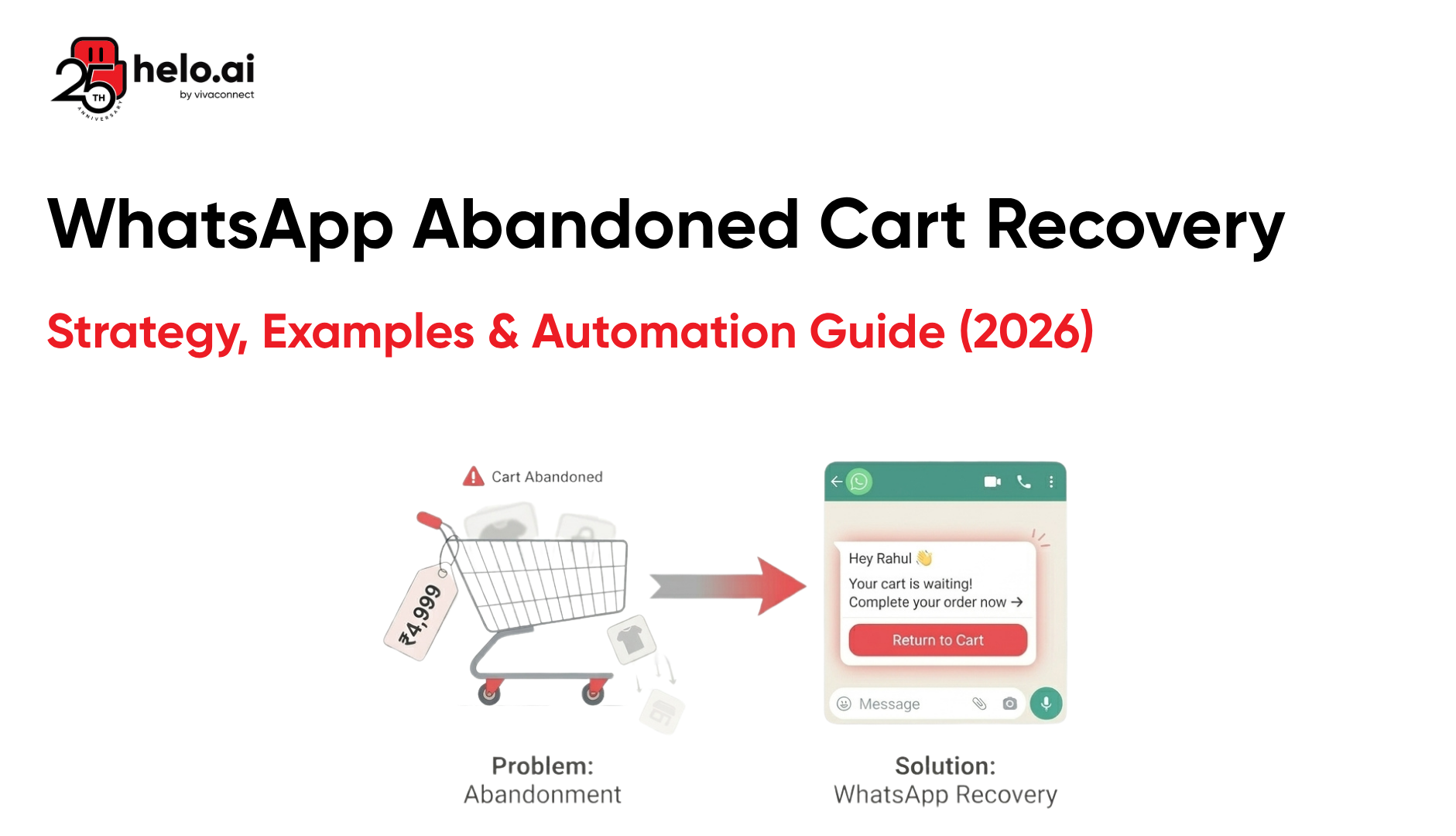


Out of every ten customers, seven fill a cart and leave without completing the purchase. This is known as cart abandonment and it is one of the biggest revenue leaks in ecommerce.
Customers browse, compare, and even select products, but something interrupts the journey. It could be unexpected shipping costs, distractions, or simple hesitation. The intent to buy is already there but the follow-up is missing.
This is where WhatsApp abandoned cart recovery becomes powerful.
Instead of relying on emails that often go unread, businesses can use WhatsApp to reconnect with customers instantly, bring them back to their cart, and complete the purchase with timely, personalized messages.
Emails Lose This Battle
Businesses try to recover abandoned carts with email reminders. They're familiar and easy to automate. The problem is they're largely ignored. Email open rates average around 20-21%, meaning roughly four out of every five recovery emails never get read. All the work put into the design, the coupon codes, the product images left unseen.
WhatsApp open rates sit at 98%. That is not a small difference. It's a different category of attention altogether.
Your customers are already on WhatsApp for a good chunk of their day, talking to friends, colleagues, and family. It is a familiar, personal space. Messages there are not left unseen for long. Businesses using WhatsApp for cart recovery commonly report recovering anywhere between 15% to 45% of abandoned carts, with well-structured sequences performing at the higher end.
Why do customers abandon their carts?
Understanding why customers abandon their carts is the first step to recovering them effectively. In most cases, the problem is not the product, it's friction in the buying journey.
Here are the most common reasons behind cart abandonment:
- Unexpected extra costs: High shipping fees, taxes, or hidden charges at checkout often push customers away at the last moment.
- Complicated checkout process: Long forms, forced account creation, or too many steps can frustrate users and cause drop-offs.
- Just browsing behavior: Many users explore products without immediate intent to buy, especially on mobile.
- Lack of trust: Missing reviews, unclear return policies, or payment concerns can make customers hesitate.
- Price comparison: Customers may leave to compare prices on other websites before making a final decision.
- Distractions: Notifications, calls, or switching apps can interrupt the purchase journey, especially on mobile devices.
- Limited urgency: If there is no time-bound offer or scarcity, users feel no pressure to complete the purchase.
Cart abandonment is not always a lost sale, it is often a delayed decision. With the right follow-up strategy, businesses can bring these customers back and convert them.
WhatsApp vs Email vs SMS for abandoned cart recovery
Choosing the right channel plays a major role in how effectively you recover abandoned carts. While email and SMS have traditionally been used, WhatsApp is emerging as the most effective channel due to its engagement and real-time nature.
Here’s a quick comparison:
Channel | Open Rate | Engagement Level | Personalization | Conversion Potential |
20–25% | Low | Medium | Low | |
SMS | 90%+ | Medium | Low | Medium |
Up to 98% | High | High | High |
To understand how brands use this effectively, explore these WhatsApp marketing strategies
Why WhatsApp outperforms other channels
- More visible than email: Emails often get buried in inboxes or promotions tabs, while WhatsApp messages are seen almost instantly.
- More interactive than SMS: SMS is one-way communication, while WhatsApp allows real conversations, quick replies, and customer support.
- More personal and trusted: WhatsApp feels like a native messaging experience, making customers more comfortable engaging with brands.
- Supports rich experiences: Unlike SMS, WhatsApp supports images, videos, buttons, and direct checkout links.
- Better for automation journeys: With WhatsApp Business API, you can create full customer journeys, not just one-time reminders.
While email and SMS still have their place, WhatsApp provides the best balance of visibility, engagement, and conversion for abandoned cart recovery.
The Recovery Sequence That Actually Works
A single reminder doesn't crack the code. Effective WhatsApp cart recovery works as a sequence, each message sent with a specific purpose, at the right moment, without crossing into spam territory.
Here is how it works:
Within a few hours: The Gentle Reminder
The customer has not forgotten the cart yet. They have recently invested their time into browsing, comparing and choosing. A gentle nudge is enough to bring them back at this stage. Keep it warm, keep it simple.
After 24 hours: The Value Message
If the first reminder did not convert, you probably need to sell the product a little more. Mention benefits that make it a good deal, share strong reviews, show that it is a popular purchase. Make them feel their choice was the right one.
After 48 hours: The Incentive
Now introduce a discount or an offer. Do not do this too early though. Customers can become habitual of abandoning carts if they learn a discount always follows. Wait, then reward.
After a week: The Deadline
If the lead has still not converted, introduce a deadline. A discount valid for only 24 hours creates a sense of urgency that interested customers do not ignore.
Real-world use cases of WhatsApp cart recovery
WhatsApp cart recovery is not limited to one type of business. Different industries use it in different ways based on customer behavior and buying patterns.
Here’s how it works in real scenarios:
Electronics & High-value products
Customers take more time to decide due to higher pricing and comparison behavior. This is common across marketplaces and premium product brands where users evaluate multiple options before purchasing.
Use case:
A user adds a smartphone to cart but leaves to compare prices across platforms.
- After 3–4 hours: Reminder message with product link
- After 24 hours: Key features, reviews, and comparison highlights
- After 48 hours: Offer like no-cost EMI, warranty, or limited-time deal
👉 Result: Conversion improves when trust, clarity, and value are reinforced during the decision-making phase
Beauty & Personal Care
Customers in this category are heavily influenced by reviews, recommendations, and social proof. Many leading D2C brands focus on building trust before pushing conversion.
Use case:
A user adds skincare products but does not complete checkout.
- After a few hours: Reminder message
- After 24 hours: Customer reviews or “most loved products” messaging
- After 48 hours: Bundle offer, discount, or limited-time deal
👉 Result: Social proof and reassurance significantly improve conversion rates
Grocery & Quick Commerce
In quick commerce, abandonment is often due to interruptions rather than lack of intent. Speed of follow-up becomes critical.
Use case:
A user adds items but leaves due to a call or app switch.
- After 1 hour: Quick reminder
- Within the same day: “Your items are still available” message
👉 Result: Fast recovery due to high intent and immediate engagement
Automotive (High-intent inquiry recovery)
High-value purchases like vehicles involve longer decision cycles, where users often drop off before completing an inquiry.
Use case:
At Shri Ram Auto Mall, users frequently explored vehicles and showed interest but did not complete the inquiry process.
- Instant WhatsApp reminders were triggered after drop-off
- Follow-up messages included vehicle details and trust signals
- Timely nudges encouraged users to return and complete their inquiry
👉 Result: Faster engagement with high-intent users and improved inquiry completion rates
WhatsApp Cart Recovery Message Templates
As important as it is to know when to say something to your customers, if you want to bring them back to their abandoned carts, what you say matters equally. Here's an example of four templates for each stage that can do wonders for your business.
“Hey [Name], the items you chose are just one click away. Your cart is waiting! [Link]"
"Great choice [Name]. The [Product Name] in your cart is doing amazingly well, customers are loving it and it is selling fast. Order now before it runs out: [Link]"
"Hey [Name], your cart comes with a special offer today. Here is your deal: [Link]"
"Hi [Name], your favourite items are at 20% off for the next 24 hours only. Grab them now: [Link]"
Whatsapp Automation Guide
It is essential businesses know how to send automated messages on WhatsApp without manual input. This means separating customers based on time, preferences and age groups, handling their queries accordingly and designing message content that suits them.
Businesses can do this well with the help of tools, chatbots and APIs. Like using the WhatsApp Business App for basic tasks, or the WhatsApp Business API for advanced automated workflows like CRM integration and bulk messaging.
There are different types of automation available for your business including greetings, reminders, bulk messaging and chatbots.
Some tools worth knowing:
WhatsApp Business App: Free, suited for small businesses to set up quick replies and away messages.
WhatsApp Business API: A better option for medium to large businesses that need to scale.
Third Party Platforms: Platforms like Helo.ai help in creation of chatbots, automated sequences and handling customer conversations from one place.
There are plenty of reasons why WhatsApp automation works well for businesses. Your customers can have their queries resolved any time of the day, at their own convenience. When executed well, this alone makes the customer experience significantly better. Within a business it saves manual work, helping employees focus on more complex situations instead.
If setting this up feels complex, platforms like Helo.ai handle the entire automation infrastructure so your team can focus on the strategy.
Best Practices for WhatsApp Cart Recovery
When using automation messages for abandoned carts, businesses must be well aware of and careful about the right practices. To make sure your business remains trustworthy and your customer experience stays above par, keep these practices in mind.
Maintaining trust: Always send automated messages only to those customers that have opted for it. This ensures that the business is not blocked and messages fall under WhatsApp policies.
Use attention catching media: In order to increase the chances of customers engaging with your automated messages, make sure to add interactive media, images, videos, links and rich posters to catch attention and ensure that customers interact with the messages.
Integrate with CRM: Connecting WhatsApp Business API with CRM helps segment your customers and messages can be automated accordingly.
Conscious time frames: Send your automated messages in carefully examined and thought through time gaps to make sure customers do not see them as spam and the messages find them at a different mental space each time.
Following these practices will make sure your WhatsApp automation is functioning well and can bring in great recovery results for the abandoned cart issue.
A lot of businesses miss out on some of the easiest sales out there. If a person spends time going through your website and products, the toughest part is already done. A gentle, strategic nudge can close the sale from there. If you time that nudge carefully, use WhatsApp as your most reliable channel and craft your messages thoughtfully, a lot of abandoned carts will turn into sold products.
Be wise, choose the right tools. Helo.ai's WhatsApp Business solution helps you build and automate the entire recovery sequence, so none of those almost-sales slip away again.
Common mistakes in WhatsApp cart recovery
While WhatsApp can significantly improve cart recovery rates, many businesses fail to get results because of poor execution. Avoiding these common mistakes can make a major difference in your conversion performance.
1. Sending messages without proper opt-in
One of the biggest mistakes is messaging users without their consent. This not only violates WhatsApp policies but can also lead to your number being flagged or blocked.
👉 Always collect explicit user opt-in before sending recovery messages.
2. Sending messages too frequently
Over-messaging can quickly turn a high-intent user into an annoyed one. If customers receive too many reminders in a short span, they may ignore or block your business.
👉 Stick to a structured sequence with clear time gaps instead of aggressive follow-ups.
3. Using generic, non-personalized messages
Messages like “Complete your purchase” without context feel robotic and are easy to ignore.
👉 Include customer name, product details, and relevant messaging to make it feel personal and meaningful.
4. Offering discounts too early
Many businesses send discount codes in the first message itself. This trains customers to abandon carts intentionally and wait for offers.
👉 Build value first, introduce incentives later in the sequence.
5. Ignoring conversation and only pushing reminders
WhatsApp is a conversational channel, not just a notification tool. Businesses that only send reminders miss the opportunity to engage.
👉 Allow users to reply, ask questions, and get instant support within the chat.
6. Not optimizing message timing
Sending messages too late reduces conversion chances, while sending them too early can feel intrusive.
👉 Timing should match user intent — early reminders for fresh intent, later messages for persuasion.
7. No clear call-to-action (CTA)
If your message does not clearly guide the user on what to do next, conversions will drop.
👉 Always include a clear action like “Complete your order” or “Return to your cart.”
8. Not tracking performance or optimizing
Many businesses set up automation once and never optimize it based on results.
👉 Track open rates, click rates, and conversion rates to continuously improve your recovery flow.
Avoiding these mistakes ensures your WhatsApp cart recovery strategy stays effective, compliant, and conversion-focused.
FAQs
What is an abandoned cart and how do you recover it?
When your customers take time to browse through and choose your products, add them to the cart but do not go through with the "Buy Now" button, it becomes a situation of an abandoned cart. This is an "almost sold" scenario and it is important to learn how to address it best. WhatsApp recovery messages work best for this situation. Customised, well thought nudges on WhatsApp can help your business significantly by directing customers back to the items they picked and urging them to complete the process.
How does WhatsApp automation work?
Through the WhatsApp Business App, CRM or third party tools like Helo.ai, you can customise messages to reach your customers at the right intervals without manual labour, giving your employees time and space to focus on higher priority tasks. These automated messages help significantly in cart recovery by convincing your customers to visit their cart again.
What are the best ways to use WhatsApp automation messages?
It is important to send automation messages at thoughtful intervals so customers do not find them spammy and block the business completely. Make sure all messages follow WhatsApp policies. Craft messages according to each customer's needs and make support available 24/7.