



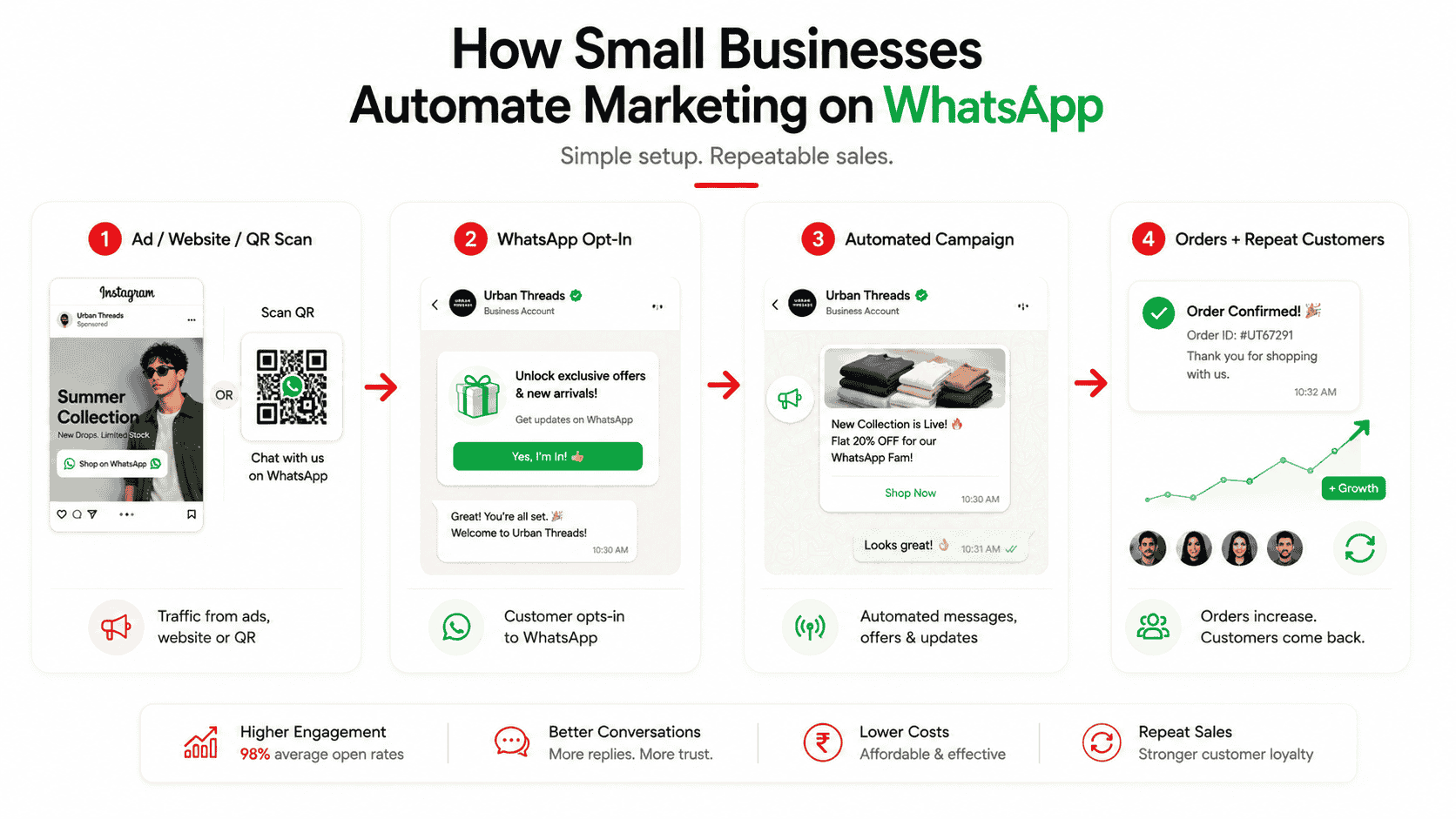
Small businesses do not always struggle because they lack products. Many struggle because staying visible takes time, money, and constant effort. Ads cost money. Social media needs consistency. Email often goes unread.
WhatsApp changes some of that. Your customers are already there.
WhatsApp has over 3 billion users globally. In India, it is one of the most used apps every day. More than one billion people message businesses on WhatsApp every week, and WhatsApp Business drives 89% higher purchases per user compared to other marketing channels.
For small businesses, that matters. Because marketing becomes easier when you do not have to pull customers somewhere else. You can reach them where conversations are already happening.
Free vs Paid: What Actually Changes?
Most small businesses start with the free WhatsApp Business App. And honestly, it does a lot more than people expect. You can create a business profile, add products and services to a catalog, organise contacts with labels, send broadcasts, use quick replies, post Status updates, and run basic campaigns.
For many businesses, that is enough in the beginning. The challenge starts later. The contact list grows. More customers message. Follow-ups become manual. Conversations start piling up. That is usually when businesses realise the free app has limits.
Broadcast lists stay capped. There is no automation. No chatbots. No CRM integration. And every follow-up depends on someone manually doing the work. The WhatsApp Business API solves that.
It is built for businesses managing larger volumes of conversations and gives access to automation, chatbots, CRM integrations, analytics, and multi-agent support. For small businesses, the move to the API usually does not happen because they want more features.
It happens because manual work starts getting in the way.
5 Zero-Budget WhatsApp Marketing Tactics
You do not need a budget to start with WhatsApp marketing. The free WhatsApp Business App already gives small businesses enough to start building visibility, staying connected with customers, and driving repeat purchases. The value usually comes from using these features consistently rather than adding more tools.
1. WhatsApp Status Updates
Most small businesses already post on Instagram. Far fewer use WhatsApp Status consistently.
That is interesting because Status reaches people who already know your business. These are existing customers, past buyers, leads, people who have saved your number. The audience is already warm.
Status works well for daily offers, new arrivals, behind-the-scenes content, customer reviews, and limited-time promotions. Since it disappears after 24 hours, it also creates natural urgency.
For businesses trying to stay visible without spending on ads, this is one of the easiest places to start.
2. Catalog Shares
Customers usually have the same questions before buying. What is available? How much does it cost? Which options do you have?
The WhatsApp catalog answers many of these questions upfront.
Customers can browse products or services directly inside the app and continue the conversation immediately. For product businesses especially, this reduces back-and-forth and shortens the path from enquiry to purchase.
A bakery can list weekly specials. A boutique can showcase new arrivals. Service businesses can display packages and pricing.
3. Broadcast Lists
Broadcasts are where many businesses begin their WhatsApp marketing journey. The feature itself is simple. The challenge is relevance.
Sending the same message to every contact rarely works. A new lead, a repeat customer, and someone who has not purchased in months are all in different stages.
The businesses that see better results usually segment first and send later. One relevant message often performs better than multiple generic broadcasts.
4. Quick Replies
Small businesses spend a surprising amount of time answering the same questions every day.
Pricing. Availability. Delivery timelines. Booking confirmations. Quick replies help reduce that manual work by saving commonly used responses and making them reusable. It saves time, keeps communication consistent, and helps customers get faster answers.
5. Referral Messages
Referrals already drive growth for many small businesses. WhatsApp simply gives businesses an easier way to encourage them.
A message asking customers to share a catalog, refer a friend, or pass an offer to someone else costs nothing. Adding a small incentive like a discount, loyalty reward, or freebie can increase participation further.
How to Segment Your Contacts with WhatsApp Labels
Labels are one of the most underused features in the WhatsApp Business App.
They help organise contacts and make it easier to send relevant messages without using any paid tools. And for small businesses, that matters because not every customer should receive the same communication.
A customer who has just discovered your business is very different from someone who purchases every month. Sending both the same message is usually a missed opportunity.
A simple labelling system can look like this:
New Lead — Someone who has just messaged you for the first time. They usually need information, product details, and a reason to buy.
Paid Customer — Someone who has completed at least one purchase. This group works well for updates, cross-sell opportunities, and loyalty campaigns.
Repeat Customer — Customers who come back more than once. These are the people who already trust your business and often respond well to early access, personalised offers, and rewards.
Lapsed Customer — Someone who has not engaged or purchased in the last 30 to 60 days. They usually need a re-engagement message rather than another promotional broadcast.
Once labels are in place, broadcasts become more targeted.
And usually, one relevant message performs better than sending the same update to everyone.
How to Write WhatsApp Messages That Do Not Get Ignored
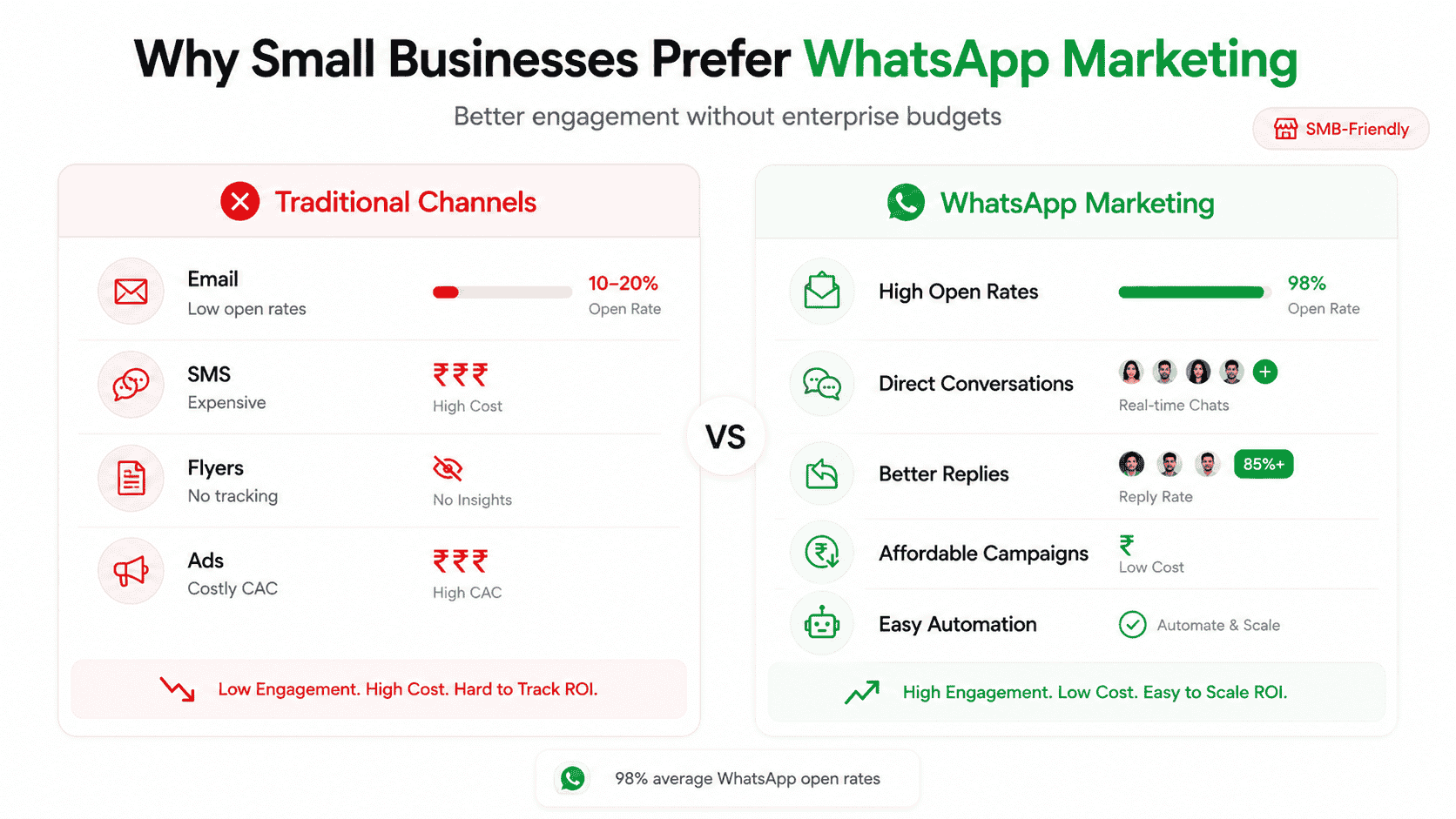
WhatsApp has a 98% open rate. But open rate and response rate are not the same thing. A customer may open the message. Whether they read it, respond to it, or act on it depends on how the message is written.
Keep it short. Most WhatsApp marketing messages do not need more than two to four lines. If the message is becoming long, there is usually too much happening in it. Get to the point early. Customers should understand the offer, update, or purpose within the first line itself.
The next step should also be clear.
Reply YES. Tap the link. Show this message. Call us.
One message works best when it has one action. Timing matters too.
For many small businesses, mornings between 9–11 AM and evenings between 6–9 PM tend to perform better because customers are more active during these hours. And frequency matters just as much.
One or two messages a week is usually a good starting point. Sending more does not always improve results. Sometimes it only increases block rates.
For example:
"Hi [Name], our weekend special is live. Buy one get one on all [product] today and tomorrow. Reply to order or tap here: [link]."
It is short, clear, and gives the customer one thing to do next.
WhatsApp Catalog Setup: Sell Directly From the Chat
The WhatsApp catalog acts like a storefront
For small businesses, that matters because customers do not need to move to another platform just to see products or services. They can browse and continue the conversation in the same place. Setting it up is simple.
Go to WhatsApp Business App → Business Tools → Catalog and add products or services with images, pricing, descriptions, and relevant details.
Once the catalog is live, customers can browse directly inside the chat.
A bakery can list weekly specials and pre-order options. A boutique can showcase new arrivals with prices and size details. A service business can display packages, pricing, and consultation options.
The catalog does not replace a website. But for many small businesses, it reduces friction because customers can move from discovery to conversation and purchase without leaving WhatsApp. It also cuts down repetitive questions because information is already available upfront.
Mistakes Small Businesses Make on WhatsApp (And How to Fix Them)
Small businesses usually do not struggle with WhatsApp because the platform is difficult. The problem often starts when it gets treated like every other marketing channel.
WhatsApp is more personal. Customers open it expecting conversations and updates, not constant promotions. When that balance shifts, engagement usually drops.
Some of the most common mistakes include:
- Using a personal number for marketing. A personal number works in the beginning, but it becomes difficult to manage as conversations grow. A WhatsApp Business profile gives access to catalogs, labels, broadcasts, quick replies, and creates a more professional presence.
- Sending messages without opt-ins. Just because someone messaged once does not mean they signed up for marketing communication. Customers should know they are opting in to offers or updates. Even a simple message like “Reply YES to receive weekly offers and updates” works.
- Broadcasting too often. More messages do not automatically mean more results. For many small businesses, one or two campaigns a week is enough to stay visible without becoming repetitive.
- Sending the same message to everyone. A first-time customer and a repeat buyer are in different stages. One may need information while the other may respond better to loyalty offers or personalised campaigns.
- Not having a clear call to action. Customers should know what to do next. Reply to order. Book now. Tap here. Show this message. Small changes like this make messages easier to act on.

.png&w=828&q=75)