


Most of the time, for education institutes, the issue isn’t teaching. It’s communication.
Admissions teams still manage leads across spreadsheets and scattered follow-ups. Parents miss fee reminders. Students don’t see exam updates or class changes because the message gets buried somewhere.
And slowly, it starts affecting everything. Admissions slow down. Payments get delayed. Students lose track of schedules. Some just stop engaging midway.
The bigger change is in how people communicate now. Most students and parents don’t regularly check portals or emails anymore. They respond faster to messages that reach them where they already spend time.
That’s why many schools, coaching institutes, and EdTech companies are shifting communication to WhatsApp. Not as another channel to manage, but as the place where updates, reminders, and replies are actually seen.
What WhatsApp Business API Means for Education
The WhatsApp Business API is very different from the regular WhatsApp Business app most small businesses use.
The app works when communication is still small and manageable. But once schools, coaching institutes, or EdTech platforms start handling hundreds of students, manual replies and follow-ups quickly become difficult to manage.
That’s where the API becomes useful.
It helps institutions automate communication on WhatsApp and connect it with the systems they already use, like CRMs, LMS platforms, admission portals, or student databases.
So instead of teams manually sending every update:
● students can automatically get exam reminders
● parents can receive fee alerts on time
● admission updates can go instantly
● common questions can be answered automatically
It also allows multiple team members to handle conversations from the same WhatsApp number, which is useful for admissions and support teams.
The difference mostly comes down to scale. The regular WhatsApp Business app is built for smaller, manual communication. The API is built for larger student communication systems where speed, automation, and consistency matter more.
Core Use Cases of WhatsApp Business API in Education
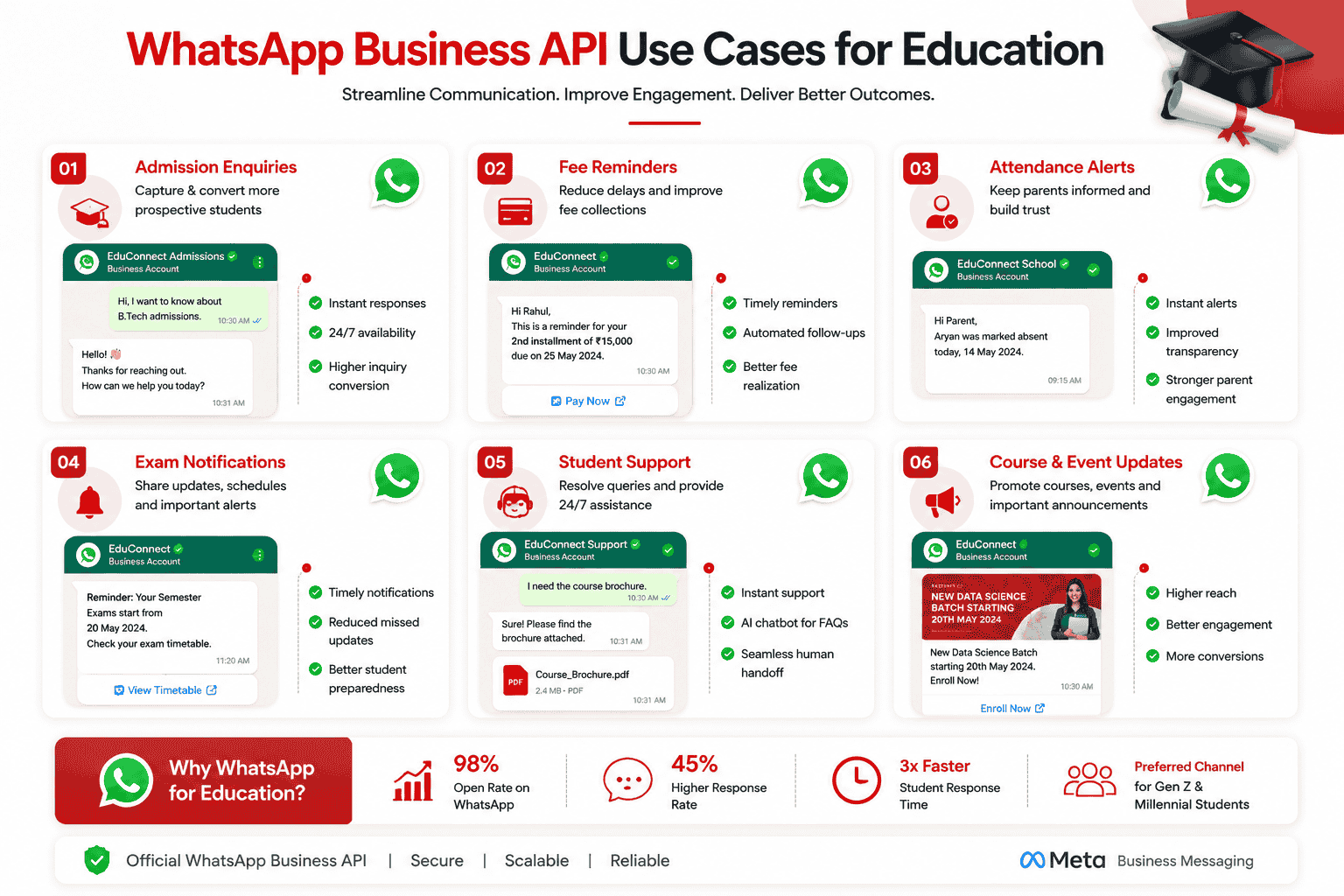
Schools, colleges, coaching institutes, and EdTech platforms are already using the WhatsApp Business API for education across different parts of student communication.
For some institutions, it starts with admissions. Others use it more for reminders, support, onboarding, or parent communication. Over time, it usually becomes part of everyday operations because teams no longer have to manage every update manually.
Here are some of the most common ways educational institutions are using it today.
1. Admissions Communication
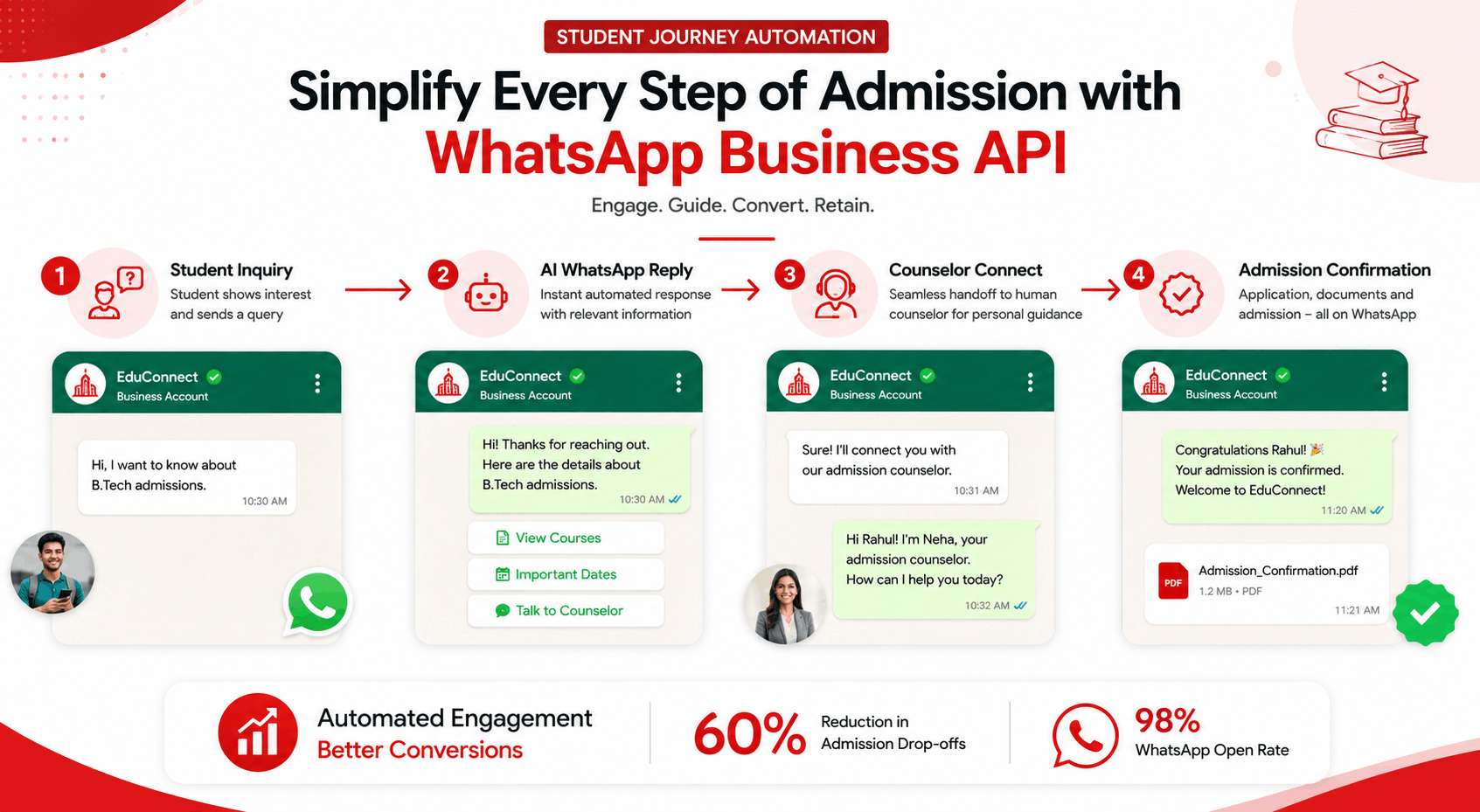
Admissions teams usually handle a huge number of repetitive queries every day. Students ask for course details, application links, fee information, scholarship updates, and deadlines, often across different channels.
With the WhatsApp API for schools and colleges, a lot of these updates can be automated. Students can receive:
● automated admission notifications
● application status updates
● brochure links
● deadline reminders
● follow-ups for incomplete forms
This makes WhatsApp for admission management much easier to handle, especially during peak admission periods when teams are dealing with hundreds of inquiries at once.
2. Student Onboarding
Once enrollment is complete, institutions still need to share a lot of information quickly. That usually includes:
● LMS login details
● orientation schedules
● class timings
● joining instructions
● support contacts
Many institutions now use student onboarding automation through WhatsApp so students receive these updates immediately after enrollment instead of waiting for separate emails or calls.
This becomes especially useful for online coaching platforms and EdTech companies managing remote learners across different locations.
3. Academic Updates & Student Communication
Daily academic communication becomes harder to manage as student numbers grow. Schools and universities regularly need to send:
● class schedule notifications
● assignment reminders
● exam reminder via WhatsApp
● attendance updates
● holiday announcements
Using the WhatsApp API for student communication helps institutions send these updates faster without depending entirely on portals or manual follow-ups.
Some institutions also use bulk WhatsApp messages for students when important announcements need to reach large batches quickly.
4. Student Engagement for EdTech Platforms
For EdTech companies, communication continues long after enrollment.
Students still need reminders for:
● live classes
● assignment deadlines
● upcoming sessions
● course progress
● inactive learning periods
This is where WhatsApp for EdTech companies becomes useful beyond just support or admissions.
Many platforms use WhatsApp broadcasts for students to keep learners engaged throughout the course instead of losing them midway because communication slowed down.
5. Fee Reminders & Administrative Updates
Administrative teams spend a lot of time following up on pending payments and routine updates.
With educational institute WhatsApp automation, reminders can be scheduled in advance so parents and students receive updates on time.
This usually includes:
● student fee reminder WhatsApp messages
● payment confirmations
● due date alerts
● receipt acknowledgements
It reduces repetitive follow-ups for admin teams while keeping communication more consistent.
6. Parent Communication
For schools especially, parent communication is constant throughout the academic year.
Attendance alerts, PTM reminders, performance updates, and school notices all need to be shared regularly. Managing this manually across different classes and departments becomes difficult very quickly.
That’s why many schools now use WhatsApp as a parent-teacher communication app alongside their existing systems.
It keeps updates faster, simpler, and easier for parents to access without logging into separate portals every time.
WhatsApp Chatbots and Conversational AI in Education
As student queries increase, handling everything manually starts becoming difficult for admissions and support teams.
Students usually reach out for simple updates throughout the day:
● Admission status updates are one of the most common queries.
● Many parents ask about fee details and payment deadlines.
● Students regularly check for class timing or schedule changes.
● Exam dates and assessment updates create frequent support queries.
● Certificate and document requests are also common.
● New inquiries often ask for course and enrollment details.
That’s why many institutions now use a WhatsApp chatbot for education to handle these repetitive conversations automatically.
Instead of waiting for manual replies, students can get instant responses directly on WhatsApp. Teams can manage a much higher volume of student queries without constant back-and-forth.
Some institutions also use conversational AI in education to make replies more personalised based on the student’s course, application stage, or previous activity.
For example:
● Students can instantly get answers to common admission queries.
● Coaching institutes can automate batch timing and class link updates.
● Universities can share exam schedules without manual follow-ups.
● EdTech platforms can send course progress reminders automatically.
WhatsApp API Integration with LMS and Student Systems
Most schools, colleges, and EdTech platforms already use different systems for admissions, learning, attendance, and payments. The problem is that communication still ends up happening manually in between them.
With WhatsApp LMS integration, institutions can connect these systems directly to WhatsApp and automate updates as students move through different stages.
This can include:
● assignment reminders from the LMS
● onboarding messages after enrollment
● class links before live sessions
● attendance or progress updates
● payment confirmations and fee reminders
For many EdTech platforms and WhatsApp API for online coaching setups, this makes communication easier to manage at scale. Instead of teams manually sending every update, messages can go automatically based on student activity inside the system.
Benefits of WhatsApp Business API for Education
Schools, colleges, coaching institutes, and EdTech platforms are using WhatsApp for much more than basic messaging now. It has become part of admissions, student support, onboarding, reminders, and everyday communication.
Here are some of the biggest benefits institutions are seeing from it.
1. Students and Parents Get Updates Faster
Admissions and support teams can respond much faster without manually handling every query. Students get updates instantly, and parents don’t have to wait for callbacks or emails.
2. Fewer Missed Updates
Important updates like exam reminders, fee deadlines, class schedule notifications, and onboarding details are much less likely to get ignored on WhatsApp compared to emails or portals.
3. Easier Admission Management
With automated admission notifications and follow-up messages, institutions can manage inquiries more efficiently and reduce delays during the admission process.
4. Less Repetitive Work for Teams
A lot of routine communication can be automated. Support teams spend less time answering the same questions repeatedly throughout the day.
5. Better Student Engagement
For WhatsApp for EdTech companies and online coaching platforms, regular reminders and progress updates help students stay active throughout the course instead of slowly dropping off.
6. Simpler Parent Communication
Schools can share attendance alerts, meeting reminders, fee updates, and notices more consistently without depending entirely on manual calls or messages.
7. Large Student Groups Become Easier to Handle
Educational institute WhatsApp automation helps institutions manage communication across large student groups without everything becoming difficult to track.
Challenges and Common Mistakes to Avoid
A lot of institutions start using WhatsApp automation expecting communication to suddenly become smoother. But if it’s not managed properly, it can easily become just another place where students start ignoring updates.
Some common mistakes show up very quickly.
1. Sending Too Many Messages
Students already get flooded with notifications every day. If every small update turns into a WhatsApp message, people eventually stop paying attention to them.
2. Sending the Same Message to Everyone
Not every student needs the same communication. Generic bulk WhatsApp messages for students usually feel irrelevant, especially when updates are not linked to their course, class, or application stage.
3. Depending Completely on Automation
A chatbot can handle common questions, but students still need real support for important issues. Delayed human responses usually create more frustration than the original problem.
4. Poorly Managed Reminder Flows
Repeated reminders, badly timed notifications, or too many follow-ups can quickly start feeling spammy instead of helpful.
5. Ignoring WhatsApp Policies
Institutions still need proper opt-ins before sending regular updates. Ignoring WhatsApp rules can affect message delivery and account quality over time.
The goal is not to automate every single conversation. It’s to make communication easier to manage without overwhelming students and parents in the process.
FAQs
1. How can schools and educational institutions use WhatsApp Business API?
Most institutions use the WhatsApp Business API for education for things like admission updates, exam reminders, fee notifications, onboarding messages, student support, and parent communication.
2. Is WhatsApp Business API free for educational institutes?
No. The API works on a paid model. Costs usually depend on the platform provider and the number of conversations happening on WhatsApp.
3. How can institutions send bulk WhatsApp messages to students without getting blocked?
Institutions need proper student or parent opt-ins before sending regular updates. Messages also need to follow WhatsApp’s guidelines instead of sending random promotional broadcasts.
4. Can WhatsApp API integrate with LMS platforms like Moodle or LearnDash?
Yes. Many institutions use WhatsApp LMS integration with platforms like Moodle, LearnDash, or custom student portals to automate reminders, onboarding updates, and course communication.
5. What is the difference between WhatsApp Business App and WhatsApp Business API for schools?
The regular app works better for smaller-scale communication. The WhatsApp API for schools is more useful when institutions need automation, integrations, shared team access, and large-scale student communication.
6. How can EdTech companies use WhatsApp to reduce admission drop-offs?
A lot of admission drop-offs happen because replies and follow-ups take too long. WhatsApp helps EdTech companies send faster responses, automated admission notifications, and reminder messages while students are still actively interested.
Conclusion
For many institutions, WhatsApp has already become the place where students and parents respond fastest. That’s why more schools, colleges, universities, and EdTech companies are moving admissions updates, onboarding, reminders, and support conversations there.
With the WhatsApp Business API for education, communication stays more consistent, students miss fewer updates, and teams spend far less time chasing routine follow-ups across different platforms.

.png&w=828&q=75)