


Banking customers don't want to download another app. They don't want to wait on hold. And they definitely don't want to scroll through an email thread to find their last statement. They want answers where they already are — and for over 535 million Indians, that place is WhatsApp. This is exactly why WhatsApp Business API for banking has shifted from a "nice experiment" to a core channel for retail banks, NBFCs, and fintechs. In this guide, I'll walk you through the seven highest-impact use cases, real examples from Indian banks like Kotak Mahindra and HDFC, and the compliance side most blogs conveniently skip.
Why Banks Are Betting Big on WhatsApp Banking
Here's the simple math: industry research suggests conversational banking can cut servicing costs significantly while accelerating revenue growth. WhatsApp pulls this off because it does three things SMS, IVR, and email can never do together — it's secure (end-to-end encryption), it's two-way (customers actually reply), and it's already on every phone. If you're new to the channel, our guide on WhatsApp vs WhatsApp Business vs WhatsApp Business API breaks down which version your bank actually needs.
Think of WhatsApp banking as the lobby of your branch, except it's open 24/7, speaks twelve languages, and never asks the customer to take a token. Whether it's a transaction alert, a loan EMI nudge, or a fraud check, the channel is fast, personal, and — crucially — read. WhatsApp messages clock open rates north of 90%, while marketing emails typically struggle to break 20%. This is why omnichannel banking strategies in 2025 put WhatsApp at the centre, not on the side.
.png)
The 7 Highest-Impact WhatsApp Business API Use Cases for Banking
Most "20 use cases" articles drown you in noise. The truth is, only a handful actually move revenue, retention, or cost-to-serve. Here are the seven that genuinely matter.
1. Real-Time Transaction Alerts and Fraud Notifications
Every debit, credit, login, and card swipe can trigger a WhatsApp alert in milliseconds. But here's where WhatsApp beats SMS: the customer can reply. If a fraudulent ₹50,000 transaction pops up, the customer hits "Block Card" right inside the chat — no calling the helpline, no waiting in IVR queues. That collapse in response time is the single biggest fraud-prevention win banks see in their first 90 days on the channel.
2. OTP Authentication and Secure Login
Industry research projects that the bulk of customer authentication will shift from SMS to encrypted messengers like WhatsApp. Why? SMS OTPs are easily intercepted via SIM-swap fraud. WhatsApp's encrypted authentication templates send OTPs through verified business accounts, slashing delivery failures and phishing risk in one move. For banks operating in tier-2 and tier-3 cities where SMS deliverability is patchy, this is a game-changer. If you want the technical playbook, see our guide on how to send WhatsApp verification codes.
3. Conversational Account Servicing
This is the bread-and-butter use case. Customers type "balance," "mini statement," or "block card," and a chatbot handles it instantly — no agent, no app login. HDFC Bank's WhatsApp service lets customers check balances, fetch IFSC codes, and request loan documents through plain text. Kotak Mahindra Bank does the same on its WhatsApp banking number. The result? Call-centre volumes drop sharply and CSAT scores climb because nobody's waiting eight minutes for an agent. A well-built WhatsApp chatbot can resolve 60-70% of these queries without ever escalating to a human.
4. Loan Lead Generation and Pre-Approved Offers
Here's where banks make actual money on WhatsApp. Instead of cold-calling customers about pre-approved personal loans, you send a WhatsApp message with a "Check Your Offer" button. The customer taps, the chatbot pulls their pre-approved limit, and they can apply right inside WhatsApp. ICICI Bank pioneered this with credit-card sourcing — running conversational marketing flows that recommended cards based on spend behaviour and booked appointments for document pickup. The conversion rate is dramatically higher than email or call campaigns because there's zero channel-switching friction. Our piece on WhatsApp lead generation goes deeper into the playbook.
5. Digital Onboarding and KYC Assistance
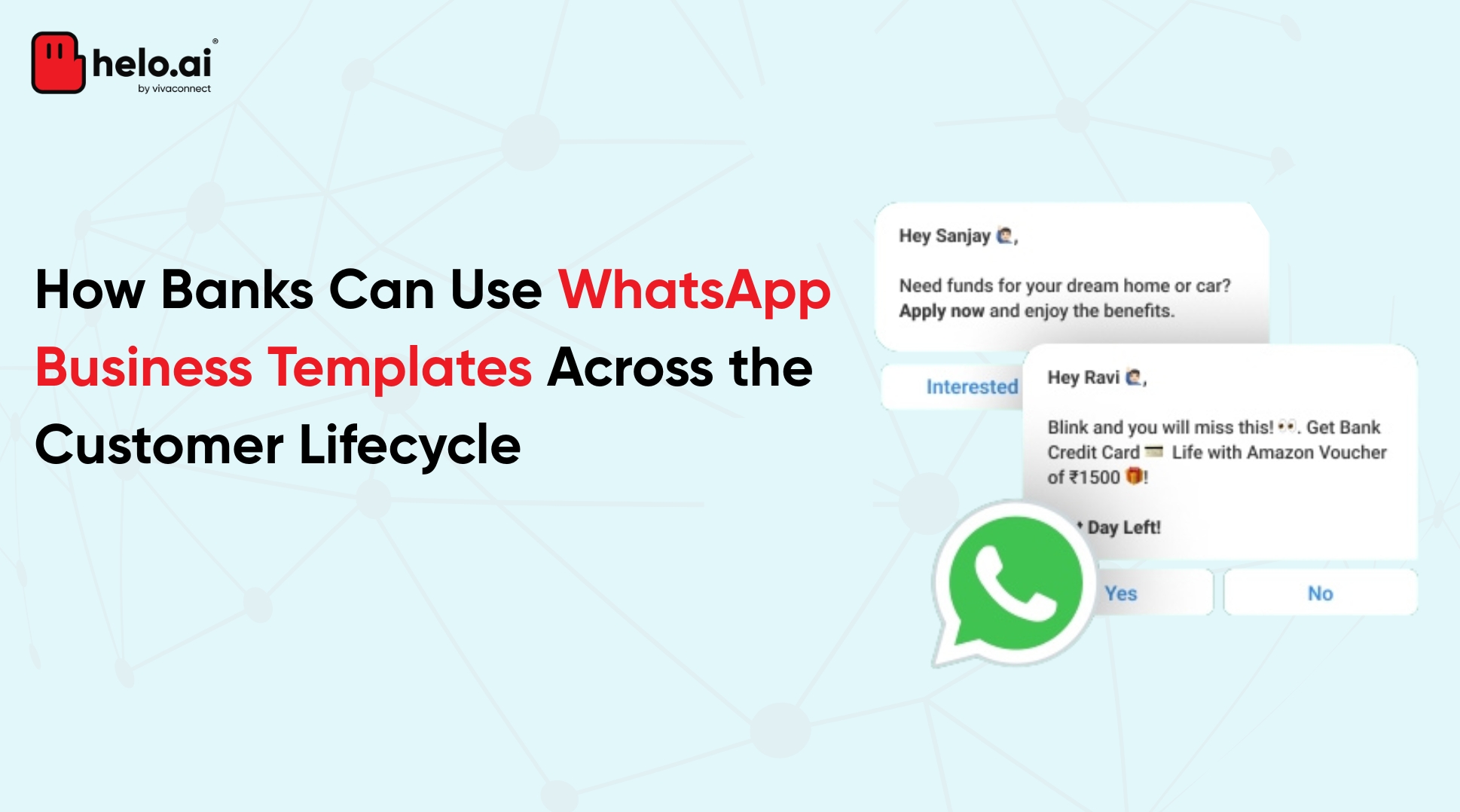
Onboarding is where banks bleed customers — drop-off rates of 60-70% on web forms aren't unusual. With WhatsApp Business API for banking, the process becomes a guided conversation: "Send a photo of your PAN," "Now your selfie," "Confirm your address." Brazilian neobank Nubank built its entire activation flow on WhatsApp, walking new customers through identity verification and first transactions inside the chat. Indian banks are adopting the same pattern for savings accounts, UPI activation, and credit-card sourcing — though the actual KYC document storage must move to secure portals (more on that in the compliance section). For an end-to-end view of the customer journey, see how banks can use WhatsApp Business templates across the customer lifecycle.
6. Loan EMI Reminders and Collections
Missed EMIs are expensive. Phone-based collection is more expensive — and increasingly, it's regulated. WhatsApp lets banks send polite, time-gated EMI reminders three days before the due date, on the due date, and after — all with a "Pay Now" button that links straight to the payment page. This single use case has cut delinquency rates by double digits at several NBFCs while staying compliant with the RBI's digital lending guidelines on contact frequency and timing. If you run an NBFC, our multi-channel marketing tips for the NBFC industry tie this directly into broader collections workflows.
7. Cross-Sell of Cards, Insurance, and Mutual Funds
Once a customer is engaged on WhatsApp, the upsell motion gets dramatically easier. Kotak Securities' "Keya Chat to Trade" lets customers place equity and derivatives orders through WhatsApp. Mutual fund houses use the channel to onboard SIP investors with a few taps. The reason this works is simple — when investing or buying insurance feels like texting a friend instead of filling a 14-page form, conversion goes up. This is the heart of conversational marketing, and banks that get it right are pulling ahead in their cross-sell metrics.
How Banks Use WhatsApp Business API: Real Indian Examples
The Indian banking sector is arguably the most mature WhatsApp banking market in the world. HDFC Bank runs WhatsApp banking alongside its EVA chatbot — a virtual assistant that has handled millions of customer queries on the bank's website and is now extended to WhatsApp. ICICI Bank was one of the earliest adopters, offering balance checks, statement requests, credit-card services, and offers discovery through its verified WhatsApp profile. Kotak Mahindra Bank layered WhatsApp on top of its Keya voice bot for a true omnichannel experience, and Kotak Securities later launched "Keya Chat to Trade" for stock-market orders. Bajaj Finance, India's largest private NBFC with over 110 million customers as of 2026, uses WhatsApp heavily for EMI reminders, pre-approved loan offers, and customer servicing.
What's striking is that none of these institutions treat WhatsApp as a standalone channel. It's plugged into their core banking system, CRM, and fraud engine — which is exactly how the Meta WhatsApp Business Platform was designed to be used.
Is WhatsApp Business API Safe for Banking? Compliance with RBI & DPDP Act
This is the section most competitor blogs skip — and it's the one your compliance team will care about most.
WhatsApp itself is end-to-end encrypted and uses verified business sender accounts, which checks the security box. But Indian banks face two additional layers: RBI guidelines (cyber security framework, KYC Master Directions, payment-data localisation rules) and the Digital Personal Data Protection Act, 2023, whose substantive provisions are being rolled out under the DPDP Rules notified in November 2025, with full compliance expected by May 2027.
In practical terms, this means three things for any bank rolling out WhatsApp banking. First, every business-initiated message needs an explicit, documented opt-in — generic loan-agreement consent doesn't count under DPDP. Second, sensitive KYC documents shouldn't be stored within WhatsApp threads; they must flow to secure, India-hosted systems for processing and erasure, in line with RBI's payment-data localisation rules. Third, communication frequency, timing, and content must follow RBI's digital-lending compliance rules — no messages before 8 AM or after 9 PM, capped attempts per day, and pre-approved templates only.
Pick a WhatsApp Business Solution Provider that handles template governance, consent logs, audit trails, and India-based data residency. Skip this and your "innovation project" becomes a regulatory headache. For a deeper dive, our guide on WhatsApp API compliance walks through the full checklist.
Measuring ROI: KPIs That Prove WhatsApp Banking Works
Don't roll out WhatsApp banking without a scorecard. The metrics that actually matter are: containment rate (% of queries resolved by chatbot without human handoff — aim for 70%+), cost per contact (compare against IVR and email — typically much lower on WhatsApp), CSAT on WhatsApp interactions, template approval and delivery rates, conversion rate on lead-gen and cross-sell campaigns, and payment completion rate for collections flows. If you can't tie a use case to one of these numbers within 90 days, kill it and pick another one. For more on this, see our breakdown of how WhatsApp chatbots are reducing support costs.
Conclusion
WhatsApp Business API for banking isn't a shiny add-on anymore — it's becoming the default front door for retail banking in India and emerging markets. The banks winning on this channel aren't the ones doing the most use cases; they're the ones doing the right seven well, with compliance baked in from day one and ROI measured every quarter. Whether you're a private bank, a public-sector lender, or an NBFC, the playbook is the same: start with transaction alerts and OTPs to build trust, layer in servicing and collections to cut costs, then unlock cross-sell and onboarding to drive revenue. The institutions that move now will own the conversational banking advantage for the next decade. If you're ready to start, explore Helo.ai's banking solutions or our broader financial services suite.
FAQs
1. Is WhatsApp Business API safe for banking transactions?
Yes — WhatsApp uses end-to-end encryption and verified business accounts, which makes it suitable for sending OTPs, transaction alerts, and account servicing. However, banks must layer on session-based authentication, opt-in consent management, and a compliant Business Solution Provider to meet RBI and DPDP Act requirements.
2. How do banks use WhatsApp Business API for customer onboarding?
Banks use the API to walk customers through guided KYC flows — collecting PAN, Aadhaar verification, selfie checks, and address confirmation through interactive messages. The actual document storage happens on secure, India-hosted backend systems, while WhatsApp serves as the conversational front-end that drastically reduces drop-off rates.
3. What are the most common WhatsApp Business API use cases for financial services?
The seven highest-impact ones are real-time transaction alerts, OTP authentication, conversational account servicing, loan lead generation, digital onboarding, EMI collections, and cross-selling cards or insurance. Together, these typically cut servicing costs significantly while improving CSAT.
4. Does WhatsApp banking comply with RBI and DPDP Act guidelines in India?
It can, when implemented correctly. Banks must obtain explicit purpose-specific consent, store payment and KYC data within India per RBI localisation rules, follow DPDP-compliant retention and erasure policies, and respect communication time windows mandated by RBI's digital-lending norms. Choosing an official Meta-approved BSP makes this much easier.
5. How much does WhatsApp Business API cost for a bank?
Costs vary based on the BSP, conversation volume, and template categories — service conversations are cheaper than marketing or authentication ones. For most mid-to-large banks, the channel pays for itself within the first quarter through reduced call-centre load and higher campaign conversion rates. See our latest WhatsApp Business API pricing for India for current rates.