


Here's the reality. You're running an e-commerce store. Your cart abandonment is sitting somewhere between 60-80%. Your COD orders have an RTO rate that's quietly eating your margins. Your email open rates dropped below 20% last quarter. And every ad rupee or dollar is getting more expensive to spend. You've heard about the WhatsApp API for ecommerce, and now you're wondering — is this the missing piece?
Short answer: yes.
Long answer: WhatsApp Business API for ecommerce is, hands down, the highest-ROI growth channel available to D2C and online retail brands in 2026. Open rates of 90-98%. Cart recovery rates 3-5x higher than email. RTO drops of up to 50% on COD orders. Real businesses using it are seeing 10-30x ROI on every dollar spent. This guide skips the fluff and gives you what you actually came for — 10 concrete use cases, real 2026 pricing math, industry-specific examples, the Click-to-WhatsApp Ads hack, and a step-by-step setup guide. Let's get into it.
10 High-ROI Use Cases of WhatsApp API for Ecommerce
You're here because you want to know what this thing can actually DO. So let's start with that.
1. Abandoned Cart Recovery
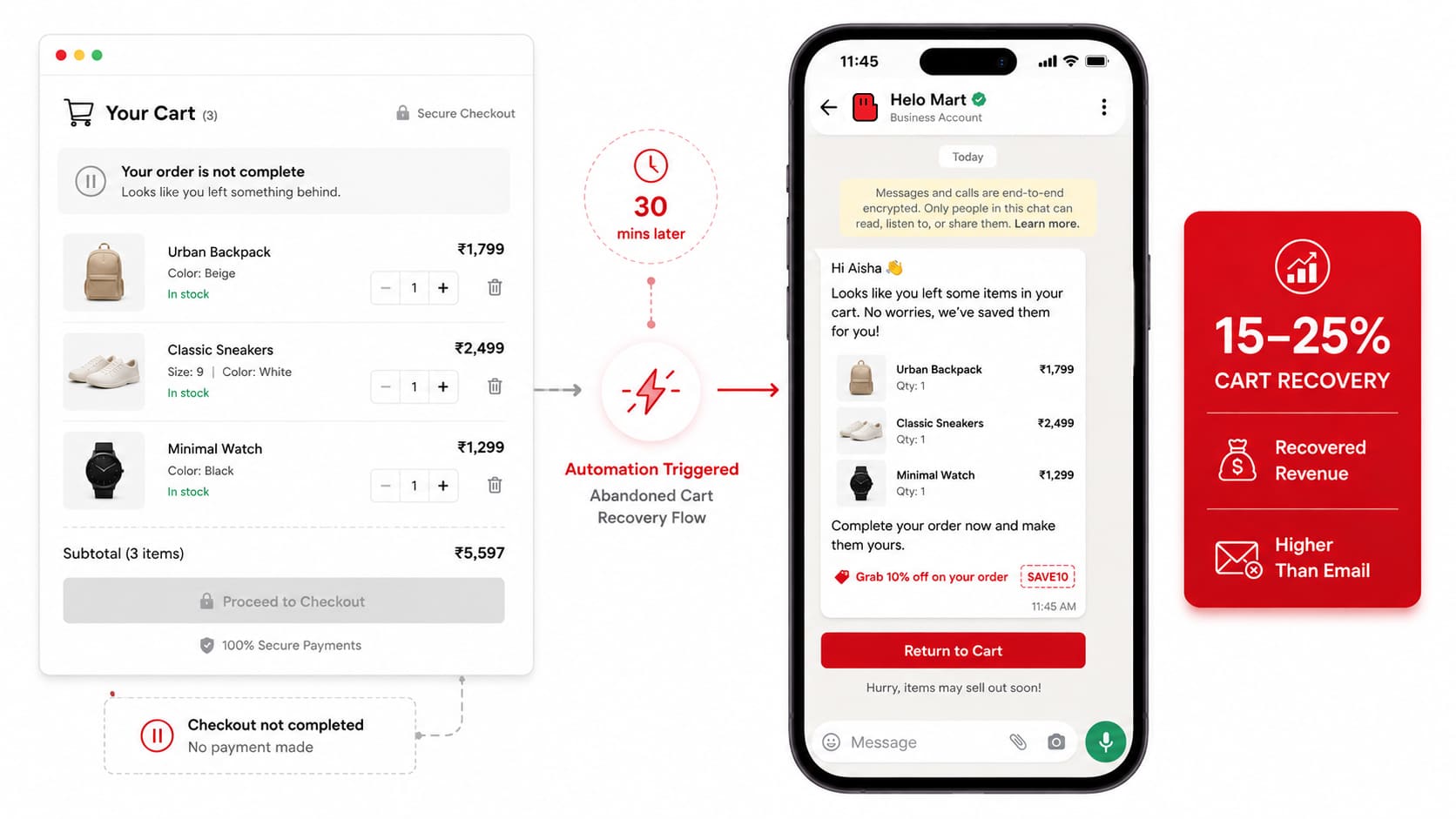
Roughly 70% of shoppers add stuff to their cart and disappear. Email reminders recover about 2-5% of those carts. WhatsApp cart recovery recovers 15-25%. That's a 5x improvement on the same audience. Trigger a friendly nudge within 30 minutes, follow up at 24 hours, and you've turned dead carts into a recurring revenue stream.
2. COD Order Confirmation (RTO Reduction)
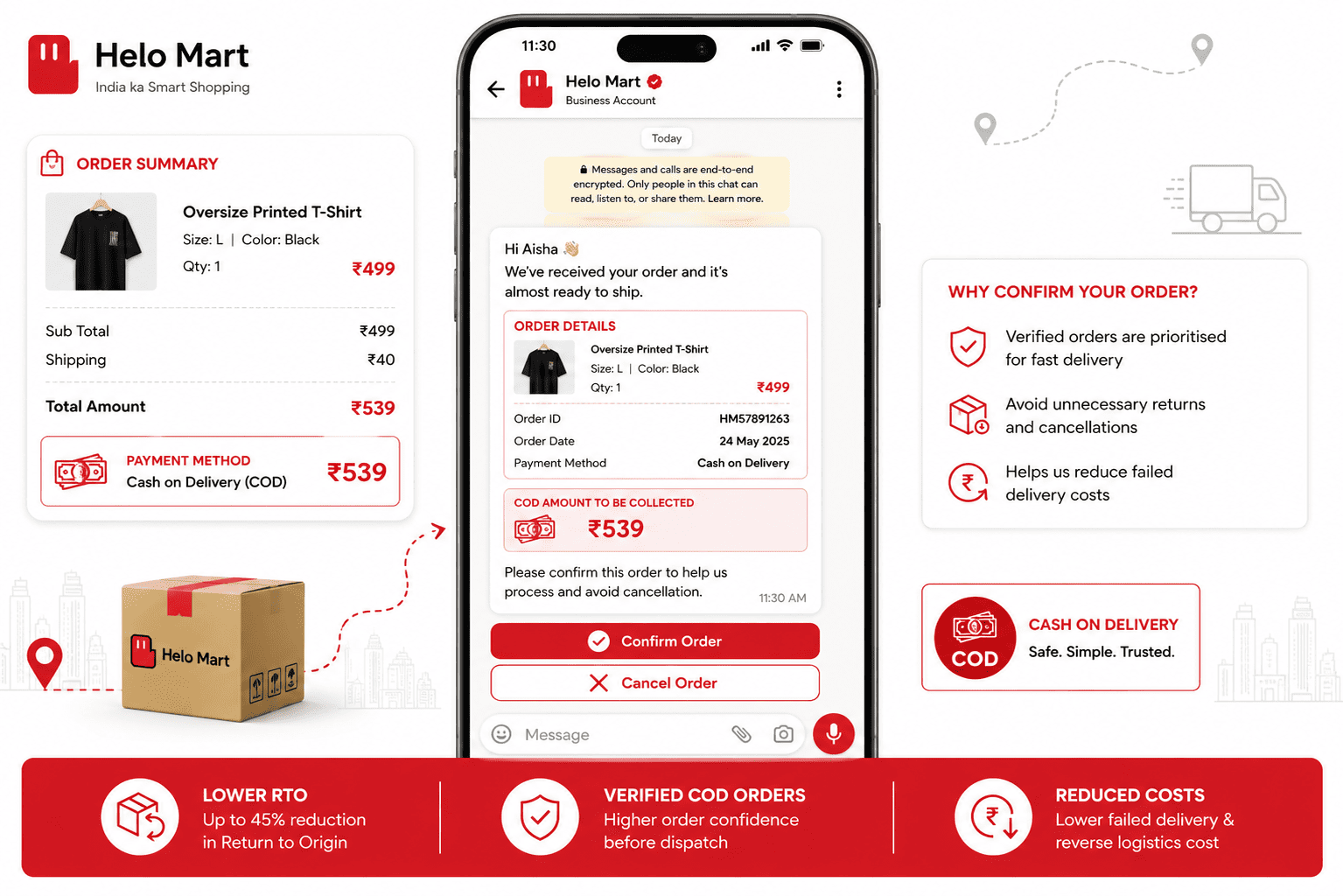
Indian and Southeast Asian D2C brands lose 30-40% of COD orders to RTO (Return to Origin). A simple WhatsApp confirmation message with a "Confirm/Cancel" button — sent right after order placement — cuts RTO by up to 50%. We'll do the math on this later, but it's worth lakhs per month for any decent-sized store.
This is exactly where WhatsApp order confirmations and instant alerts become operationally valuable.
3. Real-Time Order & Shipping Updates
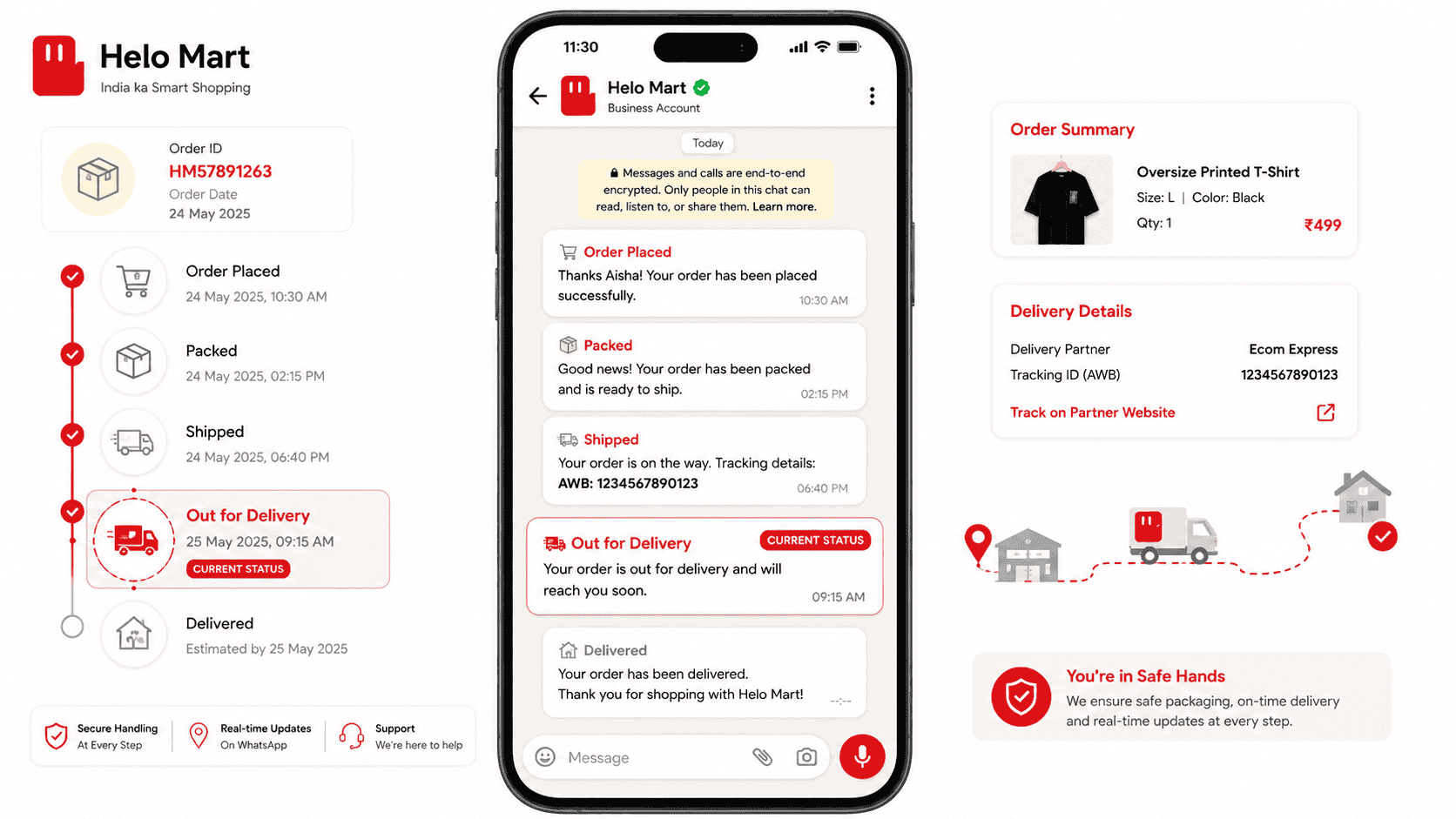
Order placed. Order packed. Order shipped. Out for delivery. Delivered. Five touchpoints, each landing on WhatsApp instead of email, where they actually get read. Customers feel taken care of, support tickets drop by 30-40%, and your team focuses on actual problems instead of "where is my order?"
4. Post-Purchase Upsells and Cross-Sells
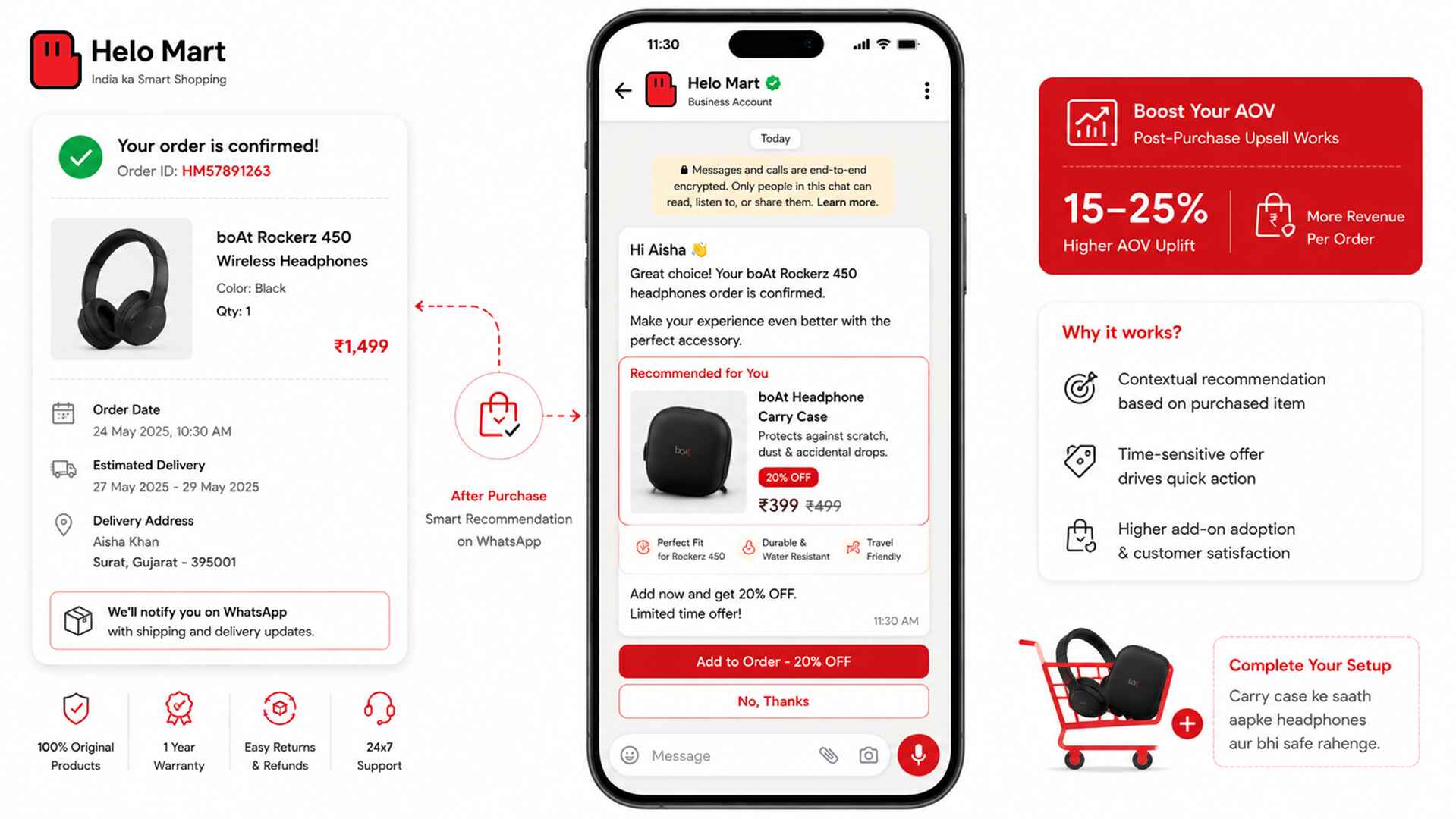
Right after an order, your customer is in peak buying mode. Hit them on WhatsApp with a 20% off cross-sell ("Pair your headphones with this wireless charger") and watch your AOV climb. Done right, this single use case lifts revenue per order by 8-15%.
5. Back-in-Stock Alerts
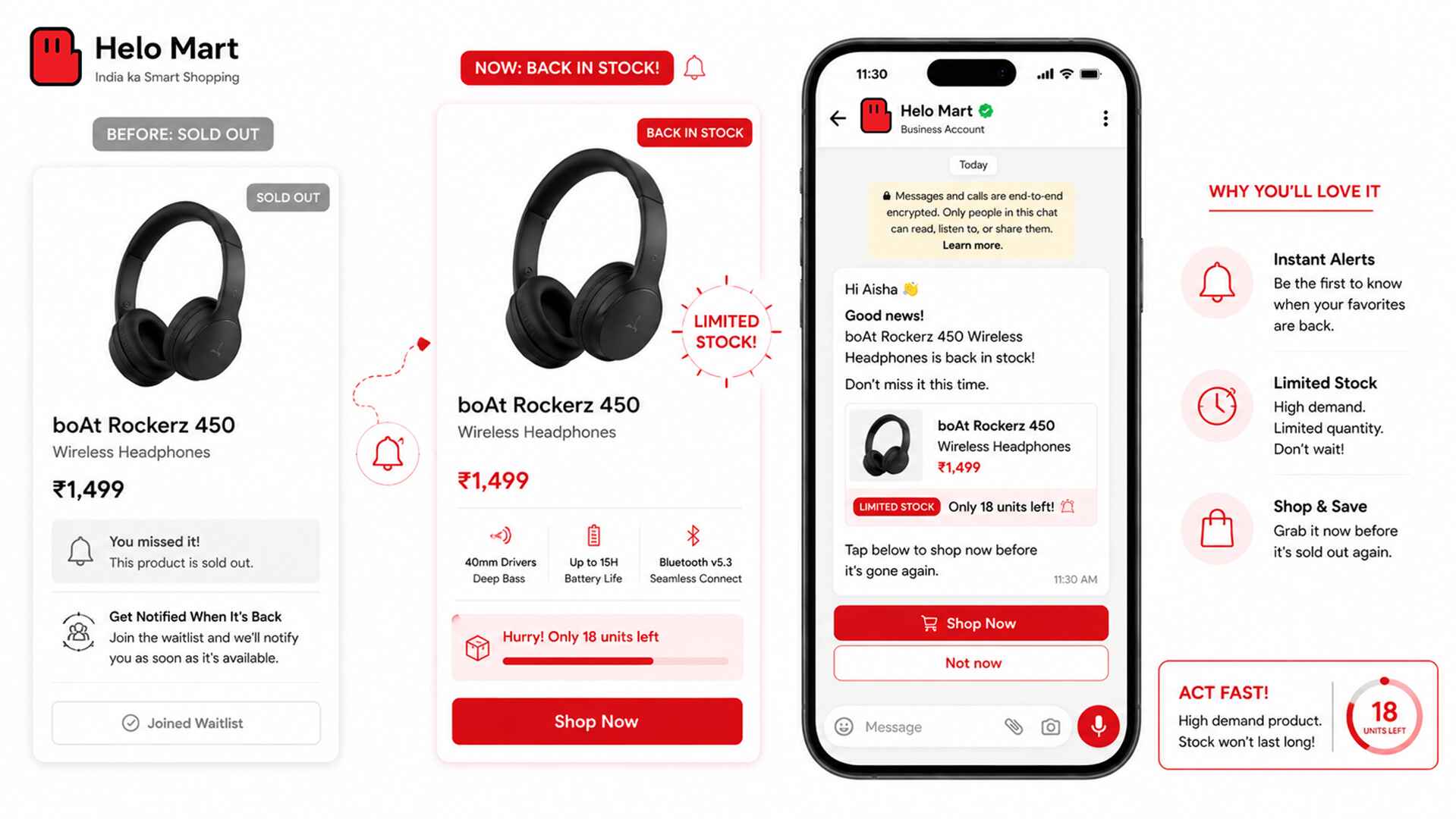
Customer clicks "Notify me when back in stock." Most stores email them — and most never come back. Send that alert on WhatsApp instead, and your conversion rate on restocks goes through the roof. Bonus: this works beautifully for limited-edition drops.
6. Click-to-WhatsApp Ads (CTWA)
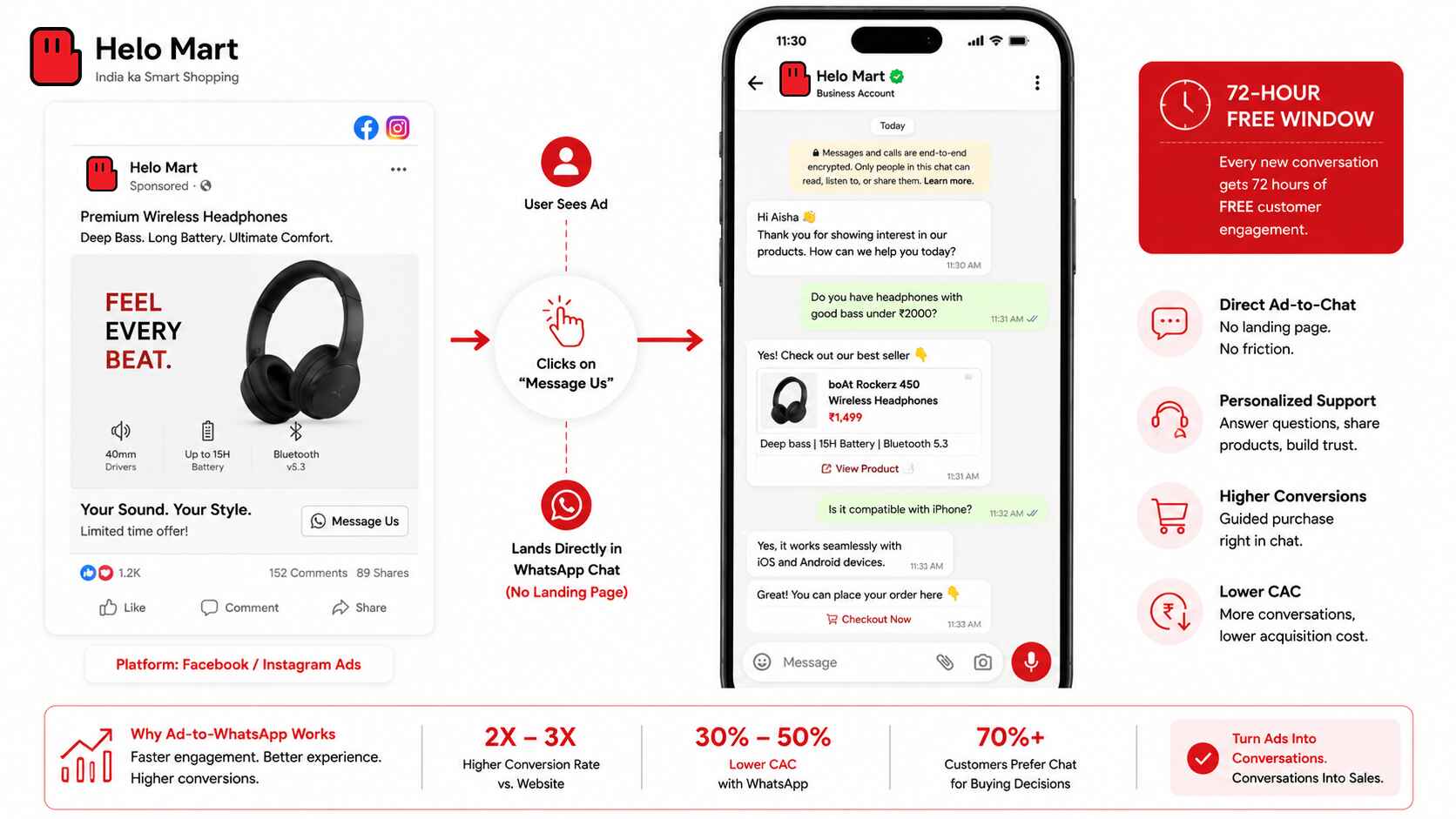
Run Click to WhatsApp Ads on Facebook or Instagram that open WhatsApp instead of a landing page. Customer messages you → you get a 72-hour free conversation window with them → you can guide them to purchase. Many D2C brands have dropped their CAC by 40-60% using this single channel.
7. Customer Support Automation via WhatsApp Bot
A smart WhatsApp bot for ecommerce can handle 70-80% of incoming queries — order status, return policy, sizing, shipping — without human intervention. Your team gets to focus on complex problems instead of answering "where's my order?" 50 times a day.
8. Win-Back and Re-Engagement Campaigns
Customers who haven't ordered in 60-90 days are sitting ducks for churn. A well-timed WhatsApp message with a personalised offer revives 10-15% of them — far better than the 1-2% email revives.
9. Product Catalog and In-Chat Checkout
WhatsApp lets you build an in-chat catalog where customers browse, select, and even pay without ever leaving the chat. For impulse purchases (₹500-₹2000 / $20-$50 range), this is a frictionless conversion machine.
10. Review and Feedback Collection
7 days post-delivery, ping the customer on WhatsApp with a quick "How was it?" message. WhatsApp's response rate on feedback requests beats email by 8-10x — which means more reviews, better social proof, and tons of UGC for your marketing.
What Is the WhatsApp API for Ecommerce?
Now that you know what's possible, here's the quick foundation. The WhatsApp API for ecommerce is Meta's official programmatic interface that lets your online store send and receive WhatsApp messages at scale connected directly to your store data (orders, carts, customers, inventory). It's not an app you download. It's a backend connection between your e-commerce platform (Shopify, WooCommerce, Magento) and WhatsApp, accessed through a Meta-approved Business Solution Provider (BSP).
Think of it as the engine that turns WhatsApp from a personal chat app into a full-blown sales, support, and retention channel for your store.
If you are evaluating vendors or setup paths, understanding WhatsApp API integration is the next step.
WhatsApp Business App vs API: Which One Do You Need?
The free WhatsApp Business App caps you at 256 contacts per broadcast and requires customers to save your number. Fine for a 3-person team running a tiny store. Useless if you're serious about scaling.
The WhatsApp Business API has no contact-saving requirement, supports automation, integrates with your CRM and Shopify, and scales to millions of messages. It requires a BSP and per-message fees — but the ROI math overwhelmingly favours it for any business doing more than ₹1L (~$1,200) in monthly revenue.
Quick rule: Over 50 daily orders or 500+ active customers? Skip the app. Go API.
If you are still comparing WhatsApp Business App vs WhatsApp Business API, the difference comes down to scale, automation, and integration
Industry-Specific WhatsApp Ecommerce Integration Examples
Use cases hit different in different verticals. Here's what's working in 2026.
Fashion and Apparel
Send lookbooks and outfit recommendations directly in chat. Use AI bots to do "size assistant" conversations ("I'm 5'7" and weigh 60kg, what size?"). Restock alerts for sold-out limited drops. Post-purchase styling tips. Cart recovery with visual reminders ("You left this in your cart 👗"). Brands like H&M and Levi's report 25-35% recovery rates on WhatsApp.
Electronics and Gadgets
COD verification is critical — high AOV means each RTO hurts. Warranty registration via WhatsApp instead of paper. Setup-help videos sent post-purchase. Cross-sells based on the product bought ("Your laptop is shipped here's a 15% off on a laptop bag"). Tech support automation via WhatsApp bot.
Food and Grocery
Same-day delivery updates with real-time tracking. Recurring order reminders ("Time to restock your usual?"). COD confirmation for ₹500+ orders. Quick-reorder buttons. Recipe content paired with restocks. Brands in this space see 40%+ repeat order rates after adding WhatsApp.
Beauty and Cosmetics
Personalised product recommendations based on skin type. Tutorial videos post-purchase. Refill reminders ("Your moisturiser is probably running low"). Loyalty rewards via WhatsApp. UGC and review requests. Mamaearth and Sugar Cosmetics have publicly credited WhatsApp for 8-12% revenue lifts.
The COD/RTO Goldmine: How WhatsApp Saves D2C Brands Lakhs
This is the one section nobody talks about properly. Let's run the math.
Say you run a D2C brand doing 500 COD orders per month at an average order value of ₹1,500. At a typical 35% RTO rate, you lose 175 orders to returns. Forward+reverse shipping cost (~₹200 per order) plus repackaging and lost inventory burns through roughly ₹35,000–₹50,000 per month — gone. Pure margin destruction.
Now add WhatsApp COD verification. Send the customer a message right after they place the order:
"Hi {Name}, please confirm your order of {Product} for ₹{Amount}. Tap Confirm or Cancel below." The result? Drop the RTO rate from 35% to ~17% (industry average post-WhatsApp). That's 90 orders saved per month, recovering ₹18,000–₹25,000 in margin. Annualised: ₹2.5-3 lakh saved. Total WhatsApp cost to run that automation? Roughly ₹4,000–₹6,000 per year. The ROI is borderline embarrassing.
Click-to-WhatsApp Ads: The 72-Hour Free Window Hack
Here's a Meta gift most brands ignore. When a customer clicks your Facebook or Instagram ad and lands in WhatsApp, you get a 72-hour FREE conversation window with them. No template fees. No per-message charges. Just pure conversational selling. Use this to nurture leads, answer objections, guide them to checkout, and close — without burning a single rupee on messaging fees.
D2C brands running CTWA report customer acquisition costs 40-60% lower than standard landing-page traffic. Why? Because chat closes hotter than forms. Customers ask their real questions, get real answers in real time, and convert at 2-4x the rate of cold landing pages.
Pro tip: Build a 72-hour automated nurture flow inside the chat — welcome message, product recommendation, social proof, offer, checkout link. Hands-free conversions while it's free.
Read the Complete: WhatsApp
WhatsApp Business API for Ecommerce: 2026 Pricing Breakdown
Meta switched to per-message pricing in July 2025. Here's what you pay in 2026 for an e-commerce store.
Message Category | India (₹) | USA ($) | UK ($) | Use Case |
|---|---|---|---|---|
Marketing | ₹0.80 – ₹1.10 | $0.025 – $0.045 | $0.05 – $0.08 | Sales, promos, win-back |
Utility | ₹0.12 – ₹0.18 | $0.004 – $0.015 | $0.02 – $0.03 | Order/shipping updates |
Authentication | ₹0.12 – ₹0.18 | $0.004 – $0.015 | $0.02 – $0.03 | OTPs, login codes |
Service (reply within 24h) | FREE | FREE | FREE | Customer-initiated chats |
Important: Utility messages sent inside an open 24-hour customer service window are also free. So if your customer messages you first, every reply you send for the next 24 hours costs zero.
Real ROI Math for an E-commerce Store
Let's run actual numbers for an Indian D2C brand doing 1,000 orders/month:
- Order updates (3 utility messages per order, free if within service window): ₹0 – ₹400/month
- Abandoned cart recovery (3,000 marketing messages, recovers ~600 carts): ₹3,000 spend → ₹6L+ revenue recovered at ₹1,000 AOV
- COD confirmation (utility, 500 messages): ₹75
- Post-purchase upsell (marketing, 1,000 messages, 8% AOV uplift): ₹1,000 spend → ₹80K+ extra revenue
- BSP platform fees: ₹2,000–₹5,000/month
Total monthly investment: ~₹6,000–₹10,000. Estimated incremental revenue: ₹6-8 lakhs. That's a 60-100x ROI. Even if you scale these numbers down by 70% for conservative estimates, you're still looking at a 20x+ return.
How to Set Up WhatsApp Ecommerce Integration (Step-by-Step)
Here's the real setup process. You can be live in 24-72 hours.
Step 1: Pick a BSP. Choose a Meta-approved Business Solution Provider that integrates with your e-commerce platform like Helo.ai
Step 2: Get Facebook Business Manager verified. You'll need a Facebook Business Account with verified business documents (GST/incorporation certificate, address proof, business website). Verification usually takes 1-3 days.
Step 3: Connect a phone number. Use a new number or migrate your existing WhatsApp Business number. Note: once on the API, you cannot use the regular WhatsApp app on that number.
Step 4: Get a display name approved. Meta approves your business display name (e.g., "Mamaearth"). Takes a few hours.
Step 5: Integrate with your store. Most BSPs have native Shopify, WooCommerce, and Magento integrations. One-click connect via app store or plugin. For custom platforms, use webhooks.
Step 6: Create and submit message templates. Submit your templates (cart recovery, order updates, COD confirm, etc.) for Meta approval. Most get approved within minutes to 24 hours.
Step 7: Build automation flows. Inside your BSP dashboard, set up trigger-based flows. "Order placed" → COD confirm. "Cart abandoned 30 mins" → recovery message. No code needed.
Step 8: Go live, monitor, and optimise. Track delivery rates, click-throughs, and conversions. A/B test templates and timing. Tweak weekly.
Common Mistakes That Tank Your WhatsApp Ecommerce API Performance
Avoid these — they sink most stores' results:
- Using "free" link-a-device tools. there have some Tools and others that connect via "WhatsApp Web" instead of the official API get accounts banned permanently. Meta detects the pattern. Always use a verified BSP.
- Not using customer-initiated windows. Every paid template you send when the customer just messaged you is money wasted. Free service windows should carry 60-70% of your traffic.
- Spamming the same template. Sending the same cart recovery message 5 times = template gets flagged + customers report you.
- Ignoring template categorisation. Putting a promo inside a utility template gets it rejected. Putting an order update inside a marketing template costs you 5x more. Get categories right.
- Sending without segmentation. Blasting your entire list with the same message tanks your quality rating. Segment by behaviour: cart abandoners, past buyers, VIPs, dormant customers.
Conclusion
The WhatsApp API for ecommerce isn't a "nice-to-have" anymore — in 2026, it's the operational backbone of any serious D2C or online retail brand. Cart recovery rates that crush email. COD verification that recovers lakhs in margin. Click-to-WhatsApp Ads that slash your CAC. Order updates that drop support tickets. Cross-sells that lift AOV. All on a single channel where customers actually read your messages within minutes.
The setup is faster than you think — 24-72 hours from sign-up to first automated message. The investment is modest — most stores spend ₹6,000-₹15,000 a month including BSP and message costs. The returns are absurd — 10-60x ROI is the norm, not the exception. So pick a BSP, integrate your store, build your first three flows (cart recovery + order updates + COD confirm), and watch your numbers move. The brands winning in e-commerce in 2026 aren't outspending — they're outcommunicating. WhatsApp is where that's happening.
Frequently Asked Questions (FAQs)
1. What is the WhatsApp API for ecommerce and how is it different from the WhatsApp Business App?
The WhatsApp API for ecommerce is Meta's programmatic interface that connects your online store directly to WhatsApp for automated messaging at scale. Unlike the free Business App (256-contact broadcast limit, single device, no automation), the API supports unlimited messaging, CRM integration, multi-agent inbox, and full automation through a Business Solution Provider.
2. How much does WhatsApp business API for ecommerce cost in 2026?
Total cost includes Meta's per-message fees (₹0.80-₹1.10 in India for marketing; $0.025-$0.045 in the US) plus your BSP subscription (typically ₹1,500-₹8,000/month). A 1,000-order/month store typically spends ₹6,000-₹10,000 monthly and sees 20-60x ROI.
3. Can I integrate WhatsApp ecommerce API with Shopify or WooCommerce?
Yes — every major BSP Like Helo.ai offers native Shopify and WooCommerce integration via app store installs. Setup takes minutes. For Magento, BigCommerce, or custom platforms, use webhook-based integrations.
4. How does a WhatsApp bot for ecommerce help my business?
A WhatsApp bot for ecommerce automates 70-80% of customer queries — order tracking, returns, sizing, FAQs without human intervention. It handles inbound conversations 24/7, qualifies leads, recovers abandoned carts, and routes complex issues to your support team, cutting support costs by 30-60%.
5. Is ecommerce on WhatsApp legal and safe for my store?
Yes, completely legal when you use the official WhatsApp Business API through a verified BSP and follow Meta's policies — explicit opt-in consent, pre-approved templates, and Commerce Policy compliance. Avoid grey-market "link-a-device" tools that get accounts permanently banned.

.png&w=828&q=75)