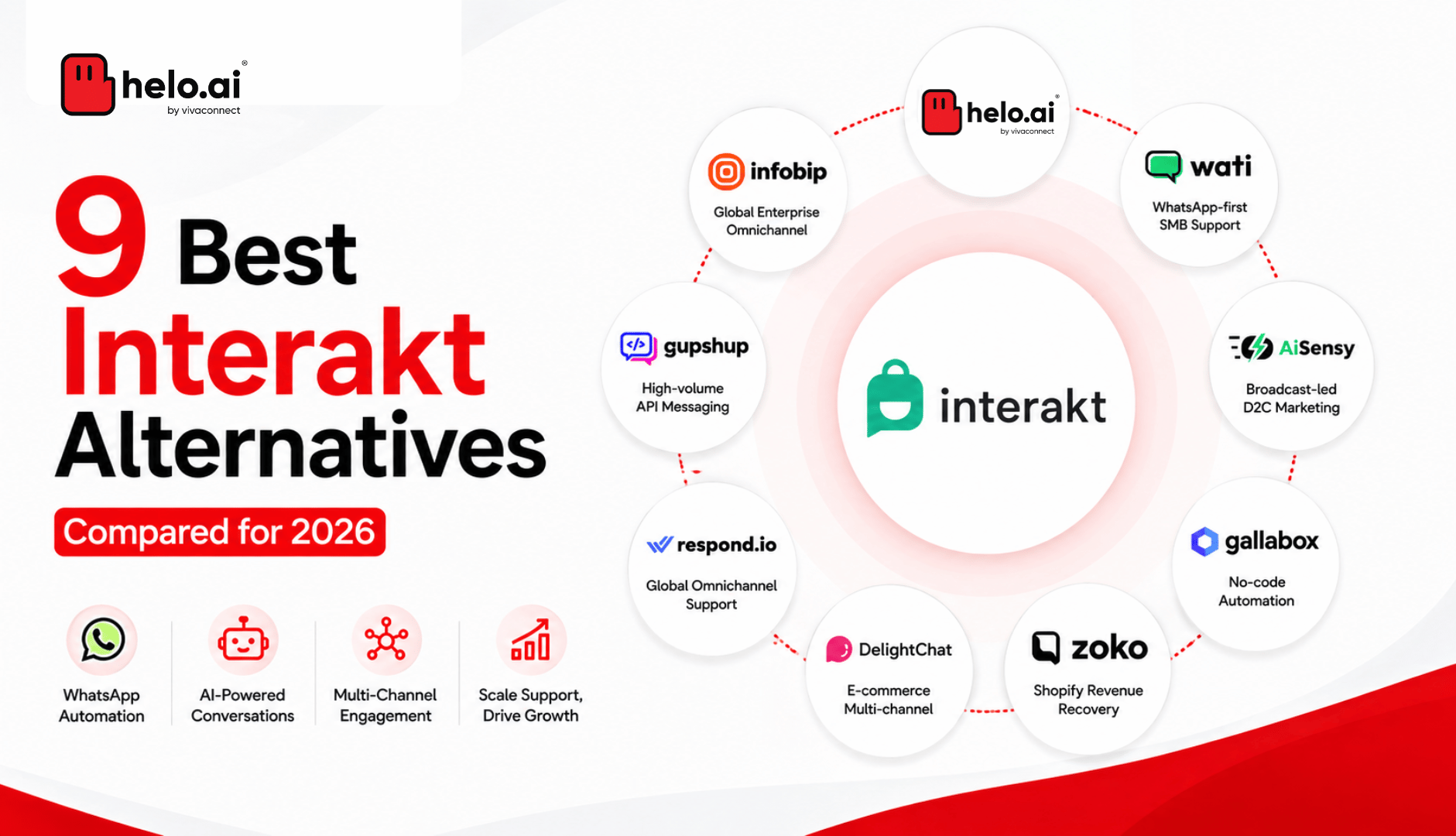


The strongest Interakt alternatives in 2026 are Helo.ai for enterprise multi-channel operations, Wati and AiSensy for WhatsApp-first SMB teams, Gallabox for no-code automation, Zoko and DelightChat for Shopify commerce, Respond.io for global omnichannel support, and Gupshup or Infobip for API-led enterprise builds. The right pick depends on one question: which limitation has Interakt stopped absorbing for you?
This comparison is published by Helo.ai, so read the entry on us with that in mind. The rest is written straight including where Interakt remains the better choice and where our own platform is the wrong one.
Quick comparison: Interakt alternatives at a glance
Pricing below is indicative entry-level list pricing as published by each vendor at the time of writing, excluding Meta's own conversation charges and GST. Rates change often treat this as a shortlisting aid, not a quote.
Platform | Best for | Channels | Pricing model | Rating |
|---|---|---|---|---|
Helo.ai | Enterprise, BFSI, regulated multi-channel | WhatsApp, RCS, SMS, voice, email | Custom / conversation-based | — |
Wati | WhatsApp-first SMB support and broadcasts | Subscription + per-seat | G2 4.6 | |
AiSensy | Broadcast-led D2C marketing | Subscription + add-ons | — | |
Gallabox | No-code automation, shared inbox | WhatsApp, Instagram | Subscription + add-ons | — |
Zoko | Shopify revenue recovery | Tiered subscription | G2 4.5 | |
DelightChat | Budget e-commerce, multi-channel starter | WhatsApp, IG, FB, email | Ticket-based tiers | — |
Respond.io | Global omnichannel mid-market support | WhatsApp, IG, email, SMS, chat | Subscription, contact-based | G2 4.8 |
Gupshup | High-volume API messaging | WhatsApp, SMS, RCS, voice | Usage-based / custom | — |
Infobip | Global enterprise omnichannel | Full omnichannel | Custom enterprise | — |
Twilio and 360dialog belong on a developer-led shortlist. Both provide raw API access without a built-in inbox, which suits teams building their own interface and frustrates teams who assumed one came included.
Two names appear on other comparison lists and are worth knowing if your requirements sit outside this set: Trengo, a collaborative support inbox with voice and email alongside WhatsApp, and SleekFlow, which carries broader Asian social channel coverage including LINE, Viber and WeChat.
First, where Interakt still wins
Interakt is a Jio Haptik product — Haptik is a Mumbai conversational AI company acquired by Reliance Jio Platforms in 2019 — and it is an official Meta Business Partner. It has earned a strong position in Indian D2C. It is a genuinely good fit when WhatsApp commerce is the core use case — catalogue, cart recovery, order notifications, in-chat payment collection — and when your team wants sales pipelines and lead auto-assignment rather than just a support inbox.
Its Shopify alignment is solid, INR billing simplifies procurement, and it carries one of the better review profiles among Indian platforms. Instagram DM and comment handling is included across plans, which several competitors gate to higher tiers or added later. The Reliance backing is also a real consideration in a category where smaller BSPs have shut down without much notice.
If you are a growing D2C brand running WhatsApp as a sales channel with one team, switching on price alone is usually a lateral move that costs more than it returns.
Why enterprise teams start looking
Four pressures recur in migration conversations. None reflects a broken product — each follows from a platform built for SMB commerce rather than enterprise operations.
Capability gated by tier
Entry plans typically carry linear chatbot flows only; branched logic with conditional routing and API webhook calls sits on higher tiers. Teams discover this after building the first flow, not during evaluation.
The AI agent sits above the platform
Interakt's bot capability draws on Haptik, and the fuller autonomous-agent tier is a premium add-on. That is a defensible commercial structure, but it means the AI you saw demonstrated may not be the AI included in your quote.
The channel ceiling
Coverage is WhatsApp with some Instagram. Indian enterprises also run SMS under DLT, RCS for branded messaging in the Android inbox, and voice for tier-2 and tier-3 customers.
Enterprise procurement questions
Published SLAs, security certification evidence, on-premise or in-country deployment, per-conversation audit trails. Platforms aimed at SMB self-serve rarely carry that apparatus.
Worth checking before you renew: Ask which of your current flows would break on the tier you actually pay for, and get the AI agent priced as a line item rather than a feature bullet. Quote-to-invoice drift in this category almost always traces back to those two questions going unasked.
The 9 alternatives, compared
1. Helo.ai — best for enterprise and regulated multi-channel
Best for: BFSI, insurance, retail and logistics enterprises running WhatsApp alongside SMS, RCS and voice under compliance scrutiny.
Strengths: Channels are owned infrastructure rather than resold integrations, built on twenty-five years of carrier-grade communication. Official Meta Business Solution Provider and Google's RCS Anchor Partner of the Year 2024. On-premise deployment available, DLT management handled as a managed service, and multilingual coverage including Indian languages. The AI agent and unified inbox come as one layer rather than a separate add-on tier.
Trade-offs: Not self-serve. There is an implementation conversation, and for a small D2C team that only needs WhatsApp commerce flows this is more platform than the problem requires.
The channel question is what separates this entry from the rest of the list. WhatsApp, RCS, SMS and voice run on infrastructure we operate, DLT registration is managed for you, and volume sits at over 200 million WhatsApp messages a month for Axis Bank, HDFC Bank, Kotak Mahindra Bank, Bajaj Finserv and Reliance Digital. See Helo Convo for the agent and inbox.
2. Wati — best for WhatsApp-first SMB support
Best for: Small and mid-sized teams wanting a polished WhatsApp inbox with broadcasts and no-code chatbot flows.
Strengths: Clean interface, quick setup, strong template and broadcast tooling, and a deeper chatbot builder than Interakt offers at comparable tiers. Consistently strong review scores (G2 4.6 across 400+ reviews).
Trade-offs: WhatsApp-led coverage, per-seat pricing that climbs with team size, and chatbot and AI capability priced separately on most plans.
Fuller analysis in our Wati alternatives comparison.
3. AiSensy — best for broadcast-led D2C marketing
Best for: D2C brands running high-frequency WhatsApp campaigns to a growing contact list.
Strengths: Affordable India-first positioning, strong broadcast and campaign tooling, self-serve onboarding and INR billing. Among the lowest entry points in the category, with several agent seats included at the base tier.
Trade-offs: Marketing-led architecture that strains on multi-team support, WhatsApp-only coverage, and chatbot capability priced as a separate module.
4. Gallabox — best for no-code automation
Best for: SMBs that want drag-and-drop chatbot building with a shared team inbox.
Strengths: Approachable no-code builder, reasonable CRM integrations including Zoho, and a usable multi-agent inbox at an accessible entry price with several users included.
Trade-offs: AI features and some connectors sit behind higher tiers, and coverage is largely WhatsApp with Instagram.
5. Zoko — best for Shopify revenue recovery
Best for: Shopify stores treating WhatsApp mainly as a conversion and cart-recovery channel.
Strengths: One of the deepest Shopify integrations available, with catalogue sync, COD handling, revenue attribution and in-chat transactions. Strong ratings from Shopify merchants specifically.
Trade-offs: Narrow by design. Largely rule-based chatbot, no voice, and limited value off Shopify.
6. DelightChat — best budget multi-channel starter
Best for: Small e-commerce brands wanting WhatsApp, Instagram, Facebook and email in one affordable inbox.
Strengths: Among the most affordable multi-channel options, with social comment management and Shopify workflows included.
Trade-offs: Ticket and contact limits on entry plans, more support-shaped than marketing-shaped, and awkward scaling past moderate volume.
7. Respond.io — best for global omnichannel support
Best for: Mid-market B2C teams handling high conversation volume across several channels.
Strengths: Genuine omnichannel coverage — WhatsApp, Instagram, Messenger, Telegram, Viber, webchat, email and voice — with strong workflow automation, AI agents and mature reporting for multi-agent operations. Highest review scores in this set (G2 4.8). Contact-based pricing stays more predictable than per-seat models as volume grows.
Trade-offs: USD pricing, AI agents gated to higher tiers, and a learning curve that comes with the breadth.
8. Gupshup — best for high-volume API messaging
Best for: Enterprises and developers needing programmable messaging at scale across emerging markets.
Strengths: Broad channel coverage, competitive economics at volume, and deep operating experience in India.
Trade-offs: No published base pricing, a more technical setup, and an interface that lags dedicated inbox products.
We have written a direct Helo.ai vs Gupshup comparison if that is the shortlist you are on.
9. Infobip — best for global enterprise omnichannel
Best for: Large multinationals needing omnichannel orchestration across many regions.
Strengths: Extensive channel and geographic coverage, enterprise compliance posture, and sophisticated journey orchestration.
Trade-offs: Quote-based pricing, longer implementation cycles, and more platform than most Indian mid-market operations need.
How to choose between them
Name the binding constraint and the shortlist writes itself. Feature grids will not do it for you.
If your constraint is… | Look at |
|---|---|
Compliance, multi-channel, regulated industry | Helo.ai, Infobip |
Chatbot depth gated behind tiers | Wati, Gallabox |
AI agent priced as a premium add-on | Helo.ai, Respond.io |
Shopify revenue and cart recovery | Zoko, DelightChat |
Multi-agent support at global scale | Respond.io, Infobip |
Developer control and raw API | Gupshup, Twilio, 360dialog |
Lowest entry price | AiSensy, DelightChat |
One warning worth heeding: moving sideways within the WhatsApp-only category solves a tier or pricing complaint but reproduces the channel ceiling within a year. It is the most common regret we hear from teams migrating a second time in eighteen months.
Eight questions that separate platforms
Question to ask | Why it decides the outcome |
|---|---|
Are channels native or resold? | Determines deliverability control and who fixes an outage at 2am |
Is the AI agent included or an add-on tier? | The single biggest source of quote-to-invoice drift |
Which flows break on the tier I am buying? | Branched logic and webhooks are frequently gated |
Markup on Meta rates, or pass-through? | Immaterial at low volume; a real budget line at scale |
Per-agent or per-conversation pricing? | Seat models penalise you exactly when volume peaks |
Is there a published SLA? | Absence is common in this category and matters at enterprise scale |
What security certifications, and what is the audit scope? | Ask for the certificate and its scope, not a logo on a page |
Who owns DLT and template approvals? | Real headcount time if the answer is 'you do' |
Ask every shortlisted vendor how they define resolution, and what their recontact rate looks like on automated conversations. Anyone leading with deflection numbers is answering an easier question. A fuller framework sits in our guide to choosing a WhatsApp API provider.
What migration actually involves
Switching is less disruptive than most teams assume, because the assets that took longest to earn do not belong to your current vendor. Meta supports migrating a WhatsApp Business Account between providers on the same number.
Asset | Transfers? | Note |
|---|---|---|
Phone number | Yes | Same number moves via ownership transfer |
Display name | Yes | No re-approval required |
Green tick (OBA status) | Yes | Held against the account, not the provider |
Quality rating | Yes | Current rating carries over |
Messaging tier | Yes | Daily capacity follows the account |
Approved high-quality templates | Yes | Only APPROVED templates with a green quality score duplicate, subject to the per-account template limit |
Low-quality, rejected or pending templates | No | Rebuild on the destination platform |
Chat history and contact lists | No | Export before you cancel, not after |
Chatbot flows and automations | No | Proprietary format; rebuild required |
The top half matters more than it looks. Quality rating and messaging tier are earned over months of sending behaviour, and losing them would mean re-warming a number from a low daily cap — a real commercial risk near peak season. Because they attach to the WhatsApp Business Account rather than the platform, they survive the move.
The downtime question, answered honestly
There is a short window during which the number cannot send. The technical transfer typically completes in well under an hour, and messages sent before completion are billed to the outgoing provider. Plan a quiet slot for it rather than assuming zero interruption — and note that transferred template quality ratings reset to "unknown" for roughly 24 hours while Meta rebuilds the data.
Prerequisites
Business verification does not need repeating provided the Meta Business Manager stays the same. The rest is narrow: administrator access to the Business Portfolio, the destination provider's app granted access to your Business Manager, both accounts in good standing, a valid payment method attached, and two-step verification temporarily disabled so the destination provider can register the number.
Two conditions where you should wait rather than migrate: an active red quality rating, which moves a penalised number onto new infrastructure with the penalty intact, and a Meta business verification still under review.
Our switching WhatsApp API provider guide covers the sequence step by step.
The switching costs nobody quotes
Agent retraining is the largest. A shared inbox is muscle memory for people who live in it all day, and output dips for a week or two regardless of interface quality. Schedule the switch away from your busiest period.
Platform-side annotations are the second. Chat history sits with the WhatsApp Business Account, but internal notes, tags, custom fields and resolution codes usually do not travel. Export what you need before the contract ends.
Commerce integrations are the third, and they bite harder here than elsewhere. If your Interakt setup drives catalogue sync, cart recovery and COD confirmation flows, those need rebuilding and re-testing against live orders before cutover. Do not migrate a commerce stack the week before a sale.
Building an honest TCO comparison
- Meta conversation charges. Your actual monthly mix at published India rates. This is the floor and it is identical whichever provider you choose.
- Platform fee plus any markup. Subscription, per-seat or per-agent charges, and any percentage applied on top of Meta's rates. Check the billing cycle — quarterly and annual commitments change the comparison.
- Add-ons you will actually deploy. AI agent tier, extra numbers, connectors. Price the month-one configuration, not the entry plan.
- Operational load. Whether DLT registration, template management and BSP escalation land on your team or the vendor's. Real headcount time that never appears in a comparison table.
Add 18% GST on the software component, then model against next year's volume rather than this month's. Current rate structures are in our WhatsApp Business API pricing India guide, and template categorisation — which quietly drives a large share of message cost — is covered in our note on utility templates reclassified as marketing.
When you should not switch at all
Three situations where migrating costs more than it returns.
- Your only complaint is price. A platform fifteen percent cheaper but architecturally identical will have you running this evaluation again next year. Switch for a capability gap, not a discount.
- You are inside ninety days of peak season. Rebuilding commerce flows and retraining agents during your highest-volume quarter is how SLAs break.
- Nobody owns the migration internally. These projects fail on ownership more than technology. If no single person is accountable for integration, template rebuild and agent training, delay until someone is.
Conclusion
The productive question is not which platform is best overall — none is — but which constraint is actually binding. Tier-gated chatbot depth points one way, AI agent pricing another, channel coverage and compliance depth somewhere else entirely. Name yours and a nine-item list becomes a two-item shortlist.
If none of those constraints is biting, staying on Interakt is a legitimate answer. Migration costs real money in rebuilt flows, reconnected commerce integrations and a fortnight of reduced agent output. It should be paid for a reason, not a feature list.
If you want a candid read on whether switching is justified in your case, talk to our team — we will tell you when it is not. Helo.ai has been building enterprise communication infrastructure for over 25 years.
Frequently asked questions
What is the best Interakt alternative?
It depends on the constraint. Helo.ai for enterprise multi-channel and compliance, Wati for deeper chatbot capability, Zoko for Shopify revenue, and Respond.io for global omnichannel support.
Why do enterprises leave Interakt?
Usually chatbot depth gated behind higher tiers, the AI agent priced as a premium add-on, WhatsApp-only channel coverage, or procurement requirements like published SLAs and on-premise deployment.
Is Interakt a bad platform?
No. It is a well-established Jio Haptik product with strong Shopify alignment and a good fit for Indian D2C commerce. The question is fit, not quality.
Who owns Interakt?
Interakt is a product of Jio Haptik Technologies, a conversational AI company acquired by Reliance Jio Platforms in 2019. That backing means the platform is well funded and unlikely to be discontinued, which is a fair consideration in a category where smaller providers have closed.
Can I keep my number and green tick when switching?
Yes. Green tick, quality rating and messaging tier sit with the WhatsApp Business Account, so they survive a provider change. There is a short window during the transfer when the number cannot send, so schedule it outside peak hours.
Will I have to re-warm my number after migrating?
No. Messaging tier and quality rating carry over with the account. This is the most common misconception about switching provider.
What does not transfer?
Chatbot flows, chat history, contact lists, and any rejected, pending or low-quality templates. Commerce integrations also need rebuilding and re-testing.
How long does migration take?
The technical number transfer is quick, usually well under an hour. Budget two to four weeks overall, most of it reconnecting commerce and CRM systems and rebuilding automation.
Is there downtime when switching WhatsApp providers?
There is a brief window during the transfer when the number cannot send messages, typically under an hour. Messages sent before completion are billed to the outgoing provider. Template quality ratings also reset to "unknown" for about 24 hours while Meta rebuilds the data.
What is the cheapest Interakt alternative?
AiSensy and DelightChat sit at the lowest entry points in this set. Remember that Meta's own per-conversation charges apply on top of any platform fee and are identical whichever provider you choose, so a cheap subscription does not mean a cheap monthly bill.