
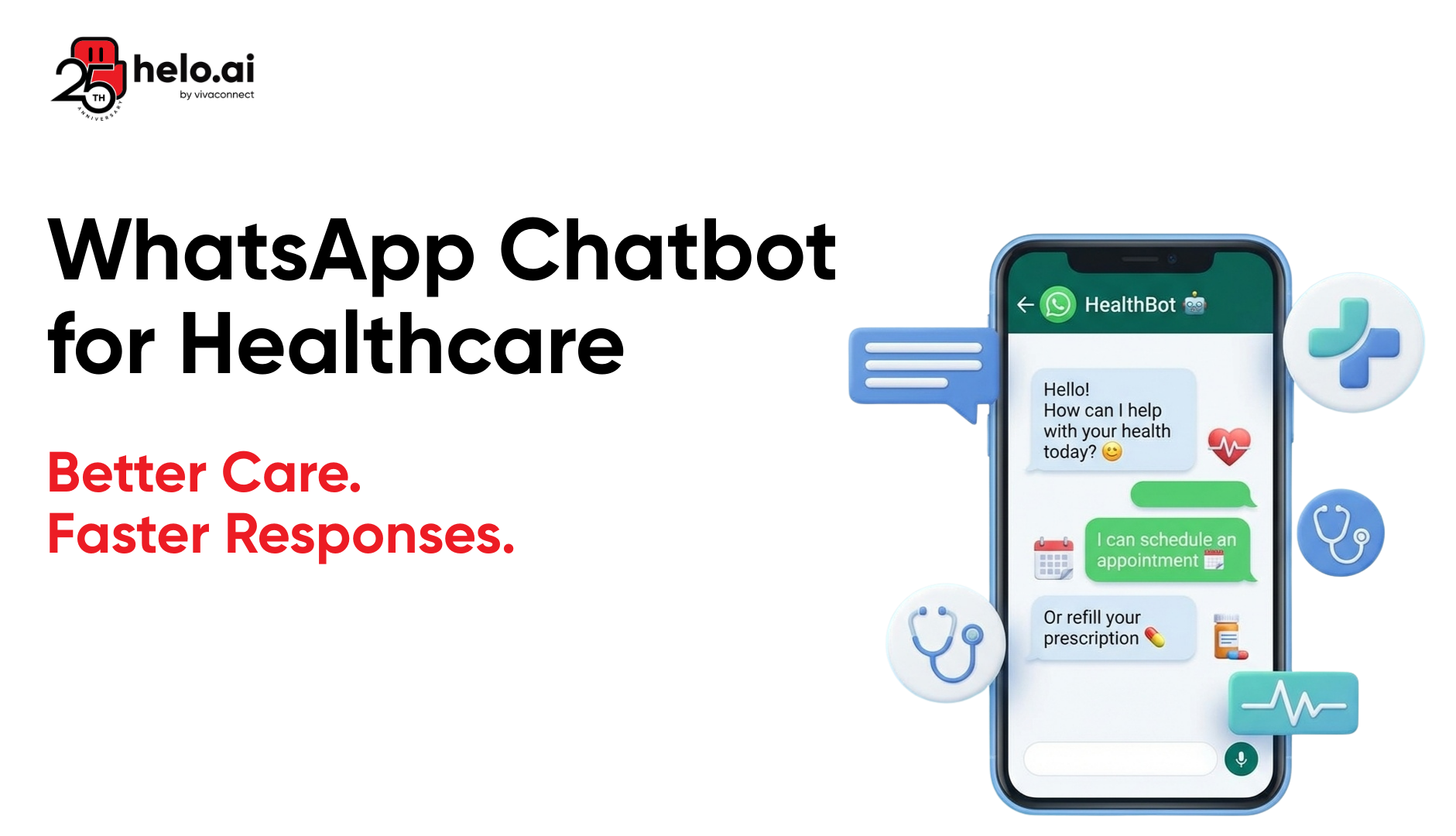


Healthcare providers today face three major challenges: rising patient expectations, staff burnout, and the need for instant, secure communication. This is where a WhatsApp Chatbot for Healthcare becomes a game-changer.
A healthcare WhatsApp chatbot allows hospitals, clinics, and diagnostic centers to automate patient conversations on WhatsApp from appointment booking and reminders to symptom triage and post-treatment follow-ups all while maintaining privacy and compliance.
With over 2 billion active users, WhatsApp is already the most familiar communication channel for patients. Instead of phone calls, long wait times, or fragmented portals, patients get 24/7 access to healthcare services directly inside WhatsApp.
In this guide, we’ll break down how WhatsApp chatbots work in healthcare, real use cases, benefits for patients and providers, security considerations, and best practices for successful implementation in 2026.
In this guide, you'll discover:
- What WhatsApp chatbots are and how they work in healthcare settings
- 10 high-impact use cases transforming patient care
- Measurable benefits for both patients and healthcare providers
- Step-by-step implementation guidance
- Common challenges and proven solutions
- Future trends shaping healthcare automation
- Real case studies with documented results
Let's explore how WhatsApp chatbot automation is revolutionizing patient engagement and operational efficiency across hospitals, clinics, and healthcare practices worldwide.
What is a WhatsApp Chatbot for Healthcare?
A WhatsApp Chatbot for Healthcare is an automated conversational system that communicates with patients via WhatsApp to handle routine healthcare interactions without human intervention.
These chatbots can:
- Answer common patient queries
- Schedule, reschedule, or cancel appointments
- Send medication and follow-up reminders
- Collect patient symptoms for initial triage
- Route complex cases to human staff instantly
Unlike generic chatbots, healthcare WhatsApp chatbots are designed with data security, compliance, and patient safety in mind, making them suitable for hospitals, clinics, telemedicine platforms, and health startups.
By automating repetitive tasks, healthcare providers can focus more on patient care while patients receive faster, more convenient support.
How WhatsApp Healthcare Chatbots Work
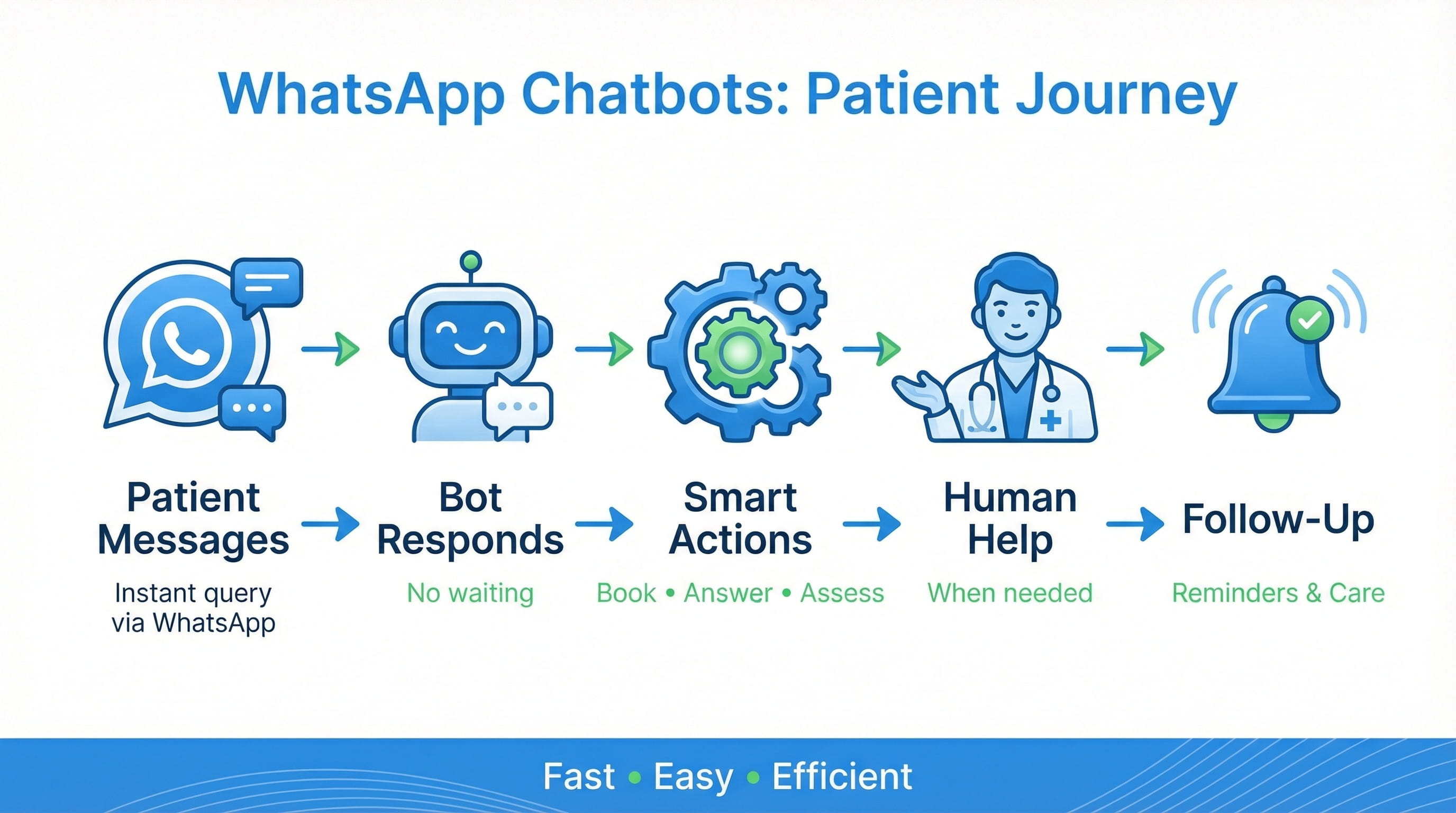
A healthcare WhatsApp chatbot follows a simple but powerful workflow:
- Patient Initiates Chat
The patient sends a message to the hospital’s verified WhatsApp number. - Chatbot Identifies Intent
The chatbot understands whether the patient wants an appointment, information, or support. - Automated Response or Data Collection
The bot shares instant answers or collects details like symptoms, preferred date, or patient ID. - Smart Routing When Needed
Complex or urgent cases are seamlessly transferred to a human healthcare representative. - Secure Data Handling
Patient information is stored and processed securely, following healthcare compliance standards.
This hybrid automation ensures speed without losing the human touch.
.png)
WhatsApp Chatbot vs Traditional Methods: Comparison
Understanding how WhatsApp chatbot automation compares to traditional healthcare communication methods helps justify implementation decisions and set realistic expectations.
Comprehensive Comparison Table
Factor | Phone System | SMS | Patient Portal | WhatsApp Chatbot |
Availability | Business hours only | 24/7 (limited automation) | 24/7 (passive) | 24/7 (instant automated response) |
Average Response Time | 2-15 minutes (if answered) | Minutes to hours | Varies (patient must check) | 10-30 seconds |
Open/Read Rate | N/A (must answer) | 90-95% | 15-25% | 98% |
Message Engagement | Must answer immediately | Moderate | Very low | Very high (conversational) |
Rich Media Support | Voice only | Limited (no images in US) | Yes | Yes (images, video, PDF, voice) |
Two-Way Interaction | Yes | Limited | Limited | Yes (instant) |
Appointment Booking | Manual (staff required) | One-way reminders only | Yes (if portal adopted) | Fully automated |
After-Hours Access | Voicemail or emergency line | One-way only | Limited functionality | Full automation |
Cost per Interaction | $8-12 (staff time) | $0.03-0.05 per SMS | $1-3 (maintenance) | $0.50-1.50 |
Scalability | Linear (more staff needed) | Good | Excellent | Excellent (exponential) |
Patient Adoption | Universal | Very high | Low (20-30%) | Very high (80%+) |
Setup Complexity | Low (existing system) | Moderate | High | Moderate |
Staff Training Required | Minimal | Moderate | Significant | Moderate |
Compliance Complexity | Moderate | Moderate | High | Moderate-High |
Integration With EMR | Manual entry | One-way | Native | API integration |
Personalization | High (human staff) | Low | Low | High (AI + data) |
Best For | Complex issues, emergencies | Reminders only | Tech-savvy patients | High-volume automation |
8 Types of WhatsApp Chatbots in Healthcare
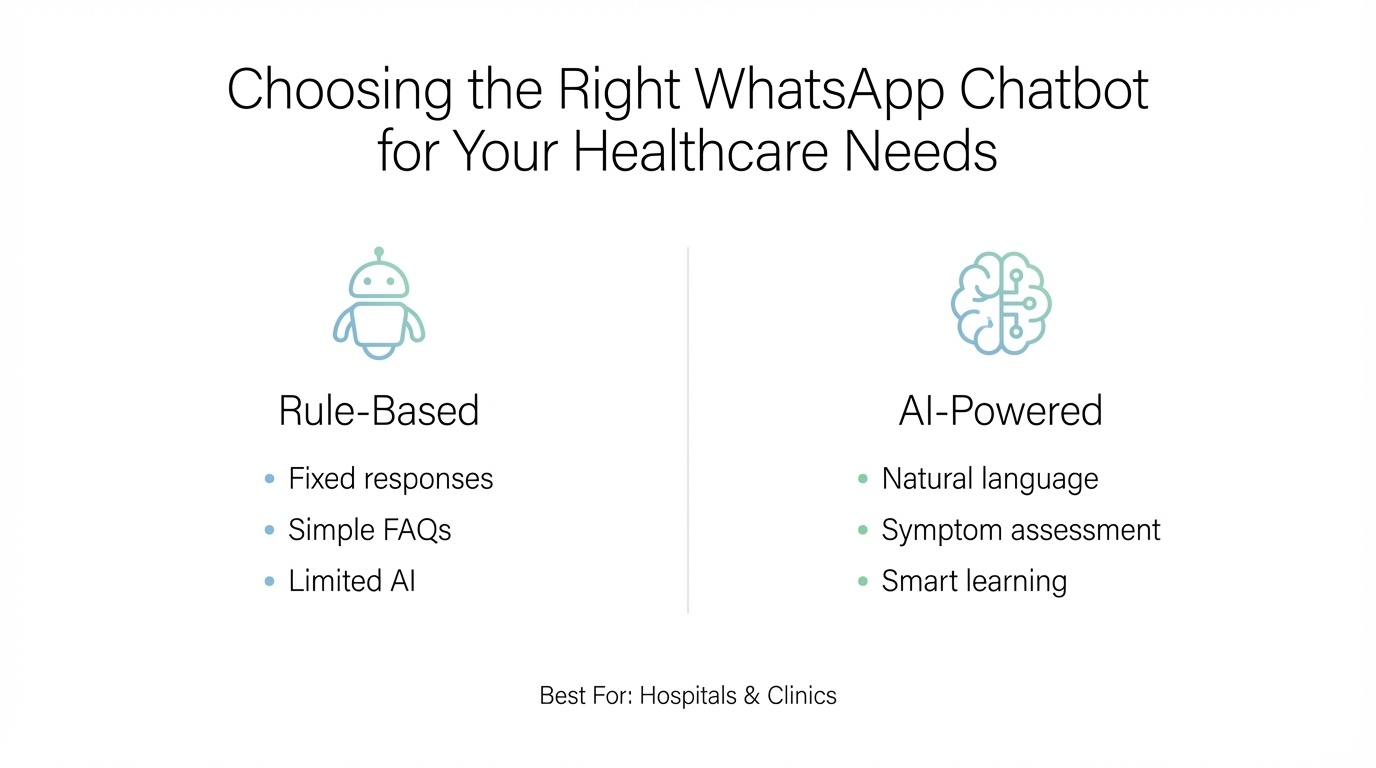
1. Appointment Scheduling WhatsApp Chatbots
Healthcare appointment scheduling chatbots automate patient booking through WhatsApp messaging. These AI-powered chatbots reduce administrative workload by 60% while improving patient access to healthcare services.
Primary functions:
- Automated appointment booking and cancellations
- Real-time calendar synchronization with EHR systems
- Appointment reminder notifications
- Waitlist management for cancelled slots
2. AI Symptom Checker Chatbots for WhatsApp
Medical symptom checker chatbots provide preliminary health assessments through conversational AI on WhatsApp. These tools help patients understand symptom severity before seeking medical care.
Primary functions:
- Interactive symptom assessment algorithms
- Medical triage recommendations
- COVID-19 and infectious disease screening
- Direct telehealth consultation routing
3. Medication Reminder Chatbots
Prescription medication reminder chatbots improve medication adherence rates by sending timely WhatsApp alerts. Studies show chatbot reminders increase adherence by 25-35%.
Primary functions:
- Personalized medication schedules
- Dosage and timing notifications
- Prescription refill alerts
- Medication adherence tracking
4. Patient Support and FAQ Healthcare Chatbots
24/7 patient support chatbots answer common healthcare questions using natural language processing. These conversational AI systems handle 70-80% of routine patient inquiries without human intervention.
Primary functions:
- Instant answers to healthcare FAQs
- Post-treatment care instructions
- General health information delivery
- Patient education content
5. Emergency Triage WhatsApp Chatbots
Medical emergency triage chatbots quickly assess urgent health situations and direct patients to appropriate care levels. These AI systems use clinical protocols to determine emergency severity.
Primary functions:
- Rapid emergency symptom evaluation
- Care level routing (ER, urgent care, telehealth)
- Emergency service connection
- Critical condition escalation protocols
6. Lab Results Delivery Chatbots
Secure lab results delivery chatbots share medical test results through HIPAA-compliant WhatsApp messaging. This automation reduces result delivery time from days to minutes.
Primary functions:
- Encrypted medical report delivery
- Test result notifications
- Basic result interpretation
- Automated follow-up scheduling
7. Remote Patient Monitoring (RPM) Chatbots
Remote patient monitoring chatbots collect daily health metrics from chronic disease patients via WhatsApp. RPM chatbots reduce hospital readmission rates by 20-30%.
Primary functions:
- Daily vital signs collection (BP, glucose, weight)
- Chronic disease symptom tracking
- Abnormal reading alerts to providers
- Wearable device data integration
8. Insurance and Billing Chatbots for Healthcare
Healthcare insurance chatbots automate eligibility verification, claims processing, and billing inquiries through WhatsApp. These bots reduce billing department workload by 40-50%.
Primary functions:
- Real-time insurance eligibility checks
- Claims status tracking
- Payment processing and reminders
- Coverage benefit explanations
Why Healthcare Providers Need WhatsApp Chatbots
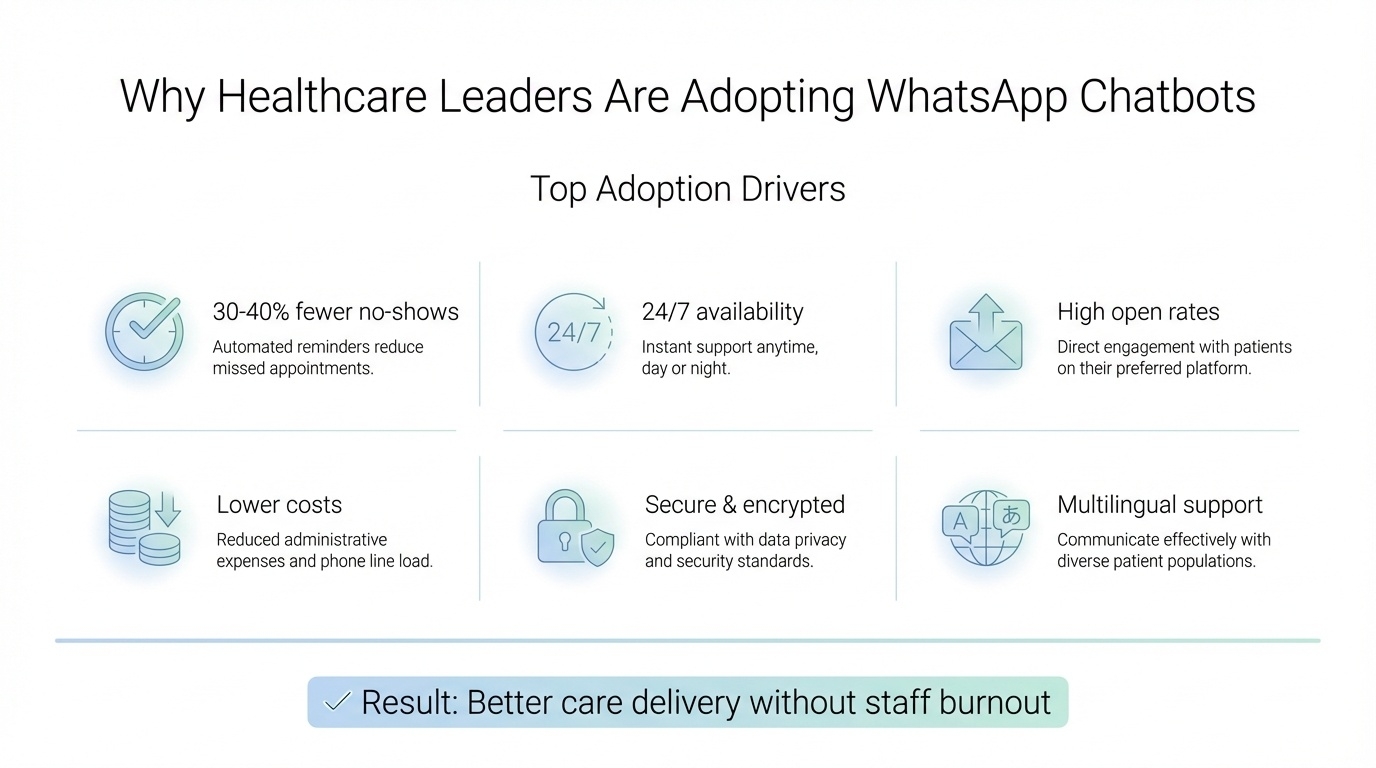
The gap between patient expectations and healthcare communication capabilities has never been wider. Patients now expect the same instant, personalized service from hospitals that they receive from retail brands and consumer apps.
Here's why WhatsApp chatbots have become mission-critical infrastructure for modern healthcare:
1. Massive Patient Reach & Adoption
WhatsApp dominates global messaging with 2.7 billion monthly active users making it the world's most-used messaging platform. In many markets, particularly across Asia, Latin America, Europe, and the Middle East, WhatsApp is the default communication channel.
2. Unprecedented Message Engagement
WhatsApp boasts a 98% message open rate far exceeding email (20-30%) and SMS (90-95%). Messages are typically read within 3-5 minutes of delivery.
Real impact: Your appointment reminders, lab results notifications, and health education content actually reach patients dramatically improving adherence and reducing no-shows.
According to WhatsApp Business official data, this exceptional engagement rate makes WhatsApp the highest-performing channel for time-sensitive healthcare communications.
3. True 24/7 Patient Support Without Staff Burnout
Healthcare emergencies don't follow business hours. Patients have questions at 2 AM, on weekends, and during holidays. Traditional staffing models can't sustainably provide round-the-clock support.
WhatsApp chatbots solve this: Automated patient support handles routine inquiries 24/7/365, while intelligently routing urgent cases to on-call staff. Your team stays focused on clinical care, not repetitive administrative questions.
4. Significant Cost Reduction & Efficiency Gains
Administrative burden consumes 30-40% of healthcare operational costs. Patient inquiries about appointments, insurance, directions, and documents drain staff time that should be dedicated to care delivery.
Documented savings:
- 42% reduction in routine administrative inquiries to clinical staff (Journal of Medical Internet Research, 2024)
- 30% decrease in customer service costs through automation
- 20-30% reduction in appointment no-shows with automated reminders
- Average savings of $300,000 annually for mid-size healthcare facilities
5. Familiar, Frictionless Patient Experience
Healthcare app adoption is notoriously low. Patients download clinic apps for one appointment, then never open them again. Portal registrations create friction, requiring usernames, passwords, and multi-step authentication.
6. Rich Media Support for Better Care Communication
Unlike SMS, WhatsApp supports rich media: images, videos, PDFs, voice messages, and documents. This transforms healthcare communication possibilities.
Practical applications:
- Share prescription images with clear dosage instructions
- Send medication tutorial videos
- Deliver lab reports securely as encrypted PDFs
- Share dietary guidelines with visual meal examples
- Provide wound care instructions with photo references
7. End-to-End Encryption for Patient Privacy
WhatsApp provides end-to-end encryption for all messages, meaning only the sender and recipient can read content. This built-in security layer, combined with proper WhatsApp Business API implementation, supports patient confidentiality requirements.
While WhatsApp alone doesn't guarantee HIPAA compliance (Protected Health Information requires additional safeguards), the encryption foundation significantly strengthens healthcare communication security compared to unencrypted email or SMS.
8. Scalability Without Proportional Staffing Increases
Traditional healthcare communication scales linearly: more patients require more staff. This model breaks during vaccination campaigns, seasonal flu surges, or public health emergencies.
WhatsApp chatbots scale exponentially: A single well-designed chatbot can manage thousands of simultaneous patient conversations without degradation in response quality or speed. During demand spikes, the chatbot absorbs volume while routing only complex or urgent cases to human staff.
6 High-Impact Use Cases of WhatsApp Chatbots in Healthcare
WhatsApp chatbot automation delivers measurable value across the entire patient journey from first contact through post-treatment follow-up. Here are the ten highest-impact use cases transforming healthcare operations worldwide:
1. Automated Appointment Booking & Scheduling
The Challenge: Phone-based appointment scheduling creates bottlenecks. Patients wait on hold, call outside business hours, or abandon the process entirely. Front-desk staff spend 40-60% of their time on appointment logistics alone.
The WhatsApp Chatbot Solution:
Patients can book, reschedule, or cancel appointments through conversational WhatsApp automation instantly, 24/7, without staff intervention. The chatbot integrates with your scheduling system to:
- Display available appointment slots in real-time
- Allow patients to select preferred doctors or specialists
- Confirm appointments with calendar details
- Send confirmation messages with visit preparation instructions
- Enable easy rescheduling with a few taps
- Process cancellations and free up slots automatically
Proven Results:
- Reduce appointment booking time from 5-8 minutes to under 60 seconds
- 24/7 availability captures bookings outside business hours (typically 20-30% of total appointments)
- Lower front-desk call volume by 40-50%, freeing staff for higher-value tasks
According to research from Emergingglobal, healthcare facilities implementing automated appointment systems reduce administrative workload while capturing significantly more bookings from patients who prefer self-service.
2. Smart Appointment Reminders That Reduce No-Shows
The Challenge: Appointment no-shows cost the healthcare industry billions annually. The average no-show rate ranges from 15-30%, with each missed appointment costing providers $150-$200 in lost revenue and creating care gaps that harm patient outcomes.
The WhatsApp Chatbot Solution:
Automated WhatsApp reminders dramatically outperform traditional SMS or phone call reminders due to WhatsApp's exceptional engagement rates. The chatbot sends personalized, multi-touchpoint reminders with interactive elements:
Reminder Timeline:
- 7 days before: Initial reminder with appointment details
- 24 hours before: Confirmation request with one-tap response buttons
- 2 hours before: Final reminder with location and parking info
Proven Results:
- 30-40% reduction in no-show rates (Prospyrmed research)
- 20-30% decrease compared to SMS-only reminders
- 85-90% confirmation rate when patients can respond with one tap
3. AI-Powered Patient Triage & Symptom Assessment
The Challenge: Emergency departments are overwhelmed with non-urgent cases, while urgent conditions sometimes go unrecognized. Patients struggle to determine appropriate care levels. Should I go to the ER? Can this wait until morning? Do I need urgent care or just a regular appointment?
The WhatsApp Chatbot Solution:
AI-powered symptom assessment chatbots guide patients through structured clinical questionnaires, evaluate symptom severity, and recommend appropriate care pathways. This intelligent triage ensures patients receive the right level of care while reducing unnecessary ER visits.
How Symptom Assessment Works:
- Patient describes symptoms in natural language
- Chatbot asks targeted follow-up questions based on clinical protocols
- AI evaluates symptom patterns, severity, and risk factors
- Bot provides care recommendations with urgency levels
- System routes to appropriate care channel (emergency, urgent care, appointment, self-care)
Proven Results:
- 81.8% top-1 diagnostic accuracy with AI symptom checkers (recent clinical research)
- 47% fewer questions required compared to traditional symptom checkers
- Reduce inappropriate ER visits by 15-20%
- Fast-track urgent cases to immediate care
According to research published in NIH's National Library of Medicine, WhatsApp-based symptom assessment tools demonstrate high diagnostic accuracy while significantly reducing the burden on clinical staff.
Important Note: Symptom assessment chatbots provide guidance, not diagnosis. All implementations include clear disclaimers and emergency protocols directing patients to call emergency services for life-threatening symptoms.
4. Medication Reminders & Treatment Adherence
The Challenge: Medication non-adherence is a massive problem in healthcare, particularly for chronic conditions. Studies show 50% of patients don't take medications as prescribed, leading to disease progression, hospitalizations, and billions in preventable healthcare costs.
The WhatsApp Chatbot Solution:
Personalized medication reminder chatbots send timely notifications at prescribed intervals, provide dosage instructions with visual aids, track adherence patterns, and alert care teams when patients miss multiple doses.
Medication Management Features:
- Scheduled reminders at prescription times (e.g., "Take 2 tablets with breakfast")
- Dosage instructions with images showing correct pill identification
- Refill alerts 7 days before medication runs out
- Drug interaction warnings when multiple medications prescribed
- Treatment progress tracking with patient-reported outcomes
- Escalation protocols when adherence patterns decline
Proven Results:
- 15-20% improvement in medication adherence rates (JMIR review, 2023)
- Reduce preventable hospitalizations by ensuring consistent medication use
- Better chronic disease management for diabetes, hypertension, heart disease
- Higher patient satisfaction through supportive, non-judgmental reminders
5. Intelligent Call Routing & Virtual Receptionist
The Challenge: Healthcare call centers struggle with high call volumes, long wait times, and misdirected calls. Patients wait on hold only to be transferred multiple times. Staff waste time routing calls instead of focusing on patient care.
The WhatsApp Chatbot Solution:
AI-powered virtual receptionist chatbots understand patient intent, gather necessary information, and route conversations to the appropriate department or specialist dramatically reducing call volume while ensuring patients reach the right resource immediately.
Intelligent Routing Features:
- Intent detection analyzes patient requests to determine routing
- Department directory with clear descriptions
- Skill-based routing matches patient needs with specialist expertise
- Queue management provides wait time estimates
- Call-back options instead of holding on phone
- Multi-language support routes to appropriate language-speaking staff
- After-hours handling with emergency protocols
Proven Results:
- 40-50% reduction in phone call volume to call centers
- Eliminate wrong department transfers through accurate intent detection
- Reduce average handle time by 30% through information pre-collection
- Improve first-contact resolution rates
- Better staff morale with fewer repetitive routing tasks
According to healthcare industry studies, AI-powered chatbots reduce routine administrative inquiries by 42%, allowing clinical staff to focus on complex patient care needs.
6. Public Health Campaigns & Population Outreach
The Challenge: Public health initiatives vaccination campaigns, disease screening programs, health awareness drives require reaching thousands or millions of people quickly with consistent, accessible information. Traditional methods (TV ads, mailers, phone banks) are expensive, slow, and have limited engagement.
The WhatsApp Chatbot Solution:
Mass communication through WhatsApp enables healthcare systems and public health organizations to broadcast important health information, screen populations for risk factors, schedule vaccination appointments, and deliver multilingual health education at unprecedented scale and speed.
Public Health Campaign Features:
- Broadcast messaging to targeted patient segments
- Vaccination eligibility screening and scheduling
- Disease awareness education (diabetes, hypertension, mental health)
- Preventive care reminders (annual physicals, cancer screenings)
- Health risk assessments with personalized recommendations
- Crisis communication (pandemic updates, natural disasters)
- Multilingual content delivery for diverse populations
- Data collection for epidemiological tracking
Real-World Examples:
COVID-19 Response: The World Health Organization launched a WhatsApp Health Alert chatbot during the pandemic that reached over 25 million users worldwide in 15+ languages, answering questions about symptoms, prevention, and vaccination.
Vaccination Campaigns: India's MyGov Corona Helpdesk handled over 100 million patient queries through WhatsApp, checking vaccination eligibility, providing nearby vaccination sites, and sending appointment confirmations.
Proven Results:
- Reach millions of patients instantly with critical health information
- Reduce misinformation spread through verified, authoritative sources
- Higher engagement rates (98% open rate vs. 20-30% for email)
- Faster population screening for public health programs
- Better program participation through convenient digital access
According to World Health Organization reports, WhatsApp-based public health interventions achieve significantly higher reach and engagement compared to traditional communication channels, particularly in underserved communities.
Benefits of WhatsApp Chatbots: For Patients & Providers
WhatsApp chatbot automation delivers measurable value to both sides of the healthcare equation improving patient experience while simultaneously reducing operational burden on healthcare teams.
Benefits for Patients
1. Instant Access to Healthcare Services (24/7/365)
Patients no longer wait until "business hours" to schedule appointments, ask questions, or access health information. WhatsApp chatbots provide round-the-clock support, eliminating the frustration of voicemail, long hold times, and closed offices.
Real impact: Patients schedule appointments at midnight, receive lab results on weekends, and get medication reminders while traveling across time zones.
2. Familiar, Frictionless Communication Channel
Zero learning curve patients use an app they already check dozens of times daily. No downloads, no logins, no new interfaces to master. This is especially valuable for elderly patients or those with limited digital literacy.
3. Faster Response Times to Urgent Questions
Instant, automated responses mean patients get immediate guidance on health concerns instead of waiting hours or days for callbacks. Critical symptoms get flagged for urgent attention, while routine questions receive instant answers.
Real impact: Reduce patient anxiety, catch deteriorating conditions earlier, and improve health outcomes through timely intervention.
4. Reduced Appointment No-Shows Through Smart Reminders
Interactive WhatsApp reminders with one-tap confirmation eliminate the "forgot my appointment" problem. Easy rescheduling options mean patients don't simply skip appointments they find alternative times that work better.
Real impact: Patients maintain care continuity, avoid complications from missed follow-ups, and experience less guilt about appointment management.
5. Better Medication Adherence & Treatment Compliance
Personalized medication reminders ensure patients take prescriptions on time. Clear instructions with visual aids reduce confusion. Refill alerts prevent "ran out of medication" gaps that disrupt treatment.
Real impact: Improved health outcomes, fewer preventable hospitalizations, better chronic disease management.
6. Multilingual Support for Diverse Populations
AI-powered translation enables patients to communicate in their preferred language, breaking down language barriers that often prevent patients from seeking care or understanding instructions.
Real impact: More equitable healthcare access, better patient comprehension, improved safety through clear communication.
7. Privacy & Convenience for Sensitive Health Topics
Some patients feel more comfortable discussing sensitive health concerns (mental health, sexual health, substance use) through messaging rather than phone calls or in-person visits, especially for initial screening or education.
Real impact: Earlier intervention, reduced stigma, better outcomes for conditions often avoided due to embarrassment.
Benefits for Healthcare Providers
1. Dramatic Reduction in Administrative Workload (42%)
Automating repetitive inquiries appointments, FAQs, directions, insurance questions frees healthcare staff to focus on complex patient needs requiring human expertise and empathy.
2. Significant Cost Savings (30% on Average)
Healthcare organizations implementing chatbots report 30% reduction in customer service costs while handling dramatically higher conversation volumes. Automation replaces expensive human labor for routine tasks without sacrificing quality.
3. Reduced Appointment No-Shows (30-40%)
Automated reminders with interactive confirmation reduce no-show rates by 30-40%, directly improving revenue (recovered appointment value) while reducing waste (staff time preparing for patients who don't arrive).
4. Scale Patient Communication Without Linear Staffing Increases
Traditional models require proportional hiring: more patients = more staff. Chatbots break this equation—a single automation handles thousands of simultaneous conversations without degradation.
5. Faster Response Times Improve Patient Satisfaction
Instant automated responses eliminate wait times for routine inquiries. Average response time drops from hours to seconds. Patient satisfaction scores improve significantly when expectations for quick communication are met.
6. Better Data Collection & Patient Insights
Structured chatbot conversations generate clean, queryable data. Healthcare teams gain insights into common patient questions, pain points, service gaps, and communication preferences—enabling continuous improvement.
7. Higher Patient Engagement & Retention
Proactive communication through WhatsApp keeps patients engaged with their health between visits. Regular touchpoints build stronger patient-provider relationships. Engaged patients are more likely to complete care plans and remain loyal to their healthcare providers.
8. Improved Staff Morale & Job Satisfaction
Healthcare workers didn't enter the field to answer "Where do I park?" 50 times daily. Automation handles repetitive, low-value tasks, allowing staff to focus on meaningful patient interactions requiring human empathy and clinical expertise.
Common Challenges & How to Overcome Them
Healthcare organizations implementing WhatsApp chatbots face predictable challenges. Understanding these obstacles in advance and having proven solutions ready dramatically increases your chances of success.
Patient Data Privacy & Compliance Concerns
The Problem: Healthcare is the most heavily regulated industry for data privacy. Organizations worry about accidentally violating HIPAA, exposing Protected Health Information (PHI), or facing penalties from regulators.
The Solution:
Architectural Approach:
- Never share PHI directly in WhatsApp messages — Use secure portal links that require authentication
- Implement proper patient verification before sharing any personal health data
- Maintain complete audit trails of all patient data access
- Use BAA-compliant infrastructure for backend systems handling PHI
- Encrypt data at rest and in transit using industry-standard protocols
Compliance Framework:
- Work with legal and compliance teams from day one
- Document all data handling procedures
- Conduct regular privacy impact assessments
- Train staff on what information can and cannot be shared via WhatsApp
- Include clear disclaimers about privacy limitations
Remember: WhatsApp provides end-to-end encryption, but that alone doesn't guarantee HIPAA compliance. Your implementation and processes determine compliance status, not just the platform.
Challenge 2: Integration Complexity With Legacy Systems
The Problem: Many healthcare organizations run on legacy EMR/EHR systems that weren't designed for modern API integration. Connecting your chatbot to scheduling systems, patient records, and billing platforms can be technically complex.
The Solution:
Modern Integration Methods:
- API-first approach: Most current EMR systems (Epic, Cerner, Athenahealth) provide REST APIs for external connections
- HL7/FHIR standards: Healthcare-specific data exchange protocols supported by major systems
- Middleware platforms: Use healthcare integration engines (Mirth Connect, Rhapsody) to bridge legacy and modern systems
- Vendor partnerships: Work with your EMR vendor's integration team—they often provide documentation and support
Challenge 3: Balancing Automation With Human Touch
The Problem: Over-automation frustrates patients when they need human empathy or complex problem-solving. Under-automation wastes the opportunity to reduce staff workload. Finding the right balance is critical.
Automate These:
- Routine FAQs (hours, location, parking)
- Simple appointment scheduling
- Prescription refill requests
- Lab result notifications (via secure link)
- Appointment reminders
- Insurance eligibility checks
Always Route to Humans:
- Clinical advice or diagnosis
- Emotional distress or crisis situations
- Complex billing disputes
- Complaints or negative feedback
- Anything involving clinical judgment
- Patient explicit request: "I want to talk to a person"
Best Practice: Make human escalation easy and obvious. Every chatbot conversation should include a visible "Talk to a human" option.
Challenge 4: Low Patient Adoption & Engagement
The Problem: You built the chatbot, but patients don't use it. They continue calling or emailing instead of messaging WhatsApp. Low adoption means low ROI.
The Solution:
Multi-Channel Promotion Strategy:
1. Proactive Outreach:
- Send announcement via email, SMS, and patient portal
- Include WhatsApp number on appointment confirmations
- Add to website homepage and contact page
- Display signage in waiting rooms and exam rooms
- Train front-desk staff to mention the chatbot during check-in
2. Incentivize First Use:
- Offer priority scheduling for patients booking via WhatsApp
- Provide small incentives (waived booking fees, health resources)
- Gamify: "Complete your first WhatsApp booking for..."
3. Make It Extremely Easy:
- Provide clickable WhatsApp links on website (not just phone number to copy)
- Use QR codes in physical locations (scan to start chatting)
- Include in signature line of all staff emails
- Pre-fill initial message: "I'd like to book an appointment"
4. Demonstrate Value Immediately:
- First interaction should provide instant value (not just "How can I help?")
- Show capabilities clearly in welcome message
- Deliver faster service than phone calls
- Collect and showcase positive patient testimonials
Best Practices for Healthcare WhatsApp Chatbots
Successful healthcare WhatsApp chatbot implementations follow proven principles that balance operational efficiency with empathetic, patient-centered communication.
1. Update Content Regularly Based on Patient Interactions
Your chatbot should improve continuously:
Monthly Content Reviews:
- Analyze questions the bot couldn't answer
- Review conversations requiring escalation
- Identify confusing phrasing or flows
- Update FAQs based on common questions
- Remove or update outdated information
Quarterly Major Updates:
- Refresh responses based on patient feedback
- Add new use cases
- Optimize underperforming flows
- Expand knowledge base
2. Train Staff on Chatbot Capabilities & Limitations
Your human staff must understand what the chatbot does and doesn't do:
Staff Training Should Cover:
- What tasks the chatbot handles automatically
- When and how escalation happens
- How to access conversation history for context
- What information patients might have already provided
- How to handle situations where the chatbot failed
Ongoing Communication:
- Share chatbot performance metrics with staff
- Celebrate automation wins
- Gather staff feedback on chatbot performance
- Update staff when new capabilities launch
3. Collect & Act on Patient Feedback
Patients will tell you what's working and what isn't if you ask:
Post-Conversation Surveys:
Thanks for using our chatbot! Quick feedback:
How was your experience?
⭐️⭐️⭐️⭐️⭐️
What could we improve? (optional)
[Text input box]
Feedback Analysis:
- Weekly review of all feedback
- Categorize common complaints or suggestions
- Prioritize improvements based on frequency and impact
- Close the loop: implement changes, then communicate improvements to patients
4. Maintain Brand Voice Consistency
Your chatbot is an extension of your healthcare brand. Ensure language, tone, and personality align with your organization's values:
Define Your Chatbot Personality:
- Professional but approachable
- Empathetic and patient-focused
- Clear and efficient
- Trustworthy and reliable
Create Voice & Tone Guidelines:
- Document preferred phrasing
- Provide example responses
- Define words to use and avoid
- Ensure consistency across all conversation flows
5. Plan for Multilingual Support From Day One
Even if you start with English only, design your infrastructure to support multiple languages:
Multilingual Architecture:
- Separate content from code (easier to translate)
- Use language tags for all text strings
- Plan translation workflows
- Test UI with longer text strings (some languages need 30%+ more space)
6. Protect Patient Privacy With Clear Disclaimers
Set expectations about privacy limitations and appropriate use:
Example Disclaimer (First Interaction):
Welcome to [Clinic Name]!
⚠️ Important Privacy Note:
• Don't share sensitive health details here
• For medical emergencies, call 911
• This chat is secure but use our patient portal for test results or detailed health information
How can I help you today?
Frequently Asked Questions (FAQ)
What is a WhatsApp chatbot for healthcare?
A WhatsApp chatbot for healthcare is an automated conversational assistant that communicates with patients through WhatsApp. Built on the WhatsApp Business API, these AI-powered chatbots handle routine tasks like appointment booking, prescription refills, FAQs, and reminders 24/7. Think of it as a digital receptionist that never sleeps, speaks multiple languages, and can handle thousands of conversations simultaneously while escalating complex issues to human staff when needed.
Is WhatsApp HIPAA compliant for healthcare communication?
WhatsApp isn't HIPAA compliant by itself, but you can use it in a compliant manner. Never share Protected Health Information directly in WhatsApp messages. Instead, use WhatsApp for appointment scheduling, general information, and reminders, then send secure portal links for accessing sensitive health data. Implement patient verification, maintain audit logs, and train staff on what can and cannot be shared via WhatsApp.
Can chatbots replace healthcare staff and doctors?
No. Healthcare chatbots augment human staff, not replace them. Chatbots handle 40-50% of routine administrative tasks like appointment booking and FAQs, freeing clinical staff for complex care requiring expertise and empathy. Human professionals remain essential for clinical diagnosis, medical advice, emotional support, clinical judgment, and building therapeutic relationships with patients.
What information can be shared through WhatsApp healthcare chatbots?
Safe to share: facility information, appointment scheduling, reminders, general health education, billing inquiries, prescription refill requests, and notifications with secure portal links. Never share directly in chat: lab results, diagnoses, detailed prescriptions, medical records, PHI, or Social Security numbers. Always use secure, authenticated portal links for sensitive health information.
How long does implementation take?
Total timeline: 8 to 15 weeks from planning to full launch. This includes planning and setup (2-3 weeks), development and integration (3-6 weeks), testing (1-2 weeks), pilot launch (2-4 weeks), and full rollout. Organizations can launch basic chatbots in 4 to 6 weeks using pre-built templates.
Do patients actually use WhatsApp for healthcare?
Yes, with 80-85% adoption rates versus 10-20% for healthcare apps. WhatsApp achieves 98% message open rates, 85-90% appointment confirmation rates, and 20-30% of bookings occur after hours. Patients prefer it because it's already on their phones, has a familiar interface, and provides instant communication without hold times.
Can WhatsApp chatbots integrate with our EMR/EHR system?
Yes. Modern platforms integrate with Epic, Cerner, Allscripts, Athenahealth, Meditech, NextGen, and eClinicalWorks using REST APIs, HL7 messaging, or FHIR standards. Integration enables real-time appointment booking, patient data verification, medication list access, and bi-directional updates between the chatbot and your EMR system.
What about elderly patients who aren't tech-savvy?
Elderly adoption is higher than expected at 60-70% when properly supported. WhatsApp's simple interface, voice message capabilities, and family support make it accessible. Optimize for seniors with step-by-step setup guides, video tutorials, simple conversation flows with clear buttons, voice capabilities, and always provide phone alternatives for those who prefer traditional communication.
How do you measure chatbot success?
Track automation rate (target 60-70% handled without humans), response time (target under 30 seconds), patient satisfaction scores (target 4.2+/5), no-show rate reduction (target 30-40% decrease), call center volume reduction (target 40%+ decrease), staff time saved, and after-hours appointment bookings. Most successful implementations see ROI over 400% within the first year.
What happens in medical emergencies?
Healthcare chatbots detect emergency keywords like "chest pain," "can't breathe," or "severe bleeding" and immediately instruct patients to call 911 or go to the nearest ER. The chatbot provides emergency contact numbers, nearest ER locations with directions, and simultaneously alerts on-call staff. Chatbots never provide clinical advice for emergency symptoms and always include upfront disclaimers that they're not for emergencies.
Can the chatbot handle multiple languages?
Yes. Advanced healthcare chatbots support 50+ languages through automatic language detection or manual selection. Start with the 2-3 most common languages in your patient population (typically Spanish, Chinese, Vietnamese in the US) using professional medical translators for critical content, then expand based on demographic analysis. AI-powered translation enables scalability while clinical review ensures medical accuracy.


.jpeg&w=96&q=75)