

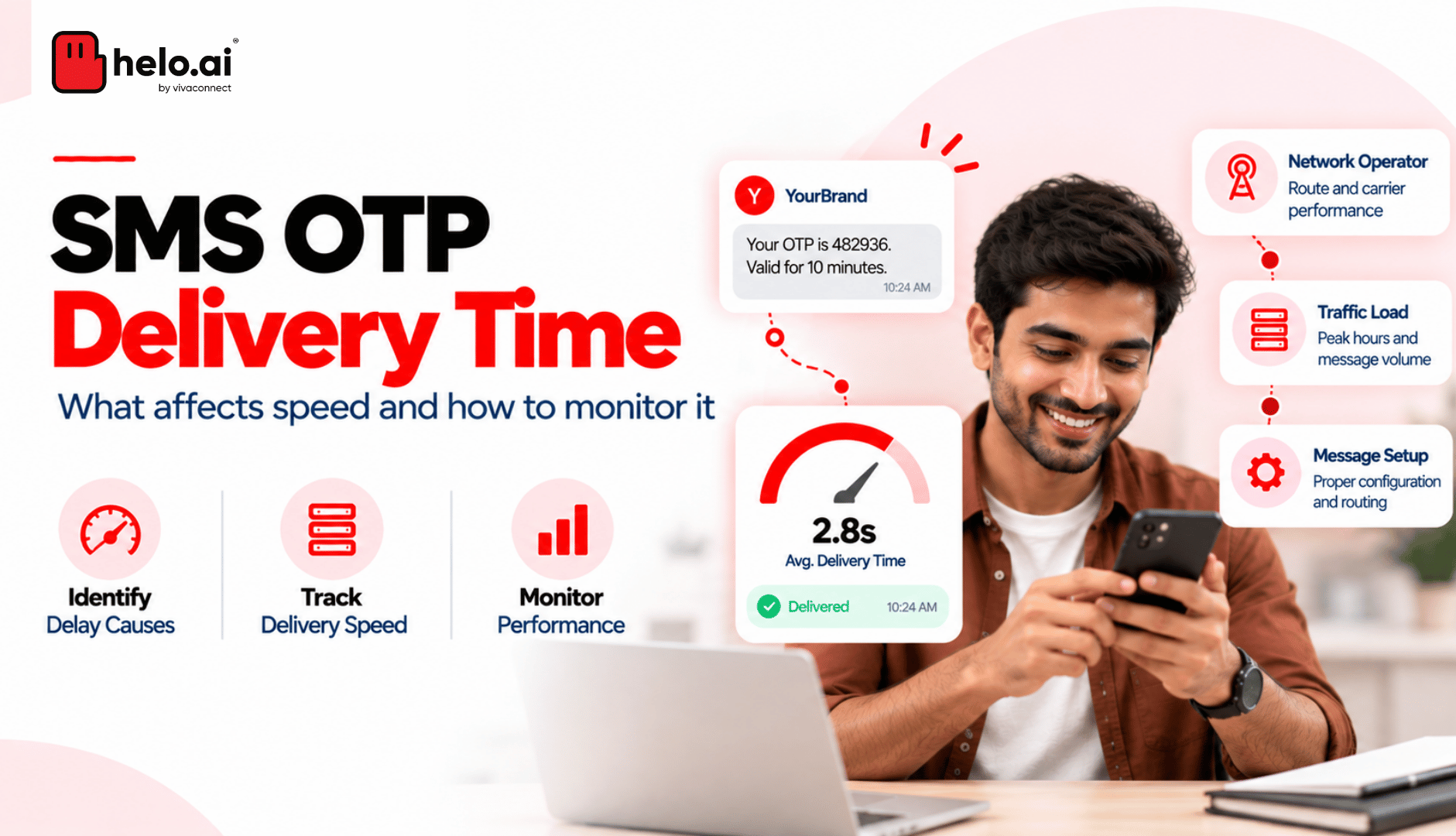


A well-routed SMS OTP should reach the handset within a few seconds. When it takes longer, users hit "Resend", codes expire, and sign-ups, logins, and payments fail. That makes delivery time a direct driver of conversion.
This guide answers the questions teams ask when OTPs feel slow: what is normal, where the delay comes from, and what to change.
What Is SMS OTP Delivery Time?
SMS OTP delivery time is the time between an application requesting a one-time password and the code arriving on the user's phone. It is a form of SMS latency applied to authentication traffic.
The full journey has three stages, and each one adds time:
Stage | What happens | Who controls it |
|---|---|---|
Issue to accept | The application generates the code and the SMS provider accepts the API request | The business and the provider |
Accept to delivered | The provider routes the message to the operator, which delivers it to the handset | The provider and the operator |
Delivered to verified | The user reads the code and enters it | The user and the app experience |
Measuring each stage separately shows where a delay actually sits.
How Long Should an SMS OTP Take?
On a direct, compliant route, most OTPs arrive within 2 to 5 seconds. We recommend teams set an internal target of 95% of OTPs delivered within 10 seconds, and investigate any route that misses it.
Averages hide the problem. A route can average 3 seconds while 5% of users wait over 30 seconds. Those users drive resends and drop-offs, so track the slowest 5% (p95) and slowest 1% (p99), not only the mean.
Delivery time | User experience | Action |
|---|---|---|
Under 5 seconds | Feels instant | Maintain |
5 to 15 seconds | Noticeable wait; some resends | Review routing for that operator |
15 to 30 seconds | Frequent resends; drop-offs begin | Investigate route and queue |
Over 30 seconds | Expired codes and failed journeys | Escalate and switch route or channel |
Why SMS OTPs Get Delayed
Most delays trace back to six causes.
1. Indirect routing. Low-cost routes pass messages through several SMS aggregators before reaching the operator. Each hop adds latency and failure risk. Direct operator connections remove these hops.
2. Shared queues with bulk traffic. When OTPs share a queue with promotional campaigns, a large send can hold codes behind thousands of marketing messages. Our guide to the SMS API queue covers how queueing affects delivery speed.
3. Throughput limits. Every account and route has a cap on messages per second. When login traffic spikes past the SMS throughput (TPS) limit, requests wait in line.
4. Compliance mismatches. In India, operators check every commercial SMS against DLT records in real time. A wrong header, an unregistered template, or a variable that does not match the template causes the message to be rejected. Users experience this as an OTP that never arrives.
5. Operator and handset conditions. Network congestion, weak signal, roaming, a switched-off phone, or a full inbox delay delivery on the user's side. These are outside the sender's control, but a fallback channel can work around them.
6. Application issues. Slow code generation and duplicate requests look like delivery problems in reports. So does a resend button that issues a new code before the first one arrives.
Does TRAI Regulation Slow Down OTPs in India?
No. TRAI's message traceability rules, which took effect in December 2024, require operators to trace every commercial message back to a registered sender and delivery chain. TRAI publicly stated that the mandate would not delay any message.
Delays in India usually come from registration gaps, not the regulation itself. OTPs must be sent from a header registered for service or transactional traffic, which now carries the -S or -T suffix, using an approved template. Teams that keep DLT records accurate rarely see compliance-related delay. A DLT management service helps keep headers, templates, and delivery chains in sync.
How to Measure SMS OTP Delivery Time
Delivery receipts provide the operator's timestamp for when a message reached the handset. Learn how a delivery receipt in SMS messaging works before relying on it for latency reporting.
Track these metrics for every route and operator:
Metric | What it shows |
|---|---|
p50, p95, and p99 delivery time | Typical and worst-case user wait |
Delivery rate | Share of OTPs confirmed as delivered |
Resend rate | Share of sessions where users requested a second code |
Verification completion rate | Share of sessions where the user entered a valid code |
Expired-code attempts | Codes entered after expiry, a sign of slow delivery |
Verification completion is the outcome that matters. A route with a strong delivery rate but falling completion is usually delivering late. Our guide to SMS API delivery reports covers how to capture these signals.
How to Reduce SMS OTP Delivery Time
- Use direct operator routes. Fewer hops means lower latency and clearer delivery reports.
- Separate OTP traffic. Send OTPs on a dedicated transactional SMS route and priority queue, never alongside promotional campaigns.
- Keep DLT records clean. Register OTP templates under the right category and match variables exactly.
- Plan for peak throughput. Size TPS for login spikes, sales events, and month-end payment traffic.
- Set realistic expiry and resend timers. Give codes a validity of a few minutes and disable "Resend" for the first 30 seconds. Align the message validity period with the code's expiry, so stale codes are not delivered late.
- Keep the message short. One-segment messages avoid the extra processing of concatenated SMS. Place the code at the start of the text so users can read it from the notification.
- Add a fallback channel. If a delivery receipt does not arrive within a set time, resend through WhatsApp, voice, or RCS. See our comparison of WhatsApp vs SMS for OTP.
- Monitor and alert by route. Alert when p95 delivery time or resend rate moves above its normal baseline for an operator.
Security Considerations
Faster delivery should not weaken authentication. Rate-limit OTP requests per number and per session to block SMS pumping fraud. Never write OTP values to application logs or support dashboards. Expire codes after one successful use. For high-risk journeys, combine SMS OTP with device binding or SIM checks.
How Helo.ai Supports Fast OTP Delivery
Helo Verify generates, delivers, and validates OTPs across SMS, WhatsApp, and RCS, with real-time reporting on delivery and authentication success. It processes over 2 million verifications daily at a 99.9% authentication success rate.
Helo.ai SMS provides direct operator connections across 225+ countries and built-in DLT compliance support for Indian traffic. To understand how OTP fits into wider authentication, read our guide on what SMS verification is.
FAQs
How long does an SMS OTP take to arrive?
On a direct, compliant route, most SMS OTPs arrive within 2 to 5 seconds. Delays beyond 15 seconds usually point to routing, queueing, or compliance issues.
Why is my OTP SMS delayed?
Common causes are indirect routing, OTPs queued behind bulk campaigns, throughput limits, DLT template mismatches, and network issues on the user's side.
What is a good OTP expiry time?
Most businesses use an expiry of 2 to 10 minutes, depending on risk. The expiry should comfortably exceed the slowest normal delivery time plus time for the user to type the code.
Do TRAI rules delay OTP messages?
No. TRAI's traceability rules do not delay compliant messages. OTPs sent from registered headers with approved templates deliver normally.
How can we reduce OTP delivery failures?
Use direct routes, separate OTP traffic from marketing, keep DLT records accurate, monitor delivery by operator, and add a fallback channel such as WhatsApp or voice.


.jpeg&w=96&q=75)