


Your customer just paid ₹4,500 for a pair of sneakers. Their phone sits on the desk. Three seconds pass. Then buzz. A single SMS lands confirming the order. Relief washes over them. They smile.
That SMS just did more for your brand than any billboard, Instagram ad, or welcome email ever could. It delivered something irreplaceable: certainty. And it did it in under three seconds.
That is transactional SMS and in 2026, it represents the most trusted, highest-opening, and most compliance-ready communication channel available to Indian businesses.
In this guide, you will learn exactly what transactional SMS is, how it differs from promotional SMS, what the India-specific DLT framework demands of you, how to integrate a transactional SMS API, and how to write messages that customers actually appreciate. We back every section with real examples, expert frameworks, and a clear content structure so you can implement this knowledge immediately.
Let us get into it.
What Is Transactional SMS? (And Why Every Business Needs It)
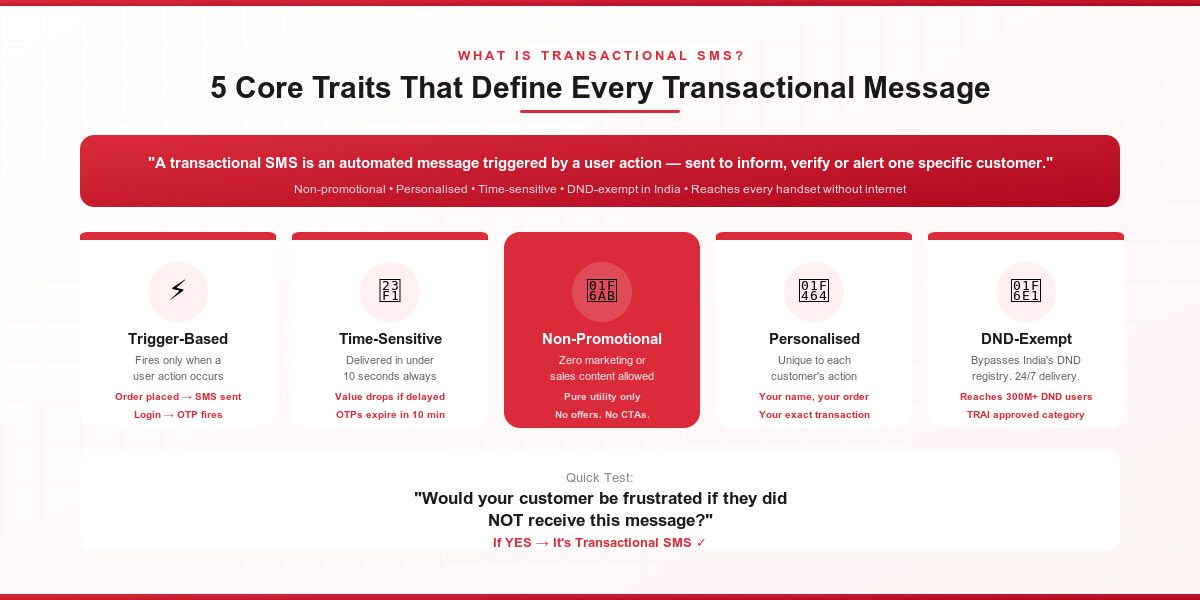
A transactional SMS is an automated text message that your system sends to a customer because a specific action or event has just occurred. The customer placed an order you send a confirmation. They tried to log in you send an OTP. Their shipment moved you send a dispatch alert.
These messages serve one purpose: to deliver essential, time-sensitive information that the recipient is either expecting or urgently needs. They carry no marketing content, no promotional offers, and no sales language. The message exists purely to inform or verify.
Why does this matter so much in 2026? Three reasons.
First, customers now expect it. A business that does not send an order confirmation text feels untrustworthy. Second, regulators require it — India's TRAI DLT framework mandates that every commercial SMS operates through a verified pipeline. Third, no other communication channel matches SMS for open rates (~98%), delivery speed (under 10 seconds), or universal reach (works on any mobile, no internet needed).
98% of transactional SMS messages get opened — most within 3 minutes of delivery
<10s average delivery time for a well-configured transactional SMS pipeline
1.2B+ mobile subscribers in India — all reachable by SMS, with or without internet
The 5 Core Traits That Make a Message 'Transactional'
Not every automated SMS qualifies as transactional. A message earns that classification only when it meets all five of these criteria:
Trait | What It Means | Real-World Test |
|---|---|---|
Trigger-based | Sent because a user action fired it | Did the customer do something to cause this message? |
Time-sensitive | Delay reduces its usefulness | Would this message still matter 30 minutes later? |
Non-promotional | Contains zero sales or marketing content | Does the message try to sell anything? |
Personalised | Specific to one individual's action | Would every customer receive the exact same text? |
Functionally necessary | The user needs this info to proceed | Can the customer complete their task without it? |
Quick Rule: If the message serves your customer, it is transactional. If it serves your revenue target, it is promotional. When in doubt, ask: 'Would the customer be frustrated if they did NOT receive this message?' If yes — it is transactional.
Transactional SMS vs Promotional SMS: The Definitive Comparison
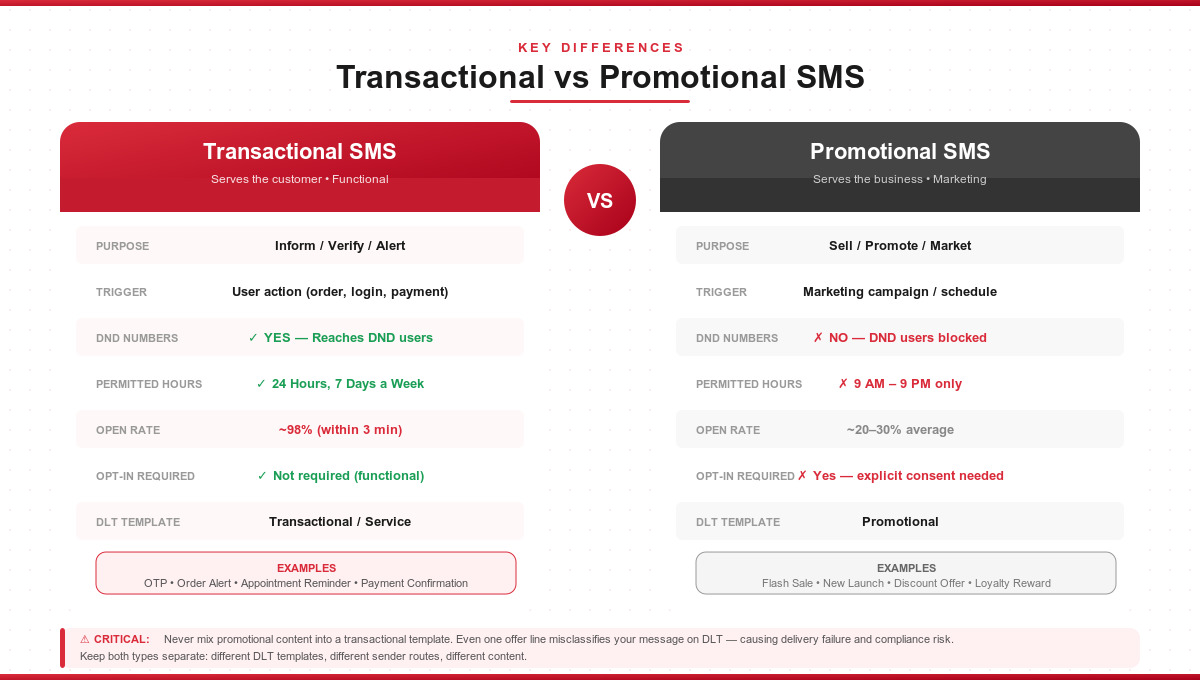
The difference between promotional vs transactional SMS is one of the most searched questions in this space — and the stakes of getting it wrong are high. Misclassify a message on India's DLT platform and you risk delivery failure, compliance violations, or a blacklisted Sender ID.
Here is the complete breakdown:
Feature | Transactional SMS | Promotional SMS |
|---|---|---|
Purpose | Informs / verifies / alerts the user | Sells, promotes, or engages for marketing |
What triggers it | User action (login, order, payment) | Marketing calendar or campaign |
DND numbers (India) | YES — reaches DND-registered users | NO — blocked by DND |
Permitted hours (India) | 24 hours, 7 days | 9 AM – 9 PM only |
DLT template type | Transactional / Service | Promotional |
Opt-in required | No — functional communication | Yes — explicit marketing consent |
Open rate | ~98% within 3 min | ~20–30% average |
Compliance risk if mixed | Template block / Sender ID blacklist | Legal liability |
Examples | OTP, order alert, appointment reminder | Flash sale, new launch, loyalty reward |
⚠️ Common Mistake: Adding even a single promotional line — like 'Also check out our new arrivals!' — to a transactional template converts your message into a hybrid. This violates DLT classification rules and can result in delivery failure or regulatory action.
Transactional vs Marketing SMS — Clearing the Final Confusion
You will often see 'marketing SMS' and 'promotional SMS' used interchangeably in global guides. In the Indian regulatory context — which is what matters most if you operate here — the official TRAI classification is Transactional, Service (Explicit), Service (Implicit), and Promotional.
When people ask about transactional vs marketing SMS, they are essentially asking: 'Is my message functional, or is it commercial?' The answer determines which DLT template category you register under, which sender route your provider uses, and whether your message reaches DND-registered numbers. Treat the distinction with the seriousness it deserves.
Real Transactional SMS Examples That Drive Results
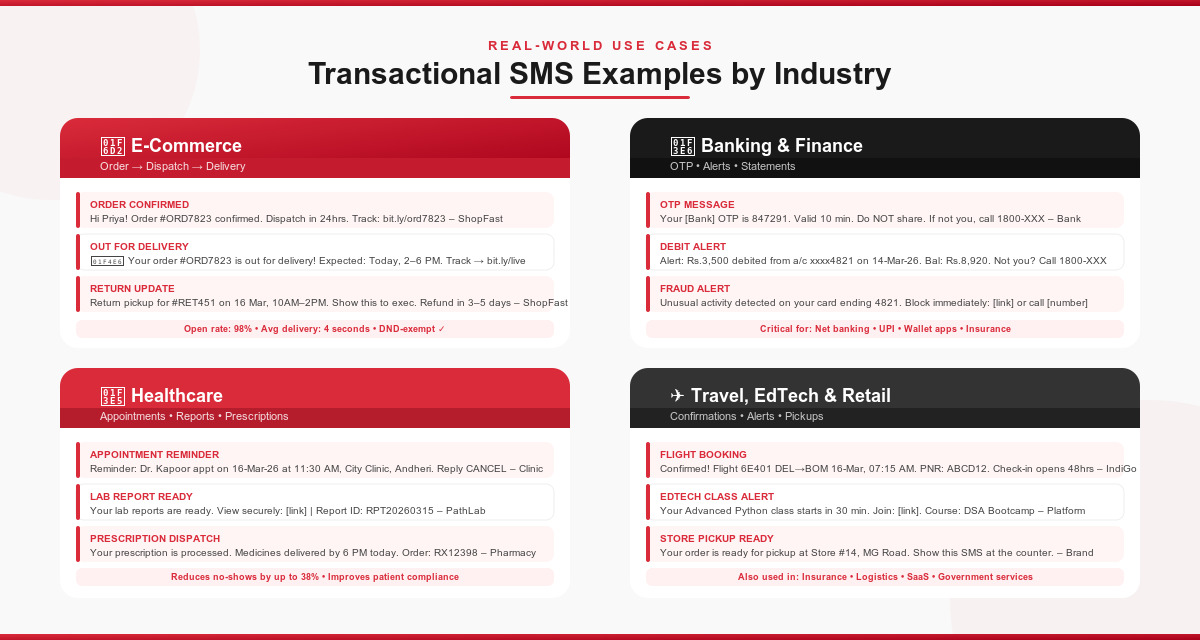
Reading definitions is one thing. Seeing transactional SMS examples from real business scenarios is what makes the concept click. Here are the most impactful use cases, industry by industry, with actual message formats you can adapt today.
E-Commerce: Turn Orders Into Trust
E-commerce businesses generate more transactional SMS touchpoints than almost any other industry. Every stage of the order lifecycle becomes an opportunity to build confidence and reduce post-purchase anxiety.
Trigger Event | Sample Transactional SMS Message |
|---|---|
Order placed | Hi Priya! Your order #ORD7823 for 2 items has been confirmed. Dispatch in 24 hrs. Track: [link] – Brand |
Order dispatched | Great news! Your order #ORD7823 is now out for delivery. Expected: 15 Mar, 2–6 PM. Track: [link] – Brand |
Delivered | Delivered! Your order #ORD7823 arrived today. Rate your experience: [link] – Brand |
Order cancelled | We have processed your cancellation for #ORD7823. Refund of Rs.899 will reflect in 3-5 days. – Brand |
Return initiated | Return pickup scheduled for 16 Mar, 10 AM–2 PM for #RET451. Show this to the executive. – Brand |
Notice the pattern: every message anchors to a reference number, states the specific action that occurred, and gives the customer a clear next step. No filler. No fluff. Pure utility.
Banking & Finance: Where Reliability Is Non-Negotiable
Banking institutions send some of the most critical transactional SMS messages in existence. A delayed OTP means a failed payment. A missed fraud alert means unchallenged financial crime. The stakes here demand 100% delivery reliability.
Use Case | Sample Transactional SMS Message |
|---|---|
OTP — login | Your OTP for [Bank] login is 847291. Valid 10 min. Do NOT share with anyone. – [Bank] |
Debit alert | Alert: Rs.3,500 debited from your ac xxxx4821 on 14-Mar-26. Bal: Rs.8,920. Not you? Call 1800-XXX. – [Bank] |
FD maturity | Your FD of Rs.1,00,000 matures on 20-Mar-26. Login to renew or withdraw: [link] – [Bank] |
Payment success | Payment of Rs.2,200 to Zomato successful via UPI. Ref: UPI20260314. – [Bank] |
Suspicious activity | Unusual activity detected on your card. If not you, block immediately: [link] or call [number]. – [Bank] |
💡 Why SMS beats email for OTPs: SMS requires zero internet connection. During payment flows, customers may be on weak data connections. SMS delivers where apps and email cannot — which is precisely why every UPI, net banking, and wallet transaction in India relies on it.
Healthcare: The Message That Changes Patient Outcomes
Healthcare providers use transactional SMS to solve a very expensive problem: missed appointments. Studies show that SMS appointment reminders reduce no-shows by up to 38%. Beyond reminders, healthcare SMS covers prescription alerts, lab report notifications, and post-consultation follow-ups.
Healthcare Scenario | Sample Transactional SMS |
|---|---|
Appointment reminder | Reminder: Your appt with Dr. Kapoor is on 16-Mar-26 at 11:30 AM, City Clinic, Andheri. Reply CANCEL to reschedule. – Clinic |
Lab report ready | Your lab reports are ready. View securely: [link] | Report ID: RPT20260315. – PathLab |
Prescription dispatch | Your prescription is being processed. Medicines delivered by 6 PM today. Order: RX12398. – Pharmacy |
Discharge summary | Discharge summary for Patient: Anjali S. is ready for download: [link]. – Hospital Name |
Travel, EdTech & Retail: More Examples That Work
Transactional SMS use cases extend well beyond the big three industries. Here are high-impact applications across other sectors:
- Travel: 'Booking Confirmed! Flight 6E401 DEL>BOM 16-Mar, 07:15 AM. PNR: ABCD12. Web check-in opens 48 hrs prior. – IndiGo'
- EdTech: 'Your class on Advanced Python starts in 30 min. Join here: [link]. Course: DSA Bootcamp. – Platform'
- Retail (in-store): 'Your order is ready for pickup at Store #14, MG Road. Show this SMS at the counter. Order: PU9821. – Brand'
- Logistics: 'Shipment AWB123456 reached Delhi Hub on 14-Mar-26. Expected delivery: 15 Mar. Track: [link]'
- Insurance: 'Premium of Rs.12,400 for Policy #LIC8923 due on 20-Mar-26. Pay now: [link] to avoid lapse. – Insurer'
DLT Compliance: The India-Specific Framework You Cannot Ignore
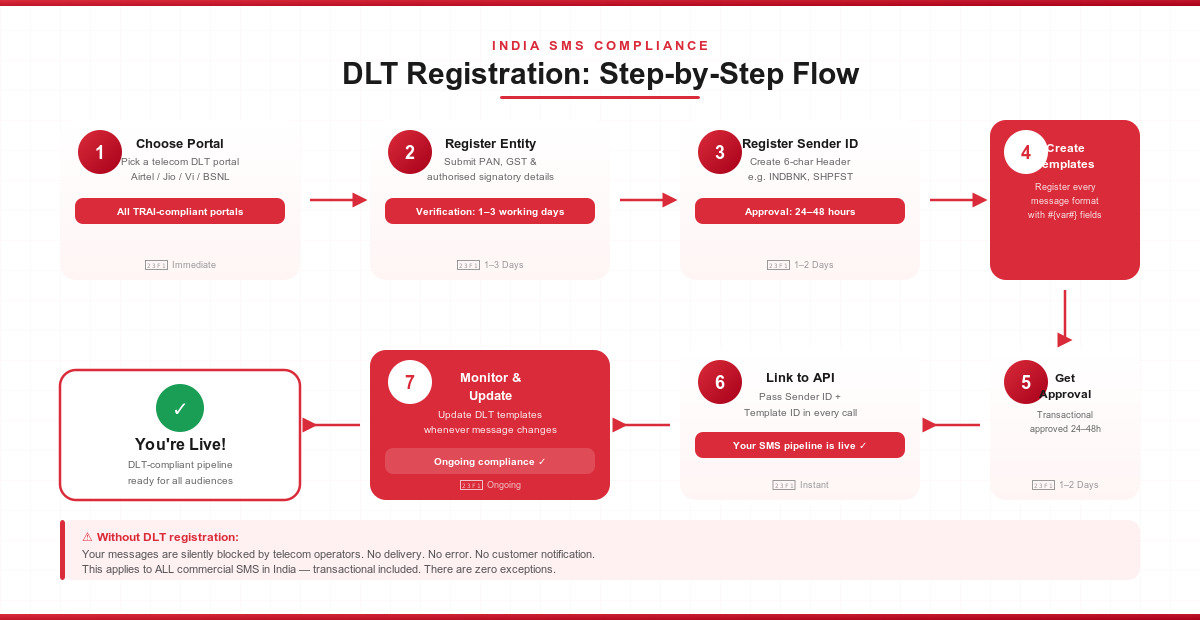
If you send commercial SMS in India, DLT compliance is not optional — it is the infrastructure layer on which your entire transactional SMS operation runs. Understanding it is not just a regulatory checkbox. It is what determines whether your messages actually reach customers.
What Is DLT and How Does It Control Every SMS in India?
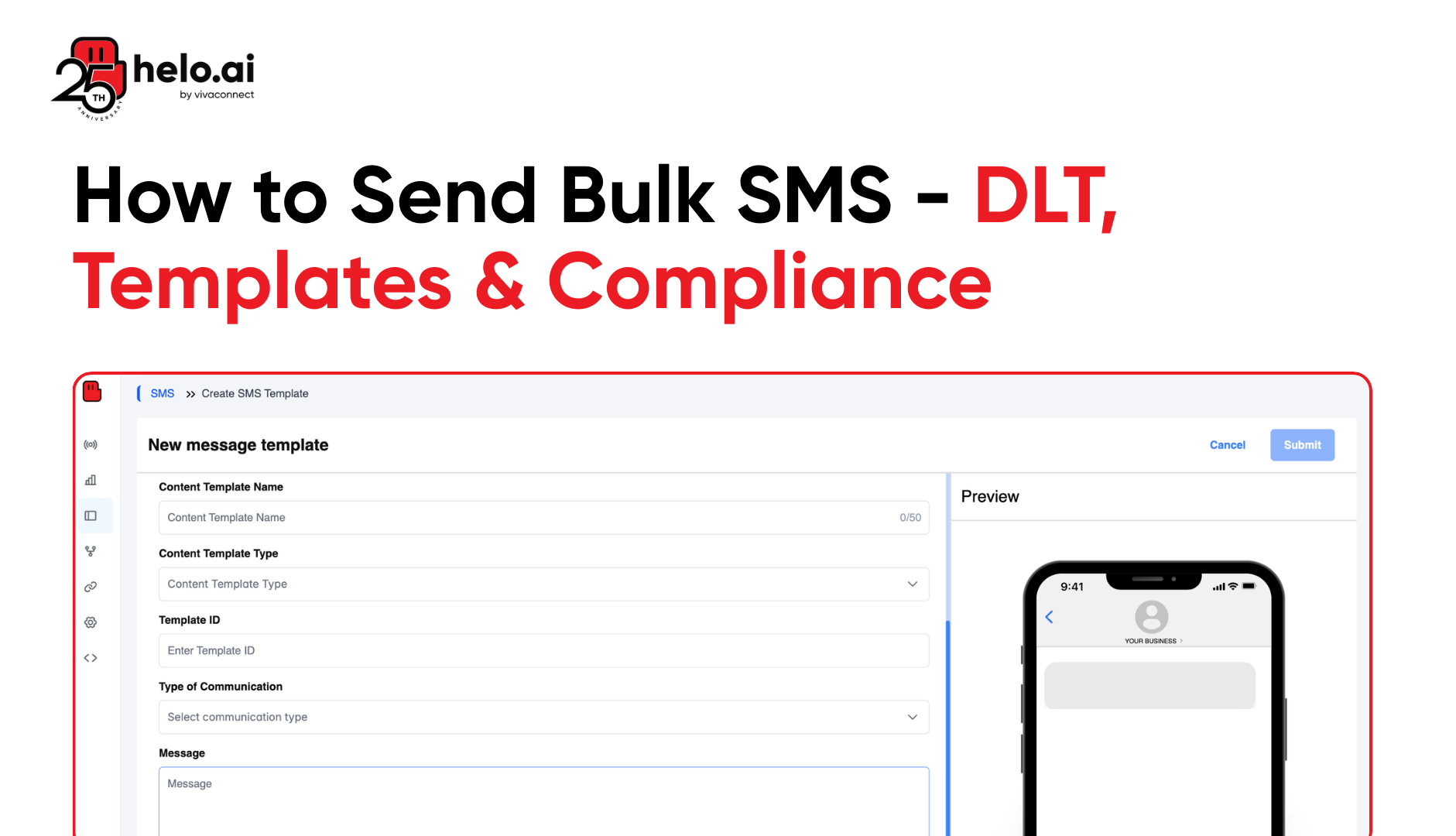
DLT stands for Distributed Ledger Technology. India's TRAI (Telecom Regulatory Authority of India) mandated the DLT platform in 2021 to stamp out SMS spam, phishing, and fraudulent brand impersonation. The system creates a tamper-proof, blockchain-backed registry of every business, sender ID, and message template operating in Indian telecom networks.
Every SMS you send flows through this registry. Telecom operators check three things in real time before routing your message:
- Is the sending entity registered on the DLT platform?
- Is the Sender ID (Header) registered and approved?
- Does the message content match a registered and approved template?
If the answer to any of these is no, the telecom operator blocks your message. It does not bounce back. It does not generate an error. It simply disappears — and your customer never receives it. For an OTP or payment confirmation, that is catastrophic.
100% of commercial SMS in India must pass DLT verification before delivery — no exceptions
The 6 DLT Mistakes That Block Your Messages
The following errors are the most common causes of DLT-related delivery failure. Avoid each one explicitly:
- Rigid templates with no variable fields — always include #{var#} placeholders for dynamic content like OTPs, names, and amounts
- Promotional content in a transactional template — even adding a short link to your website's homepage can trigger a misclassification flag
- Sender ID that does not reflect your brand — 'XYZABC' for a company called IndiaFinance erodes trust and can attract regulatory attention
- Failing to register all message variants — if you send 5 different OTP message formats, register all 5 separately
- Not updating DLT templates when your message changes — your live message must match the registered template character-for-character (outside variables)
- Using a non-approved Sender ID as a fallback — some teams use a generic ID when their branded one is pending. This also risks delivery failure if not registered.
💡 Pro Tip: Most high-quality SMS API provider offer assisted DLT onboarding. They guide you through entity registration, template creation, and approval tracking. This dramatically reduces the time-to-live for your first transactional SMS campaign.
How to Write Transactional SMS Messages That Actually Work
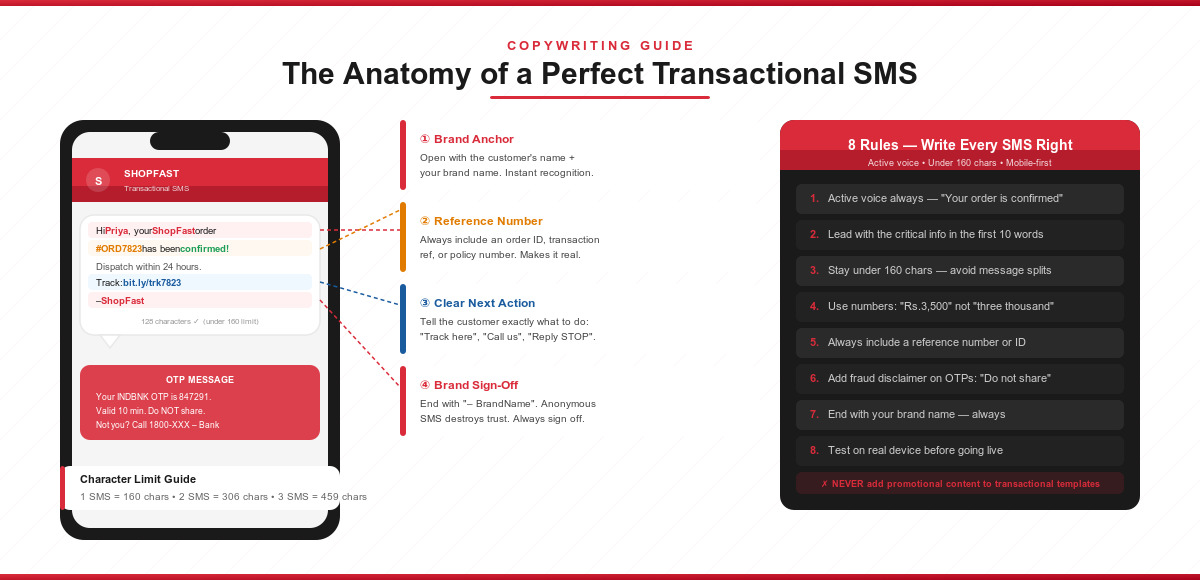
Your infrastructure can be flawless — DLT registered, API integrated, delivery confirmed — and your messages can still fail if the writing is poor. Good transactional SMS copywriting is a craft. Here is the framework that top brands use.
The Perfect Message Formula (With Templates)
Every high-performing transactional SMS follows this structure. Think of it as a recipe: miss one ingredient and the whole dish suffers.
Element | Purpose | Example |
|---|---|---|
Brand anchor | Tells reader instantly who is texting | 'Hi Priya, your [Brand] order...' |
The critical info | Leads with what matters most | 'OTP: 847291' or 'Order confirmed #ORD782' |
Reference data | Makes message unambiguous | Order number, amount, date, policy ID |
Urgency/validity | Frames time sensitivity | 'Valid for 10 minutes' or 'Deliver by 6 PM' |
Next action | Tells user what to do next | 'Track here: [link]' or 'Call 1800-XXX if not you' |
Sender sign-off | Reinforces trust and identity | End with ' – [BrandName]' |
Here is that formula applied in a single OTP message:
Template Example: Your [Brand] login OTP is 847291. Valid for 10 minutes. Do NOT share this with anyone. If you did not request this, call 1800-XXX immediately. – [Brand]
Notice: brand anchor at start, OTP leads immediately, validity stated, fraud warning included, action if unauthorised, brand sign-off at end. Every element earns its place.
8 Writing Rules Every SMS Must Follow
Apply these rules to every transactional message you register on DLT or send through your API:
- Write in active voice — 'Your order has been confirmed' not 'Confirmation of your order has been processed'
- Lead with the most important information — put the OTP, status, or amount in the first 10 words
- Stay under 160 characters — one SMS unit is 160 characters; going over splits the message and risks out-of-order delivery
- Use plain numbers, not words — 'Rs.3,500' reads faster than 'three thousand five hundred rupees'
- Include a reference number — always give the customer a receipt they can quote in support calls
- Add a fraud disclaimer on OTP messages — 'Do not share this with anyone' is non-negotiable for financial messages
- End with your brand name — always. Anonymous SMS erodes trust instantly
- Test every template on a real device before going live — what looks clean in a dashboard can render strangely on certain handsets
Promotional and Transactional SMS: Should You Use Both?
Here is a question we hear constantly: 'We already send promotional SMS. Do we really need transactional SMS too?' The answer is yes — and they are not competing channels. They complement each other at different points in the customer journey.
Think of it this way: promotional and transactional SMS serve completely different jobs. Promotional SMS fills the top and middle of your funnel — it attracts attention, creates desire, and drives action. Transactional SMS owns the bottom of the funnel and the post-purchase experience — it confirms, reassures, verifies, and retains.
Using only promotional SMS is like having a great sales team that disappears the moment a customer signs the contract. Using only transactional SMS is like having outstanding customer service with no marketing engine feeding the pipeline. You need both to run a complete customer experience.
How to Build a Unified SMS Strategy
Here is how smart businesses structure their combined SMS approach:
Customer Journey Stage | SMS Type to Use | Example Message Goal |
|---|---|---|
Awareness / Discovery | Promotional SMS | Flash sale announcement, new collection launch |
Consideration | Promotional SMS | Limited-time offer, cart abandonment reminder |
Purchase | Transactional SMS | Order confirmation, payment receipt, OTP |
Post-Purchase | Transactional SMS | Dispatch alert, delivery confirmation, returns update |
Retention | Promotional SMS | Loyalty points update, re-engagement offer |
Support / Service | Transactional SMS | Account alert, renewal reminder, policy update |
⚠️ Critical Rule: Never send transactional and promotional content in the same SMS. Keep the two message types completely separate — different DLT templates, different sender routes, and different message content. Mixing them creates compliance risk and destroys the trust that transactional messages have earned.
Why Transactional SMS Outperforms Every Channel in 2026
You have email, WhatsApp, push notifications, and RCS messaging all competing for your attention and budget. So why does transactional SMS still win? Four structural advantages make it irreplaceable in the Indian market.
Universal reach. SMS reaches every mobile phone in India — from a Rs. 500 feature phone in rural Bihar to the latest flagship in South Mumbai. No app install, no internet connection, no notification permission required. Nothing else comes close.
DND immunity for transactional messages. India has over 300 million DND-registered mobile numbers. Promotional SMS cannot reach any of them. Transactional SMS bypasses this restriction completely. If you operate in any regulated space — banking, insurance, healthcare, e-commerce — this matters enormously.
Delivery certainty. A well-configured transactional SMS pipeline delivers at 95–98% success rates. Email averages 20% open rates. Push notifications are turned off by 60% of users. WhatsApp messages go unread in busy inbox tabs. SMS arrives in the most personal space on a person's device — and they read it.
TRAI-backed trust infrastructure. The DLT framework, despite its setup friction, has made the transactional SMS channel more trustworthy than ever. Customers have been trained to expect — and trust — SMS from verified brands. The verified sender ID and consistent template format signal legitimacy that unverified channels cannot replicate.
Channel | Open Rate | Internet Required | DND Numbers | Delivery Speed |
|---|---|---|---|---|
Transactional SMS | ~98% | No | ✅ Reaches them | < 10 seconds |
~20-25% | Yes | N/A | Minutes to hours | |
WhatsApp Business | ~60-70% | Yes | N/A | Seconds (if online) |
Push Notifications | ~30-40% | Yes | N/A | Seconds (if enabled) |
Promotional SMS | ~30% | No | ❌ Blocked | < 10 seconds |
Conclusion
Transactional SMS is not a commodity feature that you bolt onto your tech stack as an afterthought. In 2026, it is the communication backbone that underpins customer trust, operational reliability, and regulatory compliance for every serious digital business in India.
You now have the full picture: what makes a message truly transactional, how it compares with promotional SMS, what real transactional SMS examples look like across every major industry, how India's DLT framework governs every message you send, how to integrate a transactional SMS API with confidence, how to write messages that customers actually value, and why SMS continues to outperform every alternative channel.
The infrastructure, the knowledge, and the framework all live in this guide. What comes next is execution.
Start with your highest-stakes touchpoints — OTP delivery, order confirmation, payment alert. Get those right. Build from there. Because every transactional SMS you send is not just a notification — it is a trust signal that compounds over time, one well-delivered message at a time.
Frequently Asked Questions About Transactional SMS
1. What is transactional SMS?
Transactional SMS is an automated text message that a business sends to a customer because a specific action or event has occurred — such as placing an order, requesting an OTP, or completing a payment. Unlike promotional SMS, transactional SMS delivers essential, time-sensitive information tied directly to an individual customer's activity. It does not contain marketing content.
2. What is the difference between transactional and promotional SMS?
Transactional SMS serves the customer by delivering functional information they need (OTP, order status, account alert). Promotional SMS serves the business by marketing products or offers. In India, the key practical difference is that transactional SMS can reach DND-registered numbers at any hour, while promotional SMS cannot reach DND numbers and is restricted to 9 AM–9 PM. Misclassifying messages on the DLT platform causes delivery failure and compliance risk.
3. What are the best transactional SMS examples?
The most effective transactional SMS examples include: OTP messages for login and payment verification (banking, fintech, e-commerce); order confirmation and dispatch alerts (e-commerce, logistics); appointment reminders and lab report notifications (healthcare); payment receipts and fraud alerts (banking); booking confirmations (travel, hospitality); and subscription renewal reminders (SaaS, insurance). Each message is triggered by a user action, personalised with reference data, and sent immediately.
4. Can I send transactional SMS to DND numbers in India?
Yes. Transactional SMS is exempt from DND (Do Not Disturb) restrictions in India under TRAI regulations, because these messages serve a functional purpose to the recipient rather than a promotional one. You can send them 24 hours a day, 7 days a week — including to users who have registered on the national DND registry. However, the message must be correctly classified as Transactional on the DLT platform.
5. What is DLT in the context of SMS in India?
DLT (Distributed Ledger Technology) is India's TRAI-mandated regulatory framework for all commercial SMS. It requires businesses to register their company, Sender ID (Header), and every message template on a telecom operator's DLT portal. Every SMS passes through a real-time DLT check before delivery. If your entity, sender ID, or template is not registered, the telecom operator blocks the message silently — it never reaches your customer.
6. How does the transactional SMS API work?
A transactional SMS API works by accepting an HTTP POST request from your application containing the recipient's mobile number, your DLT-registered Sender ID, the approved Template ID, and any variable field values (OTP, order number, name). The API validates your credentials, routes the message through a DLT-compliant pathway to the telecom network, and delivers it to the customer's handset. A delivery receipt (DLR) callback then returns the delivery status to your system in real time.
7. How do I send transactional SMS online without coding?
You can send transactional SMS online through any modern SMS platform's web dashboard — no coding required. Log in, register your DLT templates within the platform, upload your contact list, configure automated trigger rules (such as 'when order is dispatched, send notification'), and monitor delivery reports in real time. Most platforms offer native integrations with Shopify, WooCommerce, and CRM tools so that triggers fire automatically based on events in those systems.
8. What should a transactional SMS message include?
Every effective transactional SMS should include: your brand name as an anchor at the start or end; the critical information first (OTP, status, amount); a reference number (order ID, policy number, transaction ID); any urgency or validity period ('valid for 10 minutes'); a clear next action if required ('track here' or 'call us if not you'); and a brand sign-off. Keep the total under 160 characters where possible to avoid multi-part splits.
9. How is transactional SMS different from marketing SMS?
The core difference is purpose and trigger. Marketing SMS (promotional SMS in TRAI's classification) is broadcast-driven — your team schedules it to promote offers or engage audiences. Transactional SMS is event-driven — your system sends it automatically because a specific customer action just occurred. The compliance rules, DLT template classification, permitted delivery hours, DND restrictions, and content guidelines are all different for each type. You need both in a complete SMS strategy, but they must never mix in the same message.