.jpeg)
.png)


Utility messages update customers. Marketing messages promote. Here's how WhatsApp tells them apart, what happens when you mix the two, and why the category affects cost.
A customer receives two WhatsApp messages from their bank.
The first says their KYC details are incomplete. The second offers them a pre-approved personal loan.
Both messages come from the same bank. Both may be sent through the WhatsApp Business Platform. But they serve different purposes, and that difference matters.
One is a utility message. The other is marketing.
Understanding the distinction helps businesses choose the right message category and avoid treating every customer communication the same way.
WhatsApp utility vs marketing messages at a glance
Criteria | Utility | Marketing | Authentication |
|---|---|---|---|
Purpose | Updates the customer about an existing transaction, account, service or request | Promotes a product, service, offer or business objective | Verifies the customer's identity |
Triggered by | Something the customer has done, requested or is expecting | The business wanting to generate interest or bring customers back | A login or verification attempt |
Example | "Your order has been shipped." | "Enjoy 20% off with code SAVE20." | "Your verification code is 482913." |
Can include offers? | No | Yes | No |
India rate per delivered message | ₹0.115 | ₹0.8631 | ₹0.115 |
Meta's published India rates for 2026, before GST. Rates vary by country; see our WhatsApp Business API pricing guide for India.
What is a WhatsApp utility message?
A utility message provides an update related to an existing transaction, account, service or request. It is generally something the customer needs to know, rather than an attempt to sell them something.
Examples include:
- A bank notifying a customer about an account-status change.
- An e-commerce brand confirming that an order has shipped.
- A service provider reminding a customer about an existing appointment.
- A business confirming that a payment has been processed.
The common thread is that the message relates to something specific the customer has already done, requested or is expecting.
What is a WhatsApp marketing message?
A marketing message is intended to promote a product, service, offer or other business objective.
Examples include:
- A bank promoting a personal loan or credit card.
- A retailer announcing a festive discount.
- An e-commerce brand encouraging customers to return to an abandoned cart.
- A business announcing a new product or service.
These messages aim to generate interest, encourage an action or bring customers back to the business.
What if a message contains both?
This is where businesses need to be careful.
Imagine an online retailer sends:
The first sentence is a transactional update. The second promotes another purchase.
Adding the offer changes the nature of the message. Under Meta's template categorisation guidelines, mixed utility and promotional content is generally categorised as marketing.
A better approach is to separate the two messages:
This keeps each message focused on its purpose and makes the intended category clearer.
Common grey areas
Some messages look like updates but fall on the marketing side under Meta's guidelines:
- Renewal reminders. A reminder to renew a subscription or policy is asking for a renewal, so Meta treats it as marketing. A reminder that a payment is due on an existing loan or bill is generally utility.
- Feedback surveys. A survey about a specific order or interaction can be utility. A general survey about your brand cannot.
- Abandoned cart reminders. The customer hasn't completed the purchase, and the message encourages them to come back. That makes it marketing, even if the customer opted in.
Where do OTPs fit in?
One-time passwords (OTPs) and verification codes belong to a third category: authentication.
For example, when a customer signs in to a banking app and receives a code to verify their identity, that message serves a security purpose. It is not a marketing message, and it should not automatically be classified as utility.
WhatsApp's template framework distinguishes marketing, utility and authentication templates.
Why does the category matter?
The category is not just a label a business chooses for its convenience. Meta reviews template content against its categorisation rules and can reject or reclassify a template if the content does not fit.
The category also affects message pricing under Meta's applicable rate card. A promotional sentence added to a transactional message can therefore affect both its classification and cost.
For businesses, the practical lesson is simple: decide what the message needs to achieve before writing it, rather than trying to fit the finished copy into a preferred category. Our guide to WhatsApp template categories covers each category in more detail.
Can Meta change the category after approval?
Yes. If an approved template doesn't fit its category, Meta can change it. A utility template with promotional content can be moved to marketing, usually with a day's notice by email and in WhatsApp Manager. The template stays approved, but each message is then charged at the marketing rate. Businesses can request a review within 60 days. Here's what to do if it happens.
What about WhatsApp Direct Send?
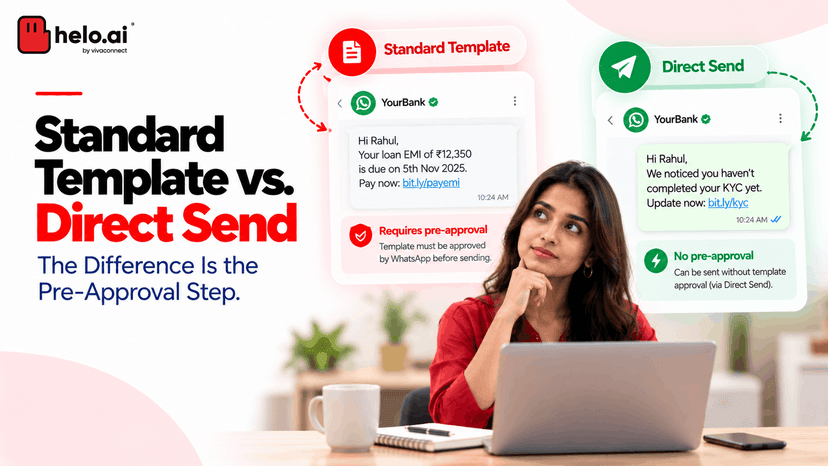
Direct Send is designed to help eligible WhatsApp Business Accounts send qualifying utility messages without waiting for standard template pre-approval.
It does not make marketing messages eligible for Direct Send. A promotional offer cannot be classified as utility simply because the business wants to send it quickly.
Businesses should check the current Meta Direct Send documentation before relying on the feature.
How to choose the right category
Before sending a WhatsApp message, ask yourself one question:
Are we updating the customer about something relevant to their existing account or transaction, promoting something, or verifying their identity?
That answer is a useful starting point for choosing between utility, marketing and authentication.
Getting the distinction right helps businesses plan messaging more clearly, follow WhatsApp's rules and avoid mixing customer updates with sales messages.
Frequently asked questions
Is a utility message cheaper than a marketing message?
Yes. In India, Meta's published rate is ₹0.115 per delivered utility message and ₹0.8631 per marketing message, before GST. Rates vary by country.
Can I add an offer to a utility message?
No. Utility messages can't include promotions, upsells or offers. If you add one, Meta treats the whole template as marketing.
Is an abandoned cart message utility or marketing?
Marketing. It encourages the customer to come back and complete a purchase, so it's promotional even if the customer opted in.
Can an OTP be sent as a utility message?
No. OTPs and verification codes must use authentication templates. Meta doesn't allow marketing or utility templates for this purpose.
.jpeg&w=640&q=75)
.jpeg&w=96&q=75)