


Loyalty programs often fail for a simple reason: customers forget to use them. A separate app may not be opened, a plastic card may be lost, and email rewards can disappear in a crowded inbox.
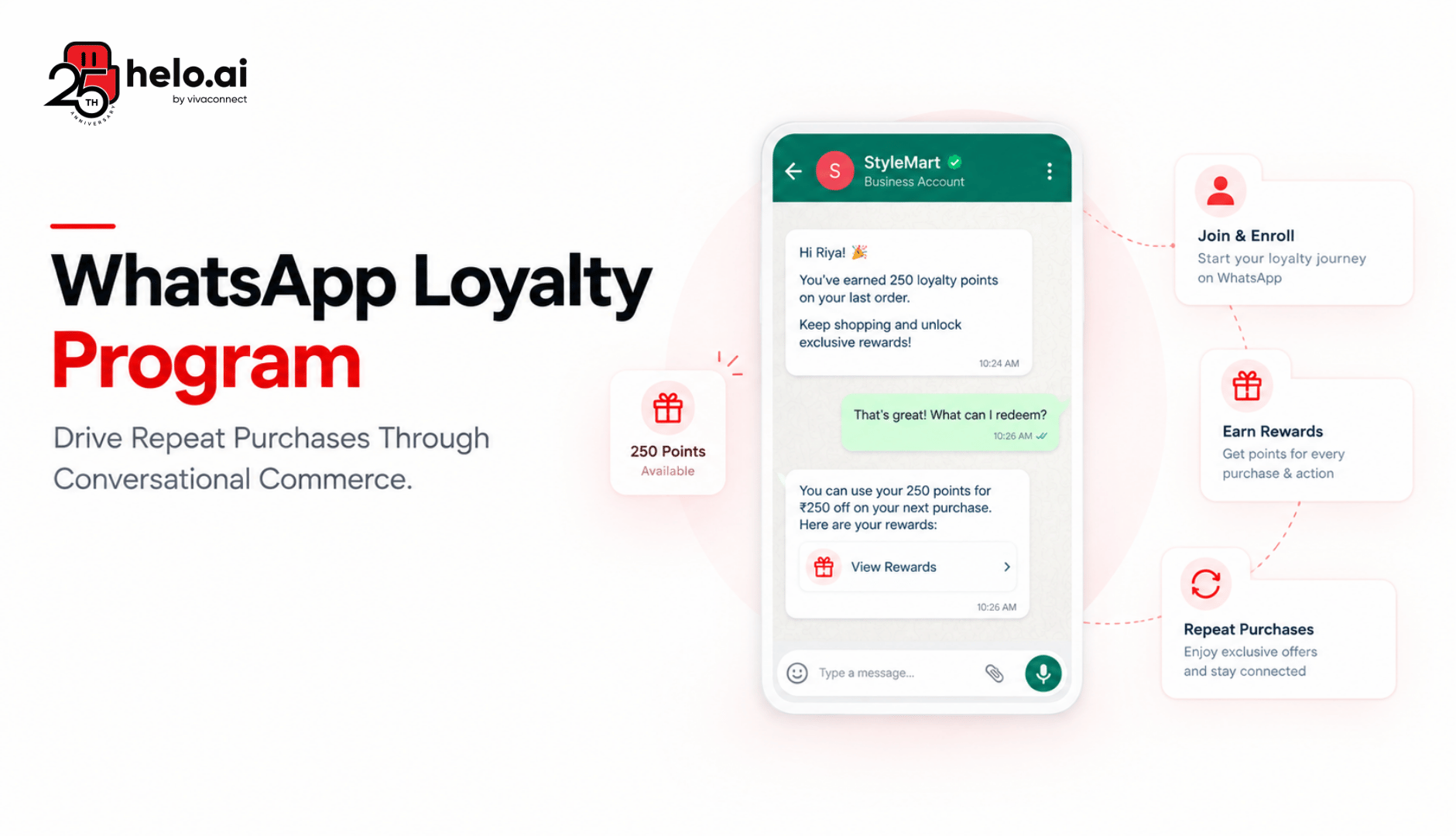
A WhatsApp loyalty program brings enrollment, points, rewards, referrals, and retention messages into a channel customers already use. It can help retailers and ecommerce brands stay connected after purchase, encourage repeat orders, and make loyalty interactions more conversational.
This guide explains how to build a WhatsApp loyalty program, connect it with ecommerce, POS, CRM, and loyalty systems, and use it to drive repeat purchases without overwhelming customers with promotional messages.
What Is a WhatsApp Loyalty Program?
A WhatsApp loyalty program is a customer-rewards program that uses WhatsApp for enrollment, points updates, reward notifications, referrals, tier communication, and retention campaigns.
Customers can interact with the program through:
- Text messages.
- Reply buttons.
- List messages.
- QR codes.
- WhatsApp links.
- Product messages.
- WhatsApp Flows.
- Chatbots.
- Customer-support conversations.
The loyalty system tracks the customer’s activity, while WhatsApp provides the conversational interface.
WhatsApp loyalty program architecture
Component | Role |
|---|---|
Customer-facing communication and conversation channel | |
WhatsApp Business API | Messaging, automation, templates, webhooks, and integrations |
CRM/CDP | Customer profiles, segmentation, lifecycle data, and interaction history |
Ecommerce platform | Orders, products, payments, and customer purchases |
POS | In-store transactions, receipts, and store-level activity |
Loyalty engine | Points, tiers, reward rules, balances, and redemption logic |
Helo.ai | Messaging, automation, AI, orchestration, and system-integration layer |
WhatsApp Business supports interactive messages, reply buttons, list messages, product messages, QR-code entry points, and engagement reporting. These features make it possible to build more useful loyalty journeys than simply sending promotional text.
For the commerce side of this journey, see Helo.ai’s guide to native WhatsApp product catalog and checkout flows.helo
WhatsApp Loyalty vs Commerce
The terms are related, but they describe different parts of the customer journey.
Concept | Main purpose | Example |
|---|---|---|
WhatsApp commerce | Help customers discover, evaluate, buy, and track products | Catalog browsing, cart creation, checkout, payment, order tracking |
WhatsApp marketing | Promote products, campaigns, offers, and launches | Sale announcement or new-product campaign |
WhatsApp loyalty | Encourage repeat purchases and deepen customer relationships | Points update, reward unlock, VIP offer, referral |
WhatsApp retention | Keep customers active and bring inactive customers back | Reorder reminder, back-in-stock alert, win-back offer |
A complete customer journey can combine all four:
Customer discovers a product → buys through WhatsApp or a website → receives order updates → earns points → unlocks a reward → redeems an offer → receives a personalized reorder reminder.
This is the practical meaning of WhatsApp commerce loyalty: combining conversational shopping with rewards and retention.
How a WhatsApp Loyalty Program Works
A typical WhatsApp loyalty workflow follows six steps.
1. Customer enrollment
The customer joins through:
- A QR code at checkout.
- A website or checkout opt-in.
- A WhatsApp link.
- A product-package QR code.
- A receipt.
- A keyword such as
JOIN. - A Click-to-WhatsApp advertisement.
- A customer-support interaction.
2. Identity matching
The business matches the WhatsApp phone number with the customer’s:
- CRM profile.
- Loyalty account.
- Ecommerce account.
- POS record.
- Email address.
- Order history.
- Customer ID.
This prevents duplicate profiles and ensures that points go to the correct customer.
3. Purchase or action tracking
A completed purchase or qualifying action triggers a loyalty event.
Examples include:
- Order placed.
- Payment completed.
- Review submitted.
- Referral completed.
- Profile completed.
- Birthday reached.
- Tier threshold reached.
- Product replenishment due.
4. Points and reward calculation
The loyalty engine calculates:
- Points earned.
- New balance.
- Tier status.
- Reward eligibility.
- Expiry date.
- Coupon value.
- Redemption conditions.
5. WhatsApp notification
WhatsApp sends a relevant message, such as:
- Points-earned notification.
- Reward-unlocked message.
- Tier-upgrade alert.
- Points-expiry reminder.
- Personalized offer.
- Referral invitation.
- Reorder reminder.
6. Redemption and measurement
The customer uses the reward, and the redemption event is synchronized with the loyalty platform, POS, ecommerce store, CRM, or analytics system.
Recommended architecture
POS/ecommerce platform → loyalty engine → CRM/customer profile → WhatsApp Business API → customer conversation → response/webhook → loyalty and commerce systems
Helo.ai should be positioned as the communication, automation, AI, and orchestration layer in this model. Do not claim that Helo.ai independently calculates loyalty points or manages reward balances unless that is a confirmed product capability.
WhatsApp Loyalty Use Cases
Loyalty enrollment through QR codes
Customers can scan a QR code placed on:
- Store counters.
- Receipts.
- Product packaging.
- Delivery boxes.
- Menus.
- Event materials.
- Website banners.
- Checkout screens.
The QR code can open a WhatsApp conversation or enrollment flow.
Example:
The enrollment message should explain the value clearly. Customers should know what they will receive and why the brand is requesting permission to contact them.
Points and balance updates
Send notifications when:
- Points are earned.
- Points are added after a purchase.
- A customer reaches a new tier.
- A customer is close to unlocking a reward.
- Points are expiring.
- A transaction is reversed.
- A reward is redeemed.
Example:
Keep the message factual and connected to a real purchase or loyalty event.
Reward unlocks and redemption
Rewards may include:
- Discount coupons.
- Free shipping.
- Free products.
- Birthday benefits.
- Early access.
- VIP experiences.
- Service upgrades.
- Exclusive product access.
Example:
Use clear expiry dates and redemption instructions. Avoid creating false urgency.
Tiers and VIP benefits
Tier programs encourage customers to increase purchase frequency or order value.
Possible tiers include:
- Member
- Silver
- Gold
- VIP
- Insider
- Elite
Benefits may include:
- Early access to new products
- Exclusive pricing
- Free delivery
- Priority support
- Birthday rewards
- Special events
- Extended return benefits
Example:
Referrals and milestones
Reward customers for actions such as:
- Referring a friend
- Completing a second purchase
- Writing a review
- Sharing a product
- Completing a profile
- Reaching a spending milestone
Example:
Referral terms should be transparent and easy to understand.
Reorder and replenishment reminders
WhatsApp loyalty and retention are especially valuable for products with predictable repurchase cycles.
Examples include:
- Skincare
- Supplements
- Pet supplies
- Grocery
- Household items
- Coffee
- Personal care
- Consumables
Example:
Helo.ai’s content on personalized messaging for D2C brands is a relevant internal link for purchase-history-based recommendations and loyalty communication.helo
How to Build a WhatsApp Loyalty Program
1. Define the business objective
Choose one primary goal first:
- Increase second purchases.
- Improve repeat-purchase frequency.
- Increase average order value.
- Reactivate inactive customers.
- Grow referrals.
- Increase customer-data quality.
- Improve loyalty enrollment.
- Reduce dependence on marketplace channels.
Avoid launching a loyalty program without a clear economic objective.
2. Choose the reward economics
Decide:
- How customers earn points.
- Whether points are based on orders, value, product categories, or actions.
- How many points are needed for a reward.
- Whether points expire.
- Which products qualify.
- Whether points can be combined with promotions.
- How returns and cancellations affect points.
- Whether rewards apply online, offline, or both.
A loyalty program should be financially sustainable. A reward that increases orders but destroys margin is not a successful loyalty strategy.
3. Select the enrollment method
Use one or more of:
- QR code at checkout.
- Website or app opt-in.
- Checkout checkbox.
- Click-to-WhatsApp ad.
- Product-packaging QR code.
- Receipt link.
- Keyword-based enrollment.
- Customer-support invitation.
For retail, QR-based enrollment is simple because it connects a physical purchase to a digital WhatsApp conversation.
4. Connect customer identity
Use the customer’s phone number, loyalty ID, CRM ID, email, order ID, or POS profile to match records.
Identity matching should prevent:
- Duplicate loyalty accounts.
- Points credited to the wrong person.
- Duplicate rewards.
- Incomplete customer profiles.
- Unwanted messages to unverified contacts.
5. Connect the systems
A complete implementation may connect:
- WhatsApp Business API
- Ecommerce platform
- POS
- CRM/CDP
- Loyalty platform
- Product catalog
- Payment system
- Customer-support platform
- Analytics tools
Use event-based triggers such as:
- Order placed
- Order delivered
- Points earned
- Reward unlocked
- Tier changed
- Coupon redeemed
- Customer inactive
- Product replenishment due
6. Build the first three workflows
Start with:
- Loyalty enrollment and welcome.
- Points-earned or reward-unlocked notification.
- Repeat-purchase or win-back campaign.
These provide a clear test of enrollment, value delivery, and retention.
7. Add interactive experiences
Use buttons, lists, carousels, and WhatsApp Flows for:
- Check points balance.
- View rewards.
- Redeem a coupon.
- Browse eligible products.
- Share a referral link.
- Update preferences.
- Contact support.
Helo.ai’s guide to WhatsApp carousel templates and quick reply buttons is useful for designing interactive reward and product journeys.
8. Pilot before scaling
Pilot with:
- One store.
- One product category.
- One customer segment.
- One reward type.
- One enrollment channel.
Measure the results for several purchase cycles before expanding.
WhatsApp Loyalty Messages and Templates
Use the following examples as starting points. Template category and approval depend on the final message content, purpose, and current Meta rules.
Welcome template
Likely category: Marketing if it promotes loyalty benefits; confirm through current template guidance.
Hi {{1}}, welcome to {{2}} Rewards! You’ll now receive points updates, member benefits, and exclusive offers on WhatsApp. Explore your rewards: {{3}}
Points-earned template
Likely category: Utility when directly linked to a purchase or loyalty transaction.
Hi {{1}}, {{2}} points have been added to your rewards account for order {{3}}. Your new balance is {{4}} points. View details: {{5}}
Reward-unlocked template
Likely category: Marketing or utility depending on the trigger and content.
Congratulations, {{1}}! You’ve unlocked {{2}}. Redeem it before {{3}} using this link: {{4}}
Tier-upgrade template
Likely category: Marketing or utility depending on the program structure.
You’ve reached {{1}} status, {{2}}! Your new benefits include {{3}}. View your member benefits: {{4}}
Birthday reward template
Likely category: Marketing.
Happy birthday, {{1}}! Enjoy your exclusive {{2}} reward from {{3}}. Redeem it before {{4}}: {{5}}
Referral template
Likely category: Marketing.
Share the love, {{1}}! Invite a friend to {{2}} and you’ll both receive {{3}} after their first qualifying purchase. Share your link: {{4}}
Reorder reminder
Likely category: Marketing unless directly tied to an active service interaction.
Hi {{1}}, ready for your next {{2}}? Based on your previous purchase, you may be due for a reorder. Shop here: {{3}}
Points-expiry reminder
Likely category: Utility or marketing depending on message content and program rules.
Hi {{1}}, {{2}} of your rewards points expire on {{3}}. View eligible rewards before they expire: {{4}}
Win-back message
Likely category: Marketing.
We miss you, {{1}}. Come back to {{2}} and enjoy {{3}} on your next qualifying order. Shop now: {{4}}
Do not promise specific performance outcomes for these templates. Test timing, segmentation, and reward structure before drawing conclusions.
Integrating WhatsApp With Ecommerce, POS, CRM, and Loyalty Platforms
A WhatsApp loyalty program works best when customer communication is connected to the systems that contain purchase and reward data.
Ecommerce integration
For Shopify, WooCommerce, or custom ecommerce systems, common events include:
- Customer created
- Order placed
- Payment completed
- Order delivered
- Return completed
- Product replenishment due
- Customer inactive
- Reward redeemed
Helo.ai’s WhatsApp API for ecommerce guide is a relevant internal resource for API setup, ecommerce events, and automated messaging.
POS integration
For physical stores, POS integration can trigger:
- Loyalty enrollment after checkout.
- Points receipt.
- Digital receipt.
- Store-level coupon.
- In-store reward redemption.
- Click-and-collect notification.
- Local store promotion.
CRM integration
CRM integration enables:
- Customer segmentation.
- Loyalty-status visibility.
- Purchase-history personalization.
- Campaign suppression.
- VIP routing.
- Customer-service context.
- Cross-channel history.
Loyalty-platform integration
If the loyalty engine is external, use APIs or webhooks to synchronize:
- Points balance.
- Tier status.
- Reward eligibility.
- Coupon codes.
- Redemption status.
- Expiry dates.
- Referral activity.
The WhatsApp layer should not display an outdated balance or reward. Real-time or near-real-time synchronization is important for customer trust.
Consent, Privacy, and Message Frequency
A loyalty program involves personal data and proactive communication. Consent must be part of the design.
Collect clear opt-in
Customers should understand:
- The business name.
- That messages will arrive on WhatsApp.
- What types of messages they may receive.
- How frequently they may receive messages.
- How to opt out.
- How their data will be used.
Helo.ai’s WhatsApp opt-in guide covers website, checkout, QR-code, customer-support, and Click-to-WhatsApp opt-in methods.
Separate transactional and promotional communication
Customers may want:
- Order updates.
- Points updates.
- Reward notifications.
- Marketing offers.
- Reorder reminders.
Give customers meaningful control over message preferences where possible.
Respect frequency
A loyalty program should not become a stream of unrelated promotions.
Use triggers based on:
- Purchase behavior.
- Reward status.
- Tier changes.
- Product lifecycle.
- Customer preference.
- Engagement history.
Avoid sending every customer the same campaign at the same time.
Provide an easy opt-out
Use a clear method such as:
Reply STOP to stop receiving promotional loyalty messages.
Process opt-outs quickly and keep transactional communication separate where applicable.
Measuring WhatsApp Loyalty Program ROI
Track loyalty performance across four levels.
Program growth
- Enrollment rate.
- Opt-in conversion rate.
- Active loyalty-member percentage.
- Profile-completion rate.
- Customer preference completion rate.
Engagement
- Points-balance query rate.
- Reward-view rate.
- Reward-click rate.
- Message response rate.
- Referral participation.
- Loyalty-flow completion rate.
Commercial outcomes
- Repeat-purchase rate.
- Second-order conversion rate.
- Average order value.
- Customer lifetime value.
- Revenue per loyalty member.
- Reward redemption rate.
- Incremental revenue.
- Win-back conversion rate.
Program economics
- Reward cost per incremental order.
- Discount cost.
- Margin after rewards.
- Customer acquisition cost versus retention cost.
- Breakage rate for unused rewards.
- Cost per enrolled customer.
Do not attribute every repeat purchase to WhatsApp automatically. Use control groups, holdout segments, or before-and-after comparisons where possible.
FAQ: WhatsApp Loyalty Program
What is a WhatsApp loyalty program?
A WhatsApp loyalty program is a rewards system that uses WhatsApp for enrollment, points updates, reward notifications, referrals, tier communication, and retention campaigns. It can connect to ecommerce, POS, CRM, and loyalty platforms so customers receive relevant messages based on real purchases and loyalty activity.
How does a WhatsApp loyalty program work?
Customers join through a QR code, link, checkout option, website, or WhatsApp keyword. Purchases and customer actions are sent to the loyalty system, which calculates points or rewards. WhatsApp then communicates balances, benefits, offers, and redemption instructions through automated messages.
Can WhatsApp replace a loyalty app?
WhatsApp can replace some loyalty-app functions, such as enrollment, balance updates, reward notifications, and redemption guidance. However, many businesses still need a separate loyalty engine or backend to manage points, rules, purchases, and reporting.
Can customers earn points through WhatsApp?
Customers can earn points through purchases or other qualifying actions connected to the loyalty platform. WhatsApp communicates the points event, while the ecommerce, POS, CRM, or loyalty system usually calculates and stores the balance.
Can customers redeem rewards on WhatsApp?
Yes. Businesses can let customers view eligible rewards, select an offer, receive a coupon code, or request redemption through WhatsApp. The redemption event should be synchronized with the ecommerce, POS, or loyalty system.
How do customers join a WhatsApp loyalty program?
Customers can join by scanning a QR code, clicking a WhatsApp link, checking an opt-in box at checkout, sending a keyword such as JOIN, or responding to a Click-to-WhatsApp ad. The enrollment flow should explain the message types and provide an opt-out option.
Can I connect a WhatsApp loyalty program to Shopify?
Yes. A Shopify store can connect purchase, customer, product, and order events with WhatsApp through the Business API and a loyalty or automation platform. The exact setup depends on the ecommerce, CRM, loyalty, and messaging tools you use.
What is the difference between WhatsApp loyalty and WhatsApp commerce?
WhatsApp commerce focuses on discovering and purchasing products through WhatsApp. WhatsApp loyalty focuses on repeat purchases, points, rewards, referrals, tiers, and retention. They work well together because a customer can discover, buy, earn, redeem, and reorder through connected journeys.
How often should I send WhatsApp loyalty messages?
Send messages when they are relevant to the customer’s purchase, reward, tier, or preference. Avoid sending frequent generic promotions. The right frequency depends on product category, purchase cycle, customer consent, engagement, and opt-out behavior.
What metrics should I track?
Track enrollment, opt-in conversion, reward views, redemption, repeat-purchase rate, second-order conversion, average order value, customer lifetime value, incremental revenue, and reward cost. Use control groups where possible to measure the program’s actual effect.
Is a WhatsApp loyalty program suitable for small businesses?
Yes. Small businesses can begin with QR enrollment, simple points or stamp rewards, automated welcome messages, and basic reward notifications. As volume grows, they can connect WhatsApp to CRM, ecommerce, POS, and loyalty systems.
Build Conversational Loyalty With Helo.ai
A loyalty program works only when customers remember to use it and understand its value.
WhatsApp can make loyalty easier to join, easier to access, and easier to personalize. Customers can receive points updates, reward notifications, referral links, reorder reminders, and support without downloading another app or searching through email.
Helo.ai helps brands connect WhatsApp with ecommerce, CRM, automation, AI, and customer-retention workflows. The goal is not to replace your loyalty engine. It is to make the loyalty experience more conversational, timely, and connected.