
.png)


Restaurants spend a major part of their day talking to customers. Taking delivery orders, sharing updates, answering menu questions, managing reservations, noting customisations, there is constant communication happening throughout the day.
Initially, this may not seem like a lot. But as orders and customer conversations increase, managing all of this manually starts taking significant time and manpower that could otherwise be used in operations, service, or the kitchen.
A whatsapp chatbot for restaurants is not just about automating repetitive customer conversations. It is also about bringing structure into them. Instead of depending on manual handling for every order, update, or request, conversations move into predefined flows.
This makes the process less dependent on manual efficiency and reduces the chances of misunderstandings, delays, missed requests, and even cancellations. Customers get a clearer journey, while restaurants get a more organised way to manage communication.
Unstructured Customer Communication is the real problem
WhatsApp has become a common channel for restaurants to communicate with customers. Most restaurants have already shifted to it for orders, reservations, delivery updates, menu sharing, and customer enquiries.
But choosing the channel is not the only concern. When not managed properly, WhatsApp conversations can become highly unstructured very quickly.
One customer asks for the menu. Another wants to customise an order. Someone is checking table availability. Another customer wants a delivery update. All of these conversations happen at the same time and are often handled manually by different people.
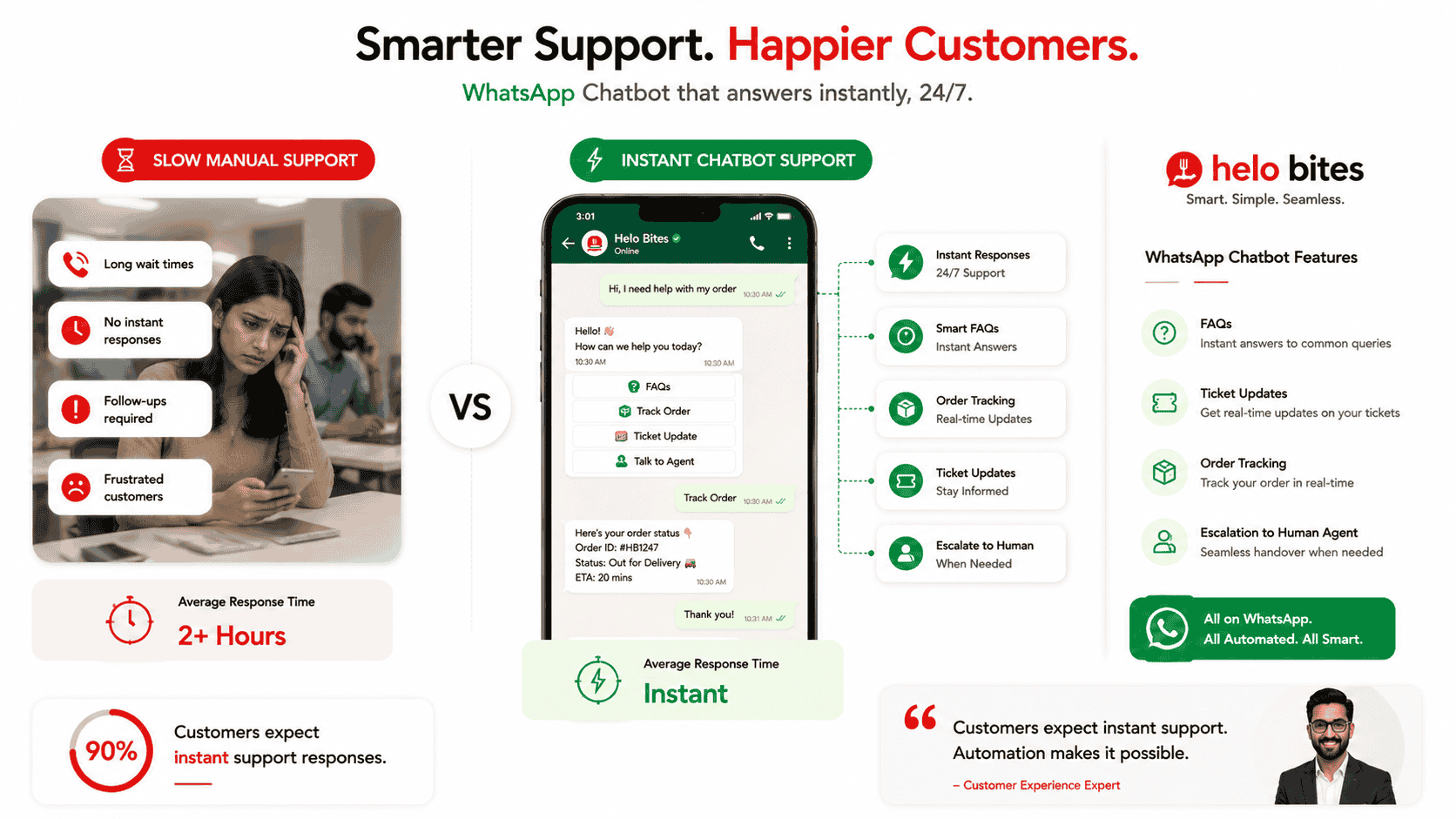
As the volume increases, everything starts depending heavily on manual efficiency. Responses get delayed, order details may get missed, customisations are not always noted properly, and customers end up waiting longer than expected.
This becomes even more difficult on busy days. Even if employees are unavailable for a few hours or someone is absent for the day, the chances of missed updates and delayed responses increase significantly.
A whatsapp chatbot for restaurants helps bring structure to these conversations. Instead of manually managing every interaction, customers move through organised flows for ordering, reservations, delivery updates, and enquiries.
The result is not fewer conversations. It is better managed conversations.
How a WhatsApp Chatbot Brings Structure to Restaurant Conversations
Restaurant conversations often revolve around the same things every day. Receiving orders and customisation requests, sharing the menu, sending delivery updates, and taking reservation requests, a large part of restaurant communication usually revolves around these interactions.
A lot of this communication is repetitive by nature, but when handled manually, it becomes time consuming and requires a lot of follow-up management. Employees need to keep switching between conversations, remember where each customer left off, note updates manually, and continue the conversation accordingly.
Managing these conversations manually without losing the history or context for each customer becomes difficult very quickly. This gets frustrating for customers and the moment customer volume goes up, it becomes difficult for employees to manage efficiently as well.
A whatsapp chatbot for restaurants helps bring structure here.
Every customer reaching out on WhatsApp can move through an automated flow with little to no manual input unless needed specifically for a case.
For example:
- Food ordering (whatsapp chatbot for food ordering)
Share the menu → take the order → note customisations → confirm the order → send delivery updates. A restaurant order bot whatsapp can manage the entire flow inside WhatsApp itself. - Reservations (whatsapp bot for table booking)
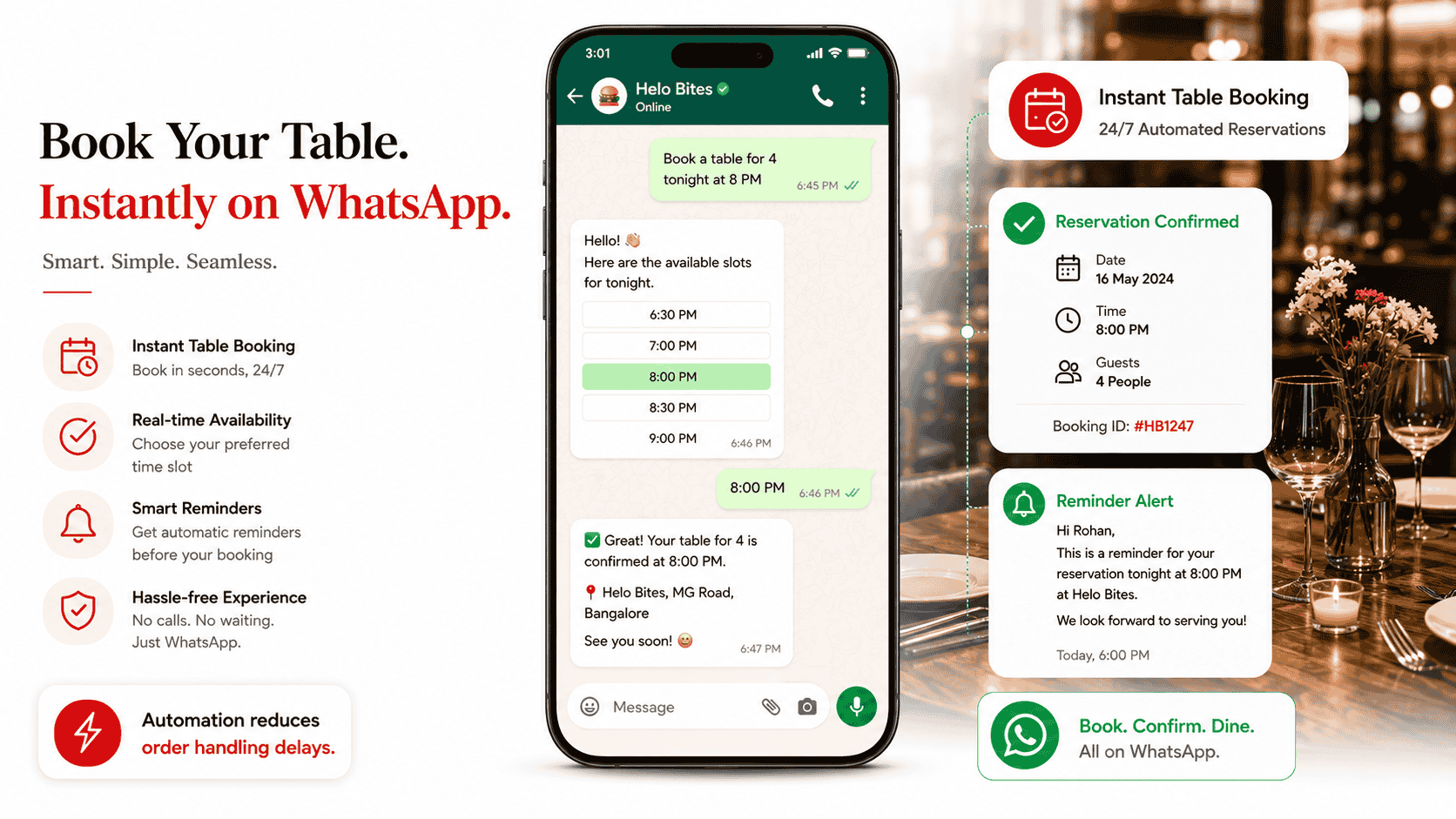
Take the reservation request → note the date and time → send confirmations → share reminder messages before the booking. - Customer enquiries (chatbot for restaurant customer service)
Menus, timings, availability, delivery questions, location details, and other common queries can move into automated flows.
This automates a lot of the back and forth between the customer and the restaurant and makes conversations easier to manage as customer communication increases.
What Changes Once Restaurant Conversations Move Into Structured Flows
Manual follow ups are a big task for restaurants, especially because of how important it is to remember the context and history for each customer conversation.
Employees need to remember where the customer left the conversation, go back to older chats, check previous order details, note customisation requests, send updates, and continue the interaction from there.
A whatsapp chatbot for restaurants changes a lot of this because a large part of these interactions no longer needs manual management.
Some major changes usually happen here:
- Customer conversations become easier to continue
Since the flow already exists, employees do not need to repeatedly understand the conversation from the beginning every time. - Less dependency on remembering every interaction manually
Order requests, customisations, reservation details, delivery updates, and other customer interactions move through organised flows instead of depending completely on manual tracking. - Less back and forth between the restaurant and customer
Menu sharing, order confirmations, updates, reminders, and common queries can happen automatically. - Conversations become easier to handle as customer volume increases
The same communication keeps repeating every day. Structured flows make it easier to manage even when the number of conversations increases.
This way, restaurants spend less time managing the conversation itself and more time on operations and customer experience.
Why Chatbots Become More Important as Restaurants Grow
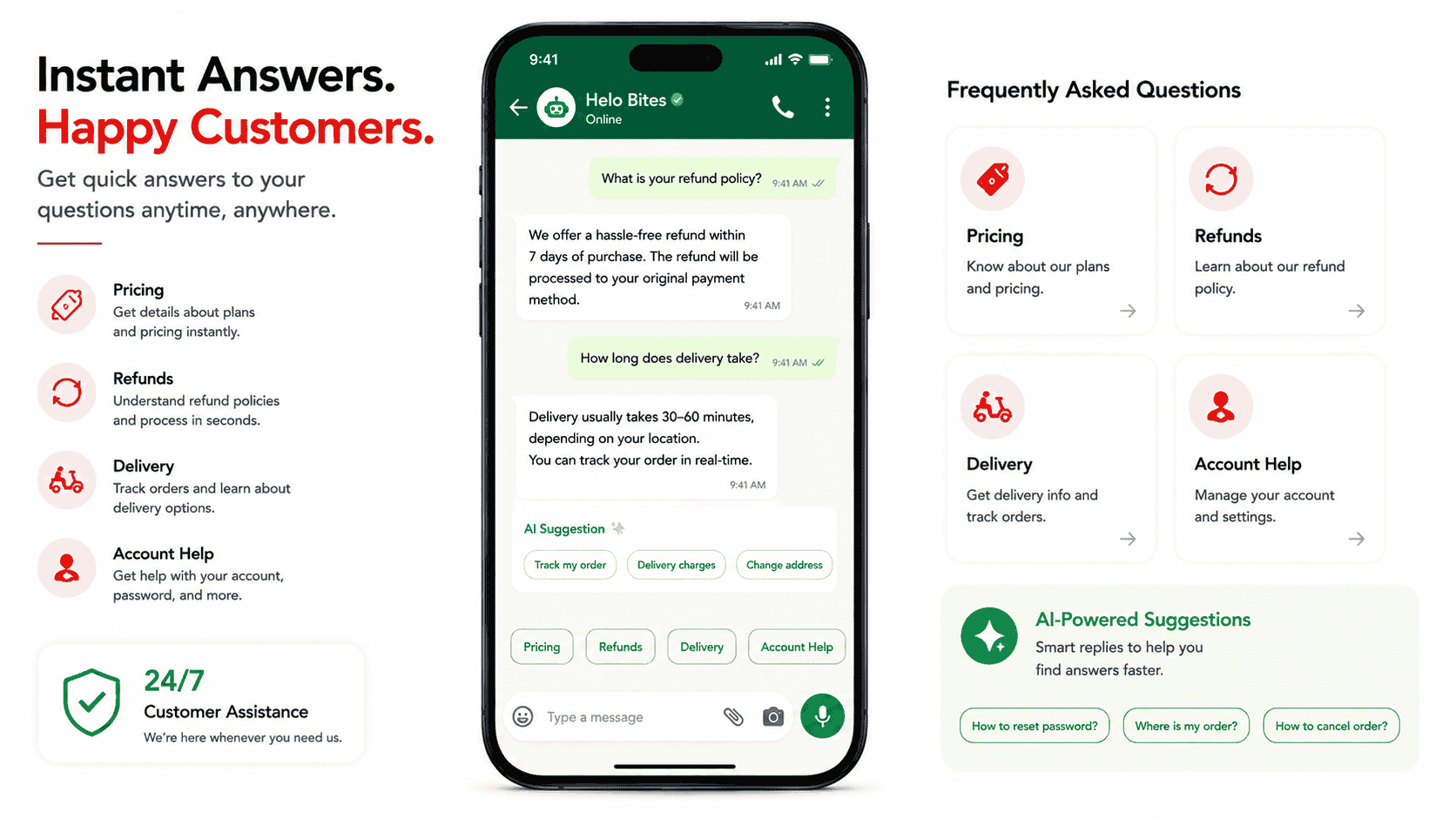
With growth, communication does not just expand in one direction for restaurants, it grows exponentially. More orders start coming in. More customers ask for updates. Reservation requests increase. Repeat customers come back. More people reach out for menus, customisations, and other questions.
At the same time, restaurants still need to manage the context and history for every customer conversation. Keeping up with all of this manually starts becoming difficult very quickly.
This, right here, is the opportunity to use a whatsapp chatbot for restaurants.
The chatbot can handle all the interactions that are repeated every day while moving them into structured flows. Menu sharing, taking orders, noting customisation requests, reservation handling, delivery updates, confirmations, and customer queries — a large part of these conversations can move into automation.
At the same time, the chatbot can also ensure there is manual handoff whenever needed for a specific case. This way, restaurants do not need to manage every customer interaction manually while still keeping human involvement wherever required.
Restaurants Are Not Just Managing Current Conversations
A lot of restaurant communication does not happen only once. Customers come back.
Someone who ordered before may return with another order. Someone may already have shared customisation preferences earlier. Repeat customers come back regarding offers, reservations, or previous interactions. This means restaurants are not only managing the current conversation.
They are also managing the context and history behind it. Doing this manually starts becoming difficult as customer communication increases because employees are no longer tracking only one interaction. They are keeping up with everything that happened before it as well.
This is something a lot of chatbot discussions miss. A whatsapp chatbot for restaurants is not only useful for automating conversations. It also helps keep customer communication organised as interactions keep increasing.
Orders, reservations, customer queries, repeat interactions, all of these continue building over time. For restaurants focusing on repeat customers, loyalty programs, memberships, and customer retention, this becomes even more important.
Because customer communication is not starting from zero every time.
How Restaurants Can Set Up a WhatsApp Chatbot
To many restaurants, setting up a chatbot may sound complicated initially because it feels like another system to manage.
But restaurants are already using WhatsApp for customer communication. Orders are already coming there. Customers are already asking for menus, updates, reservations, and other queries there. The chatbot simply moves these existing conversations into structured flows.
1. Connect with the WhatsApp Business API
Restaurants first need to connect with the WhatsApp Business API through a BSP like helo.ai. The BSP handles setup, verification, integrations, and the chatbot infrastructure, so restaurants do not need to manage the technical implementation themselves.
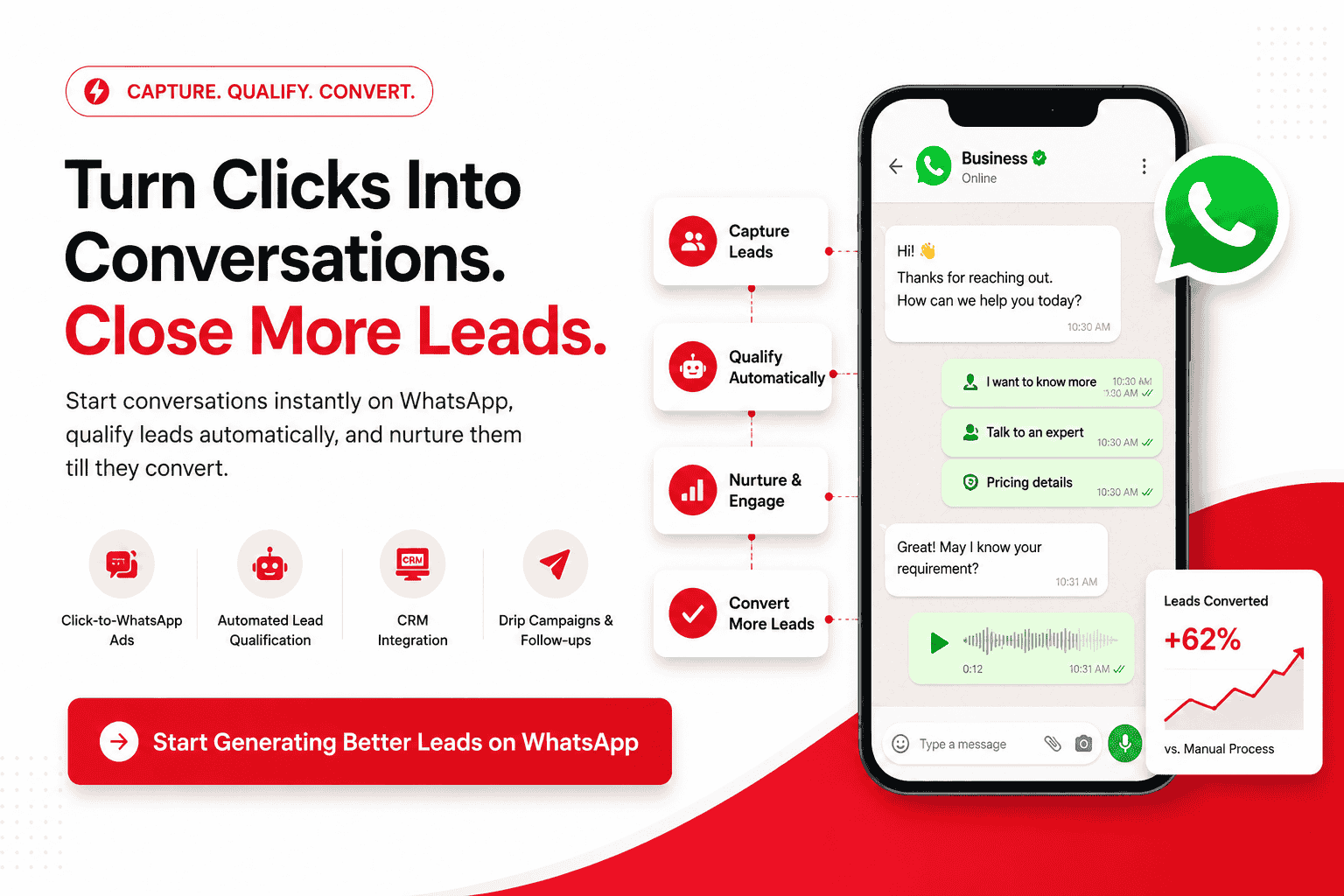
2. Build the menu catalogue
A large part of restaurant communication usually starts with menu requests. Customers reach out asking for dishes, prices, availability, or recommendations.
Restaurants can add dishes, descriptions, prices, and images to the WhatsApp catalogue and create a digital menu via WhatsApp. This works as a whatsapp menu chatbot, allowing customers to browse dishes directly inside the chat itself.
3. Move customer conversations into flows
The next step is deciding which customer interactions need automation. Order taking, customisation requests, delivery updates, reservation handling, confirmations, customer queries, and repeat customer communication can all move into flows depending on the restaurant’s requirements.
4. Add integrations
Restaurants can further connect payment systems, POS systems, and other integrations depending on their operations.
A whatsapp POS integration restaurant setup helps move order handling and customer communication further into automation.
FAQs
Q1. How do I set up a WhatsApp chatbot to take orders automatically for my restaurant?
Restaurants first need to connect with the WhatsApp Business API through a BSP. After this, they can build the menu catalogue and set up the ordering flow so orders, customisation requests, confirmations, and updates can move into automation.
Q2. Can a WhatsApp chatbot handle table reservations and send reminders?
Yes. Customers can send the reservation request on WhatsApp itself, while confirmations and reminder messages can be automated.
Q3. What is the best WhatsApp chatbot for a small restaurant or cafe?
This usually depends on the restaurant’s requirements. Smaller restaurants may only need basic automation, while growing restaurants and cloud kitchens often require integrations and more advanced flows.
Q4. How can WhatsApp chatbots help restaurants reduce dependency on Swiggy or Zomato?
Restaurants can move repeat customers towards direct ordering on WhatsApp instead of relying entirely on aggregators for every order.
Q5. Can a WhatsApp chatbot share the menu and collect payments?
Yes. Restaurants can build a digital menu on WhatsApp and also connect payment systems into the ordering flow.
Q6. What happens if the chatbot cannot answer a customer query?
The chatbot can transfer the conversation manually whenever needed for a specific case.
Conclusion
As customer communication increases, managing everything manually starts becoming difficult very quickly. Orders, updates, reservations, customer queries, a large part of restaurant communication keeps repeating every day.
A whatsapp chatbot for restaurants helps move these interactions into structured flows, making communication easier to manage as restaurants grow.
Solutions like helo.ai help restaurants bring these conversations and automations into one place.

.png&w=828&q=75)