
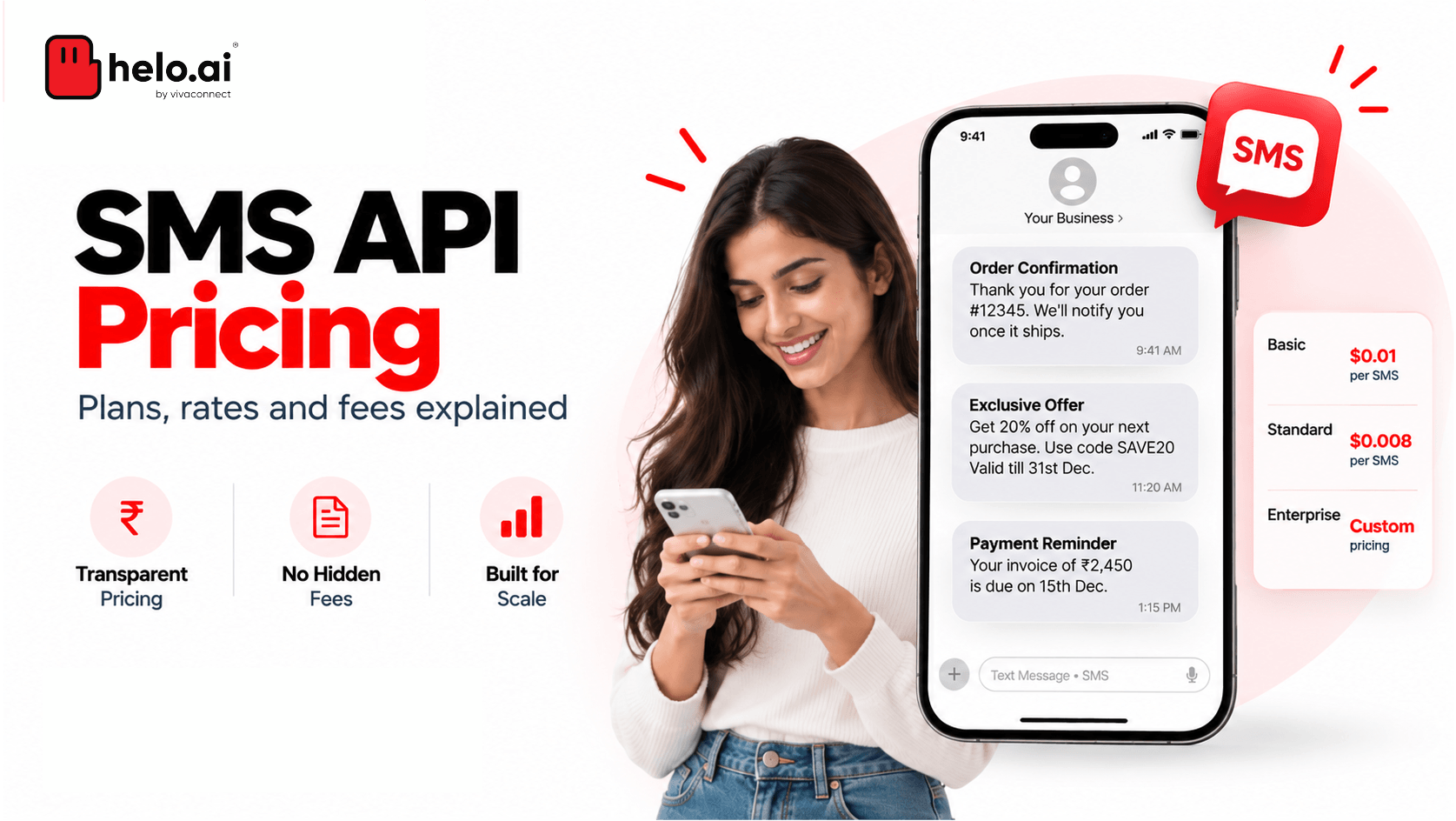


Every vendor page starts with a per-message rate, but the final invoice can include more than the headline price. SMS API pricing in India may look simple on a rate card roughly ₹0.10 to ₹0.25 per domestic A2P message but the actual cost can also include operator scrubbing fees, message segments, GST, and registration-related expenses. In the 5 lakh-message example below, these additional costs increase the total by about 30%.
This guide is for teams already running SMS in production. Instead of covering the DLT basics, it focuses on the cost factors that rate cards often leave out.
The pricing ranges below are based on public Indian and global rate cards reviewed in September 2026. They are indicative market ranges, not fixed industry prices. Actual costs vary by provider, message type, traffic volume, route, billing model, and other applicable charges.
The short answer on SMS cost per message in India
Domestic DLT-compliant traffic costs roughly ₹0.10 to ₹0.25 per message before tax. Volume, route and message category decide where a quote lands in that band:
- Specialist OTP providers list transactional rates from about ₹0.10 to ₹0.18 by volume tier.
- Wallet-based platforms price small top-ups nearer ₹0.21 to ₹0.25.
- Large CPaaS brands show a "from" rate near ₹0.13 and route serious volume to sales.
Global providers that bill in US dollars behave differently. Their India rates usually sit well above domestic cards, and some add a small fee for messages that end in a failed state. Currency movement adds a variable to the SMS cost per message in India that INR-billed providers don't carry.
Rate ranges by message type
Message type | Typical rate per SMS (pre-GST) | Reaches DND numbers | Sending window |
|---|---|---|---|
Transactional / service-implicit | ₹0.12–0.20 | Yes | Any time |
Promotional | ₹0.08–0.25 | No | Daytime only |
OTP | ₹0.12–0.20 | Yes | Any time |
All three ranges assume single-segment English messages. Promotional pricing shows the widest spread because providers bundle routing and scrubbing differently.
Transactional vs promotional SMS price: where the gap comes from
Why would the same 160 characters cost different amounts? Category decides the route, the reachable audience and the permitted sending hours. On paper, the transactional vs promotional SMS price gap is a few paise. The delivery rules behind that gap move the real cost far more.
Transactional and service messages
Transactional SMS and service-implicit templates reach numbers on the DND registry at any hour. That reach is what the premium buys.
It comes with stricter template scrutiny. Operators treat marketing language inside a service template as misclassification, and a misclassified template gets blocked. Depending on the operator setup, the blocked submission may still carry a scrubbing charge.
Promotional messages
Promotional SMS costs less per unit and more per outcome. It can't reach DND-registered numbers and is limited to daytime sending windows. Operators also stopped returning delivery reports for promotional sends in October 2020.
A promotional campaign therefore works more like a flyer drop than a tracked send. We can count what left the building and little else. Any provider billing promotional traffic "per delivered message" deserves a direct question about how they measure delivery.
This is why we compare transactional vs promotional SMS price on cost per engaged recipient, not cost per submission. NKGSB Bank runs its promotional outreach on Helo.ai. Its team reports better reachability while keeping customer service messaging prompt.
For teams running scheduled campaigns across channels, Helo Broadcast handles promotional sends from one console.
OTP SMS price in India
OTP rates usually sit at or slightly below transactional rates, around ₹0.12 to ₹0.20, because providers compete hard for authentication volume. The cheapest quote can mislead here. A slow route costs more in abandoned logins than it saves in paise.
Voice OTP fallback prices higher, near ₹0.30 to ₹0.35 per delivered call on published cards.
DLT charges and the rest of the invoice
This is where rate cards and invoices part ways. DLT charges, segment splits, tax and billing rules each add a layer. None of them is hidden in a legal sense. They sit in footnotes, onboarding PDFs and support articles rather than on the pricing page.
The true cost formula
We normalize every quote with one formula:
Effective cost = (base rate + scrubbing, if billed separately) × average segments per message × (1 + GST)
Run a ₹0.14 quote through it with separate scrubbing, 1.2 average segments and 18% GST. The effective figure lands near ₹0.23, about 67% above the headline.
GST-registered businesses can usually claim that 18% as input tax credit, which turns it into a cash-flow item. Scrubbing and segments remain real cost.
DLT scrubbing charges per SMS
Operators began charging ₹0.025 per submitted SMS for DLT scrubbing in September 2020. Some providers fold it into the headline rate, and others bill it as a separate line. Two ₹0.14 quotes can therefore differ by 2.5 paise before a single message goes out.
Get written confirmation of two things from every provider:
- whether scrubbing is included in the quoted rate
- whether scrubbing applies to messages rejected during scrubbing
GST, segments and Unicode
Segments often do more damage than any fee.
- GSM-7 (plain English): 160 characters per message, dropping to 153 per part once a message splits.
- UCS-2 (Hindi, Tamil or a single emoji): 70 characters per message, or 67 per part in multipart sends.
A 140-character Hindi order update therefore bills as three segments. Even a curly apostrophe pasted from a CMS can push an English template into UCS-2.
Long URLs are the other silent multiplier. A raw tracking link can consume 80 characters on its own.
Submission billing and failed messages
Most Indian providers bill on submission, not delivery. Some global providers also add a per-message fee for failures. Either way, failed traffic costs money. Ported, inactive and DND-registered numbers are cheaper to clean upstream in the contact database than to pay for at the gateway.
Registration and compliance overhead
Principal entity registration on a DLT portal costs about ₹5,900 including GST, and some portals charge it annually. Template registration is typically free but takes one to three business days per template.
The recent rule changes added operational cost more than fee cost:
- Since October 2024: URLs, APKs and callback numbers in templates must be whitelisted. Operators block any message with a non-whitelisted link.
- Header suffixes: sender headers now carry category suffixes (-P, -S, -T, -G), which show recipients the message type.
A rejected template delays a campaign, and that delay never appears on a rate card.
Hand off the DLT paperwork. Our DLT Management service covers entity setup, header and template registration, and URL whitelisting. It also handles rejection fixes, so templates reach production faster. Get DLT support from Helo.ai →
How SMS API pricing in India plays out at three volumes
Scale changes which line item dominates the bill. Below, the formula runs against three profiles using published mid-market rates, with scrubbing billed separately.
50,000 messages a month
Line item | Monthly cost |
|---|---|
Base (50,000 × ₹0.18) | ₹9,000 |
Scrubbing (50,000 × ₹0.025) | ₹1,250 |
DLT registration, amortized | ~₹490 |
Pre-GST total | ~₹10,740 |
At this size, onboarding time and template approvals take more effort than the rate itself. Chasing a two-paise discount rarely justifies the procurement time.
5 lakh messages a month
Line item | Monthly cost |
|---|---|
Base (5,00,000 × ₹0.14) | ₹70,000 |
Scrubbing (5,00,000 × ₹0.025) | ₹12,500 |
Extra segments (10% of messages split in two: 50,000 units × ₹0.165) | ₹8,250 |
Pre-GST total | ~₹90,750 |
That total is about 30% above the headline figure. At this tier, one template audit for segment length usually recovers its effort within a billing cycle.
10 lakh messages and up
Above 10 lakh messages a month, the public rate card stops being the reference point. Providers negotiate committed-spend discounts of [X%] against annual minimums. Larger savings often come from architecture:
- Priority OTP routes cut failed logins.
- Interactive journeys on richer channels: moving them to WhatsApp or RCS pays off where reply features justify the price. See our breakdown of WhatsApp Business API pricing in India.
- SMS as the fallback rail for everything that must reach a phone without data.
Kotak Mahindra Bank saw a similar pattern on RCS: 60% fewer manual interventions and a 30% rise in conversion rates. Our RCS vs SMS comparison covers when each channel wins.
What to check before signing with a provider
Rate is one column in any serious comparison of SMS API pricing in India. These are the questions we put into every RFP.
Routes, throughput and fallback
- Operator connectivity: ask for direct connections on Jio, Airtel, Vi and BSNL, and ask which traffic passes through aggregators. Our explainer on the difference between an SMS API and an SMS gateway covers where those hops sit.
- Throughput: check limits in messages per second. A campaign queued behind a low TPS cap delivers late, and late OTPs fail.
- Failover: confirm automatic failover between routes and to voice OTP.
- Delivery evidence: request median OTP delivery time per operator over the past 30 days.
Data handling and integration
SMS payloads carry phone numbers, names and sometimes account details. Under the Digital Personal Data Protection Act, 2023, the SMS provider typically acts as a data processor. Check data residency, log retention periods and role-based access to message records.
On integration, look for:
- REST APIs with idempotency keys
- webhook delivery reports
- native connectors for the existing CRM or ERP
A low per-message rate loses its advantage quickly if reaching a legacy system requires custom middleware. Our integrations team connects SMS with core banking, CRM and ticketing systems.
Conclusion
The rate card is the easiest number to compare and the least reliable one to budget against. We run every quote through the same formula, confirm where scrubbing sits, and audit templates for segment count before negotiating paise.
For most teams evaluating SMS API pricing in India, template hygiene and correct categorization save more than a negotiated discount. Before signing, ask any shortlisted provider for a sample invoice from a comparable customer, not just the rate card.
Get an all-in SMS quote. Helo.ai quotes each account on its real message mix, with scrubbing, segments and routing shown line by line. Explore the Helo.ai SMS API, or talk to our team for a custom quote →
FAQs
How much does 1 SMS cost in India?
A single domestic DLT-compliant SMS costs roughly ₹0.10 to ₹0.25 before GST, depending on category and volume. Add ₹0.025 if scrubbing is billed separately. Then multiply by the segment count for long or Unicode messages. The effective SMS cost per message in India usually lands well above the headline rate.
Is DLT registration mandatory for an SMS API in India?
Yes, for commercial A2P traffic to Indian numbers. The sender registers the entity, headers and templates, then passes the template ID with every message. Operators block traffic that fails DLT scrubbing. Registration DLT charges are small next to the cost of blocked campaigns.
What is the cheapest SMS API in India?
No provider wins on every measure. The lowest published headline rates sit near ₹0.10, usually at high volume tiers. Compare effective cost after scrubbing, segments and failed traffic instead. A provider with a slightly higher rate and faster delivery often costs less per completed login.
Is an SMS API cheaper than the WhatsApp API in India?
For a single one-way alert, SMS usually costs less per message. For interactive journeys with replies and buttons, WhatsApp can cost less per outcome. SMS still reaches feature phones and works without mobile data, which keeps it essential as a fallback channel. Our comparison of WhatsApp vs SMS notifications covers the trade-offs.
Do Indian SMS providers charge for undelivered messages?
Most do, because they bill on submission rather than delivery. Some global providers also add a fee for failed messages. Ask each provider whether operator-side failures get credited, and how they handle missing delivery reports on promotional traffic.