.jpeg)
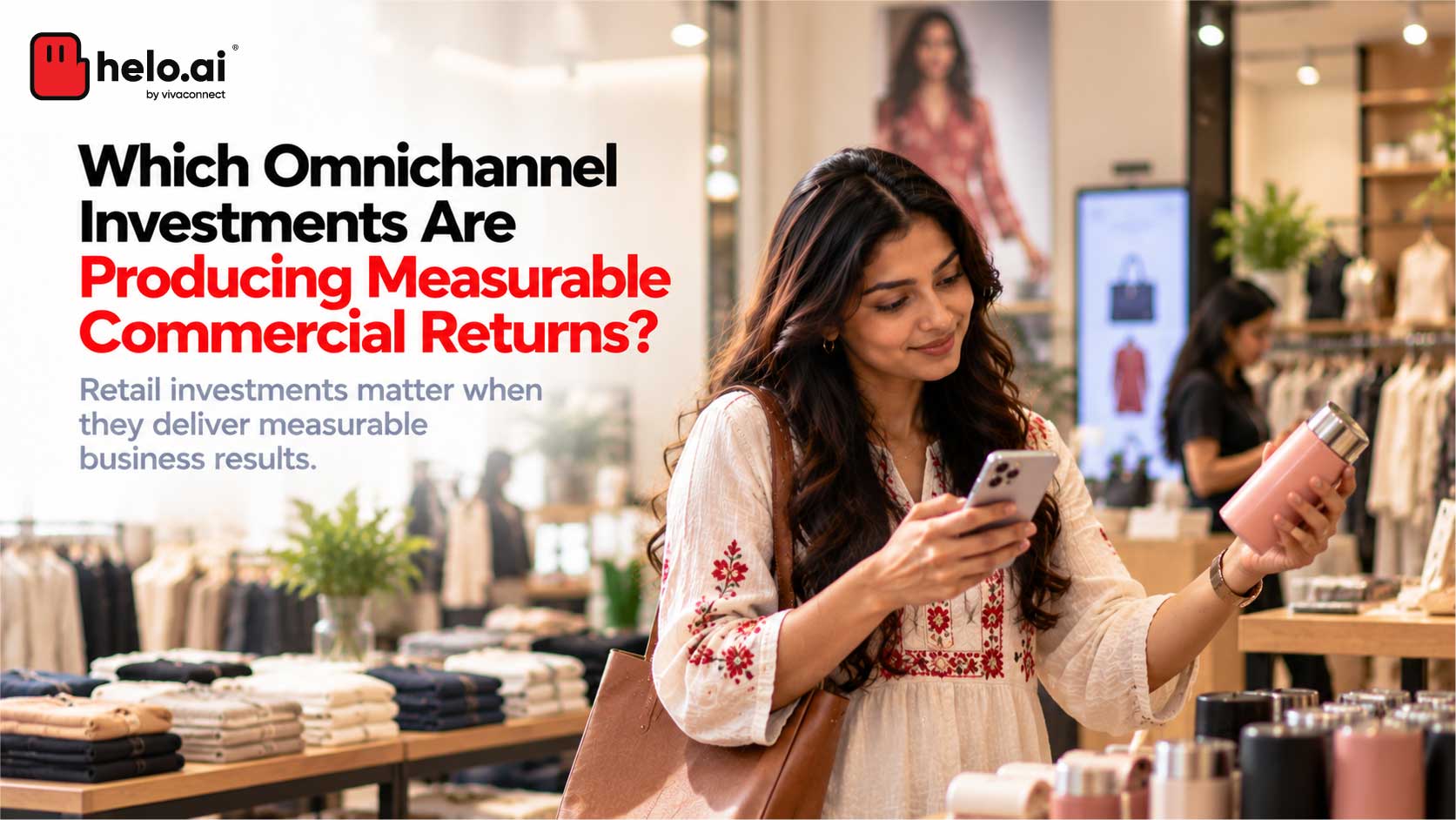


A retailer invests in a new customer data platform. Another adds more digital screens to its stores. A third starts sending personalised messages to shoppers who leave items in their carts.
All three investments sound useful. But which one brings in more sales? Which improves conversion? And which costs more than it returns?
That is the question retail leaders need to answer before expanding their omnichannel investments. Connecting stores, websites, apps and customer communication is only part of the job. The commercial result matters just as much.
A few retail case studies show how businesses are measuring that result.
At a glance: what the evidence shows
Example | Investment | Reported result | Type of evidence |
|---|---|---|---|
dunnhumby (food and beverage brand) | Targeted campaign across stores, screens and SMS | 11% sales uplift | Measured campaign result |
Max Fashion (MoEngage) | Cart-abandonment and engagement journeys | 25% uplift in conversions; 5% incremental monthly revenue | Vendor-reported |
Indian home-improvement retailer (KPMG) | Omnichannel ecosystem, lead management and CDP | ₹400 Cr+ revenue growth over 18 months | Projection |
Manhattan Associates benchmark | Unified commerce maturity (400+ retailers) | Leaders grow nearly 2x faster than basic peers | Benchmark (correlation, not cause) |
A campaign across stores and digital channels delivered an 11% sales uplift
In April 2026, dunnhumby published a case study about a global food and beverage company promoting a product through a retail partner.
Instead of reaching shoppers with the same campaign everywhere, the team used loyalty-card data to identify likely buyers and select stores with greater growth potential. The campaign combined in-store displays, digital screens and targeted SMS messages.
The results were measurable:
11% overall sales uplift
5.8 million customers reached
18 million customer exposures
The channel mix also mattered. Stores using both in-store displays and digital screens recorded a 33% sales uplift, compared with 15% in stores using displays alone.
The case study does not establish that every retailer will see the same result. But it shows why measuring each channel's contribution matters. A retailer can use the findings to decide where its next campaign investment is most likely to pay off.
Source: dunnhumby, Reaching the right customers across every channel, 29 April 2026
Max Fashion connected customer journeys to sales
Max Fashion faced a different problem. Its customer engagement tools were spread across multiple platforms, making it harder to build a consistent view of customer behaviour.
The retailer worked with MoEngage to use customer data, segmentation and targeted journeys across its app and website. It also used channels including push notifications, SMS, WhatsApp, in-app messages and web pop-ups to reach customers at different points in their shopping journey.
MoEngage's published case study reports:
5% uplift in incremental monthly sales revenue through abandonment journeys.
25% uplift in conversions through cart-abandonment journeys.
10% of online traffic driven through MoEngage via outbound channels.
These are vendor-reported results, not an independent assessment. Still, the example illustrates how retailers can link customer engagement activity to outcomes beyond message opens and clicks.
The commercial question is whether a journey brings a customer back to complete a purchase, and whether the resulting sales are genuinely incremental.
Source: MoEngage, Max Fashion observes incremental revenue uplift
For some retailers, the investment is much bigger than a campaign
A retail and home-improvement business in India had a different challenge: its customer experience was split across four to five independent sales channels. The lack of integration made customer engagement inconsistent and limited the use of data in business decisions.
KPMG India worked with the company on an omnichannel ecosystem that. This included a lead-management system, a customer data platform and tools to connect online, offline and experiential retail touchpoints.
The case study reports a projected revenue growth of more than ₹400 crore over 18 months, equivalent to around 20% of the business's then-current revenue.
That figure is a projection, not confirmed realised revenue. It shows the scale of the commercial opportunity the transformation was designed to pursue, rather than proof that the full amount was achieved.
The lesson for retailers is to set the business objective before choosing the technology. If the problem is missed leads, the investment should be measured against lead conversion. If customer data is fragmented, the business should define how better visibility will improve targeting, sales or customer value.
Source: KPMG India, Empowering customer engagement through omnichannel transformation
The wider retail picture: connected channels are still a work in progress
These individual examples sit within a broader shift in retail.
The 2026 Global Unified Commerce Benchmark, was announced by Manhattan Associates in March 2026 and conducted by Incisiv,. It assessed more than 400 specialty retailers across North America, Europe, the Middle East and Africa, and Latin America.
The findings show how much work remains:
Only 7% of retailers achieved the benchmark's leading unified-commerce status.
33% remained in the basic category.
Retailers at the leading end of the benchmark recorded nearly twice the growth rate of basic peers.
The benchmark assesses capabilities across shopping, checkout, fulfilment and service. It does not prove that any single technology investment causes higher growth. Rather, it points to the gap between retailers that connect their operations and those that still manage customer journeys in separate parts.
For retailers, this makes the investment decision more specific. The goal should not be to add another channel simply because competitors have one. It should be to remove a problem that affects customers or business performance.
Source: Manhattan Associates, 2026 Global Unified Commerce Benchmark, 23 March 2026
What should retailers measure before investing more?
The examples above show different types of return: sales uplift, conversion, traffic contribution and projected revenue. These measures should not be treated as interchangeable.
Before approving or expanding an omnichannel investment, retailers should define what success means.
Investment | Commercial measures to track |
|---|---|
Targeted campaigns across stores and digital media | Incremental sales, cost per incremental sale and channel contribution |
Cart-abandonment journeys | Recovered orders, conversion rate and incremental revenue |
Conversion, repeat purchases and customer value | |
Connected inventory and fulfilment | Fulfilment costs, order accuracy, stock availability and delivery performance |
Completed purchases, service costs, resolution time and repeat contacts |
One distinction matters across all of these: incremental results versus activity that would have happened anyway.
A customer might complete a purchase without receiving a reminder. Counting that order as fully caused by the campaign would overstate the return. Where possible, retailers should use control groups or other sound measurement methods to estimate what the investment actually changed.
Revenue is also only part of the picture. A campaign can increase sales while reducing profit if discounts, advertising or fulfilment costs rise too much.
Free resource: Download Helo.ai's 2026 enterprise playbook for AI-led customer engagement to see how retailers move from separate channels to connected, measurable journeys.
Where customer communication fits
Not every improvement requires replacing a retailer's commerce systems. Sometimes, the opportunity is to make existing customer journeys work better.
A customer who asks about a product may need a follow-up. Someone who has placed an order may need a delivery update. A shopper who has abandoned a cart may benefit from a timely reminder. These interactions can support a wider omnichannel strategy when they are relevant and their commercial impact is measured.
Manhattan's benchmark also found that more than 66% of consumers use two or more channels before buying. In Latin America, messaging-led service via WhatsApp is helping retailers close the gap.
Helo.ai's positioning is AI that connects businesses with customers. Its communication capabilities across WhatsApp, SMS and voice can support updates, reminders and customer conversations as part of a retailer's wider approach.
They are one part of the customer journey, not a replacement for inventory, checkout or fulfilment systems. The value depends on the business problem being addressed and the result the retailer measures.
See where customer communication can lift your retail ROI. Explore Helo.ai for retail or talk to our team about cart recovery, order updates and customer conversations across WhatsApp, SMS and voice.
The real test of an omnichannel investment
The case studies point to three different opportunities:
improve the performance of a campaign across channels,
recover more sales through customer-engagement journeys, or
connect systems that have been working separately.
The right investment depends on where a retailer is losing sales, time or customer trust. The figures from these case studies are useful evidence, but they come from different businesses and measure different outcomes.
Before the next investment, retail leaders should be able to answer two questions: What business problem are we solving, and what measurable result will tell us it worked?
If those answers are unclear, adding another channel may only add another cost.
Frequently asked questions
How do you measure omnichannel retail ROI?
Define one business outcome per investment, such as incremental sales, recovered orders or lead conversion. Then compare results against a control group and subtract the full costs, including discounts and fulfilment.
Which omnichannel investments deliver the fastest returns?
Targeted cross-channel campaigns and cart-abandonment journeys usually show measurable results fastest, because they tie directly to sales. Larger data and systems projects take longer and are often reported as projections.
What is unified commerce?
Unified commerce connects shopping, checkout, fulfilment and service on shared data, so customers get a consistent experience across stores, websites, apps and messaging.