.jpeg)
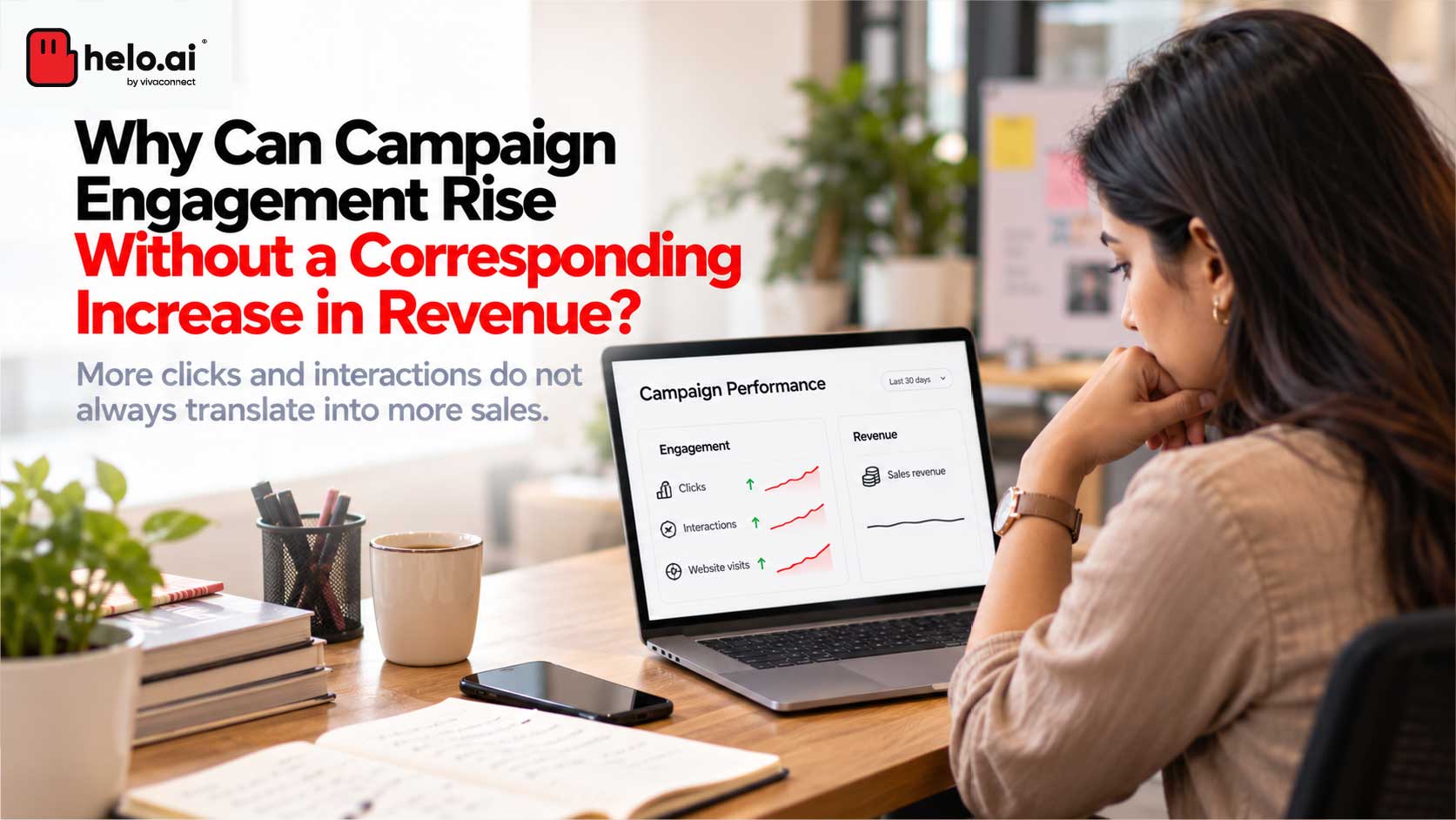


A campaign generates more clicks. Message opens increase. Website traffic climbs, and social interactions are up.
Yet revenue barely changes.
For marketing teams, this creates an uncomfortable question: if more people are responding to a campaign, why isn't the business seeing a similar improvement in sales?
The answer is that engagement and revenue measure different things. Engagement shows how people respond to marketing. Revenue reflects purchases and other commercial activity influenced by many factors, including customer intent, pricing, the buying experience and demand that already existed.
The gap between the two is not necessarily evidence of a failed campaign. But it is a reason to look beyond the engagement report and find out what happened next. Understanding campaign engagement vs revenue starts there.
The measurement gap behind the numbers
In its Marketing ROI Blueprint published in October 2025, Nielsen reported that 85% of surveyed marketers felt confident in their ability to measure ROI, but only 32% measured media spending holistically across traditional and digital channels.
The finding points to a problem with how marketing performance is measured: confidence in measurement does not always mean teams have a complete view of their investments and results.
Source: Nielsen, The Marketing ROI Blueprint (2025)
This figure does not prove that engagement fails to produce revenue. It does, however, highlight why marketers need a connected view of performance instead of relying on individual channel reports.
A social platform may report clicks. An email platform may report opens. A messaging platform may report replies. A sales system may record completed transactions. If these numbers are viewed separately, a team can see that activity increased without understanding whether it contributed to a commercial outcome.
The challenge is to connect the measures without assuming that every interaction caused a sale.
1. Engagement measures attention, not necessarily buying intent
Consider two campaigns.
The first generates thousands of clicks from people curious about an offer. The second attracts fewer visitors, but a greater proportion of them are ready to buy.
If the team looks only at clicks, the first campaign appears stronger. If the objective is sales, it may not be.
People interact with marketing for many reasons. They might open a message to check a price, click an ad to compare options or watch a video because it is entertaining. These actions can be useful signals, but they do not establish that someone intends to purchase.
Audience quality matters just as much as audience volume.
Retail: A promotion attracts visitors who leave when they discover delivery charges or unavailable products.
Banking: A loan campaign generates enquiries, but many applicants do not meet eligibility criteria.
B2B: A webinar attracts registrations from people who have no role in the buying decision.
Subscriptions: A discount drives sign-ups, but some customers never activate or continue using the service.
In each case, the campaign has generated engagement. The next question is whether the audience is progressing towards the intended outcome.
What to measure: Look beyond clicks and opens to qualified leads, completed applications, purchases, activation or another metric that matches the campaign's objective.
2. The customer journey may be losing people after the click
Sometimes the campaign reaches the right audience with a relevant offer, but the experience breaks down later.
A customer clicks an ad and lands on a slow website. A shopper adds a product to their cart but encounters an unexpected fee. A prospective borrower asks for more information but does not receive a timely response. A B2B lead submits a form and waits too long for follow-up.
The initial campaign may be doing its job. Something else is preventing customers from moving forward.
This is why marketers should examine the entire path from interaction to outcome.
Industry | Where progress may break down | What to examine |
|---|---|---|
Retail and e-commerce | Product page to checkout | Availability, delivery costs, payment failures and cart abandonment |
Banking and financial services | Enquiry to completed application | Eligibility, documentation and application drop-off |
B2B | Lead to sales opportunity | Lead quality, follow-up time and qualified meetings |
Subscription businesses | Sign-up to continued use | Activation, product usage, cancellations and renewals |
These are diagnostic possibilities, not proof that any one problem caused a revenue gap. The data needs to establish where people drop off before the team decides what to change.
Increasing campaign spend will not solve a checkout problem or a slow sales follow-up process. First, identify the point where customers stop progressing.
3. The campaign may need more time to influence sales
Not every campaign is designed to generate an immediate purchase.
A customer might see an ad today, research the product next week and buy a month later. A business buyer may interact with several pieces of content before starting a sales conversation. A customer may remember a brand when a need arises, even if the original interaction did not lead to an immediate click-through sale.
Research on advertising effectiveness supports the importance of looking beyond immediate response.
Les Binet and Peter Field's The Long and the Short of It, based on analysis of the IPA Effectiveness Awards Databank, examines how short-term response and long-term brand-building effects differ. The research warns against using very short-term online metrics as the main measure of longer-term marketing success.
Source: Institute of Practitioners in Advertising, The Long and the Short of It
The implication is not that every engagement increase will eventually generate revenue. It is that campaigns should be evaluated according to their purpose and the time it reasonably takes to observe their effects.
For a cart recovery campaign, purchases over a short, defined period may be relevant. For a brand-building campaign, the team may need to examine brand measures and commercial outcomes over a longer period.
The reporting window should reflect the customer journey, not simply the reporting cycle that is easiest to use.
4. Revenue may have changed for reasons beyond the campaign
A rise in sales during a campaign does not automatically mean the campaign caused the increase. The reverse is also true: flat revenue does not necessarily mean the marketing had no effect.
Sales can be influenced by seasonality, pricing, competitor activity, stock availability, economic conditions and existing customer demand. A promotion may coincide with a seasonal sales peak. Alternatively, a strong campaign may be unable to overcome a stock shortage.
This is the difference between observing a result and estimating the additional result created by marketing.
Google's open-source Meridian marketing mix modelling framework is designed to help estimate the contribution and incremental impact of marketing channels while accounting for other relevant factors in the model.
For a specific campaign, a controlled experiment may be more appropriate. A business could compare a group that receives the campaign with a comparable group that does not, provided the experiment is designed and analysed correctly.
The question changes from "How much revenue did we record during the campaign?" to "How much additional revenue did the campaign generate compared with what would likely have happened without it?"
That distinction helps teams avoid rewarding campaigns for sales that would have occurred anyway.
5. More spending does not guarantee proportionally more returns
Even when a campaign generates incremental revenue, its next phase may not perform as well as the last.
A campaign can reach the most interested customers first. As spending increases, it may reach people who are less likely to buy. Repeated exposure can also become less effective, while competing offers or limited audience size can constrain results.
Google Meridian's documentation includes response curves that model how marketing impact can change as spend increases, including the possibility of diminishing returns.
Source: Google Meridian, ROI and response curves
This is a modelling concept, not a claim that every campaign will follow the same pattern. It reinforces a practical point: a higher click volume or a larger budget is not enough to justify scaling.
Before increasing spend, marketers should check whether additional investment is producing additional conversions or revenue at a commercially acceptable cost.
How to connect engagement to commercial results
The solution is not to stop tracking engagement. It is to give engagement metrics a clear role in a broader measurement framework.
Measurement stage | Useful measures | Question answered |
|---|---|---|
Attention | Reach, impressions, video views | Did the campaign reach its intended audience? |
Engagement | Clicks, opens, replies, content interactions | Did people respond? |
Progression | Qualified leads, application starts, checkout starts | Did they move towards the intended action? |
Conversion | Purchases, completed applications, closed deals | Did the desired action happen? |
Commercial value | Revenue, margin, acquisition cost, retention | Was the outcome valuable to the business? |
Incremental impact | Additional conversions or revenue versus a credible baseline | What difference did the campaign make? |
Not every campaign needs every measure. An awareness campaign and a cart recovery campaign have different objectives, so they should not be judged by an identical scorecard.
A useful report should make the connection between the campaign objective, the customer's next action and the commercial result clear.
Free resource: Map these stages to real metrics with the CPaaS KPI Handbook, which covers delivery, engagement and conversion KPIs for SMS, WhatsApp and RCS.
A practical example: clicks increase, revenue stays flat
Imagine an online retailer runs a campaign that generates 30% more clicks than the previous campaign, but revenue barely changes.
The 30% increase is a hypothetical example, not a research finding. On its own, it does not explain what happened.
The team should investigate:
Audience quality: Did the extra clicks come from people likely to purchase?
Conversion rate: Did a smaller share of visitors complete checkout?
Order value: Were customers spending less per purchase?
Customer experience: Were products unavailable, delivery costs unexpected or payments failing?
Timing: Was the reporting window long enough to capture purchases?
Incrementality: Did the campaign create additional purchases, or did it reach customers who would have bought anyway?
Each answer suggests a different response. The retailer might refine its targeting, improve checkout, review the offer or test whether the campaign is generating incremental sales.
The key is to diagnose the gap before deciding to increase the budget.
What this means for cross-channel marketing
Customers may move between ads, websites, email, SMS, WhatsApp, sales teams and other touchpoints before making a decision. Yet each platform may report performance differently.
A more complete view requires consistent campaign identifiers, reliable conversion tracking and shared definitions of success. Attribution reports can help teams understand observed customer journeys, while controlled experiments and marketing mix modelling can help estimate incremental contribution where suitable.
Customer communication should be measured in the same context. More message replies, for example, indicate more interaction. They do not by themselves establish more qualified enquiries, completed transactions or revenue.
For businesses using SMS, WhatsApp and voice, Helo.ai can support customer communication as part of that wider journey. Its contribution should be evaluated against the relevant communication objective and connected to downstream business outcomes where the data allows. The final result may also depend on the offer, customer experience, sales process and other business systems.
Want to see which conversations actually drive revenue? Talk to Helo.ai about connecting WhatsApp, SMS and voice engagement to your CRM and sales outcomes.
The takeaway: measure what happens after engagement
When engagement rises without a corresponding increase in revenue, the right response is not to dismiss the campaign or assume that more activity will eventually pay off.
Find out whether the campaign attracted the right audience, whether customers could complete the next step, whether the timing was appropriate and whether the activity created additional commercial value.
Engagement tells you that people responded. Conversion data shows whether they acted. Revenue and incrementality measures help establish whether that activity mattered to the business.
A useful campaign report should explain what people did, what happened next, and what commercial result the campaign contributed to.
Frequently asked questions
Why is my campaign engagement high but sales low?
Common causes are low-intent audiences, drop-off after the click (such as slow pages, unexpected fees or slow follow-up), a reporting window that is too short, or a campaign that reached customers who would have bought anyway.
Are engagement metrics vanity metrics?
Not necessarily. Clicks, opens and replies are useful signals of attention, but they should be connected to conversion, revenue and incremental impact before being used to judge success.
How do I measure whether a campaign actually increased revenue?
Compare a group that received the campaign with a comparable holdout group that did not, or use marketing mix modelling to estimate incremental contribution.