.jpeg)
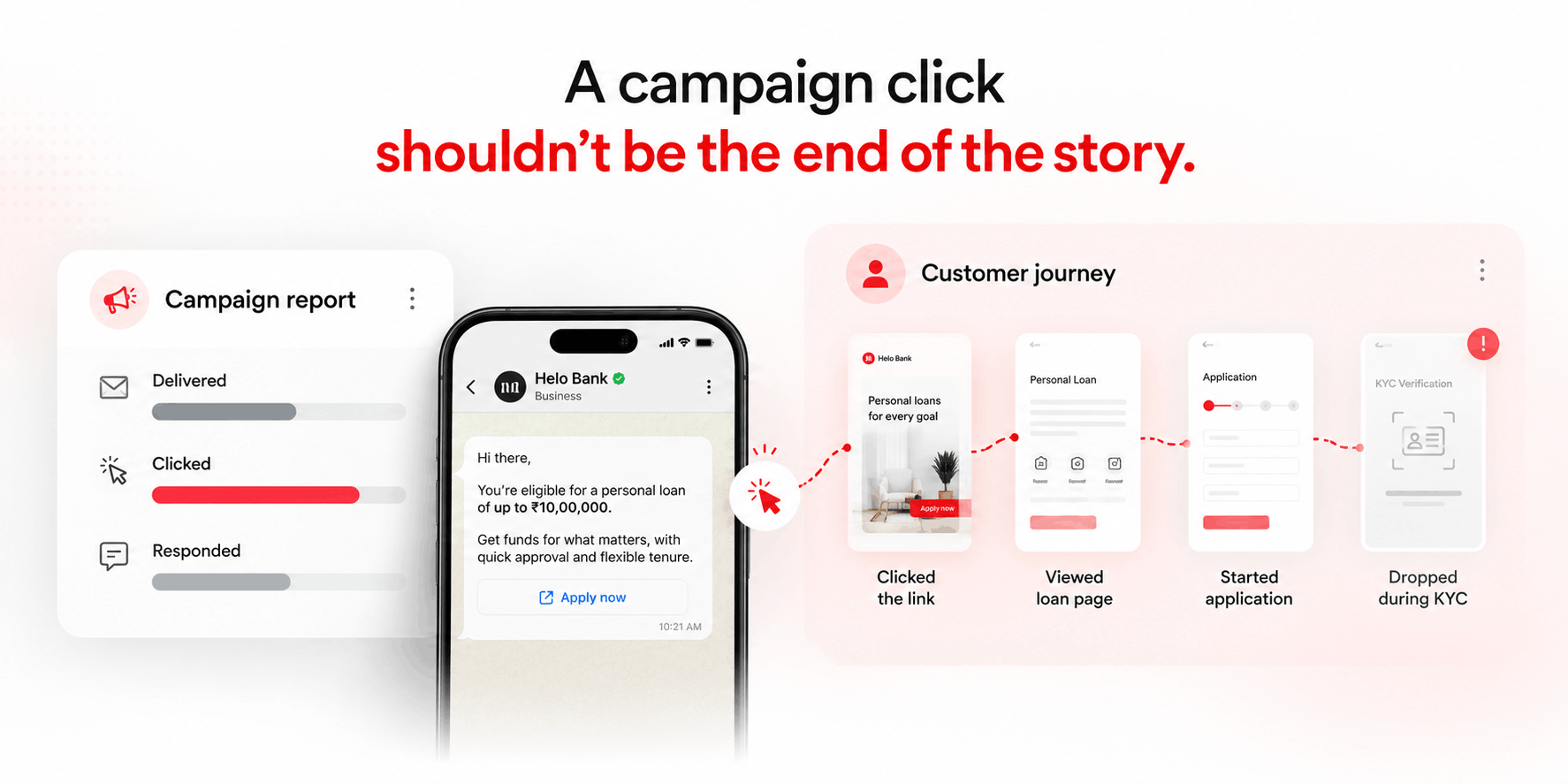


A customer clicks a campaign. The dashboard records it. Click rate: 4.2%. The campaign report is complete.
But is the customer journey?
That is where customer engagement analytics needs to go a step further.
A click tells a business that something happened. It does not necessarily explain what happened after that click, what the customer was trying to do, or what the business should do next.
A campaign click is useful. The behaviour after it is more useful.
Take a personal-loan journey. A customer receives a WhatsApp message and clicks the link.
The campaign platform can show a simple sequence: Message sent → Delivered → Clicked.
But the customer may then move through a much longer journey:
Clicked → Loan page → Eligibility → Application → KYC → Drop-off.
The campaign system has one piece. The website has another. The customer database may contain the relationship and profile information behind both.
These are all parts of the same customer journey, but they can sit in different places.
This is where Helo Clarity connects the dots
Helo Clarity is built around bringing customer data and campaigns into one platform. Its core flow is to capture events, unify them into a customer profile, analyse behaviour, create segments, activate campaigns and measure what happens next.
For customer engagement analytics, the important shift is that messaging activity does not have to remain isolated inside a campaign report. Events such as clicks, page views and campaign responses can sit alongside customer behaviour and attributes.
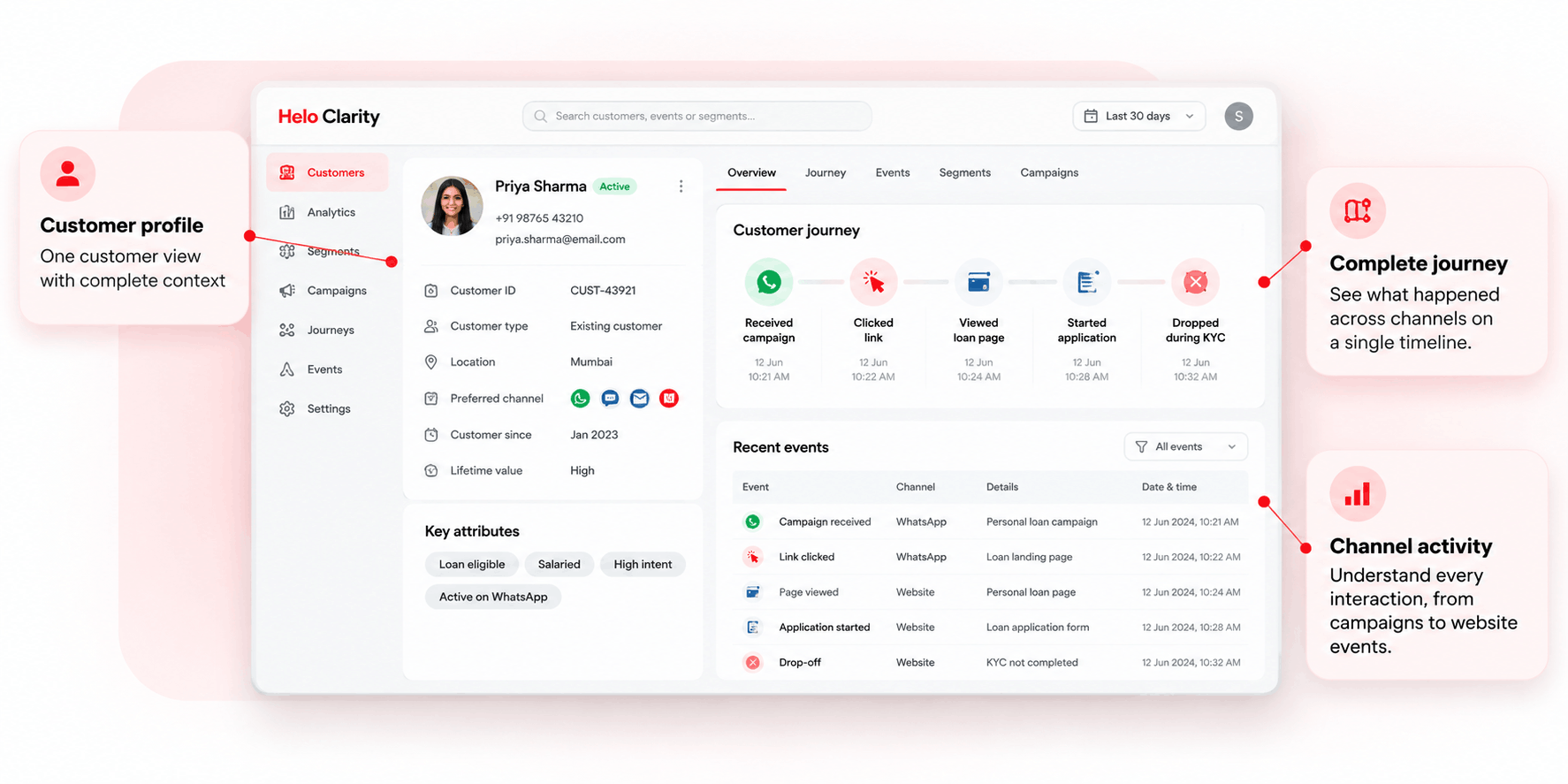
Now the campaign click has context. You can see the interaction, the journey around it and the point where the customer stopped.
From “who clicked?” to “what happened next?”
Traditional campaign reporting is designed to answer questions such as: How many messages were delivered? How many customers clicked? Which campaign got a response?
Those metrics still matter. But behavioural context adds another layer:
What happened after the click? Did the customer continue to the next stage? | Where did they stop? Which stage created the drop-off? |
What behaviour connects them? Can similar behaviour be identified as a group? | Can that behaviour become an audience? Can the next action start from what actually happened? |
When behaviour can become an audience
Imagine 20,000 customers start a loan application and a large group stops around KYC.
The insight is valuable. The challenge is what comes next.
In a disconnected setup, someone may need to identify the drop-off, build a segment, export the data, move it into another campaign tool and then launch the follow-up.
Helo Clarity is designed to shorten that distance. Funnel and event analytics can identify behaviour, and a funnel drop-off can be turned into a campaign audience without exporting the data.
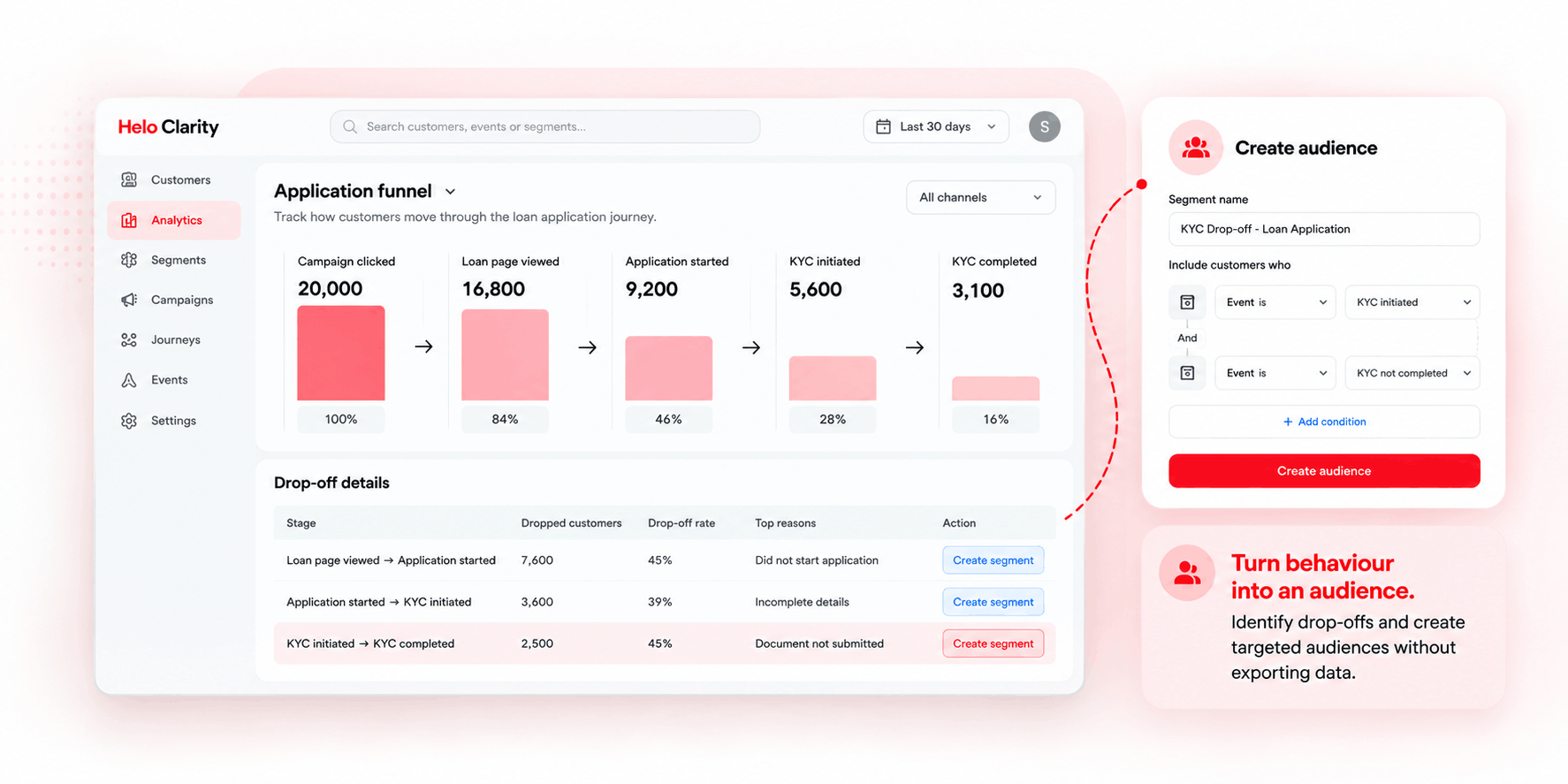
That changes the role of behavioural data marketing. It is not just something to analyse after a campaign. It can become the starting point for the next interaction.
And the campaign result doesn’t have to stop there either
The next campaign creates more behaviour.
A customer clicks. Another ignores the message. Someone completes the application. Another starts but does not finish.
If those results return to the customer view, the next audience can be based on what customers actually did rather than starting again from a blank campaign report.
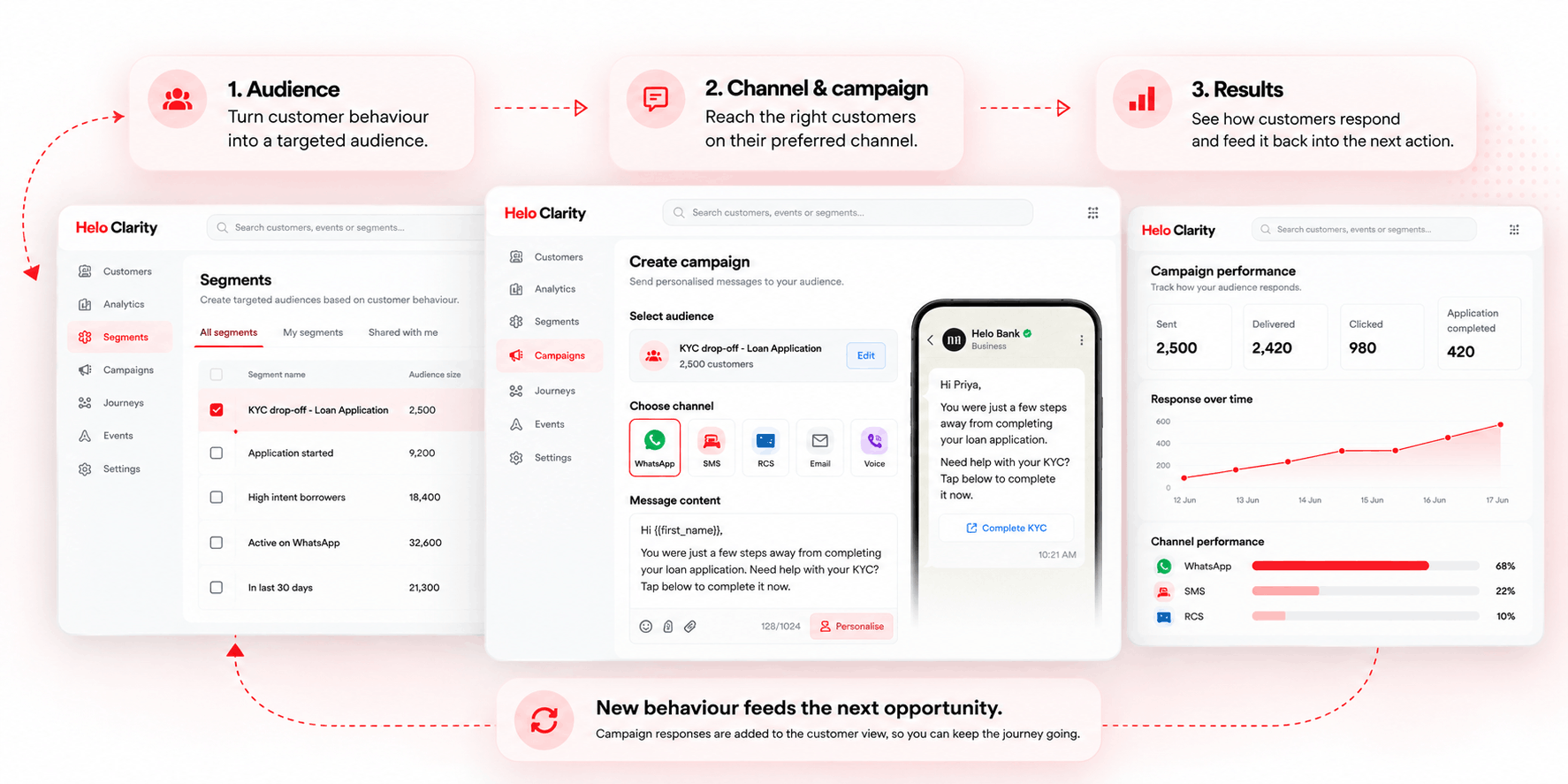
This is the larger idea behind a single customer view: the customer does not become a new data point every time they interact with a campaign. Their interactions contribute to a broader customer story.
What customer engagement analytics should really help answer
A useful customer engagement analytics setup should help move beyond the campaign itself and answer five practical questions:
1. Who engaged?
Know which customers interacted with the message.
2. What did they do afterwards?
Connect the campaign interaction to subsequent behaviour.
3. Where did they stop?
Identify the stage or event associated with the drop-off.
4. Can that behaviour become an audience?
Turn an observed customer behaviour into something the business can act on.
5. What did the next interaction change?
Bring campaign results back into the broader customer context.
.jpeg&w=640&q=75)