


Email marketing is not dead.
But it is becoming harder to win with.
For years, email was the default channel for ecommerce marketing. Brands used it for promotions, product launches, abandoned cart recovery, post-purchase communication, and retention campaigns. The problem is that customers now receive more emails than ever before, while paying attention to fewer of them.
That is why many marketers are asking the same question: why people don't open emails anymore, and are marketing emails still effective in 2026?
The answer is not that email has stopped working. The answer is that customer behavior has changed faster than most email strategies have.
The Inbox Is More Crowded Than Ever
The average customer's inbox is a battlefield.
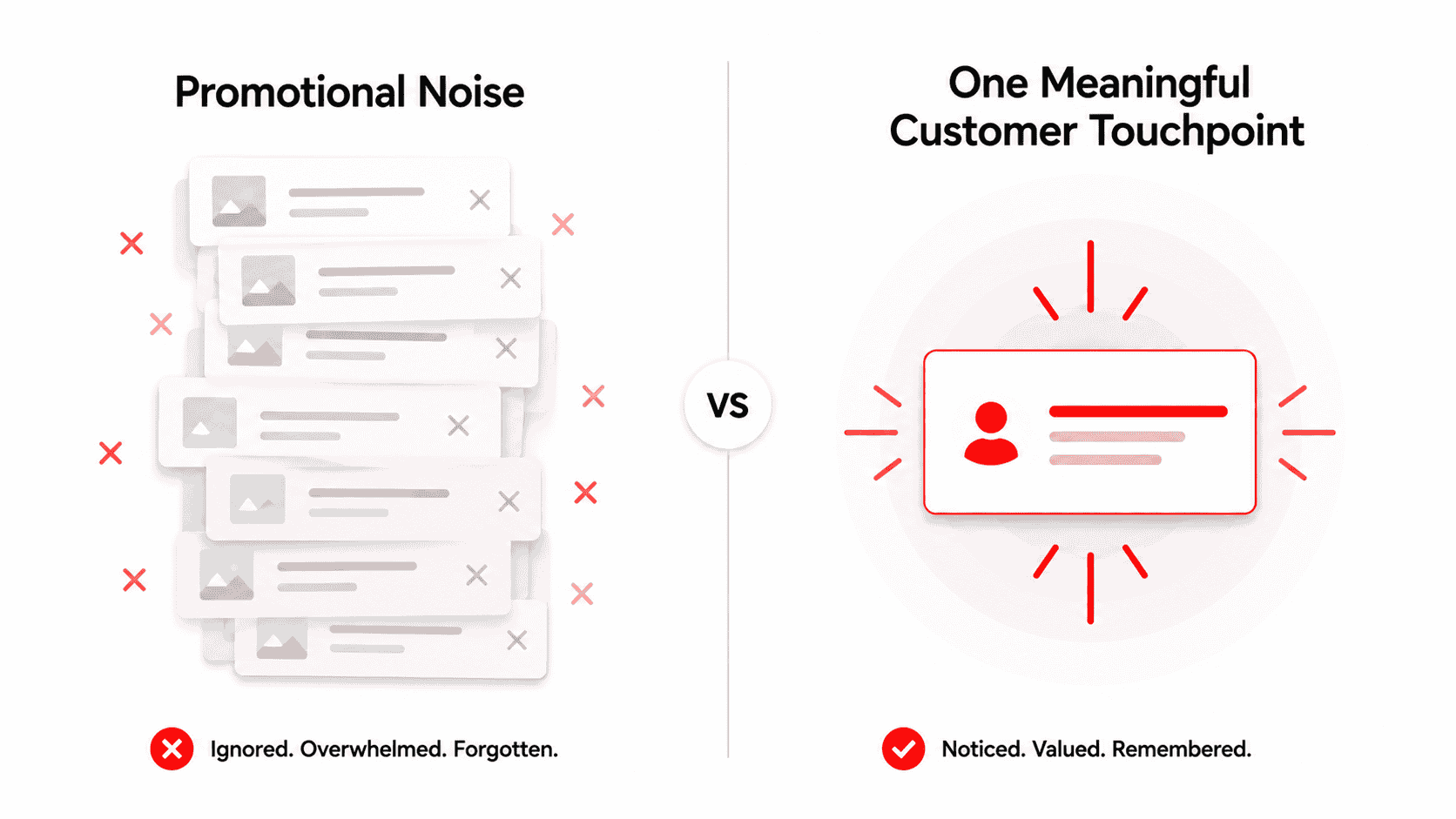
Promotional emails compete with work emails, newsletters, receipts, subscriptions, notifications, and dozens of other messages arriving every day. Even if your email is relevant, it is competing for attention in an increasingly crowded environment.
As inbox volume grows, customers become more selective about what they open.
Many marketing emails are ignored not because the offer is bad, but because the message never gets noticed in the first place.
For D2C brands, visibility has become as important as the message itself.
See how inbox competition affects engagement in our guide on why WhatsApp works better than email for D2C brands
Customers Have Learned to Filter Marketing Messages
Consumers have become remarkably good at recognizing marketing emails.
The subject line may promise urgency. The discount may be attractive. The design may be polished.
But customers have seen similar messages hundreds of times before.
As a result, many people decide whether to open an email within seconds. If it feels generic, promotional, or irrelevant, it is often skipped without a second thought.
The challenge today is not simply sending emails.
It is earning attention.
Relevance Matters More Than Volume
Many brands respond to declining engagement by sending more emails.
That usually makes the problem worse.
Customers do not ignore emails because they receive too few. They ignore them because too many feel irrelevant.
A customer who just bought a product does not need another acquisition offer.
A customer browsing a specific category may not care about a sitewide promotion.
The more personalized and timely the communication feels, the higher the likelihood of engagement.
The brands seeing the strongest results today are focusing less on volume and more on relevance.
Learn how to increase engagement through personalization in our guide on how personalized messaging increases D2C revenue.
Customers Expect Faster Communication
One of the biggest shifts in recent years is customer expectations around speed.
Email remains valuable, but it is not always the channel customers check first.
People increasingly expect updates, reminders, and conversations to happen in channels they use throughout the day.
This is especially true for ecommerce communication.
Order updates, abandoned cart reminders, payment recovery messages, and delivery notifications often perform better when customers see them immediately rather than hours later.
The issue is not email itself.
The issue is timing and visibility.
Explore proven approaches for timely communication in our guide on best WhatsApp automation flows for D2C brands.
Email Still Has a Role in the Customer Journey
Despite the challenges, email continues to play an important role.
It remains useful for:
- Newsletters and content
- Product launches
- Long-form communication
- Loyalty programs
- Promotional campaigns
The mistake is assuming email should handle everything.
Modern customer communication is increasingly multi-channel. Different messages work better on different platforms depending on urgency, context, and customer preference.
The question is no longer email versus other channels.
The question is how channels work together.
See how to combine channels effectively in our guide on how post-purchase communication improves customer retention.
Why More D2C Brands Are Adding WhatsApp
While inbox competition continues to increase, messaging platforms are becoming a larger part of customer communication.
Customers tend to check messaging apps more frequently than email. Conversations feel more immediate, and important updates are often seen faster.
For D2C brands, this creates opportunities across the customer journey:
- Cart recovery
- Order confirmations
- Delivery updates
- Payment reminders
- Review requests
- Reorder campaigns
The goal is not replacing email completely.
It is reaching customers through channels they actively engage with.
Discover more on this shift in our guide on why customers abandon their carts and how to recover them.
The Real Problem Is Attention
When marketers say email marketing is not working, what they are often describing is an attention problem.
Customers are not ignoring marketing because they dislike brands.
They are ignoring marketing because attention has become scarce.
Winning that attention requires relevance, timing, personalization, and channel choice.
The brands that adapt to these changes will continue to generate strong results. The ones that rely on the same batch-and-blast strategies will find engagement becoming harder every year.
Conclusion
Email remains an important marketing channel, but customer behavior in 2026 looks very different from a few years ago.
People are more selective, inboxes are more crowded, and attention is harder to earn. Brands that focus on relevance, personalization, and multi-channel engagement are far more likely to cut through the noise.
The future is not about sending more messages.
It is about sending the right message through the right channel at the right time.
Reach Customers Where They Actually Read
For time-sensitive updates, reminders, and recovery messages, many D2C brands are seeing significantly better results by reaching customers on channels they check throughout the day, such as WhatsApp. When combined thoughtfully with email for longer-form content, this approach helps improve both visibility and engagement.
Reach customers where they actually read — explore WhatsApp for D2C communication.
FAQs
Are marketing emails still effective in 2026?
Yes. Email remains effective for many use cases, but engagement increasingly depends on relevance, personalization, and timing rather than volume. Average ecommerce open rates sit around 30-32% for campaigns, with automated flows performing better.
Why do people not open marketing emails anymore?
Many customers receive large volumes of promotional emails daily, making them more selective about which messages deserve attention. Generic or irrelevant emails are often filtered out within seconds.
Is email marketing losing effectiveness?
Email marketing is becoming more competitive. Brands relying on generic campaigns often see lower engagement compared to brands using personalized and behavior-driven communication.
What is replacing email marketing?
Email is not being replaced entirely, but channels like WhatsApp are becoming important complements for time-sensitive communication such as cart recovery, order updates, and delivery notifications.
Should D2C brands use WhatsApp and email together?
Yes. Email works well for longer-form communication and nurturing, while WhatsApp can be effective for real-time engagement, updates, reminders, and recovery campaigns where immediate visibility matters.
How can D2C brands improve email engagement in 2026?
Focus on better segmentation and personalization, reduce volume in favor of relevance, improve subject lines and preview text, and use complementary channels for messages that need faster attention.

.jpeg&w=96&q=75)