.jpeg)
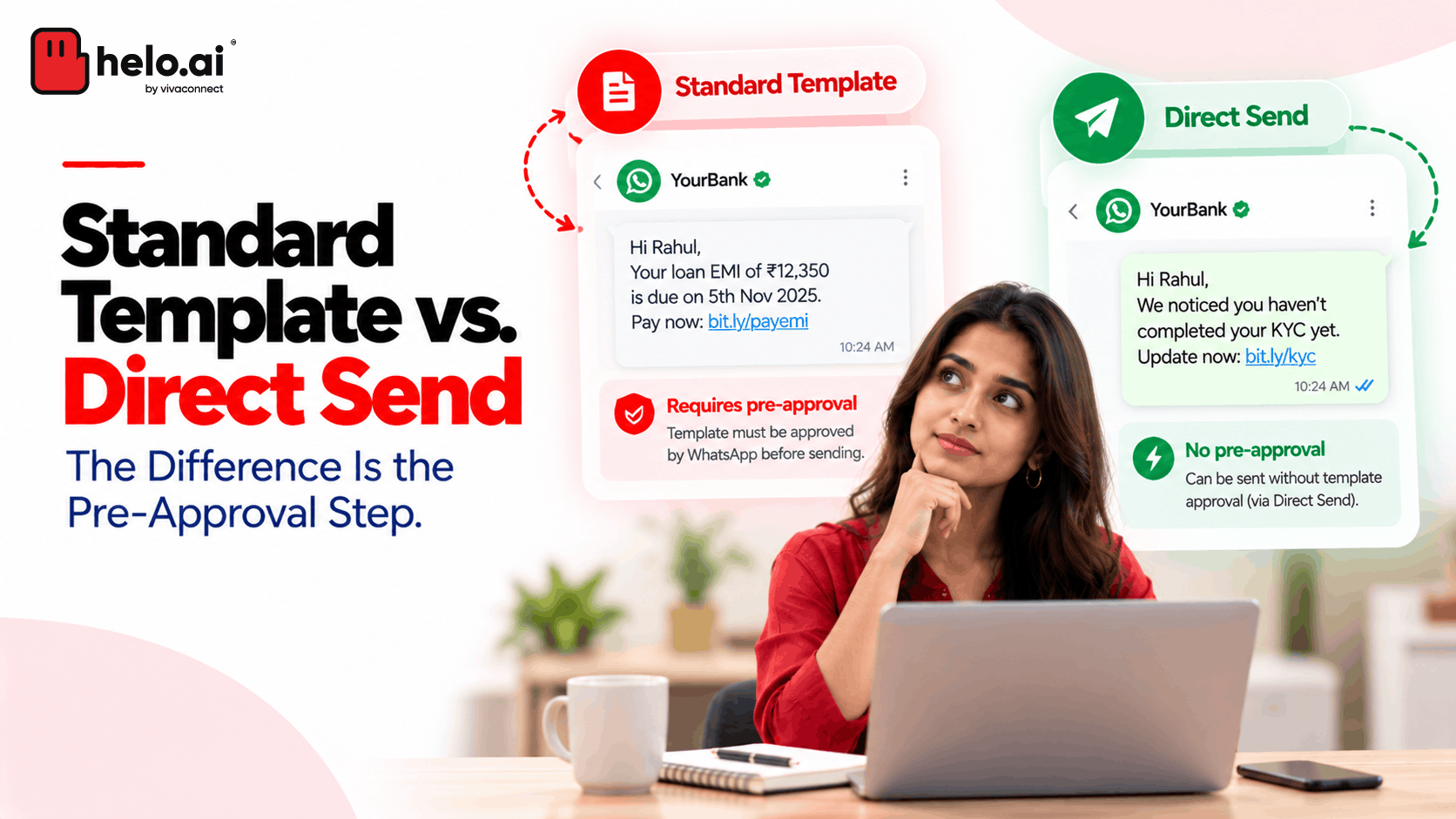


Direct Send lets eligible businesses send qualifying utility messages without waiting for template approval. Here's how it compares with standard templates, and when it's worth considering.
A bank needs to notify a customer that their account has been placed on hold because their KYC details are incomplete. The message is ready, but the bank hasn't created a template for it yet.
Does it need to create and submit a template first, or is there another option?
This is where the difference between standard WhatsApp template messaging and Direct Send becomes relevant.
What is WhatsApp Direct Send?
WhatsApp Direct Send is a Meta feature, currently in beta, that lets eligible businesses send qualifying utility messages without creating and submitting a template first. The business sends the message content, and Meta matches it to a template or generates one in the background.
Direct Send vs. standard template messages: what's the difference?
With the standard process, businesses create message templates and submit them to Meta for approval. Approved templates can then be used for business-initiated messaging when required by WhatsApp's rules.
WhatsApp Direct Send offers another option for qualifying utility messages. Eligible businesses can send the message content without waiting for standard template pre-approval. Meta handles the underlying template process in the background.
The difference is not that templates disappear. It's that businesses no longer need to complete the standard template pre-approval process before sending a qualifying Direct Send message.
Criteria | Standard template process | Direct Send |
|---|---|---|
Template preparation | Business creates and submits a template | Meta handles template generation in the background |
Pre-approval | Required before using a new template in the standard workflow | No need to wait for standard template pre-approval |
Message categories | Utility, marketing and authentication templates, subject to applicable rules | Utility and authentication only; marketing is not supported |
Eligibility | Subject to standard WhatsApp requirements | Subject to additional Direct Send eligibility requirements |
Status | Established process | Beta; features may change |
Pricing | Charged by template category | Charged as utility or authentication messages |
Meta explains the capability in its Direct Send documentation.
When does the difference matter?
Consider the bank's KYC notification.
- Standard process: If the customer's 24-hour service window has closed, the bank generally needs an approved utility template.
- Direct Send: If the bank is eligible for Direct Send and the message qualifies as utility, it may send the notification without waiting for standard template pre-approval.
For recurring notifications that are already covered by approved templates, the standard process may work perfectly well. Direct Send becomes worth evaluating when manually preparing and waiting for templates creates an operational bottleneck.
Does Direct Send replace templates?
No. Meta still handles template matching and generation behind the scenes. Direct Send also remains subject to WhatsApp's messaging policies, category rules and eligibility requirements.
A genuine account-status update may qualify as utility. A promotional credit-card offer does not become a utility message simply because the bank wants to send it quickly.
Businesses should also confirm their eligibility with Meta or their WhatsApp solution provider before planning around Direct Send.
Which approach should businesses consider?
Start with the communication need.
If existing templates support your recurring notifications, there may be no reason to change the process. If your team regularly needs to send new, qualifying utility messages without waiting for standard template pre-approval, Direct Send may be worth exploring.
Either way, the goal is the same: getting important updates to customers on time, in the right category.
Frequently asked questions
Can I send marketing messages with Direct Send?
No. Direct Send supports utility and authentication messages only. Promotional content still needs an approved marketing template.
How are Direct Send messages charged?
Direct Send messages are charged as utility or authentication messages, in line with Meta's WhatsApp pricing. Check Meta's current rate card for your market.
Do opt-in and WhatsApp's policies still apply?
Yes. Direct Send remains subject to WhatsApp's messaging policies, including opt-in and category rules. Utility messages misused for marketing can trigger warnings from Meta. See our WhatsApp opt-in guide.
Is Direct Send available to every business?
No. Direct Send is in beta and limited to eligible WhatsApp Business Accounts. Confirm eligibility with Meta or your WhatsApp solution provider.
.jpeg&w=640&q=75)
.jpeg&w=96&q=75)