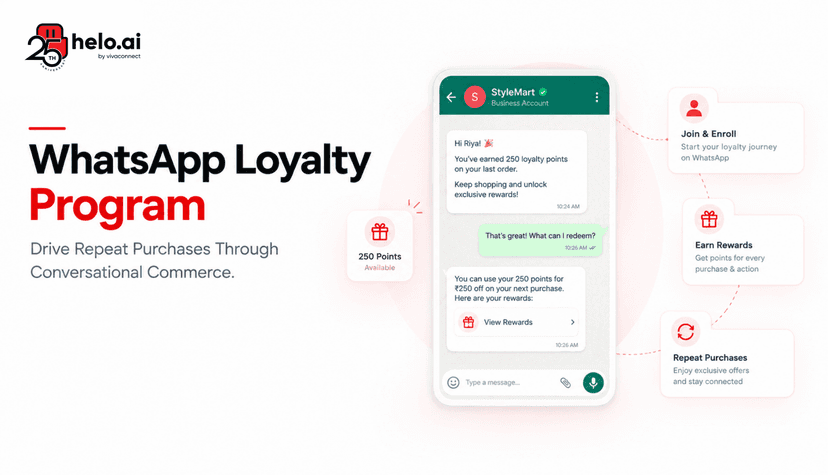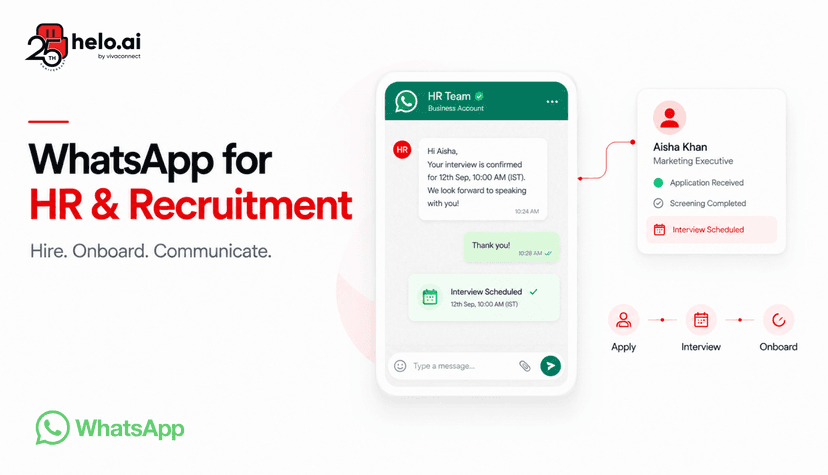


A customer sees your Instagram ad on their commute and clicks through to your site. They browse, then leave. That evening they get an email featuring the products they viewed; they open it but don’t buy. The next day they return on a laptop, add an item to the cart, and get distracted. Hours later a WhatsApp message asks if they have questions; they ask about delivery, support replies instantly, and they complete the purchase. A week later they receive relevant onboarding and recommendations.
To the customer, that’s one brand, one conversation, one journey. Inside most companies, it’s spread across systems and teams — marketing owns email, the e-commerce team owns the site, support owns WhatsApp, and customer data is scattered everywhere. As customers move between channels, context gets lost: irrelevant messages, repeated information, conversations that restart. The problem isn’t a lack of channels — it’s that the channels don’t work together. This guide explains what omnichannel customer engagement really is, why it matters, the building blocks, and how to build it — and links to deep-dives on each part.
What Is Omnichannel Customer Engagement?
Omnichannel customer engagement is the practice of creating connected, personalized experiences across every customer touchpoint and communication channel — so every interaction feels like part of one continuous conversation. The goal isn’t simply to communicate through multiple channels; it’s to ensure each interaction reflects everything that came before it and informs everything that follows.
This distinction matters because many businesses mistake multichannel presence for omnichannel engagement. A company may have a website, app, email, social, and WhatsApp support — impressive on paper. But if each channel operates independently and doesn’t share information, the experience stays fragmented. Contact a company on WhatsApp about an order, then get an email an hour later asking you to explain the same issue, then open the app and find no record of the conversation — technically three channels, practically broken. Omnichannel is the opposite: support already knows your history, the resolution syncs to email, and the app reflects it. Nothing repeats.
Multichannel vs Cross-Channel vs Omnichannel
It helps to see these as a maturity ladder rather than synonyms:
Model | What it means | Customer feels |
|---|---|---|
Multichannel | Present on many channels, each operating independently | “I have to start over every time” |
Cross-channel | Channels share some signals — behaviour on one informs another | “They sort of remember me” |
Omnichannel | One unified profile feeds a coordinated journey across all channels | “It feels like one conversation” |
Most organisations are stuck at multichannel while believing they’re omnichannel. We unpack the nuance in omnichannel vs multichannel marketing.
Why It Matters More Than Ever
Customer journeys have changed dramatically. A decade ago someone saw an ad, visited a site, and bought. Today a journey can span dozens of micro-interactions across search, social, reviews, chat, email, and support — sometimes over an hour, sometimes over months. Industry research routinely finds that most buying journeys now touch multiple channels before a decision, and the number of touchpoints before a sale can range from a handful for warm leads to dozens for cold prospects.
Expectations have risen alongside that complexity. Gartner frames the value of omnichannel engagement around four customer demands: channel consistency (issues resolved wherever they reach out), service continuity (switching channels without repeating themselves), customer recognition (being known while their data stays protected), and relationship history (being treated as a whole relationship, not a single transaction). Yet SAP’s 2026 Engagement Index reports that only around one in five brands reach high engagement maturity — most stay stuck because they treat strategy as a one-time build. The businesses that close this gap turn communication itself into a competitive advantage; those that don’t leak customers to rivals who feel easier to deal with.
The Five Building Blocks
Every working omnichannel strategy rests on the same five components — skip one and the whole thing wobbles:
1. Unified customer data
Siloed data is the root cause of broken execution. Your email tool, app analytics, CRM, POS, and support desk each think they’re the source of truth, and none talk to each other. A unified profile every channel can read from and write to is the foundation; without it, personalization stays superficial. This is where integration services connect the stack.
2. Channel orchestration
Orchestration is the difference between being on every channel and intelligently deciding the next move based on who the customer is, what they just did, and what they’re likely to do next. It assigns each channel a role and a rule (see the framework below).
3. Personalization at scale
Real personalization uses behavioural, transactional, and contextual data to tailor content, offers, channel, and timing per individual — not a first name in an email. A first-time visitor shouldn’t get the same message as a loyal customer; someone mid-support shouldn’t get an aggressive promo.
4. Real-time response
Customer behaviour changes constantly, so the system needs to react to actions as they happen rather than in delayed batches — a pricing-page visit, a cart abandonment, or a support contact should be able to shift the next message immediately.
5. Journey measurement
Without analytics, optimization is guesswork. Measure how customers move through connected journeys and what those journeys produce over time — covered in depth in our measurement guide.
Give Every Channel a Role (Framework)
The strongest strategies assign every channel a clear role so messages reinforce rather than repeat each other. A practical starting point:
Channel | Best role | Example moment |
|---|---|---|
Real-time, high-intent conversation & service | Answering a pre-purchase question, order updates | |
Rich storytelling & nurture | Post-browse follow-up, onboarding sequences | |
SMS | Urgent, universal, time-sensitive | OTPs, critical alerts, delivery windows |
Push / in-app | Contextual nudges to active users | Cart reminders, feature adoption |
Voice | Complex, high-value, relationship moments | Escalations, advisory sales calls |
The rule that ties them together: each interaction updates the shared profile, and the next channel acts on that context. For conversational channels, our guide to conversational marketing goes deeper.
How It Actually Works (Example)
The mechanics are more concrete than the theory suggests. Imagine a customer visits your pricing page three times in two days; the site records this to their profile. They download a guide, updating the profile again. A decision engine reads the behaviour — repeated pricing visits plus a guide download signal strong intent — and enrolls them in a journey. An email offers a demo; they open it but don’t book. Hours later a WhatsApp message asks if they have questions; they reply, a rep joins, and the demo is scheduled. After it, onboarding begins. Every interaction produces new information that shapes the next — the business responds to actual behaviour instead of guessing.
Omnichannel by Industry
The pain differs by vertical, but the lever is the same — a unified profile feeding a coordinated journey:
- E-commerce — connect browsing, abandoned carts, support, and post-purchase into one journey to lift repeat purchases and lifetime value.
- SaaS / subscription — guide onboarding, adoption, support, and expansion without repetitive messaging; behavioural re-engagement before dormancy protects retention.
- Financial services — simplify applications, onboarding, and support by carrying identity and context across channels (see omnichannel in finance).
- Travel & hospitality — connect pre-trip, in-trip, and post-trip phases that are usually owned by different teams — the biggest driver of repeat bookings.
For concrete brand teardowns, see omnichannel CX examples.
Explore the Full Guide
This pillar is the hub of a complete series. Each guide below goes deep on one part of omnichannel engagement:
- How to Build an Omnichannel Customer Experience (Step by Step) — the seven-step implementation playbook, from journey mapping to measurement.
- Mapping the Omnichannel Customer Journey — why journeys aren’t funnels, and how to reconstruct them with identity resolution and context.
- Omnichannel Customer Service — support across every channel without losing context, including bot-to-agent continuity.
- How to Measure Omnichannel CX — the metrics and KPIs that reflect reality, beyond channel-level vanity numbers.
- Omnichannel CX Examples — what Starbucks, Disney, Sephora, Amazon, and Nike get right.
- Omnichannel Communication: Strategy & Examples and Best Omnichannel Engagement Platforms — strategy framing and platform selection.
How to Measure Success
Measuring omnichannel engagement isn’t about collecting more metrics — it’s about understanding whether experiences are improving. The strongest signals are journey-level, not channel-level: customer retention, customer lifetime value, journey completion rate, cross-channel conversion rate, and satisfaction. The simplest litmus test: are customers experiencing your business as one connected relationship or a collection of disconnected interactions? Our metrics and KPIs guide details how to track this, including journey-integrity measures like context-retention and repeat-contact rate.
The Role of AI and Automation
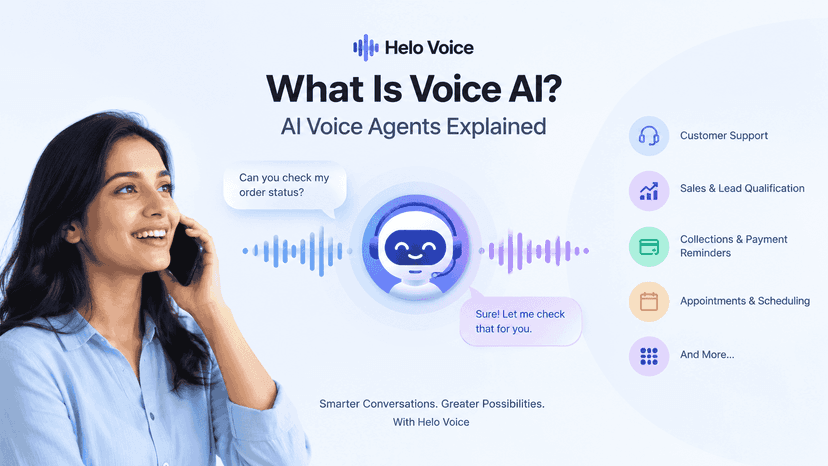
Omnichannel engagement is becoming more intelligent. AI personalizes in real time, predictive systems anticipate needs before customers express them, Voice AI extends engagement beyond text, and unified customer memory makes context available across every interaction. Gartner and others expect automation to handle a large share of routine service interactions within a few years — but the objective stays simple: customers want to be remembered, to receive relevant interactions, and to continue conversations naturally. Technology just makes that easier at scale, as we cover in five ways to improve engagement with AI.
Conclusion
Customers don’t think in channels. They don’t care which team owns email or whether support integrates with CRM — they simply expect businesses to know who they are and continue conversations naturally. That’s what omnichannel customer engagement delivers: it turns disconnected interactions into continuous conversations, and fragmented experiences into connected ones.
It rests on unified data, orchestration, personalization, real-time response, and journey measurement — and, increasingly, on AI that makes all of it work at scale. In a world where customers move effortlessly between channels, the winners won’t be the brands with the most touchpoints. They’ll be the ones that make every touchpoint feel like part of the same conversation.
FAQs
What is omnichannel customer engagement?
It’s the coordination of every customer interaction across channels, devices, and touchpoints so each one reflects prior context and shapes what comes next — creating one continuous, personalized experience rather than disconnected touchpoints.
What’s the difference between omnichannel and multichannel?
Multichannel means being present on many independent channels. Omnichannel connects them through a unified customer profile so context follows the customer and the experience feels like one conversation.
What are the building blocks of omnichannel engagement?
Five: unified customer data, channel orchestration, personalization at scale, real-time response, and journey measurement. Missing any one tends to leave the experience fragmented.
How do you measure omnichannel customer engagement?
Focus on journey-level metrics — retention, lifetime value, journey completion, cross-channel conversion, and satisfaction — plus journey-integrity signals like context retention and repeat-contact rate, rather than channel-level vanity metrics alone.
Why is omnichannel customer engagement important?
Customer journeys now span many channels, and customers expect continuity. Connected engagement improves experience, conversion, and retention, while fragmentation erodes trust and increases cost — making it a genuine competitive advantage.
Do I need a platform for omnichannel engagement?
As interactions and channels grow, coordinating context manually becomes impractical. A customer-engagement platform unifies data, orchestrates journeys, personalizes messaging, and measures outcomes from one place.