


How we picked these providers
Six criteria, applied identically to every vendor on this list:
- Network ownership vs aggregation — does the provider own carrier relationships and routing, or resell someone else's? This drives delivery quality, latency and unit economics more than any feature.
- Channel breadth — SMS, RCS, WhatsApp, voice, email, video, and the regional apps that matter in specific markets.
- Regional depth — a global footprint is not the same as local expertise. Regulatory knowledge, local support and operator relationships are market-by-market.
- Pricing transparency — whether rates are published at all. This turns out to be a meaningful differentiator.
- Compliance posture — GDPR, HIPAA, PCI DSS, ISO 27001, SOC 2, data residency, and local regimes like India's DLT and DPDP.
- Vendor stability — ownership, financial health, roadmap, and acquisition exposure.
What is CPaaS, briefly?
CPaaS — Communications Platform as a Service — is cloud infrastructure that lets you add real-time communication to your applications through APIs, instead of building telecom systems yourself. You call an API; the provider handles carrier connections, routing, delivery and compliance.
It's easily confused with two adjacent categories:
What it is | Who buys it | |
|---|---|---|
CPaaS | APIs you embed into your own applications | Developers, product teams |
CCaaS | A ready-made cloud contact centre | Customer service leaders |
UCaaS | Internal comms — calling, meetings, chat | IT, operations |
The lines are blurring, because several vendors below now sell all three. For a full breakdown, see our guide to what CPaaS is.
CPaaS Trends to Watch in 2026
Before choosing a CPaaS provider, keep these trends in mind.
More Providers Are Being Acquired
Several leading CPaaS companies have changed ownership in recent years, including Vonage, Kaleyra, and Route Mobile. Before signing a long-term contract, ask how future acquisitions could affect pricing, support, and product updates.
WhatsApp Pricing Has Changed
Meta now charges businesses per delivered template message instead of per conversation. If WhatsApp is a major channel for your business, compare providers based on their pricing markup and total messaging cost.
Security Is More Important Than Ever
Many CPaaS platforms now offer features like SIM swap detection and number verification to reduce fraud and improve customer authentication.
AI Is Becoming a Standard Feature
AI-powered chatbots, workflow automation, and intelligent message routing are quickly becoming standard. Choose a provider that offers practical AI features instead of basic messaging APIs.
The 13 best CPaaS providers in 2026
Helo.ai
A CPaaS provider with more than 25 years of enterprise communication experience. Originally launched as VivaConnect in 2001 and rebranded to Helo.ai in 2026, the platform supports WhatsApp Business API, SMS, RCS, email and voice APIs through a unified infrastructure. Beyond messaging APIs, Helo.ai also offers AI chatbots, customer engagement tools and campaign automation for enterprise communication.
Best for: Mid-market and enterprise businesses that need a single platform for customer communication across multiple channels. Helo.ai is a strong choice for high-volume WhatsApp messaging, transactional notifications, two-way customer conversations, marketing campaigns and AI-powered customer support. The platform currently processes more than 200 million WhatsApp messages every month.
Not for: Developers looking for instant self-service onboarding or businesses that require communication infrastructure across hundreds of countries. Helo.ai follows an enterprise sales model with custom pricing, so companies needing pay-as-you-go pricing or a combined CPaaS, CCaaS and UCaaS platform may find other providers better suited.
Standout capabilities:
- DLT registration held in-house — for Indian SMS, someone must own the TRAI DLT registration, headers and templates. We do it rather than pointing you at a third party. See DLT management.
- RCS depth — Kotak Mahindra Bank runs media-rich interactive messaging with us; Bajaj Finance runs RCS and SMS through the same stack.
- Voice heritage — the original VivaConnect network handled up to 50 million voice calls daily at peak. That infrastructure underpins Voice and our AI voice agents.
- Measured outcomes — Aditya Birla Capital Digital cut cost per appointment by 65%+ moving housing loan bookings into WhatsApp Flows.
Pricing: Usage-based, quoted per deployment. Not published. Talk to our team.
Twilio
The category's defining name, and still the reference point everyone else is measured against.
Best for: Developer-led teams that want the broadest ecosystem, the deepest documentation, and data-driven engagement. Its 2020 Segment acquisition means messaging, voice and customer data sit in one place enabling real-time segmentation and predictive signals like churn risk, rather than just notifications.
Not for: Cost-sensitive buyers at high volume — Twilio rarely wins on price. Also not the strongest choice where India-specific regulatory depth is the deciding factor.
Standout capabilities:
- Super Network — 4,800+ carrier connections across 180+ countries
- Segment CDP integration for predictive, contextual engagement
- 10M+ developer community, 3,000+ technology partners, ConversationRelay for LLM-backed voice agents
Pricing: Pay-as-you-go with volume discounts; free trial.
Infobip
The infrastructure heavyweight, and arguably the broadest portfolio in the market.
Best for: Enterprises that want one vendor across CPaaS, contact centre, journey orchestration and a native CDP — with vertical teams attached. Its Agent OS framing points at goal-oriented AI agents that complete tasks end to end.
Not for: Teams who want a light SMS API and nothing else. The portfolio's breadth is the point, and it's overkill for narrow use cases.
Standout capabilities:
- 800+ direct telecom connections, 1,300+ servers, 40+ data centres
- Ahead on emerging channels — 10B+ RCS messages delivered, active in GSMA Open Gateway
- Vertical squads and templated use cases across telecoms, financial services and retail
Pricing: Pay-as-you-go, free trial, cost calculator.
Vonage
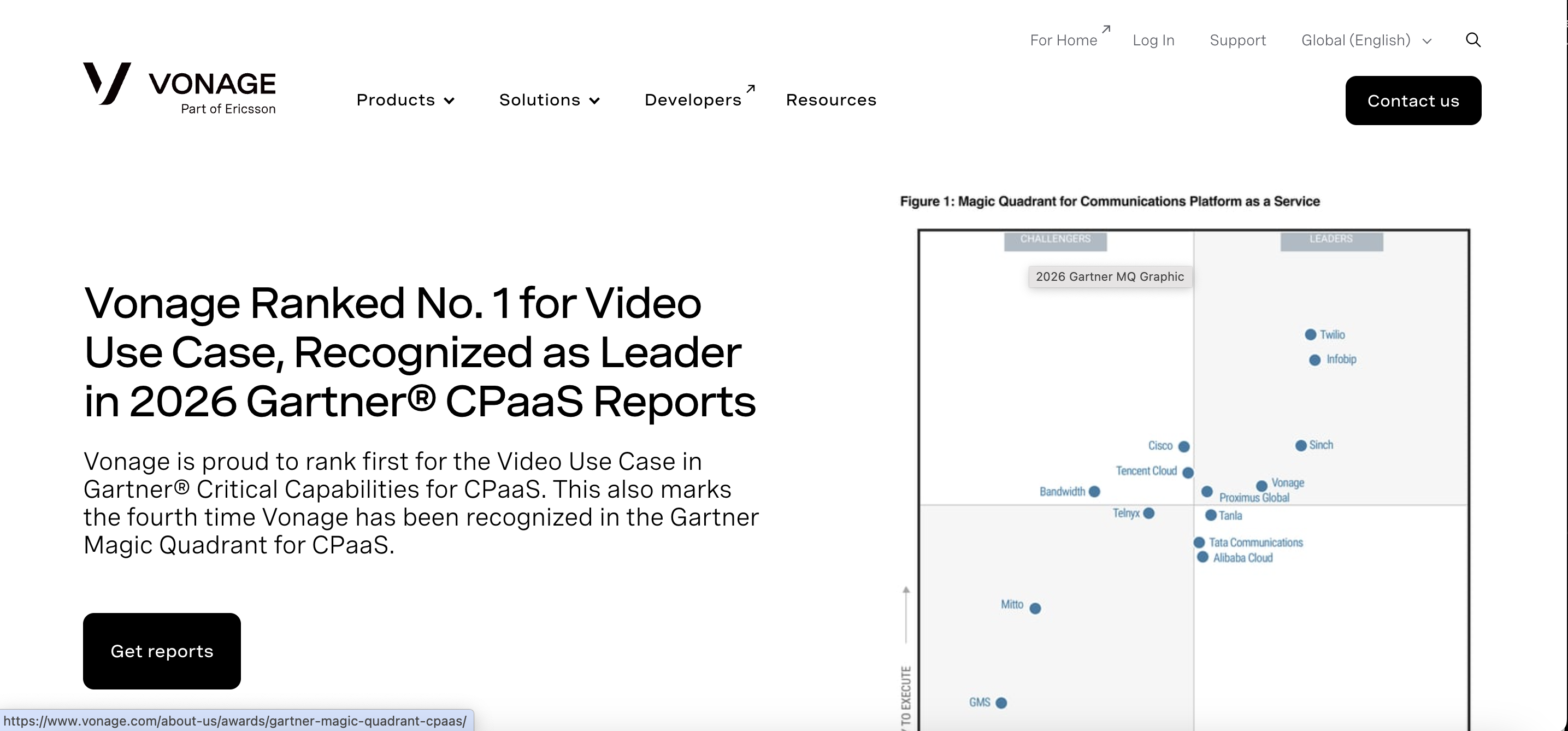
Owned by Ericsson, and that ownership is the whole differentiator.
Best for: Fraud-sensitive use cases and organisations wanting CPaaS, UCaaS and CCaaS from one vendor. Network APIs — SIM swap detection, number verification, location retrieval, quality-on-demand — give access to carrier-level signals most competitors can't replicate.
Not for: Buyers wary of big-telco ownership dynamics, or those who need India-first regulatory depth.
Standout capabilities:
- Network APIs via Ericsson, across 1,600+ telecom networks
- CPaaS + UCaaS + CCaaS in one ecosystem
- AI Studio — agents across voice, SMS, RCS and social; TTS in 50+ languages, speech recognition across 120
Pricing: Pay-as-you-go, fixed subscription, or tiered hybrid. Free trials.
Sinch
Scale plus unusually genuine local presence.
Best for: Enterprises operating across many markets that want global reach without losing local regulatory knowledge. Sinch runs a local presence in 65 countries and handles around 900 billion interactions annually.
Not for: Small teams — the enterprise integration depth is wasted if you're not using it.
Standout capabilities:
- 600+ direct telecom connections; its own US voice network reaching ~95% of US consumers
- Native integrations into Salesforce, Microsoft, SAP and Adobe, plus a large pre-built integration library
- Broad channel coverage including regional apps like WeChat and KakaoTalk; AIT fraud detection and Voice Relay
Pricing: Pay-as-you-go.
Bandwidth
The one that owns its own network end to end, and it shows.
Best for: North American voice-heavy deployments, and enterprises that want to assemble their own stack. Maestro provides no-code orchestration across Genesys, Five9, Zoom, Teams, Google and Webex — CPaaS as the connective tissue rather than the destination.
Not for: Organisations whose centre of gravity is outside North America.
Standout capabilities:
- Owns and operates a cloud-native global network — direct control of quality and economics
- Native emergency (911) capability, which almost no CPaaS offers
- Bills voice in six-second increments rather than whole minutes — materially cheaper for short calls
Pricing: Pay-as-you-go, volume-based.
Telnyx
Infrastructure ownership at a smaller scale, with a strong developer reputation.
Best for: Latency-sensitive builds where you want one vendor owning network, channels and AI orchestration. Telnyx runs its own infrastructure across 60+ countries and handles 100M+ daily API requests. It was G2's top-ranked CPaaS provider in the 2025 Best Software Awards.
Not for: Buyers who need the enterprise services wrapper — vertical squads, dedicated consulting — that Infobip or Tata provide.
Standout capabilities:
- End-to-end owned infrastructure across 60+ countries
- Blended network, channels and AI orchestration on one platform
- Strong peer-review standing
Pricing: Pay-as-you-go. Published rates.
Plivo
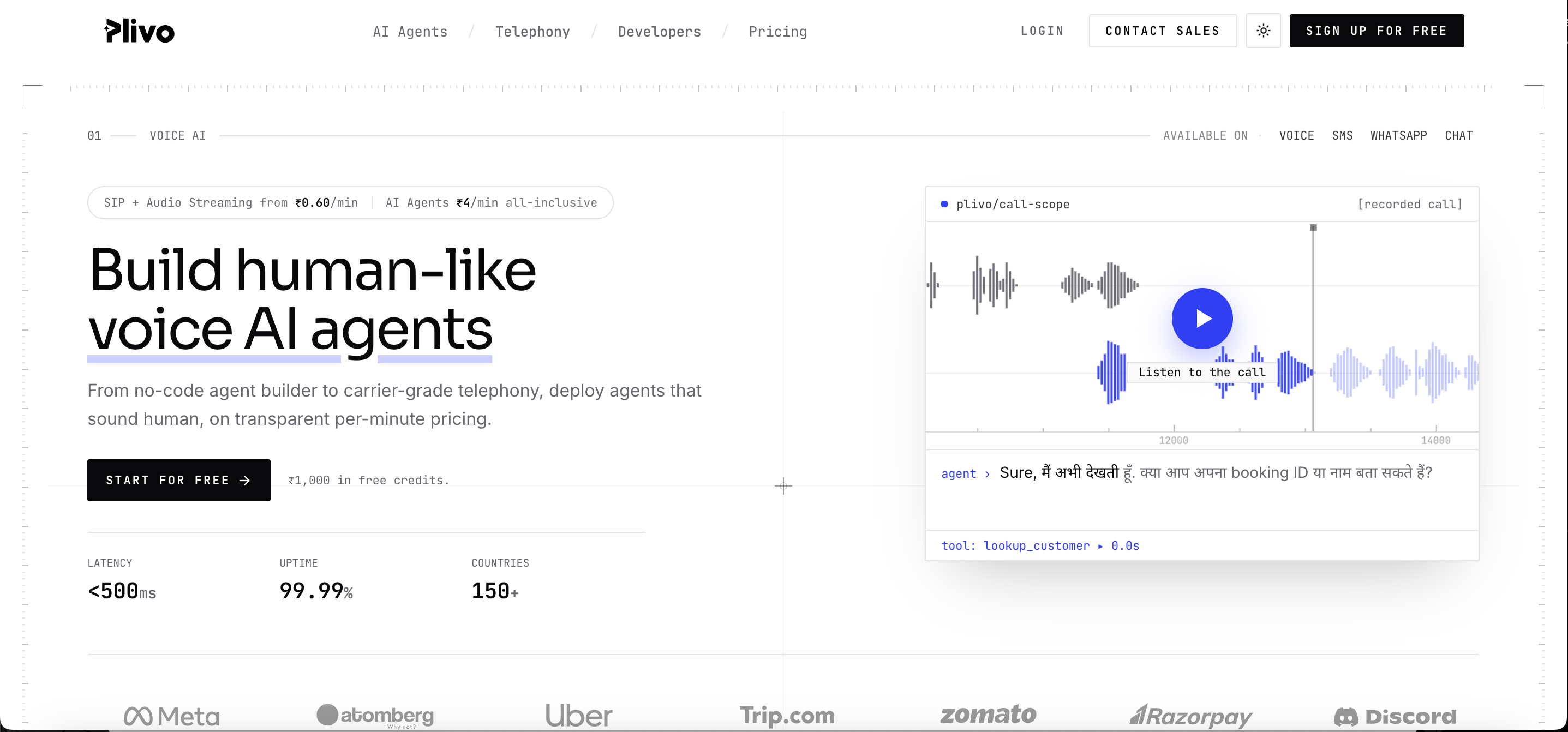
The affordability-and-simplicity play, and one of the category's originals.
Best for: Teams that want fast implementation and predictable, lower costs without a heavy platform. Founded in 2011 alongside Twilio, Vonage and Bandwidth as a CPaaS pioneer.
Not for: Enterprises needing deep vertical tooling, network APIs, or a CDP.
Standout capabilities:
- Competitive pricing and quick time-to-value
- Plivo Vibe — building agent flows via natural language, tested and published from one interface
- Frequently commended for support on verified review platforms
Pricing: Pay-as-you-go. Published rates.
Cisco Webex Connect
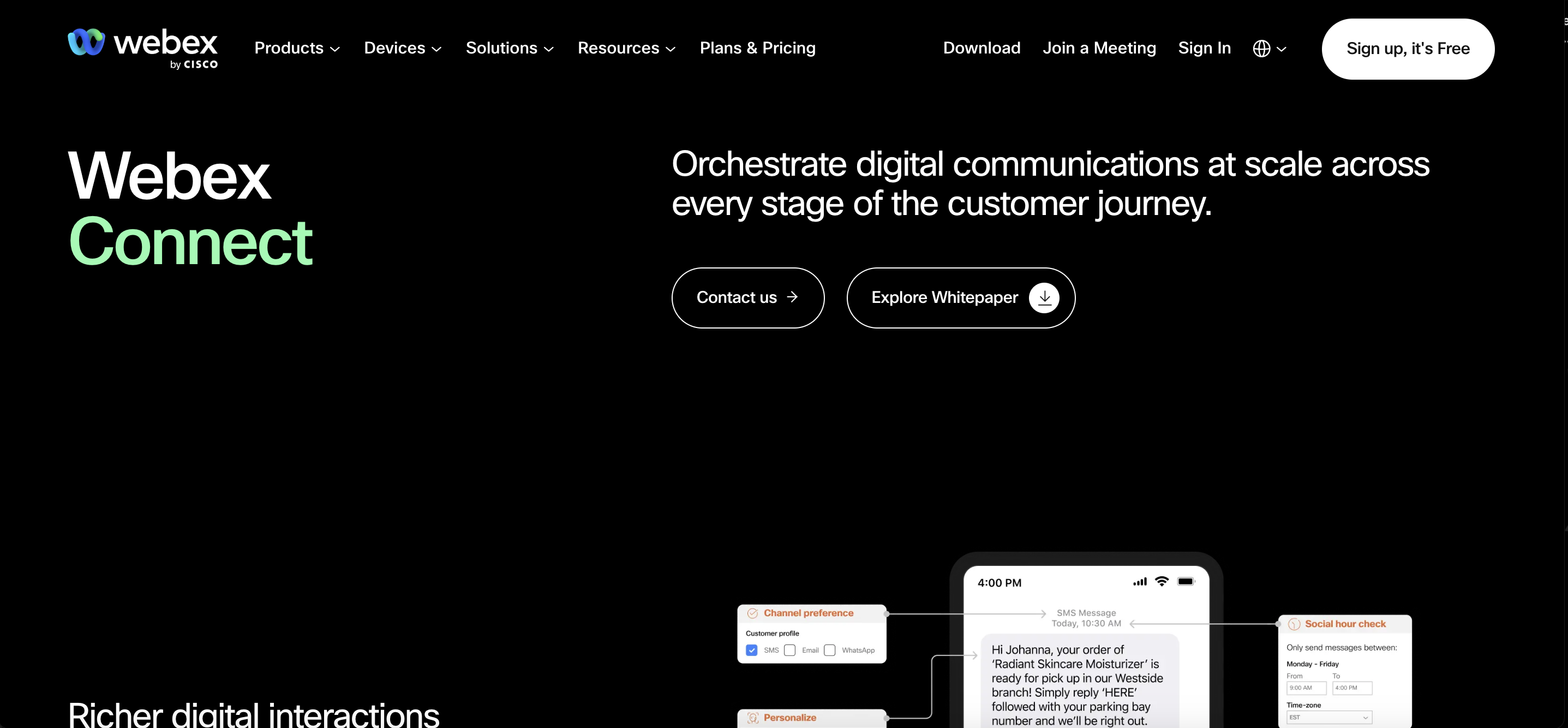
Enterprise credibility, acquired rather than built — Cisco entered via IMImobile in 2020.
Best for: Large enterprises already inside the Cisco estate, especially those bridging on-premise contact centre workloads into proactive digital journeys. The visual flow builder lets non-developers build conversational flows without replacing existing systems.
Not for: Anyone who needs to know what it costs before talking to sales — Cisco doesn't publish CPaaS pricing. Also poorly suited to small, fast-moving teams.
Standout capabilities:
- CPaaS and CCaaS natively fused; 16 channels
- Journey Data Services keeping customer profiles current across touchpoints
- Deliberately AI-agnostic — integrates Google, Microsoft, AWS, IBM and Kore.ai rather than locking you to one engine
Pricing: Not published. Understood to be pay-as-you-go.
Tanla
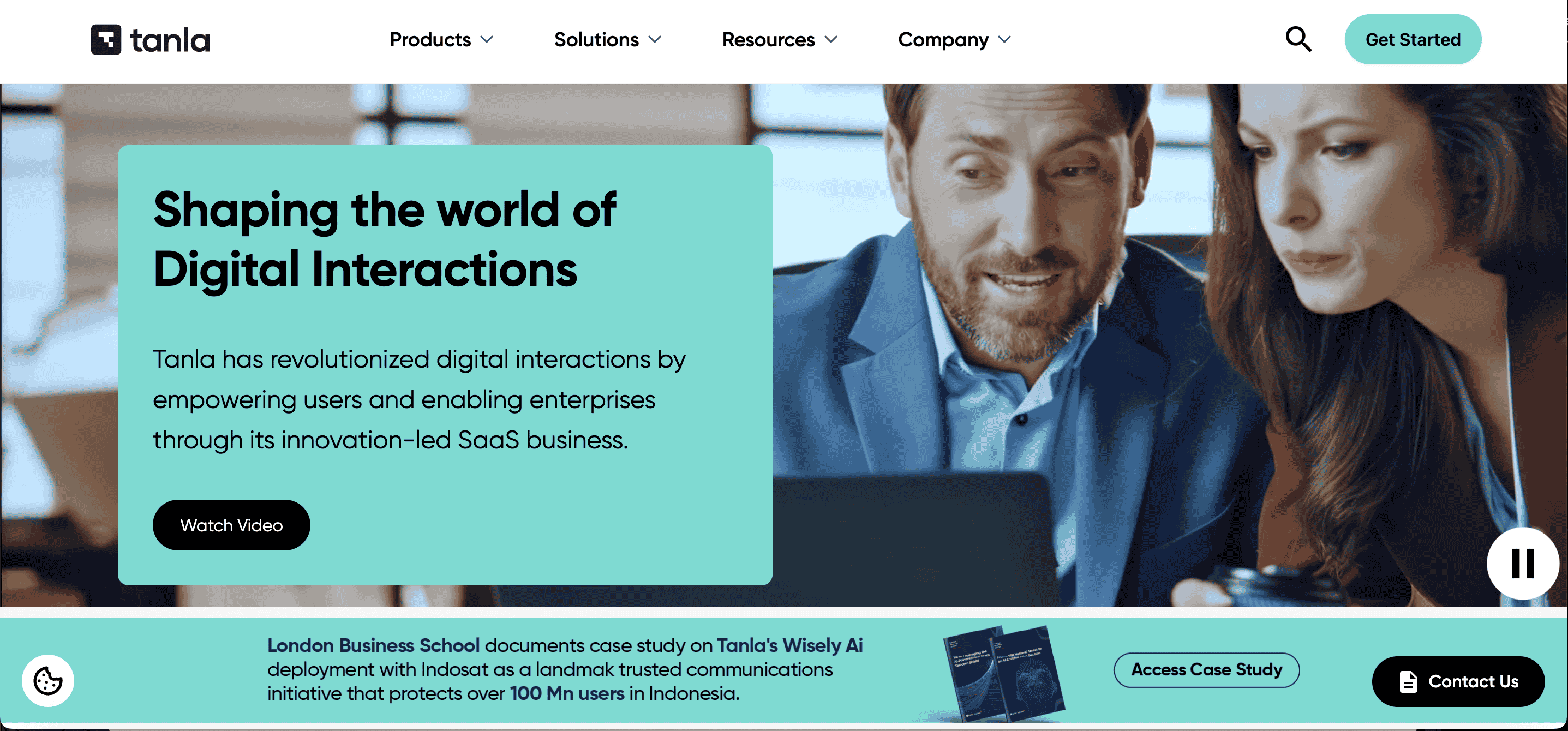
India's largest CPaaS player by revenue share, and our biggest domestic competitor. We'll write it straight.
Best for: High-volume Indian enterprise messaging where regulatory compliance and anti-spam are central. Tanla holds roughly 35% revenue share of the India CPaaS market by its own account, following its acquisition of ValueFirst from Twilio, and processes a very large share of India's A2P traffic.
Not for: Buyers wanting published pricing, or those whose volume sits mainly outside India.
Standout capabilities:
- Trubloq — blockchain-based anti-spam and DLT compliance infrastructure
- Wisely ATP for ML-driven fraud detection; Wise Albert for segmentation and campaign optimisation
- Early RCS investment paid off — now a preferred partner for Google's RBM for MaaP across India
Pricing: Usage-based. Not published.
Route Mobile (Proximus Global)
Since 2024, part of Proximus Global alongside BICS and Telesign — a deliberate East–West combination.
Best for: Enterprises needing genuine coverage across both India/MEA and North America/Europe, with identity and fraud prevention from the same vendor. Route Mobile brings India and MEA depth; Telesign brings NA and EU plus a fraud platform built on 2,000+ AI signals.
Not for: Buyers who want a single clear product story — Proximus Global is still assembling a large portfolio into one vision.
Standout capabilities:
- BICS network handling up to 10.5 billion transactions monthly, 700 direct operator connections
- Telesign digital identity and fraud prevention integrated into the CPaaS layer
- Dual go-to-market — developer-led via Telesign, consultative enterprise sales via Route Mobile
Pricing: Tailored to volume and requirements. Not published.
Tata Communications (Kaleyra / DIGO)
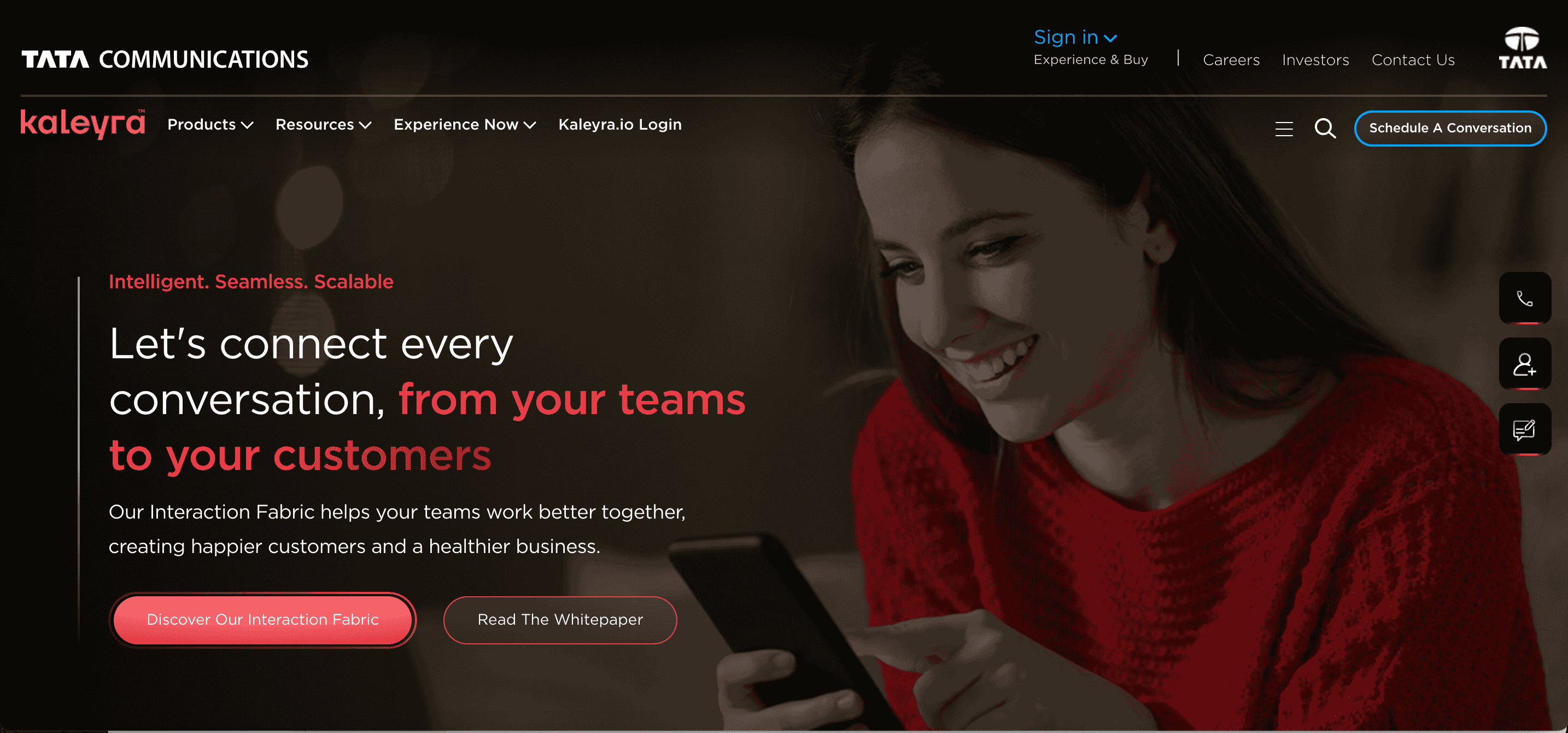
Telecom heritage plus consultancy reach, aimed squarely at large regulated enterprises.
Best for: BFSI and large enterprises wanting a strategic partner rather than an API vendor. Tata acquired Kaleyra in 2023 and folded it into a Customer Interaction Suite spanning CPaaS, CCaaS and conversational AI. Its financial services credentials run back to the 2002 VSNL acquisition, and adjacency to Tata Consultancy Services makes it more collaborator than supplier.
Not for: Startups and mid-market teams — the engagement model assumes a long sales cycle and a large contract.
Standout capabilities:
- 1,600 CSP relationships, 700+ mobile operator voice interconnections, voice into 200+ countries
- Genuinely strong across India, APAC, Middle East and Africa — unlike competitors centred on Europe and North America
- Relationships with roughly 300 Fortune 500 companies
Pricing: Usage-based, custom enterprise rates. Not published.
Gupshup
.png&w=3840&q=75)
Messaging-first, with delivery engineering as the pitch.
Best for: High-volume messaging where reach and deliverability decide outcomes, particularly across emerging markets. Multi-channel failover, automatic rerouting of failed messages and AI-driven send-time optimisation are the core of the offer.
Not for: Teams needing voice depth or network APIs.
Standout capabilities:
- Multi-channel failover and auto-rerouting on delivery failure
- AI send-time optimisation, language personalisation, propensity scoring
- No-code integrations aimed at business users, not just developers
Pricing: Usage-based. Contact for rates.
Honourable mentions
The category is crowded. Eight more worth knowing:
- 8x8 — one API across RCS, SMS, WhatsApp, Viber and voice, plus owned CCaaS and UCaaS. Journey IQ tracks how an interaction evolves across channels over time.
- Bird — MessageBird's 2024 rebrand, launched with aggressive SMS and WhatsApp discounting against Sinch and Twilio, and has since pushed into marketing and vertical tools.
- CM.com — strong European compliance posture and an unusual footprint in live events, arenas and sports venues. Bird's €166M acquisition bid didn't complete.
- Comviva — Tech Mahindra subsidiary; combines network and communication APIs in one marketplace, strongest in banking and telco, supports private and public cloud deployment.
- Exotel — Bengaluru-based, merged with Ameyo, strong on contact centre capability, regional language support and fast deployment for Indian SMEs and marketplaces.
- Microsoft ACS — the communications backbone under Teams and Dynamics 365 Contact Center, extensible via Copilot Studio. Compelling if you're already all-in on Microsoft.
- RingCentral — a UCaaS Gartner Magic Quadrant leader with 500,000+ customers, increasingly bridging UCaaS and CPaaS.
- Tencent Cloud — low-latency audio and video for gaming, education and social platforms; extends into IoT, 5G and biometrics.
How much do CPaaS providers cost?
Almost every provider runs pay-as-you-go with volume tiers. The more useful question is whether they'll tell you the rate before you talk to a salesperson.
Provider | Model | Rates published? | Free trial |
|---|---|---|---|
Twilio | Pay-as-you-go + volume | Yes | Yes |
Infobip | Pay-as-you-go | Yes | Yes |
Vonage | PAYG / subscription / tiered | Yes | Yes |
Sinch | Pay-as-you-go | Yes | — |
Bandwidth | PAYG, volume-based | Yes | — |
Telnyx | Pay-as-you-go | Yes | — |
Plivo | Pay-as-you-go | Yes | — |
Cisco Webex | Understood PAYG | No | — |
Tanla | Usage-based | No | — |
Route Mobile | Tailored to volume | No | — |
Tata Communications | Usage-based, custom | No | — |
Gupshup | Usage-based | No | — |
Helo.ai | Usage-based, quoted | No | — |
A pattern worth naming: the developer-first vendors publish; the enterprise-first vendors don't — and we're in the second group. Opacity isn't necessarily bad faith. Enterprise rates genuinely depend on volume, destination mix and channel. But it does mean comparing providers requires several conversations, and you should factor that time into your evaluation.
What actually drives your bill
- Destination country — the largest single variable. Rates differ by more than 10× across markets.
- Channel mix — SMS, WhatsApp, RCS and voice have completely different economics.
- Template category — for WhatsApp, authentication is cheapest, marketing most expensive, service conversations free.
- Volume tier — most providers discount steeply, so quoted list rates are rarely what large customers pay.
The costs nobody lists
Number provisioning. Migration and onboarding. Minimum monthly commitments. Overage rates once you exceed a committed tier. Support tiers — 24/7 with a named engineer usually costs extra. Compliance registration in regulated markets.
None of these appear in a per-message rate, and together they can exceed the messaging spend in year one.
How to choose a CPaaS provider
We've written a full evaluation framework in 7 factors for choosing the right cloud communication platform, and how to choose an omnichannel platform covers adjacent ground. Rather than repeat them, here are the three questions those guides — and every vendor list on the internet — tend to skip.
Who owns your DLT registration?
If you send SMS in India, someone must hold TRAI DLT registration: registered entity, headers, templates and consent records. This is not optional and it is not automatic.
Global providers often expect you to hold it. Indian providers usually hold it for you. This is a real operational difference that surfaces at launch, typically the week your messages start failing scrubbing — and it never appears in a feature comparison. Ask the question explicitly, and get the answer in writing. Ours is DLT management, handled in-house.
The same logic extends to DPDP consent obligations. See our WhatsApp API compliance guide.
What does migration actually cost?
Every list tells you how to choose a provider. None tells you what it costs to leave one.
The real bill: number porting (weeks, sometimes months). Template re-approval from scratch — Meta doesn't transfer approvals. Re-integration and re-testing. Parallel running both providers during cutover. Rebuilding quality ratings on new numbers. Retraining whoever operates the platform.
Ask any vendor you're evaluating what leaving looks like. The answer tells you a lot about how they expect to keep you. Our guide to switching WhatsApp API providers covers the mechanics.
What happens if your provider is acquired?
Given the last four years, this is not hypothetical. Ericsson/Vonage. Tata/Kaleyra. Proximus/Route Mobile/Telesign. Tanla/ValueFirst. Twilio buying ValueFirst and then selling it.
Ask: does your contract survive a change of control? Are your rates locked, or renegotiated? What happened to the roadmap of the last product this acquirer bought? Is your account team retained?
No vendor list asks this. Every enterprise procurement team should.
CPaaS vs CCaaS vs UCaaS vs building it yourself
What it gives you | Who it suits | Real cost | |
|---|---|---|---|
CPaaS | APIs, carrier connections, compliance | Product and engineering teams | Per message/minute + integration effort |
CCaaS | A working contact centre | Support leaders | Per agent per month |
UCaaS | Internal calling, meetings, chat | IT | Per seat per month |
Build direct | Meta's Cloud API, carrier contracts, no middle layer | Strong backend teams, single channel | Lowest unit cost, highest maintenance |
That last row deserves saying out loud, given who's writing this: some teams should skip CPaaS entirely.
If WhatsApp is your only channel, your volume is modest, your routing rules are simple, and you have backend engineers with capacity — integrate directly against Meta's Cloud API and pay Meta's rates. No markup, full control. Our WhatsApp Notification API guide walks through exactly how, including the Cloud API vs provider trade-off, and Cloud API vs on-premises covers the infrastructure question.
You need a CPaaS when you're running fallback across channels, operating in regulated markets, honouring per-user preferences at scale, or when the maintenance burden of separate integrations per channel stops being a good use of your team. Not before.
Frequently asked questions
What is CPaaS?
Cloud infrastructure that lets you embed messaging, voice, video and authentication into your applications through APIs, without building telecom systems. See our full guide.
Who are the leading CPaaS providers in 2026?
Globally: Twilio, Infobip, Vonage, Sinch, Bandwidth, Telnyx, Plivo and Cisco Webex Connect. In India: Tanla, Route Mobile, Tata Communications, Gupshup, Exotel and Helo.ai. The right one depends far more on your geography, channel mix and regulatory position than on any ranking.
What's the difference between CPaaS, CCaaS and UCaaS?
CPaaS is APIs you build with. CCaaS is a ready-made contact centre. UCaaS is internal communication. Several vendors now sell all three.
How much does CPaaS cost?
Almost universally pay-as-you-go with volume tiers. Cost is driven by destination country, channel, message category and volume. Rates vary by more than 10× across markets, so a single "per message" figure is meaningless without a destination.
How hard is it to switch CPaaS providers?
Harder than vendors imply. Number porting takes weeks. WhatsApp template approvals don't transfer. You'll re-integrate, re-test, run both providers in parallel during cutover, and rebuild quality ratings on new numbers. Ask about exit before you sign.
Do I need a CPaaS provider with DLT registration?
If you send SMS in India, someone must hold TRAI DLT registration. Global providers often expect you to hold it yourself; Indian providers usually hold it for you. Confirm which, in writing, before signing.
What happens if my CPaaS provider gets acquired?
Contracts, rates, roadmaps and account teams can all change. Given the recent pace of consolidation, ask about change-of-control terms during procurement rather than after.
Did WhatsApp's 2025 pricing change affect CPaaS costs?
Yes. Meta retired conversation-based pricing on 1 July 2025 in favour of per-message billing, priced by category and recipient country, with further rate updates in January and July 2026. If WhatsApp is a meaningful share of your volume, this changed your economics and how you should compare providers' markups.
Is CPaaS being commoditised by AI?
It's a live argument. Analysts have suggested AI can interpret APIs directly and route across multiple providers automatically, which erodes the developer-experience advantage CPaaS was built on. The likely outcome is that providers owning something structural — physical network, regulatory position, vertical depth — hold value, while undifferentiated resellers get squeezed.

.jpeg&w=96&q=75)