.jpeg)


Key takeaways
- Cost per message measures activity. Communication channel ROI measures business outcomes.
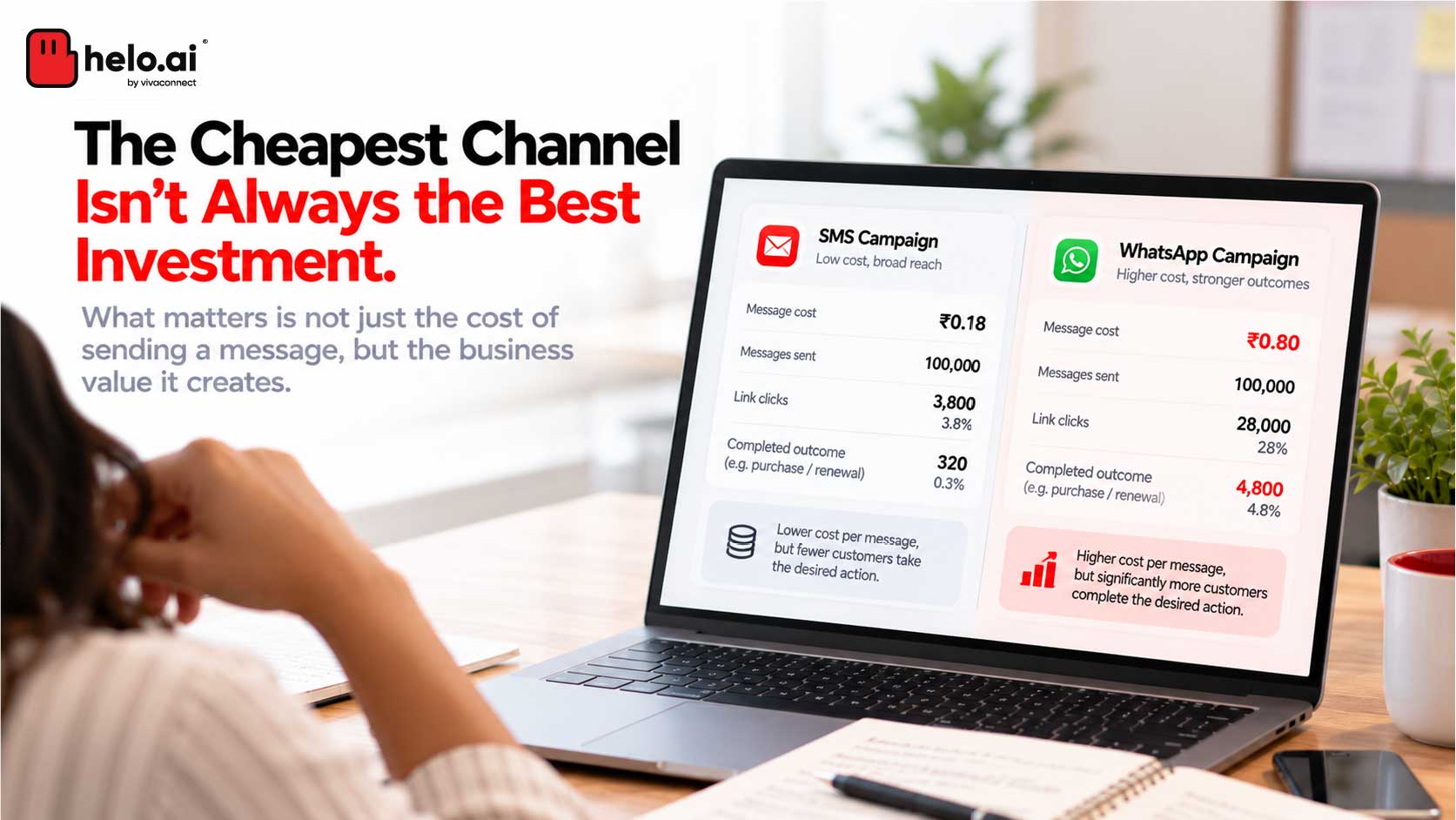
- A channel can cost twice as much per message and still deliver a lower cost per conversion.
- Use incrementality (what would have happened anyway) rather than attribution to judge value.
- From 1 October 2026, WhatsApp service messages are billed beyond 1,000 free per number each month, so re-check your channel maths.
- Test premium channels on high-value, time-sensitive journeys first.
A lower cost per message looks good on a campaign report. But does it mean the business made a better investment? Not necessarily. One channel might cost less but generate fewer completed transactions. Another might cost more while helping more customers complete a payment, purchase or renewal.
The real question for communication channel ROI is not which channel costs less. It is whether the additional business value justifies the additional cost.
Why is cost per message a misleading metric?
A delivered message is not necessarily a read message. A click is not necessarily a conversion. And a purchase made after a message is not automatically a purchase caused by it.
Google's Meridian measurement framework separates overall ROI from marginal ROI (mROI), which it describes as the return on the next unit of spend. It recommends using mROI to judge whether a channel is saturating (Google Meridian: ROI, mROI and response curves).
The same logic applies to messaging: what matters is whether additional spend on a channel produces worthwhile additional results.
The takeaway: measure communication against the business outcome that matters, not the activity that is easiest to count. If you already track channel metrics, our guide to WhatsApp marketing ROI shows which numbers to pull first.
How do you compare channels by cost per outcome?
Consider an illustrative campaign of 10,000 messages. These figures are hypothetical, not industry benchmarks.
Measure | Channel A | Channel B |
|---|---|---|
Campaign cost | Rs 1,000 | Rs 2,000 |
Completed outcomes | 100 | 250 |
Cost per outcome | Rs 10 | Rs 8 |
Incremental cost per extra outcome (B vs A) | - | Rs 1,000 / 150 = Rs 6.67 |
Channel B costs twice as much but generates 2.5 times as many outcomes, so its average cost per conversion is lower. Each extra outcome it adds over Channel A costs about Rs 6.67.
However, this doesn't prove that Channel B caused all of those outcomes. Some customers would have converted anyway. Controlled tests, including holdout groups where practical, estimate how many outcomes are genuinely attributable to the channel.
When is paying more for a channel worth it?
A higher-cost channel may make commercial sense in four situations:
Timing matters. A payment deadline or abandoned checkout needs a message that reaches customers at the right moment. See how brands reduce checkout abandonment with timely, interactive nudges.
The interaction is more involved. Customers may need to ask questions, share documents or complete several steps. A two-way, rich channel often beats a one-way text here. Our RCS vs SMS comparison breaks down the difference.
The outcome has greater value. Lifting conversion on a high-value application or renewal can justify more spend than a low-value promotion. For example, insurers use voice AI for policy renewals to reduce lapses.
Failure has a cost. Missed deadlines, repeat sends and extra support contacts all raise the true cost of an unsuccessful interaction. This is why teams that recover failed payments automatically often accept a higher per-message price.
These are situations worth testing, not guarantees that a particular channel will perform better. You need evidence that the additional investment improves outcomes.
What changed in WhatsApp pricing in October 2026?
Channel costs are not static, so channel ROI calculations go stale. According to Meta's official pricing documentation, from 1 October 2026:
WhatsApp charges per delivered message, by message category (marketing, utility, authentication, service) and recipient market.
Service messages (free-form replies inside the 24-hour window) are billed again. Each business phone number gets 1,000 free service messages per month, with no roll-over.
Messages inside a free entry point window, opened from a Click-to-WhatsApp ad, are still not charged.
(Meta: Pricing on the WhatsApp Business Platform)
If your support-heavy journeys run on WhatsApp, your cost per outcome has probably moved. Review current WhatsApp Business API pricing in India before setting next quarter's budget.
What does the research say about channel ROI?
A Marketing Science study, "Estimating the Value of Offsite Tracking Data to Advertisers: Evidence from Meta", ran randomised experiments on campaigns from more than 70,000 advertisers on Facebook and Instagram. It estimated that the median cost per incremental customer rose from $38.16 under purchase-optimised delivery to $49.93 under click-optimised delivery, an increase of 31% (Marketing Science study).
The study is about advertising optimisation, not SMS, WhatsApp, RCS, voice or email. Its relevance is this: what you optimise and measure for can materially change what an additional customer costs. Optimising for clicks instead of outcomes made each incremental customer more expensive.
Tulip's Clienteling Benchmark Report adds a retail perspective. On its report page, the vendor says associate-led, personalised communications convert at 5-15%, compared with 2-5% for corporate communications (Tulip Clienteling Benchmark Report). These are vendor-specific findings, not a controlled, cross-industry ranking of channels.
Neither source names a universal channel winner. Use research to shape your questions, then validate decisions against your own data.
Attribution vs incrementality: what is the difference?
Imagine a customer receives an email, sees an ad and later gets a WhatsApp message before buying. Giving all the credit to the last touch could overstate WhatsApp's contribution.
Attribution assigns credit for a conversion to interactions along the customer journey.
Incrementality estimates how many additional outcomes happened because of an activity, compared with what would likely have happened without it.
Holdout test: a random group of customers deliberately doesn't receive the message. The difference in outcomes between that group and the messaged group is the incremental lift.
Marketing mix modelling (MMM): a statistical model that estimates each channel's contribution and diminishing returns across a whole budget.
As Google's Avinash Kaushik puts it, incrementality asks "how many of those conversions would have happened anyway?" (Google on marketing incrementality). For cross-channel journeys, pair this with a plan to measure omnichannel customer experience so that you capture both value and experience.
How to calculate communication channel ROI: a 6-step framework
Before investing in a higher-cost channel, work through these six questions:
What outcome matters? Define a purchase, payment, renewal, qualified lead or another measurable result.
Who needs the premium experience? Focus on the audience segments most likely to benefit.
What is the full cost? Include platform, message, operating, support and retry costs. Watch for the hidden cost of fragmented tools.
What additional value does it create? Compare performance with a sensible alternative channel or a holdout group.
Does the value cover the premium? Weigh additional contribution and verified savings against additional cost.
Does the advantage last? Re-check performance across segments and as campaigns scale. Marginal returns usually fall as volume rises.
Formula 1 - Incremental cost per outcome
Incremental cost per outcome = Additional cost / Additional outcomes caused
Formula 2 - Incremental net contribution
Incremental net contribution = Additional contribution + Verified savings - Additional costs
Worked example: a channel costs an extra Rs 5,000 and causes 100 additional transactions, so its incremental cost is Rs 50 per transaction.
If each transaction contributes Rs 35, the premium is not covered by transaction contribution alone.
If each contributes Rs 100, net contribution is +Rs 5,000 and the investment is likely worthwhile, provided you have included every relevant cost.
Free resource: Want the KPIs to plug into this framework? Download the CPaaS KPI Handbook. It covers delivery, engagement and conversion metrics for SMS, WhatsApp and RCS.
Which channel fits which job?
Channel | Typical strength | Good fit for | Watch-out |
|---|---|---|---|
Universal reach, low unit cost | OTPs, broad alerts, fallback | Limited interactivity | |
Two-way, rich media, high familiarity in India | Payments, support, cart recovery | Category-based pricing; service messages billed from Oct 2026 | |
Branded, verified, interactive cards | Offers, onboarding, rich journeys | Device and network coverage varies; plan an RCS-to-SMS fallback | |
Immediate, human-like, high attention | Renewals, collections, verification | Higher cost per contact; best for high-value moments |
Strengths are general characteristics, not performance guarantees. Validate each with your own tests.
Where Helo.ai fits
Helo.ai supports enterprise communication across SMS, WhatsApp, RCS and voice from one platform. Each channel can serve a different customer communication need.
For example, a business might use a lower-cost channel for a broad service update and keep a more interactive channel for customers who need help completing an important action. This is a strategy to test, not a guaranteed performance advantage. Our guide to choosing the right messaging channel walks through how to set up channel failover.
The commercial value comes from matching each channel to its communication objective and measuring its contribution. A platform supports execution, but sound measurement and a clear definition of success are still essential.
Conclusion: pay for the outcome, not the assumption
A higher-cost communication channel is justified when its additional contribution exceeds its additional cost. That value could come from more completed transactions, higher renewals or reduced support effort. But it must be measured, not assumed from a channel's reputation or engagement rate.
The cheapest channel isn't always the most profitable, and the most expensive isn't automatically the most effective. Choose the one that delivers the strongest measurable business value for its cost. That is the core of communication channel ROI.
Frequently asked questions
What is communication channel ROI?
Communication channel ROI is the business value a messaging channel (SMS, WhatsApp, RCS, voice or email) generates relative to its total cost. It is best measured as incremental outcomes caused per rupee spent, not as messages delivered or clicks.
Is a more expensive messaging channel ever worth it?
Yes, when the extra outcomes it causes are worth more than its extra cost. This is most likely in time-sensitive, high-value or multi-step journeys such as payments, renewals and abandoned checkouts.
How do I calculate incremental cost per outcome?
Divide the additional cost of the channel by the additional outcomes it caused. For example, Rs 5,000 extra spend divided by 100 extra transactions equals Rs 50 per incremental transaction.
What is the difference between attribution and incrementality?
Attribution distributes credit for a conversion across touchpoints. Incrementality estimates how many conversions would not have happened without the activity, usually by comparing against a holdout group.
Is WhatsApp cheaper than SMS for businesses in India?
It depends on message category, volume and outcome. From 1 October 2026, WhatsApp charges per delivered message by category and market, and service messages are billed after 1,000 free per number each month. Compare cost per outcome, not cost per message.
How long should a channel holdout test run?
Run it long enough to collect a statistically meaningful number of outcomes in both groups, typically across at least one full purchase or payment cycle, and re-check results as you scale.