


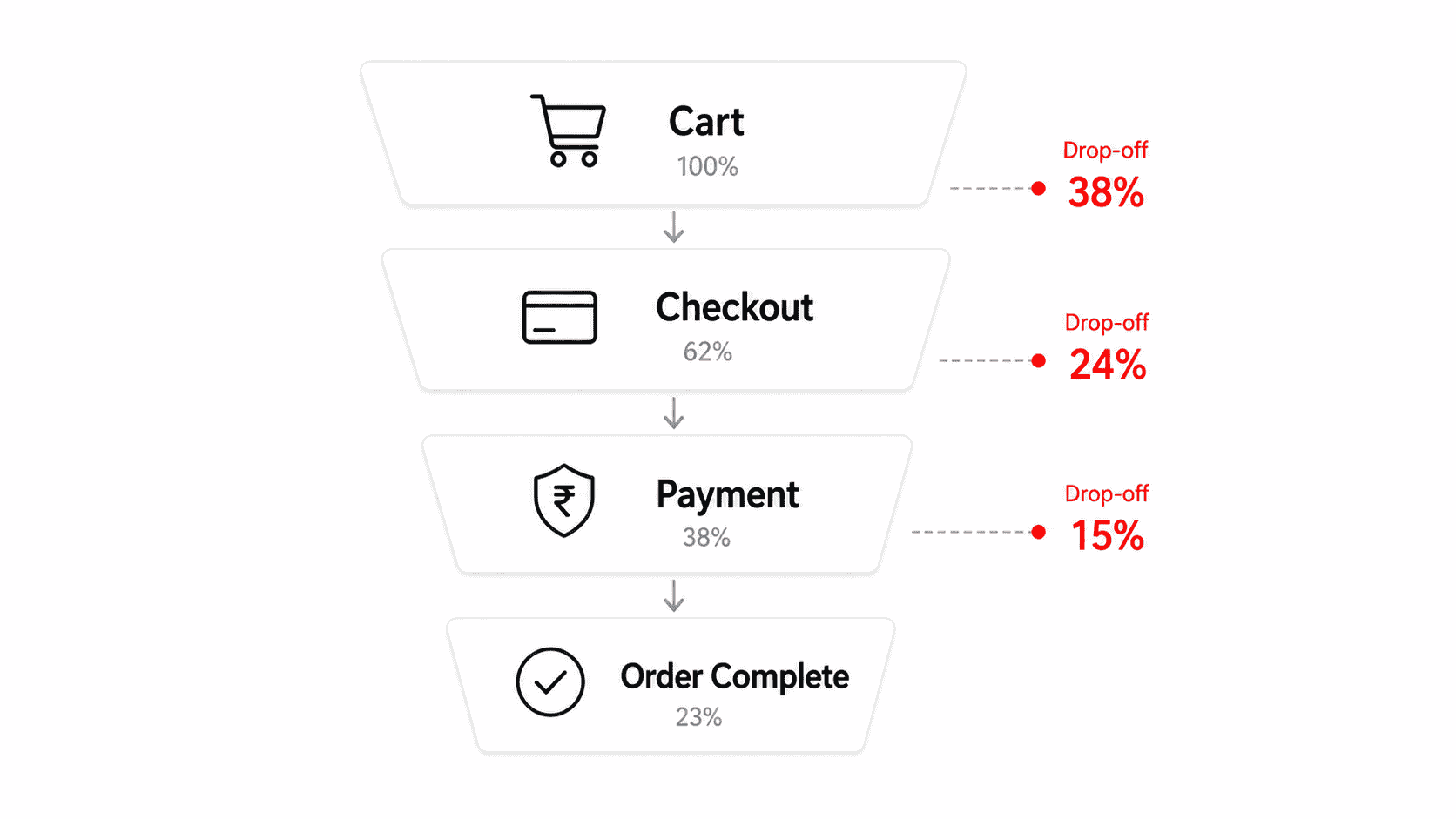
Getting customers to checkout is hard. They've discovered your product, explored your site, compared options, and decided to buy. Yet many D2C brands still lose 60-80% of customers at the final step — the average global cart abandonment rate sits at approximately 70% according to Baymard Institute’s 2026 meta-analysis of dozens of studies.
That's why reducing checkout abandonment has become a top priority for growth, conversion, and marketing teams in D2C.
Checkout drop-offs are frustrating because the customer has already shown strong purchase intent. The sale is close. But small moments of friction, uncertainty, or distraction prevent completion.
The good news: most abandonment isn't random. It's caused by identifiable issues that can be fixed with the right strategies.
Direct Answer: To reduce checkout drop-offs in D2C, focus on transparency (no hidden costs), simplification (fewer fields, guest checkout), relevant payment options (UPI, COD, cards), mobile optimization, trust signals (returns, security, delivery info), and proactive recovery via personalized messaging like WhatsApp.
Why Customers Drop Off During Checkout
Customers rarely abandon without reason. Something creates doubt or friction at the last moment.
Common causes include:
- Unexpected shipping costs or taxes
- Limited payment options
- Mandatory account creation
- Long or complicated checkout forms
- Slow page load times
- Concerns about trust, security, or returns
Even small inconveniences have outsized impact because customers are already evaluating if the purchase is worth the effort.
The easier checkout feels, the higher the conversion likelihood.
Hidden Costs Are Conversion Killers
Few things increase abandonment faster than surprises.
A customer sees one price on the product page and a significantly higher total at checkout. Shipping charges appear unexpectedly. Taxes feel higher than anticipated. Additional fees pop up late.
At that point, customers pause to reconsider. Some leave entirely.
Solution: Be transparent about pricing earlier in the journey (e.g., show estimated shipping on product pages or cart). This reduces friction and improves completion rates.
See how post-purchase communication builds lasting trust and reduces returns in our detailed guide on how post-purchase communication improves customer retention.
Simplify the Checkout Experience
Many checkout flows ask for more information than needed.
Extra fields create extra work. Extra work creates extra friction.
Customers should complete a purchase with minimum effort.
Simple improvements:
- Reduce form fields to essentials only
- Enable guest checkout (no forced account)
- Auto-fill address information where possible
- Simplify navigation and steps
- Minimize unnecessary decisions
The fewer decisions, the easier to buy.
Pro Tip for D2C in India: Prioritize mobile-first design. Over 70% of D2C traffic is mobile, and friction here kills conversions fast.
Learn more about reducing support load with smart automation in our guide on how to reduce customer support load using automation.
Offer the Payment Methods Customers Expect
Payment preference plays a major role in conversion.
A customer who prefers UPI may hesitate if only cards are available. Someone wanting COD may abandon if not offered.
The goal isn't every payment method it's the ones your customers actually use.
Common D2C payment expectations (India-focused 2026):
Payment Method | Why It Matters | Impact on Abandonment |
|---|---|---|
UPI (Google Pay, PhonePe, etc.) | Fast, trusted, low friction for digital natives | High preference; missing it = instant drop-off |
Cash on Delivery (COD) | Builds trust for first-time or high-value buys | Still 30-50% of orders in many D2C verticals; removing it hurts |
Credit/Debit Cards | Standard for higher AOV | Essential but not sole option |
Wallets & BNPL (e.g., Pay Later) | Growing for younger audiences | Reduces hesitation on bigger carts |
Removing payment friction often leads directly to higher checkout conversion rates.
Discover WhatsApp automation strategies tailored for D2C lead generation and payments in our guide on WhatsApp automation for lead generation.
Mobile Checkout Deserves Special Attention
For many D2C brands, mobile generates the majority of traffic.
Yet mobile checkout is often harder: long forms, small buttons, poor layouts, slow loads create frustration quickly.
A smooth mobile checkout can significantly improve overall conversion performance.
If customers struggle on phones, even strong product demand may not translate to revenue.
Mobile best practices:
- Use responsive design with large tap targets (min 44px)
- Enable one-tap payments where possible (UPI deep links)
- Minimize scrolling; use progress indicators
- Test load times (<3 seconds ideal)
Trust Matters Most at the Final Step
Customers may trust your products but hesitate on the transaction.
Questions at checkout:
- Is payment secure?
- What if I need a return?
- When will the order arrive?
- Can I contact support if something goes wrong?
Trust signals answer these:
- Clear return/exchange policies (link prominently)
- Delivery estimates and tracking info
- Secure payment badges (SSL, PCI compliance)
- Visible customer support options (chat, WhatsApp)
- Customer reviews/testimonials near checkout
- Money-back guarantees
Often, customers don't need more persuasion—they need reassurance.
For regulated or high-AOV D2C (fashion, electronics, beauty): Emphasize authenticity and support.
See how instant order confirmation builds immediate customer trust in our guide on instant order confirmation and customer trust.
Recovery Matters When Abandonment Happens
Not every abandoned checkout can be prevented.
Customers get distracted. Calls come in. Payment sessions expire. Browsers close.
This is where recovery becomes critical.
Brands that proactively reconnect often recover sales that would otherwise be lost.
A timely reminder, payment link, or personalized checkout recovery message can help customers continue where they left off.
The faster the recovery attempt, the better the chance of conversion.
Best recovery channels for D2C:
- WhatsApp (highest open rates, conversational)
- SMS/Email (backup)
- Retargeting ads
Helo.ai helps D2C brands recover abandoned checkouts through WhatsApp-based recovery journeys, payment reminders, and personalized follow-ups that bring customers back before purchase intent disappears.
Using Helo Automate for event-triggered journeys (e.g., cart abandonment trigger) and Helo Broadcast for bulk/smart reminders, brands see significant recovery lifts. Combine with Helo Clarity for behavioral segments (e.g., high-intent abandoners) and Helo Conversations for real-time support.
D2C brands using unified messaging platforms report 20-40% recovery rates on abandoned carts when messages are personalized and timely.
Ready to recover more sales? Start with WhatsApp-based checkout recovery journeys from Helo.ai. Contact us or explore the platform at helo.ai.
Checkout Optimization Is Really About Removing Friction
Many brands approach checkout optimization as a design exercise.
It's actually a friction-reduction exercise.
Every unnecessary field.
Every extra click.
Every unanswered question.
Every moment of uncertainty.
These cause abandonment.
The brands that consistently improve conversion rates make buying feel effortless.
Step-by-Step: Implementing a Frictionless Checkout + Recovery System
- Audit Current Flow — Use tools like heatmaps and funnels to spot drop-off points.
- Simplify Forms & Add Guest Checkout — Cut fields and remove mandatory accounts.
- Implement Transparent Pricing & Payment Options — Show full costs early and match customer preferences (UPI, COD, etc.).
- Add Trust Signals & Mobile Optimization — Prominent policies, security badges, and fast mobile experience.
- Set Up Automated Recovery Journeys — Trigger on abandonment using WhatsApp via intelligent automation.
- Test & Iterate — A/B test messages, timings, and flows while monitoring results.
- Integrate Full Stack — Connect data, intelligence, and delivery in one platform (like Helo.ai) to eliminate handoffs.
Time estimate: Initial audit 1-2 weeks; full implementation 4-8 weeks depending on current stack.
Common mistakes to avoid: Over-communication without frequency controls, generic messages, ignoring mobile, or lacking fallback channels.
FAQs
How to reduce checkout abandonment?
Reduce checkout abandonment by simplifying forms, offering preferred payment methods (UPI, COD), improving transparency on costs, adding trust signals, optimizing for mobile, and recovering abandoned sessions quickly with personalized messaging like WhatsApp.
What causes checkout drop-offs in ecommerce?
Common causes include unexpected costs, lengthy checkout flows, payment issues, trust concerns, poor mobile experiences, and distractions. Data shows these account for the majority of the ~70% average abandonment rate.
How can brands improve checkout conversion optimization?
Brands can improve by removing friction (fewer fields, guest checkout), matching payment options to audience, building trust early, using AI-driven personalization for recovery, and measuring with funnels/heatmaps. Integrated platforms close the loop from insight to action.
Why do customers abandon checkout at the last step?
Customers often abandon due to unexpected charges, distractions, payment failures, trust concerns, or complicated experiences—even after showing intent. Proactive recovery prevents loss.
Can abandoned checkouts be recovered?
Yes. Timely recovery messages, payment links, and personalized follow-ups via WhatsApp or other channels can recover 20-40%+ of abandoned carts when done right. Speed and relevance are key.
What role does WhatsApp play in D2C checkout recovery?
WhatsApp offers high open rates (often 70%+), conversational recovery, rich media (images, buttons, flows), and direct payment links. It's ideal for India D2C where users live in messaging apps. Helo.ai powers this with automation and AI optimization.
How does Helo.ai help with D2C checkout optimization?
Helo.ai provides a vertically integrated Martech + Messaging platform: AI-powered Broadcast for bulk/personalized reminders, Automate for event-triggered journeys (e.g., cart abandonment), Conversations for chat support, Clarity for behavioral analytics/segments, and Touchpoints for smart tracking links. From data to delivery—one platform. "From Data to Delivery - One Platform."
Conclusion
Reducing checkout drop-offs isn't about convincing more customers to buy. It's about making it easier for customers who already want to buy.
By simplifying checkout, removing friction, offering relevant payment methods, building trust, and recovering abandoned sessions quickly with tools like WhatsApp automation, D2C brands can improve conversion rates without increasing traffic or ad spend.
Sometimes the fastest path to growth isn't finding more customers—it's converting more of the ones you already have.
Ready to implement? Contact Helo.ai for a demo of WhatsApp recovery journeys tailored to your D2C brand. Start here or explore E-commerce solutions.

.jpeg&w=96&q=75)