


Chatbot vs Conversational AI: The Short Version
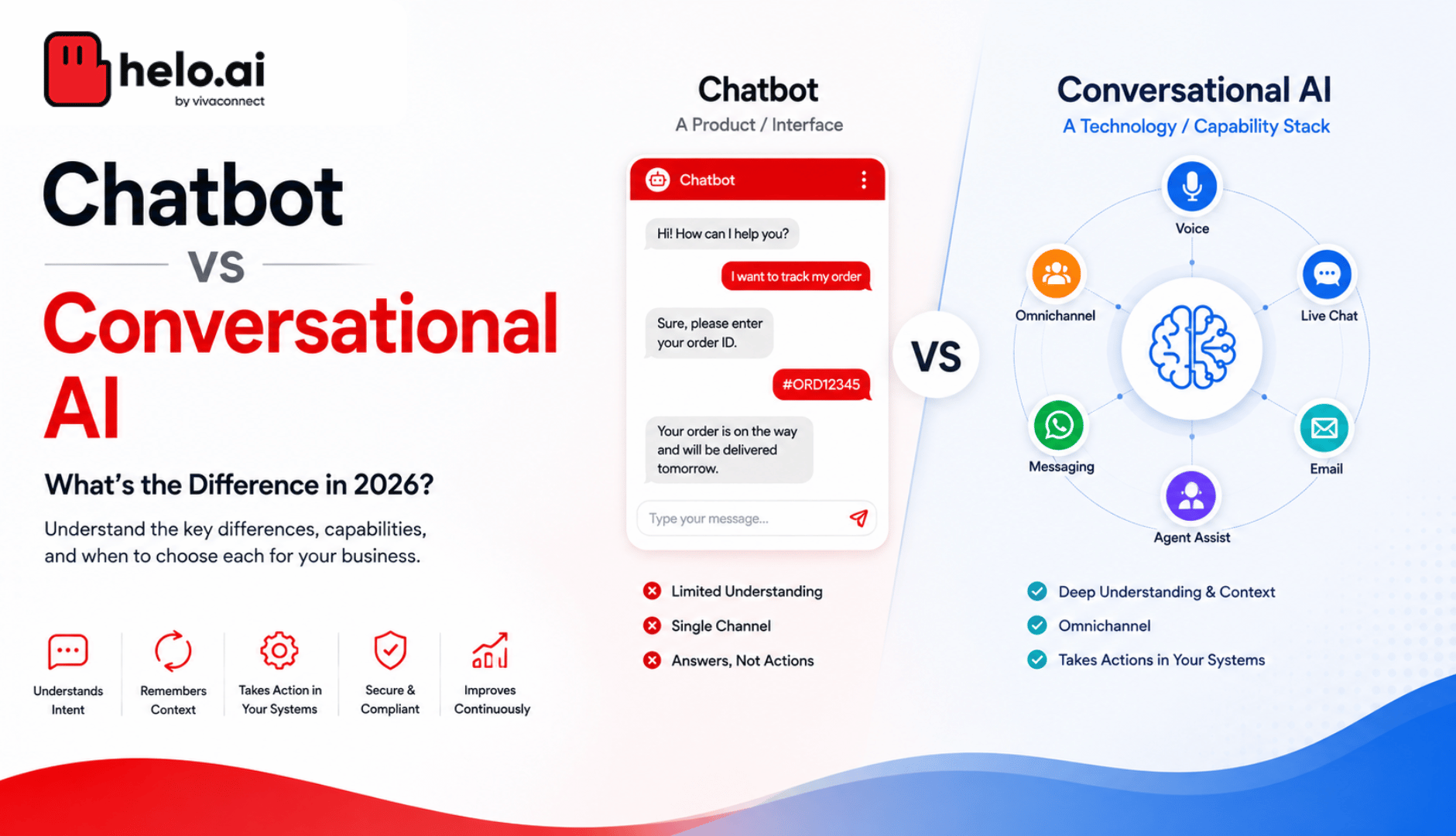
Chatbot | Conversational AI | |
|---|---|---|
What it is | A product or interface | A technology capability stack |
Scope | One channel, usually text | Voice, chat, messaging, email, agent assist |
Can exist without the other? | Yes — rule-based bots use no AI | Yes — powers voice agents with no chat window |
Understands | Keywords, or trained intents | Intent, context, sentiment across turns |
Memory | None, or within one session | Across sessions and channels |
Handles unexpected input | No, or partially | Yes |
Takes action in your systems | Rarely | Depends entirely on integration |
Typical cost | Low | Medium to high |
The relationship in one line: a chatbot is a delivery mechanism; conversational AI is what makes the delivery worth having.
The category error most buyers make is treating these as two options to choose between. They are not parallel choices. You choose a tier of capability, and the interface follows from it.
What Is a Chatbot?
A chatbot is software that simulates conversation usually text, sometimes voice to handle interactions automatically. The word describes the interface, not the intelligence behind it, which is precisely why it tells you so little.
There are three meaningfully different things sold under the word.
Rule-based chatbots run on decision trees and keyword triggers. Customer says X, bot replies Y. Fast to build, cheap to run, and brittle the moment someone goes off script. Ask an unexpected question and it loops back to the menu or hands off to a human. Functionally it is a phone menu in text form — and if you have read our guide to IVR with AI, the failure modes will look familiar.
AI chatbots add natural language processing. They infer intent rather than matching keywords, tolerate varied phrasing, and hold some context within a session. Better, but still bounded by their training data and the flows built around them.
LLM-based chatbots generate responses dynamically with a large language model. They feel dramatically more natural and handle a far wider range of inputs. But they remain response generators: they answer questions without completing workflows. A fluent answer to "where is my order" is not the same as finding the order.
The common thread across all three: chatbots produce output. They do not, by themselves, take action.
What Is Conversational AI?
Conversational AI is the broader technology category enabling human-like interaction between machines and people across text, voice and digital channels. Where a chatbot is a product, conversational AI is a capability stack:
- Natural language processing (NLP) — parse what was said
- Natural language understanding (NLU) — interpret what was meant
- Dialogue management — track context across a multi-turn conversation
- Natural language generation (NLG) — produce a coherent, appropriate response
- Retrieval — ground answers in your actual knowledge base rather than the model's imagination
- Guardrails — redaction, refusal behaviour, escalation rules
Every AI-powered chatbot uses this stack. But conversational AI appears in many forms with no chat window anywhere: AI voice agents on the phone, real-time coaching tools that prompt human agents mid-call, sentiment detection running silently over a support queue, and email triage.
This is why "chatbot vs conversational AI" is a slightly malformed comparison. One is a subset application of the other. The genuine comparison — the one buyers need — is between tiers of capability, which is the next section.
Key Differences Between Chatbot and Conversational AI
Six differences that actually change outcomes.
Understanding: Keywords vs Intent
A rule-based bot matches strings. Ask "I want to cancel" and it works; ask "I'd rather not continue with this" and it fails. Conversational AI infers intent from phrasing it has never seen, which is the difference between a system that works in a demo and one that works on real customers.
Memory: Stateless vs Contextual
Rule-based bots remember nothing. AI chatbots typically remember within one session. Full conversational AI carries context across sessions and channels — a customer who called yesterday and messages on WhatsApp today does not start from zero. In practice this is the single most visible quality difference to a customer.
Channel: Single vs Omnichannel
Chatbots usually live in one place, most often a website widget. Conversational AI is channel-agnostic by design, which matters enormously in markets where the conversation starts on WhatsApp or a phone call rather than a web page.
Learning: Static vs Improving
A rule-based bot changes only when someone edits it. Conversational AI systems improve through retraining, feedback loops and knowledge-base updates. Worth a caveat, though: "self-learning" is oversold. Most enterprise systems improve because a team reviews failed conversations and fixes them — not by magic.
Action: Answering vs Doing
The decisive one. Can the system authenticate a customer, read their record, change something, and confirm it? That requires integration into your CRM, billing or order systems — and it is an integration question far more than an AI question. A brilliant model with read-only access is still just a well-spoken FAQ.
Failure Mode: Dead-Ending vs Hallucinating
They fail differently, and you need to plan for both. Rule-based bots dead-end — annoying but safe and visible. LLM systems hallucinate — fluent, confident and wrong, which is worse in a regulated industry. This is why retrieval grounding and guardrails are not optional extras. Our note on generative AI chatbots covers the mitigations.
The Four Generations: Rule-Based to Agentic AI
Most articles on this topic present a two-way split. That framing is out of date — the market has moved through four distinct generations, and the fourth is where the current argument is.
Gen 1: Rule-Based | Gen 2: NLU Chatbot | Gen 3: LLM Conversational AI | Gen 4: Agentic AI | |
|---|---|---|---|---|
Understands | Keywords | Trained intents | Context and intent | Context and goal |
Memory | None | Session | Session, sometimes cross-channel | Persistent across sessions |
System access | None | Fixed API calls | Usually read-only | Read and write |
Multi-step tasks | No | Scripted only | Limited | Plans and executes |
Success metric | Deflection | Containment | Containment | Autonomous resolution |
Fails by | Dead-ending | Falling out of scope | Hallucinating | Taking the wrong action |
Maintenance | Editing rules | Retraining intents | Curating knowledge | Governance and permissions |
What Makes Generation 4 Different
Agentic AI adds planning, tool use, and the authority to act. Instead of answering "how do I change my flight," it authenticates the passenger, checks live inventory, applies fare rules, rebooks and confirms in writing. The interaction ends because the problem ended.
That shift — from a system with read access to one with write access — is an operational and governance change, not a model upgrade. It brings permissions, audit trails, approval thresholds and rollback into scope. We cover the architecture in agentic AI in customer service and multi-agent orchestration.
The realistic warning: Forrester's 2026 predictions suggest slightly more AI self-service efforts will fail than succeed this year, largely because organisations deploy under cost pressure without doing the integration work that makes resolution possible. Generation 4 is not a chatbot upgrade you can buy. It is an architecture change you have to earn.
How to Tell Which One You Actually Have
Vendors label everything "AI-powered," so the label is worthless. Run these five tests on your existing system — or on a demo — and you will know the generation within ten minutes.
Test 1 — The rephrase test. Ask the same question three ways, one of them oddly ("my thing hasn't turned up yet"). Gen 1 fails on the second attempt. Gen 2 handles synonyms but not unusual framing. Gen 3 and 4 handle all three.
Test 2 — The memory test. Give information, change topic, then refer back to it obliquely: "what about the one I just mentioned?" Anything below Gen 3 loses it.
Test 3 — The action test. The decisive one. Ask it to do something — change an address, cancel an order. If it hands you a link, a phone number or an escalation, it answers rather than resolves. Only Gen 4 completes the task.
Test 4 — The off-script test. Ask something outside its remit entirely. Gen 1 dead-ends. Gen 2 offers a wrong intent. Gen 3 may confidently invent an answer — watch for this specifically, because it is the most dangerous behaviour and the least visible in a demo.
Test 5 — The channel test. Start on chat, continue on the phone. If the customer repeats themselves, you have a chatbot, not conversational AI, regardless of what the contract says.
When buying: run these five tests on the vendor's demo using your awkward questions, not the ones they suggest. Every platform performs beautifully on its own scripted examples. The rephrase and action tests are where the tiers separate.
Deflection vs Resolution: The Metric That Changed
This is the most consequential shift in the category, and it reframes the whole comparison.
Chatbots were sold on containment — what share of conversations can we keep away from a human? It is a cost metric, and it can improve while the customer experience gets worse. A bot that dead-ends a frustrated customer who then gives up has technically contained the interaction.
The 2026 measure is autonomous resolution — what share of issues were actually fixed, verified by the state of your backend systems rather than by the conversation closing.
Published benchmarks vary widely by source and by how "resolution" is defined, so treat specific percentages with caution. The directional pattern is consistent across industry reporting: rule-based bots land at the low end of containment, LLM-integrated systems materially higher, and well-implemented agentic systems higher again — with the important distinction that the last figure measures resolution rather than deflection. Gartner's widely cited projection is that agentic AI will autonomously resolve around 80% of common customer service issues by 2029.
Why this matters for your comparison. Two systems can report similar containment and deliver completely different outcomes. Ask any vendor for:
- Resolution rate verified against backend state, not conversation closure
- Re-contact rate within 72 hours — the honest check on whether "resolved" meant resolved
- Escalation quality — does the human receive full context, or does the customer repeat everything?
If a vendor can only report containment, you are being sold a Generation 2 or 3 system in Generation 4 language.
Cost Comparison: Chatbot vs Conversational AI
Cost differences between tiers are real but routinely misrepresented, because the licence fee is the smallest component.
Cost component | Rule-based chatbot | AI chatbot | Conversational AI / agentic |
|---|---|---|---|
Licence | Low, often per-seat or flat | Medium | Higher; increasingly per-resolution |
Build effort | Days | Weeks | Weeks to months |
Integration | Minimal | Moderate | The dominant cost |
Knowledge base prep | Not needed | Some | Substantial — and ongoing |
Maintenance | Constant rule editing | Intent retraining | Content curation and governance |
Hidden cost | Conversations it fails | Escalations it causes | Integration work deferred at purchase |
Three things buyers consistently get wrong:
The integration is the project. For anything that takes action, connecting to CRM, billing and order systems is where the time and budget go. An AI agent can only complete work your systems let it access. Vendors quote the licence; the systems integration is yours.
Rule-based is not free. Its cost shows up as failed conversations, escalations and the standing maintenance burden of editing rules whenever a policy changes. Cheap to buy, expensive to keep accurate.
Pricing models are shifting. The market is moving from per-seat to per-resolution and outcome-based billing. Model your costs against conversation volume growth, not headcount, and get a written definition of what counts as a billable "resolution" — it varies enormously between vendors. Our contact centre cost breakdown works through the arithmetic.
When to Use a Chatbot vs Conversational AI
Neither is universally correct. Match the tier to the job.
When a Rule-Based Chatbot Is Genuinely the Right Call
- Routing to the correct department
- The same ten FAQs your team answers daily
- Collecting basic details before a human takes over
- Simple, predictable, low-stakes paths that rarely deviate
If the conversation follows a known path, a decision tree is cheaper to build and easier to maintain than an AI system. Deploying heavy infrastructure for lightweight questions is wasteful. A well-built FAQ chatbot is not a failure of ambition.
When You Need Conversational AI
- Customers phrase things unpredictably
- Conversations span multiple turns or multiple channels
- You operate in several languages
- Escalation rate is high and customers repeat themselves
- Context must survive a handover to a human
When You Need Agentic AI
- The customer's goal requires doing something, not learning something
- Tasks span several backend systems
- Deflection has plateaued and cost per resolution has not moved
- You can support the governance: permissions, audit trails, rollback
The Honest Answer for Most Organisations: All Three
Mature deployments layer them. Rule-based flows handle routing and structured capture, conversational AI handles the messy middle, agentic AI resolves the tasks worth automating end to end, and humans take the emotionally complex cases. The question is not which to pick but how to orchestrate them — and how the handovers work, which we cover in bot-to-human handover architecture and human in the loop AI support.
How to Upgrade From a Chatbot to Conversational AI
A migration sequence that avoids the common failure of buying capability you cannot connect to anything.
- Audit your current bot's failures, not its successes. Export the conversations where it dead-ended, escalated or was abandoned. That transcript set is your requirements document, and it is more honest than any vendor questionnaire.
- Classify the failures. Separate misunderstanding (an NLU problem) from could-not-act (an integration problem). The mix tells you whether you need Generation 3 or Generation 4 — and buying the wrong one is the most expensive mistake available.
- Fix the knowledge base first. Retrieval-grounded systems are only as accurate as what they retrieve. Contradictory or out-of-date documentation produces confident wrong answers. Do this before procurement, not after.
- Map your systems of record. List every system the AI must read from or write to, and confirm each has a usable API with the right permissions. This step kills more projects than model quality ever has.
- Pick two or three high-volume, low-risk intents for the first agentic use case. Order status, appointment rescheduling, address changes. Not refunds, not anything irreversible.
- Run a bake-off on your own transcripts. Same 200 real conversations across two or three finalists. Vendor demos use vendor data.
- Instrument resolution before launch. Define what "resolved" means in backend terms, and measure re-contact rate from day one. Retrofitting this later is how teams end up unable to prove value.
- Keep the rule-based flows that work. Migration is not replacement.
What This Means for Indian Businesses
The global version of this comparison assumes an English-speaking customer typing into a website widget. That assumption breaks in India, and it changes which tier you need.
The channel is WhatsApp or a phone call. A website chat widget is not where most Indian customer conversations begin. That pushes you toward conversational AI earlier than a Western buyer, because a WhatsApp chatbot with rule-based logic hits its ceiling quickly on an informal, high-context channel.
Code-switching breaks rule-based systems immediately. Customers mix Hindi and English within a single sentence. Keyword matching cannot survive that, and intent models trained only on English degrade badly. Ask vendors specifically about mid-sentence code-switching rather than a language count — "supports 100+ languages" often means machine translation in front of an English model. See multilingual voice AI for Indian businesses.
Voice matters more. For a large share of customers, speaking is easier than typing — particularly in regional languages and on feature phones. Conversational AI that exists only as a chat widget solves a fraction of the problem, and voice brings its own constraint: latency determines whether a conversation feels natural.
DPDP obligations arrive with Generation 4. Once a system can read and write customer records, consent, purpose limitation, retention and access control stop being theoretical. Settle the data governance before granting write access, not after.
Conversational AI vs Chatbot: Which Should You Choose?
The honest summary of chatbot vs conversational AI: a chatbot is an interface, conversational AI is the intelligence layer beneath it, and most of the confusion is vendor marketing applying both terms to everything from a decision tree to an autonomous agent.
The distinction worth carrying into a buying decision is not the terminology. It is the four generations — and specifically whether a system answers or resolves. Run the five tests. Ask for resolution rates verified against backend state rather than containment. Budget for the integration, because that is the project.
And do not assume the newest tier is the right one. A rule-based bot that routes calls correctly is a better investment than an agentic system with no permission to change anything.
If you want help working out which tier a specific use case needs — including when the answer is the cheaper one — talk to our team. For a look at the vendors in this space, see our comparison of conversational AI platforms.
Frequently Asked Questions
What is the difference between a chatbot and conversational AI?
A chatbot is an application that lets users interact through chat. Conversational AI is the technology that helps systems understand language, context, and intent. A chatbot can use conversational AI, but not every chatbot does.
Is a chatbot the same as conversational AI?
No. A chatbot is a type of application, while conversational AI is the underlying technology. Rule-based chatbots use fixed logic, while AI chatbots use conversational AI to understand more natural and varied questions.
Which is better, a chatbot or conversational AI?
It depends on the use case. Rule-based chatbots work well for simple FAQs and fixed workflows, while conversational AI is better for complex questions, multiple languages, and context-based conversations.
What is the difference between conversational AI and agentic AI?
Conversational AI focuses on understanding and responding to users. Agentic AI goes further by planning tasks and taking actions across business systems such as CRM, billing, or order platforms.
How do I know if my chatbot uses conversational AI?
Test whether the chatbot can understand rephrased questions, remember context, and handle unexpected requests. If it only follows fixed keywords or decision paths, it is likely rule-based rather than conversational AI.
Do chatbots use NLP?
Some do, and some do not. Rule-based chatbots typically rely on keywords and predefined rules, while AI chatbots use natural language processing (NLP) to understand user intent and different ways of asking the same question.
Is conversational AI more expensive than a chatbot?
Conversational AI usually costs more than a basic rule-based chatbot because it requires AI capabilities and system integrations. However, the total cost also depends on usage, integrations, maintenance, and the complexity of the workflows.
Can conversational AI replace human agents?
Conversational AI can automate many routine conversations, but it does not replace human agents in every situation. Human support remains important for complex, sensitive, or high-risk customer issues.
What is the difference between an AI chatbot and a rule-based chatbot?
A rule-based chatbot follows predefined rules, keywords, and decision trees. An AI chatbot uses technologies such as NLP to understand different wording, identify intent, and respond based on context.
Which is better for WhatsApp, a chatbot or conversational AI?
Conversational AI is usually better for WhatsApp when conversations involve varied questions, multiple languages, or ongoing context. Rule-based chatbots are still useful for simple FAQs, menus, and fixed workflows.