


What Is a Conversational AI Platform?
A conversational AI platform is software for building applications that simulate human conversation across channels and modalities, combining natural language processing with generative and agentic architectures, typically with low-code or no-code build tooling.
What It Is Not
Not a chatbot builder. Chatbot builders create simple Q&A bots that follow decision trees. Conversational AI platforms orchestrate multi-turn conversations, integrate with systems of record, and execute actions across your business stack.
Not a standalone LLM. Large language models (GPT-4, Claude, Gemini) are components, not platforms. A platform wraps the LLM with orchestration, guardrails, integrations, analytics, and governance.
Not an IVR with better speech recognition. Traditional IVR systems follow rigid decision trees. Conversational AI platforms understand context, maintain state across turns, and take autonomous actions across connected systems.
The Seven-Layer Stack
Every serious conversational AI platform shares a common architecture:
Layer | Function | Why It Matters |
|---|---|---|
Input (ASR/STT) | Voice-to-text, noise handling | Sub-800ms latency for natural voice |
NLP/NLU/NLG | Parse text, extract intent, generate reply | Core understanding engine |
LLM Orchestration | Route between models by task complexity | Prevents model lock-in |
RAG (Retrieval) | Ground answers in your knowledge base | Prevents hallucination |
Dialogue Management | Multi-turn context, slot filling, memory | Conversations feel coherent |
Action Layer | API calls, CRM writes, workflow execution | Moves from answering to doing |
Guardrails | PII redaction, refusal behaviour, escalation | Keeps AI safe and compliant |
Understanding this stack is essential before evaluating any vendor. A platform that's weak on guardrails or action orchestration will fail in production, no matter how good its NLU scores look in a demo.
Related reading: How AI voice agents handle latency in real-time conversations
Chatbot vs. Conversational AI vs. Agentic AI
The industry has moved through four generations, and the distinctions matter when you're signing a multi-year contract:
Capability | Rule-Based Chatbot | NLU Chatbot | LLM Conversational AI | Agentic AI Platform |
|---|---|---|---|---|
Understands | Keywords | Trained intents | Context + intent | Context + goal |
Multi-turn | No | Limited | Yes | Yes, with persistent state |
Takes action | No | Fixed API calls | Rarely | Yes, across systems |
Fails by | Dead-ending | Falling out of scope | Hallucinating | Wrong action (needs guardrails) |
Maintenance | High (manual rules) | High (retraining) | Medium | Shifts to governance |
The commercial reframe: the industry has moved from deflection (get them off the queue) to resolution (finish the job end-to-end). This changes what you should measure see the metrics section below.
Customer Service or Employee Service? Pick Your Market First
The category has formally split, and most buyers don't realize it. Forrester now publishes two separate evaluations:
Customer-Service Platforms (External-Facing)
- Buyer: CX or contact centre leader
- Channels: Voice, chat, email, WhatsApp, SMS
- Metrics: Containment rate, CSAT, cost per resolution
- Typical vendors: NICE Cognigy, Kore.ai, Sierra, Google Dialogflow CX, Amazon Lex, IBM watsonx Assistant, Rasa, Helo Voice
Employee-Service Platforms (Internal-Facing)
- Buyer: CIO, IT service owner, or HR ops
- Channels: Slack, Teams, internal portals
- Metrics: Ticket deflection, time-to-resolution
- Typical vendors: Moveworks, ServiceNow Virtual Agent, Microsoft Copilot Studio, Salesforce Agentforce
Employees spend roughly a fifth of the workweek searching for internal information (McKinsey). Employee-service platforms solve that problem—but they typically have no voice stack, no telephony, and no contact-centre routing. Shortlists don't transfer between these two markets.
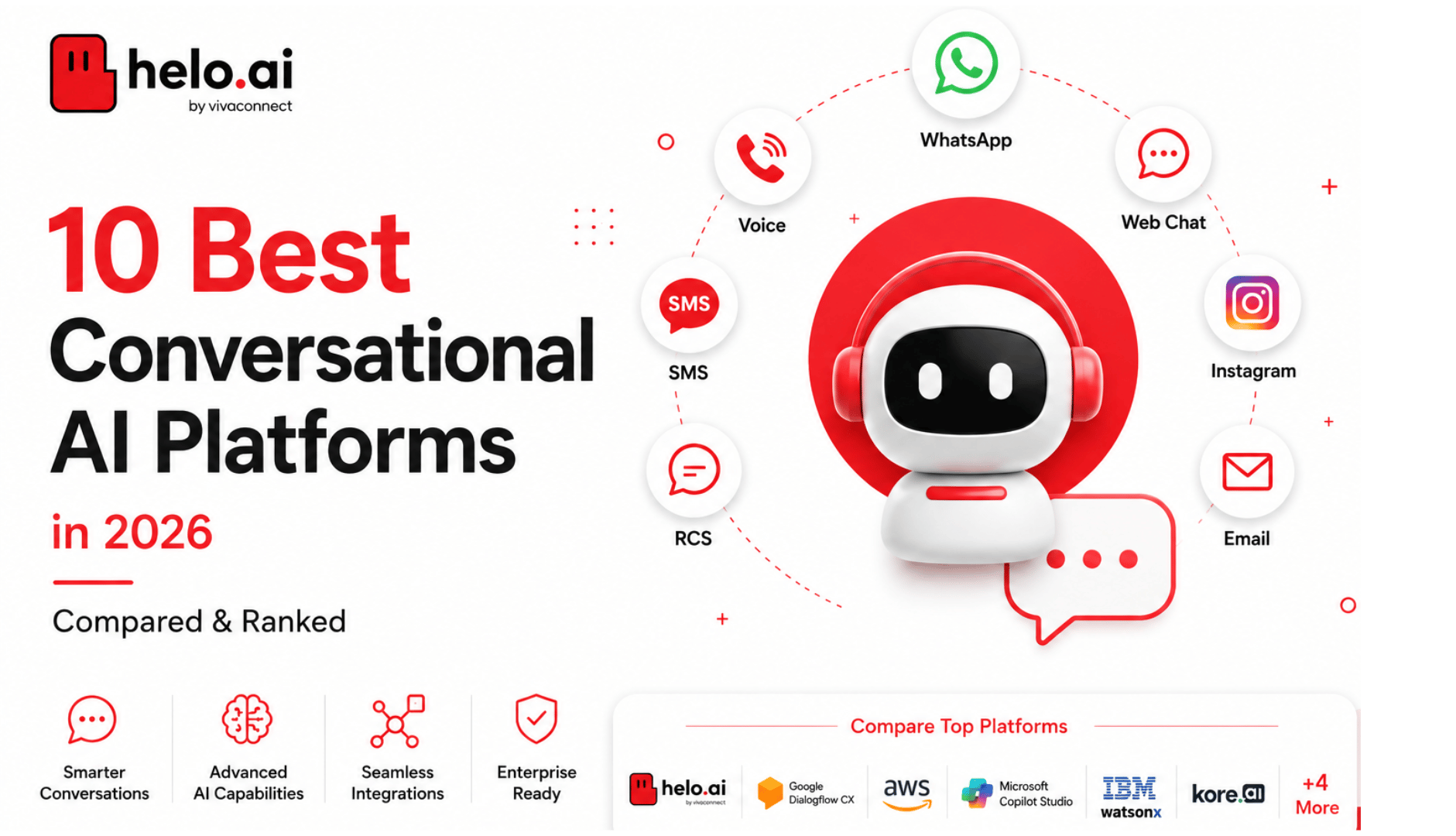
10 Best Conversational AI Platforms in 2026
We evaluated 10 platforms against the 2026 Forrester Wave: Conversational AI Platforms for Customer Service (Q2 2026), the Gartner Magic Quadrant, G2 and Gartner Peer Insights reviews, and vendor documentation. Last verified: August 2026. Platforms were scored on model quality, integration depth, containment reporting, security/compliance, build effort, pricing transparency, and total cost of ownership.
Quick Comparison Table
Platform | Best For | Purchase Shape | Deployment | Starting Price | Analyst Recognition |
|---|---|---|---|---|---|
Enterprise voice AI with carrier-grade telephony | Managed + CCaaS | Cloud | Enterprise custom | Enterprise Companies Recommended ,SOC 2 Type II, ISO 27001, DPDP Act | |
NICE Cognigy | Enterprise CX with voice | Managed + CCaaS | Cloud | Enterprise custom | Forrester Leader (highest Strategy) |
Kore.ai | Deep integrations & regulated industries | Managed + CAIP | Cloud, On-prem | ~$60/mo (free tier) | Forrester Leader (highest Current Offering: 4.14) |
Sierra | Agentic AI for enterprise CX | Managed | Cloud | Per-resolution (custom) | Forrester Strong Performer |
Google Dialogflow CX | CAIP builds on Google Cloud | CAIP | Cloud | $0.007/text, $0.06/voice min | Gartner Visionary |
Microsoft Copilot Studio | Microsoft 365 ecosystem | CAIP | Cloud (Azure) | Per-tenant capacity | Gartner Challenger |
Amazon Lex | AWS-native builds | CAIP | Cloud (AWS) | $0.00075/text request | Gartner Niche Player |
IBM watsonx Assistant | Regulated industries, hybrid deployment | CAIP | Hybrid, On-prem | Enterprise custom | Gartner Leader |
Rasa | Open-source, data sovereignty | CAIP (OSS) | Self-hosted | Free (OSS); Enterprise custom | Capterra 4.7/5 |
Intercom Fin | Highest resolution rate in SaaS | Managed | Cloud | $0.99/resolution | G2 #1 AI Agent |
Detailed Platform Profiles
1. Helo Voice: Best for Enterprise Voice AI with Carrier-Grade Telephony
Enterprise voice AI platform built on 25 years of telephony infrastructure by Helo.ai (formerly VivaConnect). The telephony is not bolted on it's where we started.
- Strengths:
- Carrier-grade telephony built-in (native SIP, WebRTC, PSTN)—not a media gateway bolted onto an AI product
- Multilingual by design, including Hindi, Tamil, Telugu, Bengali, Marathi, Kannada, and more
- 60-day deployment from contract to live
- Live human handoff with zero audio gap (most platforms have 1-2 second gap)
- Knowledge-grounded answers via RAG, CRM/API actions, full-stack observability
- SOC 2 Type II, ISO 27001, GDPR, DPDP Act compliance; data hosted in India
- Limitations: Voice-first platform not built for SMB; managed assistant model (not a build-it-yourself CAIP)
- Pricing: Per-call model based on volume and concurrency; no per-seat fees
- Best for: Enterprise contact centres needing reliable voice AI at scale (10,000+ calls/month), especially in regulated industries and multilingual markets
Enterprise clients include HDFC Bank, Axis Bank, Kotak Mahindra Bank, Tata Power, and Aditya Birla. Learn more about Helo Voice →
Related: Multilingual voice AI for businesses serving diverse markets | How AI voice agents handle appointment scheduling
2. NICE Cognigy: Best for Enterprise CX with Voice
Enterprise conversational AI with the highest Strategy score in the 2026 Forrester Wave. Deep voice capabilities, 100+ pre-built integrations, and enterprise-grade security. Best for organizations with 1,000+ agents needing voice-first automation.
- Strengths: Voice-native, mature CCaaS integration (CXone), broad language support
- Limitations: Enterprise-only pricing, complex implementation (4-6 months)
- Pricing: Enterprise custom; expect $2,500+/month minimum
- Best for: Large enterprises with existing NICE CXone infrastructure
3. Kore.ai: Best for Complex Workflows & Regulated Industries
Highest Current Offering score (4.14 out of 5) in the 2026 Forrester Wave, with top marks across 10 evaluation criteria. 150+ pre-built integrations and industry-leading NLU accuracy.
- Strengths: Best-in-class NLU, deep CRM/ITSM integrations, omnichannel
- Limitations: Enterprise pricing, 6-month implementation timeline
- Pricing: Free tier available; enterprise plans via sales
- Best for: Regulated industries (banking, insurance, healthcare)
Related: How conversational AI is transforming BFSI with EMI reminders and loan collections
5. Sierra: Best for Agentic AI (New Entrant)
Founded in 2023, already valued at ~$10 billion, and winning enterprise logos including SiriusXM and WeightWatchers. Agentic AI architecture that takes autonomous actions on behalf of customers.
- Strengths: Cutting-edge agentic AI, modern architecture, massive funding
- Limitations: New entrant with limited long-term track record
- Pricing: Per-resolution model (custom enterprise pricing)
- Best for: Enterprises that want cutting-edge agentic AI and can tolerate a newer vendor
6. Google Dialogflow CX: Best for Google Cloud Ecosystem
The CAIP (Conversational AI Platform) for building on Google Cloud. Strong NLU powered by Google's language models, visual flow builder, and serverless infrastructure.
- Strengths: Google Cloud integration, strong NLU, serverless scaling
- Limitations: Requires engineering resources; 4-6 month build time
- Pricing: $0.007 per text request, $0.06 per voice minute (pay-as-you-go)
- Best for: Google Cloud shops with dedicated engineering teams
7. Microsoft Copilot Studio: Best for Microsoft 365 Shops
Low-code bot building with deep Microsoft 365 integration. Autonomous UI actions across M365 and web applications. Plays in both customer and employee service, though shallow in each.
- Strengths: Microsoft 365 integration, Copilot ecosystem, low-code
- Limitations: Shallow depth in both CX and EX markets
- Pricing: Per-tenant capacity; per-user licenses for premium features
- Best for: Microsoft-centric organizations wanting Copilot integration
8. Amazon Lex: Best for AWS-Native Builds
The conversational AI engine behind Alexa, available as a managed service. Serverless, pay-per-use, and deeply integrated with the AWS ecosystem.
- Strengths: AWS integration, serverless, extremely cost-effective at low volumes
- Limitations: Requires engineering; limited out-of-box integrations
- Pricing: $0.00075 per text request, $0.004 per voice request
- Best for: AWS shops with engineering resources building custom solutions
9. IBM watsonx Assistant: Best for Regulated Industries
Enterprise-grade AI with hybrid deployment options (cloud, on-premises, air-gapped). Strong in banking, insurance, and government. Deep data access and audit-friendly logging.
- Strengths: Hybrid deployment, strong security, regulated industry focus
- Limitations: Legacy perception, complex implementation, steeper learning curve
- Pricing: Enterprise custom; trial via IBM Cloud
- Best for: Regulated industries needing on-premises or hybrid deployment
10. Rasa: Best for Open-Source & Data Sovereignty
The leading open-source conversational AI framework. Full NLU + dialogue management, self-hosted deployment, and no vendor lock-in. Rasa Voice adds native telephony connectors (Twilio, AudioCodes, Genesys).
- Strengths: On-prem deployment, data sovereignty, no lock-in, active community
- Limitations: Requires engineering team; 6-month build; no built-in analytics in OSS
- Pricing: Free (open-source); Enterprise plan pricing is custom
- Best for: Organizations that need full data sovereignty and have strong engineering teams
11. Intercom Fin: Best Resolution Rate in SaaS
AI agent with the highest autonomous resolution rate in SaaS and digital-first companies (65% resolution rate). Outcome-based pricing at $0.99 per resolution—pay only when Fin actually resolves the issue.
- Strengths: Highest resolution rate, outcome-based pricing, easy setup
- Limitations: Primarily digital channels (chat, email); limited voice capability
- Pricing: $0.99 per resolution; $29/seat/month for platform
- Best for: SaaS and digital-first companies wanting fast, measurable AI resolution
How to Choose: 10 Evaluation Criteria
1. Model Quality, Choice & Lock-In
Can you bring your own model, route between models, and swap later? Model-agnostic architecture prevents lock-in.
Ask the vendor: "If we want to switch from GPT-4 to Claude in 12 months, what does that require?"
2. Knowledge Grounding & RAG
How are answers grounded in your knowledge base? What happens when content changes?
Ask the vendor: "When we update a policy document, how long until the AI reflects the change?"
3. Action & Workflow Orchestration
Can it complete a task end-to-end, or only answer questions?
Ask the vendor: "Can the AI book an appointment in our calendar, or does it just provide availability?"
4. Integration Depth
Native connectors vs. middleware. CRM, ITSM, telephony, IdP.
Ask the vendor: "Do you have a native Salesforce connector, or do we build it?"
5. Omnichannel & Context Persistence
Does context survive a chat→voice escalation?
Ask the vendor: "If a customer starts on WhatsApp and escalates to voice, does the agent see the full history?"
Related: Omnichannel messaging strategies for enterprise
6. Human Handoff Design
Full transcript and context passed to the agent, or a cold start?
Ask the vendor: "When the AI can't answer, what exactly does the human agent see?"
7. Guardrails & Hallucination Control
Grounding enforcement, refusal behaviour, PII redaction, prompt-injection resistance.
Ask the vendor: "Show me your red-team report and current hallucination rate."
8. Security, Compliance & Data Residency
SOC 2 Type II, ISO 27001, HIPAA + BAA, GDPR, FedRAMP, regional hosting, and whether your data trains their models.
Ask the vendor: "Is our data used to train your models? Where is it physically hosted?"
9. Build Effort & Change Ownership
No-code claims vs. reality. Who can ship changes?
Ask the vendor: "If we want to change a conversation flow, do we need your professional services, or can our team do it?"
10. Total Cost of Ownership
Implementation, professional services, admin overhead, usage fees at 3× current volume.
Ask the vendor: "Give me a total cost projection at 3× current volume, in writing, before signature."
Seven Mistakes That Sink Conversational AI Projects
- Buying on feature list instead of your top-10 intents. Buy for YOUR use cases, not the vendor's feature matrix.
- Measuring deflection and calling it resolution. Deflection flatters the dashboard. Measure containment and resolution.
- Automating the intents you find annoying rather than the ones that are frequent. Automate the top 10 by volume × automatability.
- No owner for knowledge freshness after go-live. Assign a knowledge owner. When a policy changes, the AI must reflect it within 24 hours.
- Treating handoff as an afterthought. Design handoff FIRST. When the AI can't answer, what does the human agent see?
- Skipping the pilot with your own data. Pilot with 200+ real utterances per intent before going live.
- Underestimating internal security review. Security review takes 4–8 weeks. Build it into the timeline from day one.