
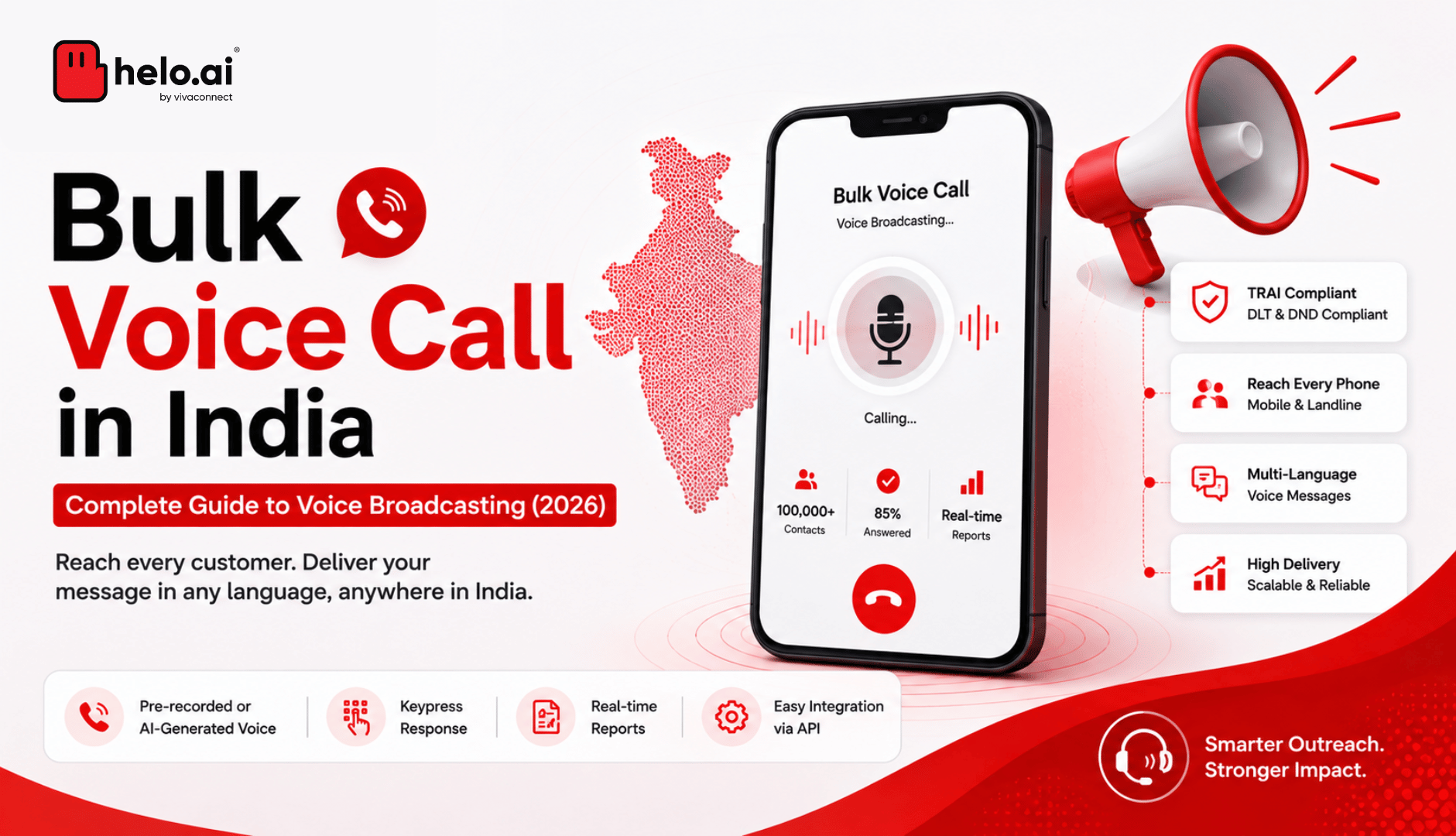


A bulk voice call is an automated phone call that plays a pre-recorded or synthesised message to a large list of numbers at once. No agent dials. No one waits in a queue. You upload the audio and the contact list, the platform places the calls, and you get a report on who answered and for how long.
The channel is also sold as voice broadcasting, bulk voice broadcast, voice SMS or OBD (outbound dialler), and the platforms behind it as bulk voice calling software or bulk auto calling software. These names describe one underlying mechanism. It sits alongside the other one-to-many channels we cover — bulk SMS and broadcast messaging.
This guide covers what the channel costs once you account for unanswered calls, which features actually matter in a platform, what TRAI permits, and when SMS or WhatsApp beats voice outright.
One thing to know before you shortlist anyone: several bulk voice call providers advertise "no DND restrictions" as a product feature. That is not a feature. It is a description of a regulatory violation, and the liability sits with you, not the vendor.
What Is a Bulk Voice Call?
A bulk voice call delivers one pre-recorded audio message to many phone numbers simultaneously, without a human agent on the line. The system dials, detects when the call is answered, plays the audio, optionally captures a keypress, logs the outcome, and moves on.
Three properties make it different from every other channel:
It reaches feature phones and landlines. No app, no smartphone, no data connection, no literacy requirement. In tier-2 and tier-3 India this is not a minor detail — it is often the entire reason the channel exists.
It is one-way by default. The recipient listens. Unless you add a keypress option, they cannot reply.
It is interruptive. A ringing phone demands attention in a way a notification does not. That is the channel's strength and the reason it is heavily regulated.
Bulk Voice Call vs Voice Broadcasting vs OBD vs Voice SMS
These terms are used interchangeably by most Indian providers, which makes comparison shopping harder than it should be.
Term | What It Usually Means | Practical Difference |
|---|---|---|
Bulk voice call | The umbrella term for automated calls to a list | None — the general category |
Voice broadcasting | Same mechanism, framing emphasises one-to-many | None in practice |
Bulk voice broadcast | Same again | None |
Voice SMS | A misnomer. It is a voice call, not an SMS | Marketing label only. Same billing, same rules |
OBD (outbound dialler) | The technical name for the dialling system | Sometimes implies keypress capture and routing |
Bulk calling software | The platform you run campaigns from | Emphasis on self-serve tooling |
Bulk auto calling software | Same platform, emphasis on automation | None in practice |
If a vendor uses several of these on one page to imply several products, they are describing one product.
Types of Bulk Voice Calls
Indian regulation does not treat all automated calls the same way, and the category your call falls into determines the number series you must use, whether you need consent, and when you may dial.
Type | Example | What Changes |
|---|---|---|
Promotional | Offers, new launches, cart recovery, upgrade nudges | 140 series, consent required, DND scrubbing, restricted hours |
Transactional | OTP, order confirmation, payment receipt | Triggered by a customer action, tighter template control |
Service | Outage alerts, EMI due reminders, KYC prompts | 1600 series for regulated entities, existing-customer relationship |
Getting this classification wrong is the most common compliance failure in the category. We cover it in detail below.
How Bulk Voice Calling Works, Step by Step
The mechanism is simple. The parts that decide whether a campaign works are mostly outside it.
- Record or generate the audio. Upload an MP3, or use text-to-speech to generate it in the language you need.
- Register the content. Under India's DLT framework, the campaign content and your sender identity must be registered before the campaign runs.
- Upload and scrub the list. Numbers are checked against the national preference register before dialling, not after.
- Schedule inside the permitted window. Promotional calls may only be placed during defined daytime hours.
- The platform dials in parallel. Concurrency determines how fast a list clears — 100,000 numbers at 500 concurrent channels is a very different campaign from the same list at 50.
- Answer detection runs. The system decides whether a human answered, a machine answered, or the call failed. This step is where most of the wasted spend hides.
- Audio plays, keypress captured. If the message offers "press 1 to speak to an agent," that input is logged and can route to a live queue.
- Retries fire on defined rules. Busy and unreachable numbers are re-attempted on a schedule you set.
- Reports land. Answered, unanswered, duration, keypress, and — if the platform is honest — how many "answered" calls were actually voicemail.
Answer Machine Detection: Where Campaign Budgets Leak
Step 6 deserves separate attention. Answer-machine detection is imperfect on every platform, and the difference between a call answered by a person and a call answered by voicemail is the difference between a delivered message and a billed non-event.
Ask any prospective vendor two questions: does your billing distinguish voicemail from human answer, and what is your measured answer-machine detection accuracy on Indian mobile networks. Vendors who charge "for answered calls only" and count voicemail as answered are quietly billing you for silence.
Key Features of Bulk Voice Calling Software
Feature lists across bulk calling software vendors look near-identical. These are the ones that change campaign outcomes, and what to actually verify about each.
Feature | What It Does | What to Verify |
|---|---|---|
Campaign scheduler | Queues campaigns for a date and time window | Whether it enforces permitted calling hours automatically |
Text-to-speech | Generates audio from typed script, per language | Output quality in your specific regional languages |
Dynamic fields | Inserts name, amount, due date into each call | Whether TTS fields can mix with human-recorded audio |
Keypress / DTMF capture | Records the digit the listener presses | Where the keypress routes next, and how fast |
Answer machine detection | Separates human answers from voicemail | Accuracy figure, and whether billing respects it |
Retry rules | Re-dials busy and unreachable numbers | Whether retries respect DND and calling-hour limits |
Concurrency control | Number of simultaneous channels | The real ceiling at peak, not the sales figure |
DND / NCPR scrubbing | Removes registered numbers pre-campaign | Whether it runs per campaign or once at upload |
Live dashboards | Campaign progress in real time | Refresh interval on a large campaign |
Reporting and export | Per-number outcome data | Raw export, not just dashboard summaries |
Cloud vs On-Premise Bulk Calling Software
Almost every Indian provider now sells cloud-hosted bulk calling software, billed per call with no infrastructure to run. That is the right default for the overwhelming majority of buyers.
On-premise deployment is worth the cost and effort in two situations only: where a regulator or internal policy requires call recordings and customer data to stay inside your own network, and where you are running sustained volumes high enough that per-call pricing exceeds the cost of owning the stack. If neither applies, cloud wins on setup time, elasticity during campaign peaks, and the fact that regulatory updates arrive as platform changes rather than as your problem.
Bulk Auto Calling Software: API and CRM Integration
Most serious use is triggered, not scheduled: a payment falls overdue, a shipment fails, a policy approaches renewal, and a call needs to fire without anyone opening a dashboard. That requires an API, and it is the single most common gap in cheaper bulk auto calling software — at least one widely-ranked Indian provider states plainly on its own site that it does not support an API.
Check three things: whether campaigns can be triggered programmatically, whether outcomes and keypress data flow back into your CRM automatically, and whether webhooks fire in real time or via a batch job overnight.
Bulk Voice Call Use Cases and Benefits
The channel has a genuine and narrow set of jobs it does better than anything else.
Use Case | Why Voice Wins Here |
|---|---|
Harder to ignore than SMS; reaches customers who do not read messages | |
Interruptive by design, which is exactly what you want | |
Delivery and appointment confirmation | Keypress confirmation closes the loop without an agent |
Feature-phone and rural audiences | The only channel that needs no app, no data and no reading |
Audio sidesteps literacy and script barriers entirely | |
Keypress polling at scale, cheaply | |
"Press 1 if interested" filters a cold list before agents touch it |
When Bulk Voice Broadcast Is the Wrong Channel
Anything requiring a conversation. A pre-recorded message cannot answer a question. If the customer's likely response is "yes but what about my case specifically," voice broadcast is the wrong tool and will generate inbound calls you have not staffed for.
Cold promotional lists. High complaint risk, low conversion, and a direct route to a suspended Principal Entity registration. The same rules that govern promotional SMS apply here, with a lower tolerance.
Anything needing a document, link or image. Voice cannot deliver a receipt, a policy PDF or a payment link. Pair it with SMS, RCS or WhatsApp, or use one of those instead.
High-frequency campaigns. Complaint rate rises with frequency faster on voice than on any other channel, because the interruption cost to the recipient is highest.
Bulk Voice Call Price in India
Published rates in this category cluster in a narrow band, and they are all quoted the same misleading way.
Vendors advertise a per-call rate — often framed as a pulse rate for a 30-second call — and many advertise "pay only for answered calls." Both framings understate real cost, for four reasons.
What You Are Quoted | What Actually Happens |
|---|---|
A per-call or per-30-second rate | Longer messages bill multiple pulses. A 45-second message can cost double a 29-second one |
"Answered calls only" | Voicemail may be billed as answered, depending on the platform's detection and its billing policy |
A flat campaign price | Retries on busy and unreachable numbers bill again |
The platform rate | DLT registration, template fees and number rental sit outside it |
How to Calculate Cost Per Answered Call
The number that matters is not cost per call. It is cost per answered-by-a-human call, and beyond that, cost per outcome you actually wanted.
Work it out this way. Take your campaign spend, divide by the number of calls a human genuinely answered and heard the message through. Then divide by the number of those people who did the thing you wanted — pressed 1, paid the instalment, turned up.
A campaign at ₹0.12 per call with a 30% human answer rate and a 2% action rate is not a ₹0.12 campaign. It is a ₹20 cost per action, and that is the figure to compare against your other channels.
How Message Length Affects Cost
Because billing is usually per pulse, message length is a direct cost lever and one of the few you fully control. A message that says what it needs to in 25 seconds costs half what the same message costs at 35 seconds, across the whole list. Write to the pulse.
Bulk Voice Call Compliance: TRAI, DLT and DND Rules
This is the section most bulk voice call service pages skip, and it is the one that determines whether your campaign runs at all.
Bulk voice calling in India sits under the TCCCPR framework administered by TRAI. The obligations are specific and they attach to you as the Principal Entity, not to the platform you bought.
DLT Registration for Bulk Voice Calls
Register as a Principal Entity on a telecom operator's DLT portal, register your calling headers, and register your content templates. Unregistered commercial traffic does not get delivered. This is a prerequisite, not a formality, and it takes days rather than minutes. We run DLT management as a managed service because the alternative is a member of your team learning a telecom portal.
140 vs 1600 Number Series
Promotional calls must originate from the 140 series. Service and transactional calls from RBI, SEBI, IRDAI and PFRDA-regulated entities must originate from the 1600 series — a live obligation for BFSI, not a future one. Routing a promotional call through a service number, or the reverse, is itself a violation regardless of what the message says.
DND Scrubbing and NCPR Rules
Every list must be scrubbed against the national preference register before every campaign. The register changes daily, so a list cleaned last week is already stale. Scrubbing is also category-level: a customer may accept banking calls and refuse real-estate calls.
This is where the "no DND" vendors come in. A provider advertising delivery to DND numbers is either routing your promotional traffic as something it is not, or accepting that complaints will land on your Principal Entity registration. Five complaints in a short window can trigger suspension. The penalty and the blacklisting attach to your entity.
Classifying Promotional vs Transactional Calls
Teams get this wrong in one direction almost every time: they classify something as transactional because it relates to an existing customer, when the content is promotional.
The clearest worked example is abandoned-cart recovery. The customer is real, the cart is real, and the call feels like a service message. It is not — it is an attempt to complete a sale, which makes it promotional. That means 140-series, DND scrubbing, consent, and calling-hour limits, none of which apply if you had classified it as transactional. If cart recovery is your use case, an AI calling flow paired with WhatsApp is usually the better-performing and cleaner route anyway.
Apply the same test to renewal nudges, upgrade offers and "your points are expiring" calls. If the business outcome you want is a purchase, it is promotional.
Consent Requirements Under TCCCPR
Promotional calls require demonstrable consent, and the 2025 amendments tightened both what counts as consent and how long it lasts. "We bought the list" is not consent. "They filled a form two years ago" is unlikely to survive scrutiny.
Bulk Voice Call Timing Rules
Promotional calls are restricted to a daytime window. The most commonly cited window is 9am to 9pm, though some operator guidance and sector circulars specify narrower bands, and preference registers allow subscribers to set their own permitted slots. Confirm the exact window that applies to your traffic with your operator or DLT provider before you schedule — this is one where the general answer and your specific answer can differ.
Call Recording and the DPDP Act
If you record responses, the DPDP Act, 2023 governs retention, purpose limitation and who may access the audio. Sector regulators add their own retention floors on top.
The practical test. Ask a prospective vendor to explain, without prompting, how they handle DLT registration, number series routing, DND scrubbing frequency and consent records. A vendor who cannot answer those four questions crisply is not a vendor whose invoice you want your compliance team reading.
Bulk Voice Call vs SMS vs WhatsApp vs AI Voice Agent
Choosing the channel correctly matters more than optimising within the wrong one.
Bulk Voice Call | SMS | AI Voice Agent | ||
|---|---|---|---|---|
Reaches feature phones | Yes | Yes | No | Yes |
Needs literacy | No | Yes | Yes | No |
Two-way | Keypress only | Limited | Yes | Full conversation |
Can send links or documents | No | Yes | Yes | No |
Interruptive | High | Low | Medium | High |
Cost per contact | Low | Lowest | Medium | Highest |
Handles the unexpected | No | No | Partly | Yes |
Best at | Alerts, reminders, rural reach | Confirmations, OTP, links | Rich commerce and support | Resolution, qualification |
The honest summary: bulk voice is the cheapest way to make a phone ring with a message on it. It is not a way to have a conversation. When the caller will have follow-up questions, an AI voice agent handles what a broadcast cannot — and when the answer needs a link or a document, SMS or WhatsApp will outperform both.
The strongest campaigns run more than one. A voice call that says "press 1 and we will WhatsApp you the payment link" uses each channel for what it is good at. That is also why running them on one platform matters — see campaign management for how the sequencing works in practice.
How to Choose a Bulk Voice Call Service Provider
Seven criteria, in the order they should decide your shortlist.
Compliance Handling and DLT Support
Does the vendor manage DLT registration, correct number-series routing, and pre-campaign DND scrubbing — or hand you a portal and a disclaimer? Ask who is named as telemarketer and who carries the complaint exposure. This belongs first because it is the only criterion whose failure mode is regulatory rather than commercial.
Billing Transparency on Answer Detection
Does the platform distinguish human answer from voicemail, and does the invoice reflect that distinction? Ask for the detection accuracy figure. Ask for a sample invoice against a sample report.
Concurrency and Campaign Throughput
How many simultaneous channels, and what happens at peak? A list that must clear inside a two-hour window needs concurrency, not a low per-call rate. This is the single most common reason a campaign misses its window.
Regional Language and Text-to-Speech Quality
If you are broadcasting in Hindi, Marathi, Tamil or Telugu, listen to the synthesised output before signing. Poor TTS in a regional language sounds worse than no campaign at all. Ask whether you can mix recorded human audio with dynamic TTS fields. For banks this is not optional — RBI's master circular requires customer-facing material in Hindi, English and the regional language, which we cover in our note on multilingual voice for pan-India businesses.
Keypress Routing and Live Agent Transfer
If the message offers "press 1," where does that person land? A live queue, a callback list, a dropped call? A keypress that leads nowhere is worse than not offering it.
Retry Rules and Scheduling Control
Retry count, interval, and whether retries respect the calling window and the preference register. Aggressive retries are the fastest way to generate complaints.
Reporting, Analytics and Data Export
Per-number outcome, duration, keypress, and the ability to push it into your own warehouse. If the numbers only live in the vendor's dashboard, you cannot audit them and you cannot reconcile them against your own outcomes.
How to Write a Bulk Voice Call Script
The audio decides the campaign. Most bulk voice messages fail in the first three seconds.
Lead with who you are. The recipient does not recognise the number. If the first words are not your brand name, they hang up.
State the reason in one sentence. Say what this call is about before anything else.
Keep it to 20 to 30 seconds. Longer costs more per pulse and holds fewer listeners.
Say numbers slowly and repeat the important one. Amounts and dates should be spoken twice.
Put the action last and make it single. One keypress option, not four.
Record in the language the recipient speaks, not the language your head office uses.
Test on a small sample first. Send to 500 numbers, listen to the outcome data, then release the rest.
Bulk Voice Call Script Examples
Payment reminder (~22 seconds). "Hello, this is a reminder from [Brand]. Your instalment of four thousand two hundred rupees is due on the fifteenth of this month. That is four thousand two hundred rupees, due on the fifteenth. To receive a payment link on WhatsApp, press 1. Thank you."
Service outage (~18 seconds). "This is an important service update from [Brand]. Water supply in your area will be interrupted on Tuesday the ninth, from 10am to 4pm. Again, Tuesday the ninth, 10am to 4pm. We apologise for the inconvenience."
Feedback survey (~20 seconds). "Hello, this is [Brand] calling about your recent service visit. To rate your experience, press 1 for good, 2 for average, or 3 for poor. Your feedback takes one second and helps us improve. Please press a number now."
Note what all three share: brand name inside the first four words, one piece of information, the critical number repeated, and exactly one action at the end.
Bulk Voice Call Metrics to Track
Metric | What It Means | The Catch |
|---|---|---|
Delivery / connect rate | Calls the network completed | Says nothing about whether a person heard it |
Human answer rate | Answered by a person, not voicemail | The real denominator for everything else |
Listen-through rate | Share who heard the message to the end | The single best signal of audio quality |
Drop-off point | Where in the audio people hang up | Tells you exactly which sentence to cut |
Keypress rate | Share who took the offered action | Only meaningful against listen-through, not against dials |
Complaint rate | Recipients who reported the call | Watch this weekly. It precedes suspension |
Cost per action | Spend divided by outcomes achieved | The only number to compare across channels |
Two of these deserve more attention than they get. Drop-off point is free diagnostic data most teams never look at; if 60% hang up at second seven, your opening line is the problem. Complaint rate is the leading indicator of a regulatory problem, and by the time it shows up in a suspension notice it is far too late to manage.
Getting Started With Bulk Voice Calling
Bulk voice call is a narrow tool that does one job better than anything else: making a phone ring, anywhere in India, on any handset, in any language, with a message the recipient does not need to read. For payment reminders, outage alerts and rural reach it is genuinely hard to beat on cost.
It is also the most heavily regulated channel you can buy, and the market selling it is full of vendors advertising non-compliance as a feature. The buying decision is less about per-call rates — which barely vary — and more about who handles DLT, how honestly the platform bills answer detection, and whether the vendor understands that the complaint lands on your registration rather than theirs.
If you want a straight answer on whether bulk voice is the right channel for a specific campaign, talk to our team. We will tell you when SMS or WhatsApp would do the job for less.
Frequently Asked Questions
What is a bulk voice call?
A bulk voice call is an automated phone call that plays a pre-recorded or synthesised audio message to a large list of numbers simultaneously, without a human agent. It is also called voice broadcasting, voice SMS or OBD. The system dials, detects an answer, plays the message, optionally records a keypress response, and reports the outcome per number.
How does bulk voice calling work?
You record or generate the audio, register the content and sender identity on the DLT platform, upload and scrub the contact list against the preference register, then schedule the campaign inside permitted calling hours. The platform dials numbers in parallel, detects answers, plays the message, captures any keypress, retries failed numbers on your rules, and returns a per-number report.
Is bulk voice calling legal in India?
Yes, when done under the TCCCPR framework. That requires DLT registration as a Principal Entity, promotional calls from 140-series numbers and BFSI service calls from 1600-series numbers, DND scrubbing before every campaign, demonstrable consent, and calling only within permitted daytime hours. Providers advertising "no DND restrictions" are describing a violation, and the penalty attaches to your entity rather than theirs.
What does a bulk voice call cost in India?
Per-call rates in the market cluster in a narrow band and are usually quoted per 30-second pulse. That figure understates real cost because longer messages bill multiple pulses, retries bill again, and some platforms count voicemail as an answered call. Calculate cost per human-answered call and then cost per action instead, and add DLT registration and template fees, which sit outside the platform rate.
What is the difference between bulk voice call and voice SMS?
None in practice. "Voice SMS" is a marketing label for the same mechanism — an automated voice call playing a recorded message. It is not an SMS, it is billed as a call, and the same TRAI rules apply. Treat the terms as interchangeable when comparing vendors.
What is the difference between bulk voice call and IVR?
A bulk voice call is outbound and one-way: you call the customer and play a message. An IVR is inbound: the customer calls you and navigates a menu. They overlap when a broadcast offers a keypress that routes into a live queue, at which point the IVR — and your call routing — handles what happens next.
Do bulk voice calls reach DND numbers?
Promotional calls must not be placed to numbers on the preference register. Service and transactional calls from regulated entities to their own existing customers operate under a different framework and specific number series. Any vendor offering promotional delivery to DND numbers is exposing your Principal Entity registration to complaints and possible suspension.
What is a good answer rate for a bulk voice campaign?
Ask for the human answer rate rather than the connect rate, because the two differ substantially once voicemail is excluded. Rather than chasing an industry benchmark, compare each campaign against your own previous campaigns to the same audience segment — the variance between segments and times of day is larger than the variance between platforms.
How long should a bulk voice message be?
Twenty to thirty seconds. Billing is usually per pulse, so length is a direct cost multiplier across the whole list, and listener drop-off climbs sharply after about thirty seconds. Lead with your brand name, state the reason in one sentence, repeat any amount or date, and finish with a single action.
Can bulk voice calls be sent in regional languages?
Yes, and for much of India this is the main reason to use the channel. You can upload human-recorded audio per language or generate it with text-to-speech. Listen to the synthesised output before committing to a campaign — text-to-speech quality varies widely across Indian languages, and a poor regional voice performs worse than no call.