
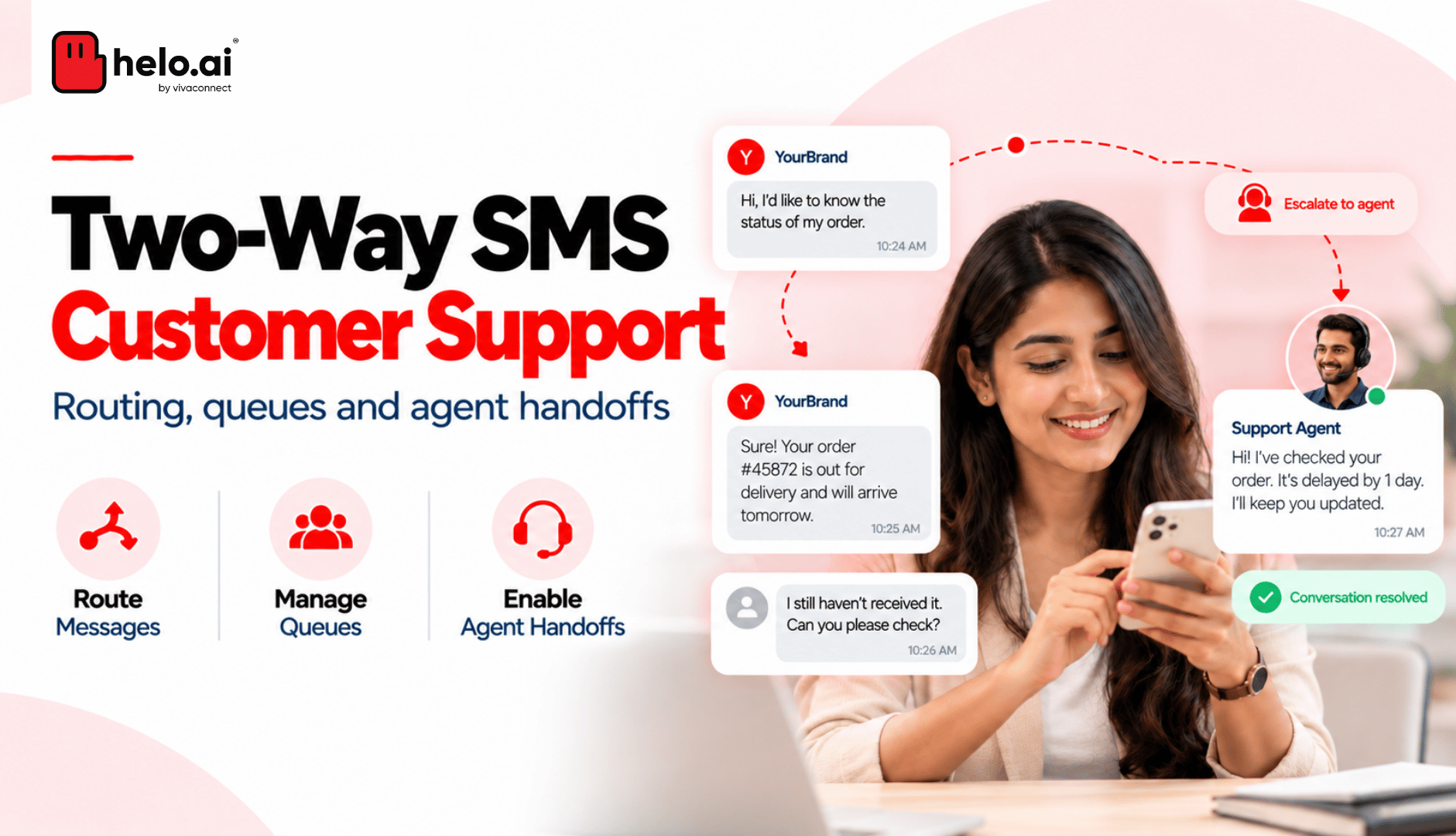


Most enterprises already send SMS alerts. Few let customers reply. Two-way SMS customer support closes that gap by turning each alert into a conversation an agent or automation can resolve. It works on every phone, with no app or data connection required.
What Is Two-Way SMS Customer Support?
Two-way SMS customer support uses one business number to send texts and receive customer replies. Agents, automation, or both respond in the same thread.
Standard alerts use an alphanumeric sender ID, which cannot receive replies. Two-way messaging uses a reply-capable number, so a customer can answer a delivery alert with a question and get a response.
One-way SMS | Two-way SMS support | |
|---|---|---|
Customer can reply | No | Yes |
Sender | Alphanumeric sender ID | Long code, short code, or virtual number |
Best for | OTPs and alerts | Service requests and confirmations |
How Two-Way SMS Customer Support Works
A deployment has four parts:
- Reply-capable number. A long code or short code receives inbound texts. In India, a 10-digit virtual mobile number is the usual choice.
- Inbound capture. The platform receives each reply from the carrier and passes it to internal systems through a webhook.
- Routing and shared inbox. Rules assign each thread to a queue or agent by keyword, customer profile, or the message being replied to. Helo.ai Inbound brings SMS, WhatsApp, and email replies into one dashboard.
- Systems of record. Agents see account data from the CRM in the thread, and each resolution writes back to the ticketing system.
The fourth part takes the longest. Legacy databases and on-premise ERPs often need middleware, so we recommend scoping integration before choosing a platform.
Benefits and Use Cases
Two-way SMS suits requests that are frequent, simple, and resolvable in a few messages. Moving these off voice lowers call volume and lets one agent handle several threads at once.
Use case | Example | Metric to track |
|---|---|---|
Order status | Customer texts "STATUS 48213" and gets tracking | Calls deflected |
Appointments | "Reply 1 to confirm, 2 to reschedule" | No-show rate |
Payment support | Customer replies "PAID"; agent confirms | Promise-to-pay rate |
Outage reporting | Customer texts "OUTAGE" with meter ID | Time to ticket |
Feedback | "Rate today's support from 1 to 5" | CSAT response rate |
Order-status queries are usually the best first use case. Our guide to reducing where-is-my-order tickets shows how to size that opportunity.
Automation and Human Handoff
Automation handles predictable requests, and agents handle the rest. Keyword replies and AI intent detection can answer balance, status, and rescheduling requests by pulling data from the CRM.
Handoff rules protect the customer experience. Escalate to an agent on negative sentiment, repeated failed answers, regulated decisions, or a request for a person. Pass the full thread so the customer does not repeat details. Our view on human-in-the-loop support covers these rules.
For AI-generated replies, ground answers in approved data and log every output for audit.
Compliance and Security
Registration and consent must be in place before launch. Several markets block unregistered traffic at the carrier level.
India. All commercial SMS must go through TRAI's DLT framework, covering the entity, sender headers, and templates. Since 6 May 2025, sender headers carry a suffix showing message type: -P, -S, -T, or -G. Links and callback numbers in templates must be whitelisted.
Under the DPDP Rules, 2025, core data fiduciary duties apply from 13 May 2027. These include notice, security safeguards, and breach reporting. Support threads contain personal data, so they fall in scope. See our note on DPDP Act changes for AI conversations.
United States. Traffic on 10-digit long codes needs A2P 10DLC registration, and unregistered traffic has been fully blocked since February 2025. TCPA consent rules also apply.
Platform security. Require role-based access control (RBAC), encryption at rest, audit logs, automatic STOP handling, and SOC 2 Type II or equivalent attestations. Avoid sending sensitive data in the message body, because SMS is not end-to-end encrypted.
How to Set Up Two-Way SMS Customer Support
- Pick one use case. Choose a high-volume, simple request such as order status.
- Get a reply-capable number. Provision a virtual number, long code, or short code.
- Complete registration. Register DLT templates in India or 10DLC campaigns in the US.
- Connect core systems. Link the inbox to the CRM and helpdesk through APIs and webhooks.
- Set routing and handoff rules. Define keywords, queues, and escalation triggers.
- Pilot and measure. Track first response time, resolution rate, and calls deflected, then expand.
Budget for more than message fees. Plan for number rental, platform seats, integration work, and AI usage. Replies over 160 characters, or 70 characters in Unicode for regional languages, are billed as multiple messages.
What to Look for in a Platform
Requirement | Why it matters |
|---|---|
Shared inbox with assignment | Prevents missed or duplicate replies |
Keyword automation and AI handoff | Resolves routine requests without an agent |
Keeps account data and ticket history in sync | |
Built-in DLT and consent handling | Avoids blocked traffic and opt-out violations |
RBAC, audit logs, data residency | Meets security and procurement review |
Channel-level reporting | Shows whether SMS is reducing load |
WhatsApp and RCS fallback | Adds rich media while keeping SMS reach |
Helo.ai SMS provides direct carrier connections, DLT support, and integrations with CRMs, ERPs, and core banking systems. Explore our customer service solutions to scope a pilot.
FAQs
Can customers reply to a business SMS?
Only when the business uses a reply-capable number, such as a long code, short code, or virtual number. Alphanumeric sender IDs cannot receive replies.
Is two-way SMS secure for customer support?
The platform can be secured with RBAC, encryption, and audit logs. SMS itself is not end-to-end encrypted, so send secure links instead of sensitive data.
Do we need DLT registration for two-way SMS in India?
Yes. Commercial SMS in India requires DLT registration of the entity, headers, and templates.
Should we use SMS or WhatsApp for support?
Most enterprises use both. SMS reaches every phone, and WhatsApp supports rich media for app users.
How do we measure success?
Track first response time, resolution rate, and the drop in calls for the requests moved to SMS.


.jpeg&w=96&q=75)