
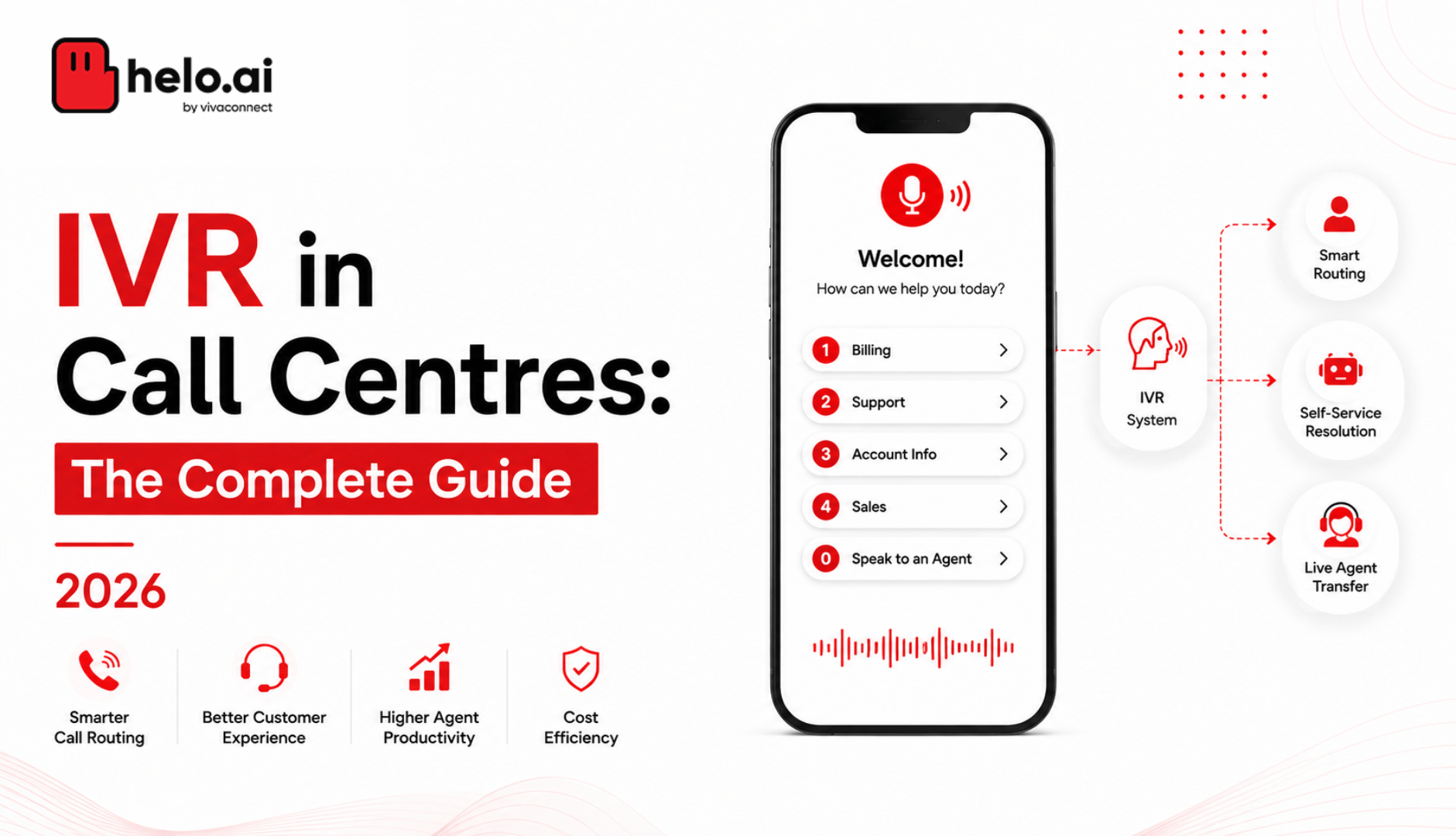


IVR, or interactive voice response, is the automated system that answers your inbound calls, presents options, and routes each caller to the right place. Press 1 for billing. Press 2 for support. Say "account balance." It has run the front door of the call centre for four decades.
Most guides on this subject are written to convince you that IVR is essential. This one assumes you already have one, and that the question you are actually asking is harder: which parts of it are still earning their place, which parts are quietly costing you customers, and what should replace the parts that are failing.
There is a method for answering that using call data you already have. It is the middle of this guide.
What IVR means in a call centre
An IVR system answers the call, plays a prompt, collects an input, and acts on it. The input arrives one of two ways: the caller presses a key, or the caller speaks.
DTMF: the keypad path
DTMF (dual-tone multi-frequency) is the keypad path. Each key press sends a pair of tones the system decodes. It is old, it is extremely reliable, and it works on any handset and any line quality. That reliability is why DTMF has outlived every prediction of its death.
Speech input
Speech input lets the caller say a word or phrase instead. Older speech IVR matches against a fixed grammar, so it recognises "billing" but fails on "I want to talk about my bill."
CTI and ACD: the rest of the stack
Behind the prompt sits the rest of the stack. CTI (computer telephony integration) connects the phone system to your business software, so the call can carry data. ACD (automatic call distribution) is what actually places the caller with an agent once the IVR has worked out where they belong.
The distinction between IVR and ACD matters and is often blurred. IVR gathers intent. ACD assigns the resource. IVR asks what you need; ACD decides who takes it and in what order. If you are diagnosing a routing problem, knowing which of the two is at fault saves a quarter of wasted work — this is the same split that governs intelligent call routing.
IVR, ACD and auto-attendant
System | What it does | Where it sits |
|---|---|---|
Auto-attendant | Answers and forwards to an extension or department | Simplest form, common in small offices |
IVR | Answers, collects intent, can self-serve, then hands off | Front of the call flow |
ACD | Queues the call and assigns it to an agent by rule | After IVR, before the agent |
CTI | Passes call and caller data between phone and business systems | Underneath all three |
The three generations of IVR
Generation | Input | Handles | Typical failure |
|---|---|---|---|
Touch-tone | Keypad, DTMF | Fixed menus, deterministic routing | Deep menus, caller gets lost or zeroes out |
Directed dialogue | Constrained speech | A limited set of spoken keywords | Caller says the wrong word, system asks again |
Natural language | Free speech | Open-ended requests, no fixed phrasing | Costs more, needs real intent design |
Most enterprises are running a mix, usually a touch-tone trunk with a natural-language layer bolted to the top of it.
How a call actually flows
Nine steps, and every one is a place where callers leave.
- The call arrives on your trunk, over PSTN or SIP.
- The IVR answers and plays a greeting.
- The system may look the caller up by number through CTI, so it already knows who is calling.
- The main menu plays.
- The caller inputs a choice, by key or by voice.
- Sub-menus play if the tree goes deeper.
- The system either self-serves the request or decides where to route it.
- ACD queues the call and applies routing rules.
- An agent answers, with or without the context the IVR gathered.
Step 3 is where most enterprises leave value on the table. If CTI can identify the caller and pull their last order or their overdue instalment, the menu should change to reflect that. Very few do this, and playing a generic seven-option menu to someone whose only plausible reason for calling is the payment due tomorrow wastes everyone's time. It is usually an integration gap rather than a telephony one.
Step 9 is where most of the damage shows up. If the agent does not receive what the IVR collected, the caller repeats themselves, and every second spent in the menu was wasted from their point of view.
Where the IVR is actually broken: the audit
This is the part to run before you buy anything. Everything you need is in reporting you already have.
Pull ninety days of call data and calculate five numbers per menu path.
Metric | What to measure | What it means |
|---|---|---|
Zero-out rate | Share of callers who press 0 or ask for an agent, by menu level | The single best indicator of a menu people do not trust. High at the main menu means they have learned it cannot help |
Drop-off by level | Where callers abandon inside the tree | Abandonment deep in the tree means the path is too long or the labels are wrong |
Mis-route rate | Calls transferred again after reaching an agent | The menu is collecting the wrong intent, or the labels do not match how customers describe their problem |
Repeat-call rate | Callers who call again within 48 hours | Self-service that appears to complete but does not actually resolve |
Self-service completion | Started a self-service task and finished it | Distinguishes deflection from abandonment, which look identical in most dashboards |
The last one deserves attention. Containment and deflection numbers count calls that did not reach an agent. A caller who gave up and hung up counts as a success in that maths. Self-service completion is the honest version.
Sorting each path into keep, fix or replace
Once you have the numbers, every menu path lands in one of three buckets.
Keep
Keep the paths where the request is genuinely deterministic and the data proves it works. A caller choosing a language. A two-option emergency split. Secure PIN entry, where DTMF is safer than speech because the caller is not saying their PIN out loud in a public place. High completion, low zero-out, no repeat calls. Adding conversational AI to these adds latency and cost for nothing. When we scope a Helo Voice deployment, these are the paths we recommend leaving alone.
Fix
Fix the paths where the design is the problem rather than the technology. Menus more than three levels deep. Options labelled in your internal vocabulary rather than the customer's, "policy servicing" where the customer would say "change my address." Prompts that read out all seven options before the useful one. No path to a human. These are rewriting jobs, not procurement projects.
Replace
Replace the paths where the request is not deterministic at all and the menu is a lossy compression of what the caller wanted. The catch-all "for anything else, press 9" that dumps into a general queue. Anything where callers routinely zero out at the first prompt. Anything where the customer's actual question has too many variants to enumerate, which is most support.
That third bucket is what the market calls conversational IVR, and what we would call an AI voice agent, because the caller simply says what they want and the system works it out. It is the bucket Helo Voice is built for, and the distinction is set out in more detail in our comparison of an AI voice answering desk versus traditional IVR.
How to fix an IVR menu without buying software
Most menus can be substantially improved without buying anything.
Cap the depth at three levels
Every level loses callers. If a path needs four, the taxonomy is wrong.
Cap the main menu at five options and thirty seconds
People hold roughly four items in working memory at once, not the seven that gets quoted (Cowan, 2001). A seven-option menu means listening twice.
Label in customer language
Pull the actual words from call transcripts and use those. Not "policy servicing." "Change my address or phone number."
Put the most common path first
Order options by real volume, and re-order them quarterly, because volumes shift.
Offer a human early and clearly
Hiding the zero-out increases frustration and does not reduce transfers. It just makes the caller angrier when they arrive.
Use CTI to shorten the tree
If you know who is calling and what is outstanding on their account, lead with that. "Calling about the instalment due tomorrow? Press 1."
Offer a callback instead of a queue
Holding the caller's place and calling them back reduces abandonment and, unlike hold music, does not spend their time. This is one of the highest-return changes available in most contact centres, and it costs nothing in AI spend. It is also the cheapest way to reduce call abandonment before you touch the menu itself.
Carry everything forward to the agent
Whatever the IVR collected should land on the agent's screen before they speak. If it does not, the menu is a tax on the caller with no benefit. This is the same principle we hold Helo Voice to on transfer: the receiving agent gets the whole conversation, not a summary, and the caller never starts again.
Review quarterly
Menus drift. Promotions end, departments merge, and the prompt still mentions a website you launched three years ago.
What IVR is genuinely good at
It is worth being clear about this, because the honest answer is not "nothing."
Strength | Why it holds |
|---|---|
Deterministic routing | When there really are four departments, four options is the correct design |
Secure input | DTMF entry of PINs and card numbers keeps them out of the audio and out of transcripts |
Reliability on bad lines | Keypad tones survive noise and packet loss that would defeat speech recognition |
Predictable cost | No per-turn inference cost, no model spend, no latency budget to manage |
Compliance flows | Fixed disclosure and consent scripts are a feature when a regulator requires exact wording |
Universal access | Works on any handset, including feature phones, which still matters across much of India |
Card payments are a specific case for keeping DTMF
If you take card payments over the phone, the keypad is not a legacy choice, it is a compliance architecture. DTMF masking suppresses the tones from the call recording and from the agent's audio, so card data never enters your telephony environment and the scope of your PCI DSS assessment shrinks accordingly. Speech capture of a card number does the opposite: it puts the digits into the audio, into the transcript, and into whatever storage both land in. Any replacement plan that removes DTMF from a payment path should be checked with whoever owns your PCI scope before it is scheduled, not after.
Any replacement should preserve these strengths rather than discard them. In practice the strongest architecture keeps DTMF for authentication, payment capture and secure entry, and puts natural conversation everywhere the caller is describing a problem.
Where IVR fails, and what it costs
The failures are well known to anyone who has called their own contact centre as a customer.
Callers cannot map their problem onto your options, because their problem does not have a menu item. They wait through prompts that do not apply. They reach a queue, hold, then repeat everything to the agent because nothing carried forward. They call back the next day because the self-service path looked complete but did not resolve anything.
Two costs follow, and only one of them appears in your reporting. The visible one is handle time and repeat contacts. The invisible one is the caller who hangs up during the menu and does not call back at all, which in a sales or collections context is revenue that simply disappears without ever becoming a metric. If you want to put a number on the visible half, start with a contact centre cost breakdown per resolved contact rather than per call.
This is why zero-out rate deserves more attention than containment. Containment tells you callers did not reach an agent. Zero-out tells you they tried to escape.
The India and BFSI layer
Global IVR guides skip this entirely, and it drives most of the design decisions in an Indian contact centre.
Language is not a menu option
Selecting Hindi at the top of the tree and then hearing English prompts, or reaching an agent who does not speak it, is worse than not offering the choice. The language selection has to persist through the routing and into agent assignment, which is an ACD configuration problem as much as an IVR one. This is not only a CX preference in banking: the RBI has reiterated that customer communication should be issued in Hindi, English and the relevant regional language, and its own contact centre runs IVRS in Hindi, English and ten regional languages. Helo Voice handles recognition and synthesis per language on one agent, so the language a caller chooses is the language the conversation continues in.
Callers code-mix
A customer will say the product name in English inside a Hindi sentence. Fixed-grammar speech recognition breaks on this, which is why so many Indian deployments quietly fall back to keypad input. Handling code-mixing without that fallback is one of the specific things we built multilingual voice AI for Indian businesses to do.
Feature phones and poor lines are still real
DTMF works when speech recognition will not. Any design that assumes a clean connection and a smartphone will fail a meaningful share of your callers.
Regulated flows constrain the script
In BFSI, disclosure wording, consent capture and authentication steps are set by RBI and IRDAI requirements rather than by CX preference. The IVR is often where those obligations are discharged, and changing the script is a compliance exercise, not a copy edit.
Outbound is a separate regime
If you also run outbound campaigns from the same operation, DLT registration under the TRAI framework governs sender identities, headers and templates, TCCCPR governs consent and preference scrubbing, and the DPDP Act, 2023 reaches into how long you keep recordings and who can play them back. We run DLT management as a managed service alongside the platform for this reason. None of this is optional and none of it appears in a global vendor's IVR guide.
We build Helo Voice against these constraints rather than around them, which is a large part of why 25 years of Vivaconnect infrastructure sits behind banking, insurance and utility operations including Kotak and HDFC. Auditability, PII redaction at transcript level and regional-language handling are entry requirements in that sector, not upgrades, and we document how we meet them in our security and compliance pages.
Metrics that tell you the truth
Metric | Definition | Why it misleads on its own |
|---|---|---|
Containment rate | Calls handled without an agent | Counts abandoned calls as successes |
Self-service completion | Tasks started and finished in the IVR | The honest version of containment |
Zero-out rate | Callers who request an agent, by level | Rising zero-out at the main menu is the clearest failure signal there is |
Abandonment rate | Calls dropped before reaching anyone | Split it by in-menu and in-queue; the causes are different |
Average handle time | Agent time per call | Falls when the IVR passes context forward, rises when it does not |
First contact resolution | Resolved without a repeat call | The number that correlates with CSAT |
Mis-route rate | Transfers after the first agent | Measures whether the menu captured intent correctly |
Cost per resolved contact | Total cost divided by resolved contacts | Not cost per call; a cheap call that resolves nothing costs you twice |
Measure these per menu path, not as contact-centre averages. Averages hide the two broken paths that are generating most of your complaints.
That granularity depends on what your platform exposes. Full transcripts, per-call timing and the actions taken, delivered into your own dashboards and warehouse rather than trapped in a vendor console, is the difference between a monthly report and something you can act on. In Helo Voice it is the default on every call, for the plain reason that a queue an auditor will eventually ask about should not be a black box.
Choosing between fixing, upgrading and replacing
If your data shows | The right move |
|---|---|
Good completion, low zero-out, stable volumes | Keep the path. Review it quarterly and leave it alone |
High drop-off deep in the tree, correct routing | Fix the design. Flatten it, relabel it, reorder it |
High zero-out at the main menu | Replace the front door. Callers have concluded the menu cannot help |
High mis-route despite a clean tree | Intent is more varied than a menu can express. Replace with natural conversation |
Long queues, high abandonment in queue | Add callback before anything else. Cheapest fix available |
Agents re-asking what the IVR collected | Integration problem, not a menu problem. Fix CTI first |
Language selected but not honoured downstream | Routing problem. Fix ACD configuration before redesigning prompts |
Two rules worth holding to. Do not replace a menu that is working, because deterministic routing is genuinely cheaper and faster as a menu. And do not redesign a menu when the real fault is that nothing reaches the agent, because you will spend a quarter on prompts and the caller will still repeat themselves.
What replacing the front door actually looks like
Where the audit says replace, the shape of the answer is that the caller stops choosing from a list and simply says what they want.
The system transcribes the speech, works out the intent without a fixed grammar, retrieves what it needs from your own content, calls your systems to fetch the order or the outstanding amount, and either resolves the request or passes the call to a human with the whole conversation attached. No tree. No "press 9 for anything else." An inbound voice bot for support calls is the same architecture pointed at a single high-volume queue.
Three things determine whether that works in production rather than in a demo.
Response time
The budget for a spoken turn is a few hundred milliseconds across nine processing stages, because human conversational turn-taking runs on gaps of roughly two hundred milliseconds (Stivers et al., 2009). Past a second, the call feels wrong. Ask any vendor for stage-by-stage latency on live calls rather than one headline figure. In Helo Voice we report it per call, because a budget you cannot see is a budget you cannot hold.
Interruption
Callers talk over the system, especially when it starts saying something they already know. The agent has to stop within a beat and respond to what was actually said.
Handoff
In-flight transfer with no audio gap and the full conversation handed to the receiving agent. If the caller repeats themselves after the transfer, you have rebuilt the problem you were trying to solve, with better speech synthesis. We treat this as a pass or fail test rather than a scored one, and it is worth putting on any vendor the same way.
Keep the DTMF paths that earn their place. Authentication, secure entry, language selection on a bad line. The strongest architecture is a hybrid, not a rip and replace, and any vendor who tells you otherwise is selling rather than advising. Helo Voice is built to sit alongside those paths rather than demolish them, connecting over SIP to the carriers and numbers you already run.
How to run an IVR pilot that proves something
Pick the single worst path from your audit, usually the one with the highest zero-out rate. Not the whole tree.
Run it live against real traffic with a defined split, measure for a full cycle including a peak day, and compare against the same path's previous numbers rather than against a vendor benchmark. Track self-service completion, zero-out, mis-route and first contact resolution, not containment.
Listen to actual recordings daily for the first fortnight. Dashboards will tell you the rate moved. Only the audio tells you why.
Expand one path at a time. Contact centre changes fail when they arrive all at once and nobody can attribute the result.
Audit your IVR
Send us ninety days of call data and we will map every menu path into keep, fix or replace, with the five numbers behind each call. No obligation to change anything, and you keep the analysis either way.
Frequently asked questions
What does IVR stand for in a call centre?
Interactive voice response. It is the automated system that answers inbound calls, presents options, collects the caller's input by keypad or voice, and routes or resolves the call.
What is the difference between IVR and ACD?
IVR works out what the caller needs. ACD, automatic call distribution, decides which agent takes the call and in what order. IVR sits at the front of the flow, ACD after it. Many contact centres treat them as one system, which makes routing problems hard to diagnose.
What is the difference between IVR and an auto-attendant?
An auto-attendant answers and forwards to an extension. IVR does that too, but can also collect information, complete self-service tasks and pass data to the agent. Auto-attendant is the simpler subset.
What is the difference between IVR and a chatbot?
An IVR operates on the voice channel and interacts through audio prompts, keypad input or speech recognition. A chatbot operates on digital channels — web, app or messaging — through text. Conversational IVR and chatbots share the same underlying intent recognition, but the constraints differ: a voice caller cannot scroll back, cannot see a menu, and will not wait a second for a reply.
Is conversational IVR the same as an AI voice agent?
Broadly yes, and the difference is mostly who is naming it. "Conversational IVR" is the term the market uses when it upgrades an existing menu. "AI voice agent" describes the same capability without the assumption that a menu came first. What matters is whether the caller can state their problem in their own words and be understood, not what the category is called.
How deep should an IVR menu be?
Three levels at most, with five options or fewer at the main menu and a total run time under thirty seconds. Every additional level loses callers, and abandonment climbs sharply past the third.
What is a good containment rate?
The question is slightly wrong, because containment counts abandoned calls as successes. Measure self-service completion instead, which counts only tasks a caller started and finished. Then compare each path against its own history rather than an industry average. If someone quotes you a benchmark, ask whether it separates callers who resolved their issue from callers who gave up, because most benchmarks do not.
What is zero-out rate and why does it matter?
The share of callers who press 0 or ask for an agent. Measured per menu level, it is the clearest available signal of a menu callers do not trust. High zero-out at the main menu means they have already concluded the system cannot help them.
Does IVR still make sense in 2026?
For deterministic routing, secure keypad entry and fixed compliance scripts, yes. Those are cheaper, faster and more reliable as menus. For open-ended requests where the caller's problem does not fit a list, a menu is a lossy way to capture intent, and that is where natural conversation replaces it.
Can we keep our existing phone numbers and carrier?
Yes. Voice platforms connect over SIP trunking, so numbers and carrier relationships stay as they are. Confirm this early, because migration is a much larger project than integration.
How do we handle multiple languages properly?
The selection has to persist past the prompt, through routing and into agent assignment. Offering a language and then failing to honour it downstream is worse than not offering it. Test the full path, not the greeting.
How long does it take to improve an IVR?
Redesigning prompts and flattening a tree is a weeks-long exercise using tools you already own. Replacing a path with conversational handling takes longer, mostly because of integration and security review rather than the conversation design itself.