


Key Takeaways
- First-order retention sits between 20% and 35% across most D2C categories — meaning 65–80% of first-time buyers never come back (Shopify D2C benchmarks).
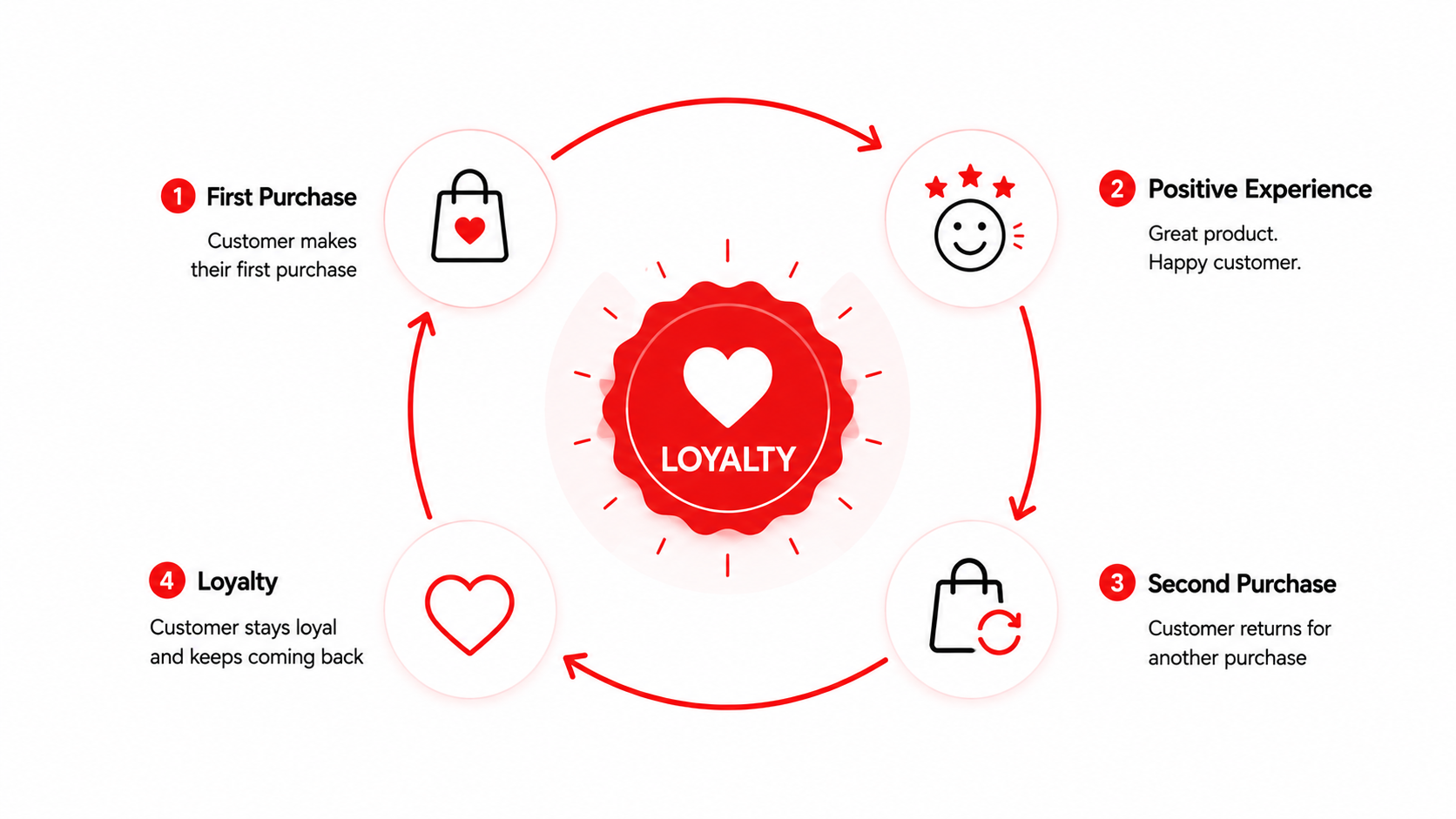
- Loyalty is built between the first and second order, not at acquisition. The post-purchase journey decides whether the relationship continues.
- The 7 post-purchase touchpoints that drive repeat purchases: order confirmation, delivery updates, post-delivery onboarding, review request, reorder reminder, cross-sell nudge, win-back journey.
- Customers who place a second order generate 2–4× the lifetime value of one-time buyers (Bain & Company retention research).
- Timing beats frequency. Trigger-based messages aligned to product usage cycles outperform calendar-based promotional blasts.
Turning first-time buyers into loyal customers requires running a structured post-purchase journey order confirmation, delivery updates, onboarding, review request, and reorder reminder — that closes the silence gap between the first and second order. Loyalty isn't won during acquisition; it's won in the weeks after delivery, through consistent, useful, and well-timed communication.
Most D2C brands spend enormous time and money acquiring customers. Ads get clicked. Orders come in. Acquisition targets are hit. Then something quietly damaging happens: a large share of those customers never buy again.
This is one of the most important growth challenges for D2C brands. Acquiring a customer is expensive; getting a second order is often where profitability begins. The brands that grow sustainably are not the ones acquiring the most customers — they're the ones that consistently turn first-time buyers into repeat buyers.
How Big Is the First-Order Retention Problem?
For most D2C categories, first-order retention sits between 20% and 35% (Klaviyo retention benchmarks) — meaning 65–80% of first-time customers never place a second order. The number varies sharply by category, but anything significantly below the category average is usually a post-purchase communication problem, not a product quality problem.
What makes this number stark: customer acquisition costs across D2C have risen sharply year-over-year. A first-order retention rate of 25% means the brand is essentially renting customers — paying CAC for them, shipping them one order, and watching them leave. The unit economics only work when retention pulls the second, third, and fourth order through.
This is also why retention has become a board-level metric for D2C brands. The acquisition-only model has stopped working. (See Why most D2C brands lose customers after the first order for the deeper diagnosis.)
Why Customers Don't Come Back (and What That Tells You)
Most first-order churn doesn't happen because customers dislike the product. It happens because the brand goes silent after delivery, and customers simply forget. The challenge is rarely satisfaction it's absence. Without ongoing engagement, the relationship fades within weeks.
The common patterns behind first-order churn:
- No post-purchase engagement — the order confirmation is the last message the customer ever receives
- Lack of product education — customers don't get full value from what they bought, so they don't re-buy
- Poor delivery experience — slow updates, missed windows, no WISMO visibility
- Generic communication — broadcast blasts that don't match where the customer is in the lifecycle
- Better competitor offers — easy to switch when there's no relationship to walk away from
- No reminder to purchase again — consumables and replenishables get forgotten without nudges
Each of these has a different fix. The seven sections below map directly to them.
What Does It Take to Build Loyalty? A Working Definition
Customer loyalty in D2C is the cumulative outcome of repeated positive post-purchase experiences delivery reliability, communication quality, support responsiveness, and well-timed relevance that compound into trust, preference, and repeat purchase behaviour. Loyalty is not a single moment. It's a pattern.
A few quick definitions worth pinning down before we get tactical:
- First-order churn — customers who buy once and never return. The largest single churn cohort for most D2C brands.
- Second-order rate — the percentage of first-time customers who place a second order. Industry benchmark: 20–35% across most D2C categories.
- Repeat purchase rate (RPR) — the percentage of customers who purchase more than once over a defined period.
- Customer lifetime value (LTV) — the total revenue a customer generates across their lifecycle. Repeat customers typically generate 2–4× the LTV of one-time buyers (Bain).
Now to the tactical work.
1. Make the First Order Feel Like the Start of a Relationship, Not the End of a Transaction
The first message a customer receives after checkout sets the tone for everything that follows. A clear, branded order confirmation sent within seconds — covering payment, order details, and delivery expectations — does more for retention than most acquisition spend.
Customers don't differentiate between "operational" and "marketing" communication. Every message either reinforces trust or erodes it. (See Instant order confirmation builds customer trust.)
For helo.ai customers, this typically runs through Helo Broadcast for the campaign trigger and Helo Automate for the conditional flow logic — failover to SMS if WhatsApp delivery fails, branch by payment method (COD vs prepaid), etc.
2. Eliminate the Post-Purchase Silence with Proactive Delivery Updates
Customers don't expect perfect logistics — they expect to know what's happening. Sending proactive delivery updates at every milestone (shipped, in transit, out for delivery, delivered) eliminates the "Where is my order?" anxiety and cuts WISMO support tickets by 40–70%.
The silence between order and delivery is when first-time buyers form their lasting opinion of the brand. Most fail this test by going quiet for 3–5 days while the order moves through fulfilment. (See Why delivery updates matter more than you think and How to reduce WISMO support tickets.)
The right milestone sequence:
- Order shipped with tracking link
- In-transit update (especially for long delivery windows)
- Out for delivery alert with courier contact
- Delivered confirmation + immediate thank-you
- Delay notification when needed (proactive, not reactive)
3. Use the First 7 Days to Educate, Not to Sell
The week after delivery is the highest-attention window in the entire customer lifecycle. Use it for product onboarding, care instructions, and usage tips — not for cross-sell. Customers who understand how to get value from a product are dramatically more likely to reorder it.
This is where most D2C brands miss the biggest retention opportunity. The customer has the product in hand, is paying attention, and is trying to decide whether the purchase was worth it. Educational content at this moment shifts the outcome.
Category-specific examples of what works:
- Skincare: how to layer the product, what results to expect by week 2 vs week 4
- Supplements: optimal timing, what to combine with, when results typically appear
- Apparel: care instructions, styling ideas, fit tips for first wear
- Electronics: setup walkthrough, key features the customer might miss
- Food/FMCG: recipe ideas, pairing suggestions, storage tips
Behavioural segmentation drives which onboarding sequence each customer receives. helo.ai handles this through Helo Clarity — the customer intelligence layer that captures the behavioural events, builds segments by category and purchase pattern, and feeds those segments directly into Helo Broadcast for execution. This is the difference between sending "a welcome email" and sending the right onboarding sequence to the right customer at the right moment.
4. Ask for the Review at the Moment of Peak Product Impression
Review requests work when they arrive at the moment of peak product impression — not on a fixed calendar day. The right window varies by category (apparel: day 3–7; skincare: day 14–21; supplements: day 21–30) because the moment a customer can credibly review depends on when they can actually experience the product.
The brands collecting the most reviews aren't selling better products. They're asking at the right moment with the lowest possible friction. (Full playbook: How to increase product reviews automatically.)
A working review request flow has three parts:
- One-tap rating as the first interaction (star or emoji on WhatsApp)
- Branch by score — 4–5 stars routes to public review platform; 1–3 stars routes to a human agent before the review goes public
- Optional photo upload for UGC (never required)
The review itself matters less than what the review does for the next customer. Reviews are the highest-leverage social proof asset for first-time buyer conversion.
5. Trigger the Reorder at the Right Cycle, Not on a Fixed Day
Reorder reminders aligned with the product's natural consumption cycle outperform calendar-based promotional blasts. A skincare reorder reminder sent on day 25 (when the bottle is running out) converts dramatically better than the same message sent on day 30 because the calendar said so.
This is where the difference between "retention marketing" and "retention engineering" shows up. Engineering means trigger-based, not schedule-based. (See Best WhatsApp automation flows for D2C brands.)
Categories where reorder reminders drive the strongest results:
- Consumables (skincare, supplements, food, pet care)
- Subscription-alternative products
- Coffee, tea, household replenishments
- Health and wellness (vitamins, protein, gut health)
For helo.ai customers, this is Helo Automate territory — multi-step journeys triggered by product-specific replenishment cycles, with conditional branches for "purchased again" vs "didn't reorder by day 35" vs "lapsed at day 60."
6. Personalise the Communication or Don't Send It
Generic messages sent to the entire customer list damage retention. Customers who feel pattern-matched to (skincare buyer gets skincare content; supplement buyer gets supplement content) stay engaged; customers who feel like a list entry tune out fast.
Personalisation isn't about using first names. It's about behavioural relevance. A first-time buyer doesn't need the same message as a 5x repeat customer. Someone who purchased last week doesn't need the same communication as someone inactive for 60 days. (See How personalised messaging increases D2C revenue.)
A practical D2C segmentation framework:
Segment | Definition | Right message type |
|---|---|---|
New visitor / lead | No purchase yet | Welcome, social proof, first-purchase nudge |
Cart abandoner | Added to cart, didn't checkout | Cart recovery flow |
First-time buyer (<30 days) | One purchase, recent | Onboarding, education, review request |
Active repeat customer | 2+ purchases, recent | Cross-sell, loyalty, new launches |
Replenishment due | Predictable cycle approaching | Reorder reminder |
Lapsed / churn risk | No purchase in 60+ days | Win-back, soft offer |
VIP / high-value | Top revenue percentile | Early access, exclusive, white-glove |
The intelligence layer that drives segmentation is Helo Clarity — behavioural events streamed in from the brand's app or storefront, segments built dynamically, and pushed directly into Helo Broadcast for execution. Without this layer, "personalisation" usually means slot-filling first names into a generic broadcast.
7. Build a Win-Back Journey Before Customers Are Lost
A win-back journey triggered at the first signal of churn risk (typically 60 days of inactivity for non-subscription D2C) recovers 8–15% of lapsing customers. Without it, those customers are typically lost entirely.
Most brands run win-back campaigns reactively — after a list looks "soft." By then, the customers are gone. The right approach is to set the trigger to fire automatically at the inactivity threshold, regardless of campaign calendar.
A working three-message win-back sequence:
- Day 60 of inactivity — "We miss you" — soft re-engagement, no offer, no pressure
- Day 75 of inactivity — Value reminder + soft incentive (10% off, free shipping)
- Day 90 of inactivity — Last-chance with strong incentive + clear unsubscribe option (respect the customer who wants out)
The unsubscribe option matters. A clean list of engaged customers outperforms a bloated list with dead contacts on every metric — opens, clicks, conversions, and sender reputation.
What a Working Retention System Looks Like End-to-End
The seven touchpoints above only work as a system, not as standalone campaigns. The brands that consistently move first-order retention from 25% to 40%+ run them as a connected journey orchestrated by one platform — not as separate campaigns running in different tools.
This is where the fragmentation problem hits most D2C brands. The order confirmation runs through Shopify email. Delivery updates run through a logistics partner. Reviews run through a separate review platform. Reorder reminders run through a CRM. Each tool sees only its slice of the customer.
What that fragmentation costs:
- No unified customer profile — the same customer is treated as a stranger in each tool
- Conflicting message timing — the customer gets a promotional blast the same hour the order confirmation fires
- Lost signal across the stack — the review submitted in one tool doesn't feed the segmentation in another
- Manual stitching effort — your team spends time integrating data instead of running retention
The alternative is a unified Martech + Messaging stack where the customer profile (Clarity), the campaign engine (Broadcast), the journey builder (Automate), and the conversational layer (Conversations) share one data model. That's the helo.ai architecture — From Data to Delivery, One Platform.
Conclusion
The biggest mistake D2C brands make is assuming the first order guarantees a second. In reality, retention requires intention.
Brands that turn first-time buyers into loyal customers do four things consistently: they keep the post-purchase conversation going, they personalise based on real behavioural data, they trigger messages based on customer state (not calendar), and they orchestrate the whole journey through one platform instead of stitching tools together.
Sustainable growth comes from keeping customers, not just finding new ones. Winning the first order gets attention. Winning the second order builds growth.
Build a Post-Purchase Journey That Drives Loyalty
helo.ai helps D2C and enterprise brands build connected post-purchase journeys across WhatsApp, RCS, SMS, and email — orchestrated through Helo Broadcast for campaign execution, Helo Automate for journey logic, Helo Clarity for customer intelligence, and Helo Conversations for two-way support. One platform from data to delivery, built on 25 years of enterprise messaging infrastructure.
Frequently Asked Questions
How do D2C brands retain first-time customers?
D2C brands retain first-time customers by running a structured post-purchase journey: instant order confirmation, proactive delivery updates, day-1 onboarding content, well-timed review requests, behavioural reorder reminders, and a win-back sequence triggered by inactivity. The work happens between the first and second order, not during acquisition.
What is a typical first-order retention rate?
Across most D2C categories, first-order retention sits between 20% and 35%, meaning 65–80% of first-time buyers never place a second order. Anything significantly below the category benchmark is usually a post-purchase communication problem, not a product quality problem.
Why do customers not buy again after their first order?
The most common reasons are post-purchase silence (the brand stops communicating after delivery), lack of product onboarding (customers don't realise the full value), poor delivery experience, generic communication that doesn't match the customer's lifecycle stage, and absence of a reorder reminder aligned with the product's natural consumption cycle.
What is the best way to increase the second-order rate?
The highest-leverage levers, in order: proactive delivery communication, day-1 to day-7 onboarding content, category-appropriate review request timing, behavioural reorder reminders, and a segmented win-back journey for inactive customers. Together these typically move second-order rate from the 20–35% baseline to 40%+.
How does personalisation help convert new buyers into loyal customers?
Personalised communication based on actual purchase behaviour (category, price point, frequency, cycle) significantly outperforms generic broadcasts. Customers who feel the brand understands what they bought and why are more likely to engage with follow-up messages and place a second order. See How personalised messaging increases D2C revenue.
What's the difference between a retention campaign and a retention system?
A retention campaign is one-time and calendar-based (sent on a specific date to a list). A retention system is trigger-based and continuous — every customer enters the right journey at the right moment based on their behaviour (purchased, abandoned, replenishment due, lapsing). Systems outperform campaigns because they scale without proportional team effort.
How important is the second order for D2C profitability?
The second order is typically where customer acquisition becomes profitable. Customers who place a second order generate 2–4× the lifetime value of one-time buyers and are far more likely to continue purchasing into a third, fourth, and fifth order. (See Bain & Company retention research.)
Can a D2C brand build this whole system without engineering support?
Yes — modern Martech + Messaging platforms let marketing teams build the full post-purchase system without engineering tickets. The journey logic, segmentation, channel routing, failover rules, and analytics are all configurable from one interface. (helo.ai's Automate module is built specifically for this.)

.jpeg&w=96&q=75)