
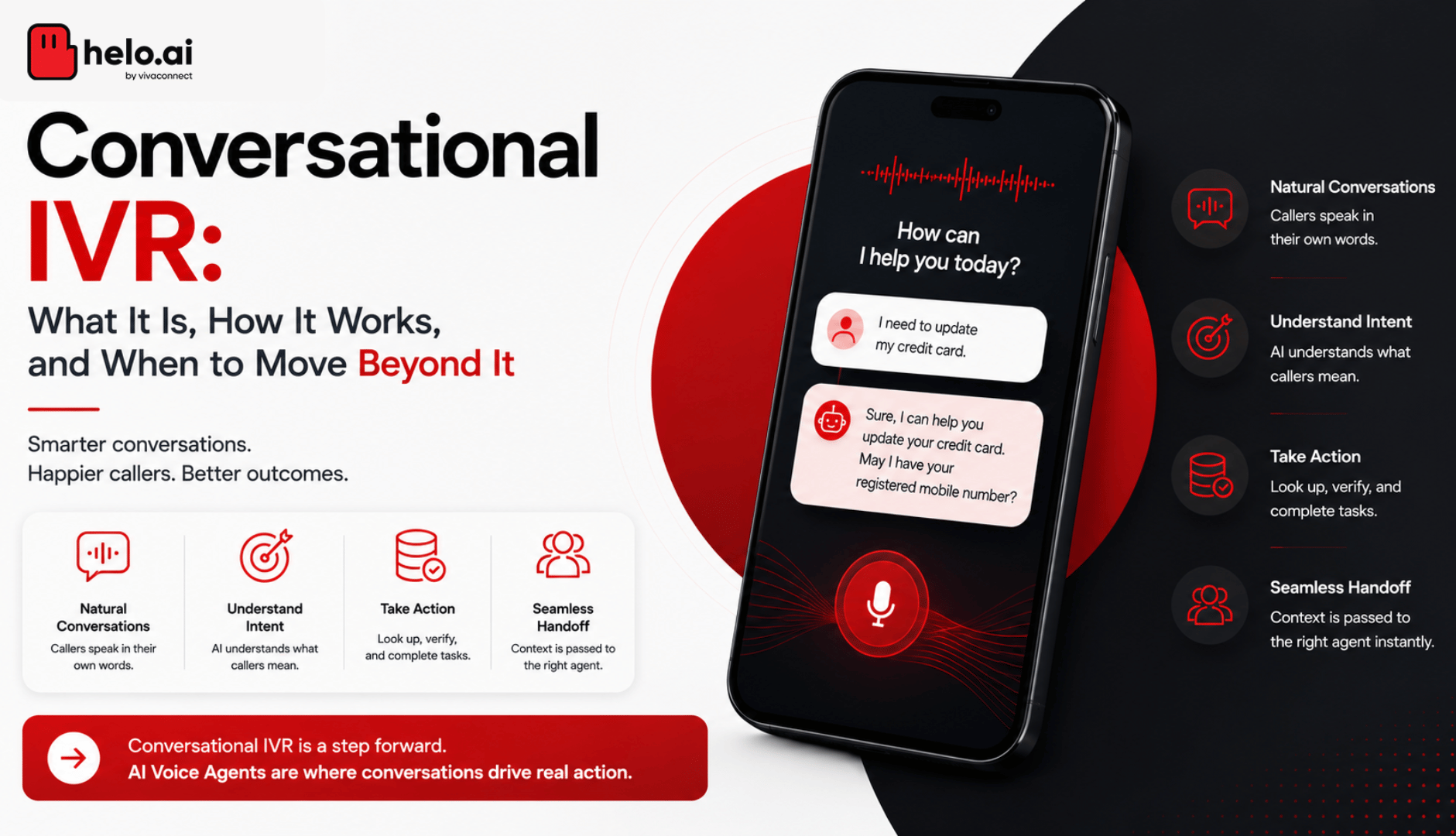


Conversational IVR is a phone system that lets callers say what they need instead of pressing buttons. It uses speech recognition and natural language understanding to identify intent, then resolves the request or transfers the call with full context.
That is the definition. The useful question is where it stops.
Conversational IVR beats a button menu. Most contact centres running a deep touch-tone tree would benefit from it. But it has a ceiling that vendor pages rarely name.
The ceiling is action.
Conversational IVR changes how a caller tells you what they want. It does not always change what you can do about it. A caller can say "transfer ₹5,000 to my savings" in perfect English and still get handed to an agent. Understanding a sentence and executing a transfer are different engineering problems.
What Is Conversational IVR?
Conversational IVR accepts natural speech instead of keypad presses. Rather than "press 1 for billing," it asks "how can I help you today?" and interprets the answer.
Three parts make it work:
- Speech recognition turns audio into text
- Natural language understanding maps that text to an intent
- Response generation replies, asks a follow-up, or routes the call
Good NLU generalises. "My bill looks wrong," "I've been charged twice" and "there's a mistake on my statement" all hit the same billing-dispute intent.
Conversational IVR vs Conversational AI vs AI Voice Agents
These three get used as synonyms in sales calls. They are not. Confusing them is how teams buy speech when they needed execution.
What it is | Can it act? | |
|---|---|---|
Conversational IVR | An IVR that takes speech instead of keypresses | Reads from your systems. Rarely writes |
Conversational AI | The umbrella tech category, across chat and voice | Depends entirely on integration |
AI voice agent | Speech input plus execution | Writes to your systems mid-call |
The difference is not speech. It is whether the system can change the state of your business.
A test for vendor demos: ask what is different in your database after the call ends. If the answer is "a transcript and a log entry," that is conversational IVR — whatever the slide says.
More on where each fits in our guide to IVR with AI, and how we draw the line in what Helo Voice is.
How Does Conversational IVR Work?
A call runs through seven stages. Each adds latency. Each can fail on its own and a failure at stage 3 looks identical to a failure at stage 4 from the caller's side.
# | Stage | What happens | Main risk |
|---|---|---|---|
1 | Call arrives | Answers over SIP/PSTN, plays an open greeting | Long branded intros delay the caller's first turn |
2 | Caller speaks | States their need in their own words | Real phrasing differs from what product teams predict |
3 | Speech recognition | Transcribes audio to text | Errors here are inherited silently by every later stage |
4 | Intent recognition | Maps the transcript to an intent | Over-confident guessing instead of admitting uncertainty |
5 | Response + TTS | Replies or asks a clarifying question | Skipping clarification to seem fast |
6 | Action or routing | Resolves, or transfers to the right queue | This is where the ceiling sits |
7 | Context handoff | Pushes transcript and intent to the agent | Most commonly skipped. Destroys most of the value |
Three stages deserve more than a table row.
Stage 3 Is Unforgiving
Everything downstream runs on the transcript. If recognition mishears, the system does not know. It confidently acts on the wrong words.
Ask vendors for word error rate on audio that resembles your callers — not a clean benchmark dataset. Your callers are on a mobile, in traffic.
Stage 4 Fails by Guessing
The dangerous failure is not misclassification. It is over-confidence: mapping an unfamiliar request onto the nearest known intent instead of admitting it does not know.
That produces a confidently wrong call. For the caller, that is worse than an honest "sorry, I didn't catch that."
Stage 7 Is the One Teams Skip
A caller who explains their problem to the system, then explains it again to a human, got a slower version of the old IVR.
Context handoff needs CTI integration — the least glamorous part of the project, and the first thing deferred past launch.
The Latency Budget
Human turn-taking is fast. Everyday conversation runs on gaps of roughly 200 milliseconds. Listeners predict the end of your sentence rather than waiting for it.
Systems that take a second or more break that expectation. Callers repeat themselves, talk over the reply, or assume the call dropped.
The budget is cumulative: telephony leg, ASR, NLU, backend lookup, response generation, TTS, return leg. The slow component is usually a backend API, not the AI model. So the fix is normally an integration change. Our breakdown of AI voice agent latency shows where the milliseconds go.
Conversational IVR vs Traditional IVR
Dimension | Traditional IVR | Conversational IVR |
|---|---|---|
Caller input | Keypad digits, fixed tree | Spoken language, any phrasing |
Finding the path | Caller translates their problem into your categories | System maps their words to an intent |
Ambiguous requests | No mechanism. Caller guesses or zeroes out | Asks a clarifying question |
Multi-part requests | One intent per interaction | Multi-turn within one call |
Personalisation | Same menu for everyone | Branches on CRM data |
When it fails | Repeats the menu, then loops or transfers | Can detect low confidence and escalate |
Handoff | Blind transfer. Caller re-explains | Transcript and intent travel with the call |
Changing it | Re-record prompts, rebuild the tree | Update intent models and content |
Cost per call | Very low | Higher — ASR, NLU and TTS on every turn |
Two rows carry most of the value.
"When it fails" is where menus do real damage. A menu that lacks the caller's problem offers no recovery. They pick the closest wrong option or escape to an agent.
A conversational system can notice its own low confidence and escalate. But only if you configured it to escalate instead of guess. That is a design decision, not a free feature.
"Handoff" is where the measurable win shows up. Context-rich transfer removes the repeat-yourself moment and shortens agent handle time.
Note the last row. Conversational IVR costs more per call. That is fine where it resolves or shortens calls. It is waste on a path a two-option menu already handled.
Conversational IVR Examples by Industry
It works best where intent fits in one spoken sentence and a defined workflow can serve it.
Banking — balance enquiries. "What's my current balance?" Authenticate, retrieve, speak it back. Reliable because the vocabulary is small and the action is a read.
Insurance — first notice of loss. "Someone hit my car, I need to file a claim." The caller is describing an event. Describing an event into a menu is impossible.
Healthcare — rescheduling. "I need to move my Thursday appointment." Note this needs a write — which is exactly where many deployments stop and hand off.
Telecom — service status. "My internet has been down since last night." Matches the address to a known incident, gives a restoration estimate. Deflects a volume spike when the queue is longest.
E-commerce — order status. "Where's my order?" The highest-volume, lowest-complexity intent in most retail centres, and usually the right place to start. See deflecting WISMO calls with voice AI.
Utilities — outage reporting. "I want to report a power cut." Captures the address, checks if it is already logged.
Travel — itinerary changes. "Change my flight to Thursday." Easy to say, hard to execute. A genuine test of whether a system understands or acts.
The common thread: a statable intent with a defined workflow behind it.
Where it struggles: requests that fit no predefined intent, and resolutions needing several systems updated in sequence.
Conversational IVR Benefits
How much you gain depends on what you have now. Replacing a five-level tree delivers far more than replacing a clean two-option menu.
- Callers skip the tree. The saving is not faster navigation — it is no navigation.
- Higher self-service completion, provided the backend can finish the task.
- Fewer mis-routes. Intent recognition beats asking callers to guess your department names.
- Context-rich handoff. Agents start informed. Handle time drops.
- Recovery from ambiguity. The system can ask. A menu structurally cannot.
- Multilingual on one system, with the India caveat below.
- Changes ship without re-recording, so the system stays current instead of drifting.
The Honest Counterweight
Conversational IVR increases variance.
A menu behaves identically for everyone. A speech system performs differently across accents, line quality, background noise and phrasing.
Average performance can improve while a specific caller segment gets worse service than before. That is why the next section insists on per-segment reporting.
How to Measure Conversational IVR Performance
Most vendor reporting leads with containment rate.
Containment counts every call that did not reach an agent. A caller who gave up and hung up is counted as a success. It is a capacity metric wearing a quality metric's clothes, and it rises when you make the system harder to escape.
Track these instead:
Metric | What it catches |
|---|---|
Self-service completion | Tasks actually finished, confirmed by the backend — not by the system announcing success |
Zero-out rate, before vs after | Whether the new system earned trust. If it does not fall, callers concluded it cannot help |
Intent accuracy, per intent | A strong blended figure hides a badly served minority |
Mis-route rate | An intent taxonomy that mirrors your org chart instead of your callers' problems |
Repeat calls within 48h | The system completed the conversation without completing the task |
The single most important reading: containment and repeat-call rate rising together. That is deflection, not resolution.
Formulas, action thresholds, and why published benchmarks disagree by seventy points are in our IVR metrics guide.
Conversational IVR for Indian Contact Centres
Global coverage assumes one language per call, usually English. That assumption fails here — cheaply testable, expensively discovered after launch.
Speech Recognition Across Indian Languages
ASR trained on American or British English degrades on Indian English. It degrades further on Hindi and regional languages.
A system that demos flawlessly can misrecognise a meaningful share of your actual callers.
- Test on recordings of your own callers. Vendors quote accuracy on clean audio.
- Measure word error rate per language, never blended. A strong English number hides a weak Tamil one.
- Start with English and Hindi. Add regional languages by measured call volume.
- A badly tuned regional language is worse than none. The caller already invested trust before you failed them.
Code-Mixing Is the Real Test
Indian callers switch language inside a sentence — "mujhe apna order status check karna hai" — with no pause or signal.
Most platforms are built around one language per session and degrade when it happens.
This is the largest gap between what a global vendor demos and what an Indian deployment needs. It is also the easiest thing to test, and the thing most often left untested.
Two rules:
- Track intent accuracy separately for monolingual and code-mixed turns. Code-mixed calls are often a minority of volume and a majority of the frustration.
- Where code-mixed accuracy is weak, keep DTMF as an announced fallback — not a hidden one.
More in our guide to multilingual AI voice agents for pan-India businesses.
Language Selection Must Persist
If a caller picks Hindi and reaches an English-speaking agent, the language menu was decoration.
Track the share of calls where IVR language does not match the answering agent's language. This is almost always an ACD skill-routing defect, not an IVR defect. Teams routinely misdiagnose it and rewrite prompts that were never the problem.
DLT Compliance for Outbound
If the same platform triggers outbound calls, DLT registration applies: registered templates, consent on file, DND scrubbing before dialling.
One correction worth stating plainly. Transactional and service calls originate from the 1600 series — not a "160 series." Promotional calling uses the 140 series. Sending service traffic on a promotional series exposes it to DND filtering and to the caller assuming it is spam.
We run DLT management as a managed service for exactly this reason.
When to Replace Conversational IVR With an AI Voice Agent
Conversational IVR improves how callers express themselves. It does not always improve what happens next.
When those diverge, callers notice. A system that clearly understood them and still could not help feels like a refusal, not a limitation.
Two Calls That Show the Difference
"Check my balance and move ₹5,000 into savings."
- Conversational IVR: reads the balance, transfers for the transfer. One request, fully understood, half served.
- AI voice agent: reads the balance, executes the transfer, writes the record, confirms both.
"Reschedule Thursday's appointment and change my phone number."
- Conversational IVR: reschedules, hands off for the number change — that is a CRM write.
- AI voice agent: does both, confirms both.
In each case the difference lands at stage 6. Understanding was never the bottleneck.
Five Signals the Ceiling Has Been Reached
- Abandonment on multi-step tasks. High intent accuracy alongside low completion on the same path. Comprehension works, execution does not.
- Callers stating several intents at once. "Check my balance and pay my bill and update my address." Serving one teaches them the system is unreliable for anything compound.
- Repeat calls after apparent success. The system said the right thing and did nothing.
- Agents doing work the system understood. Address changes and balance transfers still reaching humans after correct identification. Every one is an execution gap.
- Zero-out rate stays high after launch. The most telling signal. Callers learned it understands them and still cannot help. No amount of NLU tuning moves this.
Three or more on one path means that path needs execution, not better speech. See our comparison of an AI voice answering desk versus traditional IVR.
How to Implement Conversational IVR
Decide Path by Path
The common mistake is treating this as a platform swap. Different paths in the same IVR need different answers. Some should be left alone.
Path type | The move | Why |
|---|---|---|
Language selection | Keep as DTMF | Two or three fixed options. Speech adds latency and error |
PIN and card entry | Keep as DTMF | Safer and faster. Nobody should read a card number aloud in public |
Intent routing | Convert | Highest return available. Replaces the caller's guess about your org chart |
Simple read-only lookups | Convert if the menu underperforms | If the existing path completes well, converting buys little |
Multi-step transactions | Needs an AI voice agent | Conversational IVR will understand, then hand off |
Open-ended support | Convert, expect handoffs | Speech captures the request. Resolution often still needs a human |
Catch-all "anything else" | Convert first | Where zero-outs and mis-routes concentrate. Highest yield in most centres |
The strongest architecture is mixed. Keep DTMF for authentication and language. Use speech for routing and the catch-all. Use genuine agent capability for transactions.
A system that converts everything is as badly designed as one that converts nothing.
The Eight-Step Rollout
1. Audit against call data. Ninety days. Zero-out by level, drop-off by level, mis-route rate, completion —per path, not centre averages. Averages hide the two broken paths causing most complaints. Method in our IVR audit guide.
2. Rank call reasons by volume. The top three to five are your only sensible first candidates.
3. Pick one high-volume, simple intent. Order status, balance, appointment confirmation. Not the interesting edge case. Release one exists to prove the pipeline and expose integration problems.
4. Train on real transcripts. Actual recordings, not workshop guesses. Callers phrase things product teams reliably fail to predict.
5. Write the happy path like an experienced agent talks. Short turns. No corporate register. One question at a time. If a good agent would not say it aloud, cut it. Wording detail in our IVR script examples.
6. Design failure before launch. No-match, low confidence, backend timeout, silence, interruption. Set an explicit rule: two failed attempts, then a human. Systems that keep retrying turn a recoverable moment into an abandoned call.
7. Pilot on a traffic split. Compare against that path's own history, not a benchmark. Listen to real recordings daily for two weeks — week-one defects rarely show up in aggregate metrics.
8. Measure and retrain monthly. Completion, zero-out, intent accuracy, 48-hour repeat calls. Systems degrade quietly as products and policies change around them.
That path-by-path model is how Helo Voice is built to deploy: one agent across inbound support, outbound, qualification, collections and bookings — converting what the audit says to convert, leaving working menus alone.
The Bottom Line on Conversational IVR
Conversational IVR is a step, not a destination. For most centres still running a deep touch-tone tree, it is the right next step.
If your callers are lost in menus, speech helps. Navigation disappears. Mis-routes fall. Agents get context instead of a cold transfer.
But if your callers need things done rather than said, you will hit the ceiling — and you will hit it in a recognisable way. The system understands perfectly, says something reasonable, and passes the caller to a human to do the thing it could not.
So the question is not "should we upgrade to conversational IVR?"
It is: which of our paths need speech, which need action, and which are already fine as menus?
Three different answers, applying to different parts of the same system. Your call data already contains all three.
Evaluate Your IVR for Conversational AI
Send us ninety days of call data. We will map every path into keep, augment or replace, with the metrics behind each verdict.
You will know which paths are ready for conversational IVR, which need a full AI voice agent, and which should stay exactly as they are.
No obligation. You keep the analysis either way.
Frequently Asked Questions
What is conversational IVR?
Conversational IVR is a phone system that lets callers speak their request instead of navigating a touch-tone menu. It uses speech recognition and natural language understanding to identify intent, asks a clarifying question when a request is ambiguous, then resolves it or transfers the call with context attached.
How does conversational IVR work?
It runs each call through seven stages: greeting, caller speech, speech recognition, intent recognition, response generation, action or routing, and context handoff to the agent. Each stage adds latency. Errors at the transcription stage are inherited silently by everything after it.
What is the difference between conversational IVR and traditional IVR?
Traditional IVR takes keypad input on a fixed tree. Conversational IVR takes natural speech and maps it to intent. The two differences that matter most are failure handling — a menu cannot recover from a request it does not contain, while a conversational system can ask a clarifying question — and handoff, where the transcript and identified intent travel with the call instead of a blind transfer.
Is conversational IVR the same as an AI voice agent?
Not quite, and the gap matters. Conversational IVR generally reads from your systems and routes with context. An AI voice agent also writes to them, completing payments, rebooking appointments and updating records during the call. The test: has anything in your systems of record changed after the call ends?
What are examples of conversational IVR?
Balance enquiries in banking, first notice of loss in insurance, appointment rescheduling in healthcare, outage status in telecom, order tracking in e-commerce, outage reporting in utilities, and itinerary changes in travel. They share one property: the caller can state the intent in a single sentence and a defined workflow can serve it.
Does conversational IVR work for Indian languages?
It can, but accuracy varies sharply by vendor for Hindi and regional languages, since most speech models are trained mainly on Western English. The specific thing to test is code-mixing, where callers switch language mid-sentence, because most global platforms handle one language per call. Test on recordings of your own callers and measure word error rate per language rather than blended.
When should you keep traditional IVR instead of conversational IVR?
For short, deterministic, security-sensitive tasks: language selection, PIN entry and card capture. Keypad input is faster and safer, and no caller should read a card number aloud in public. Converting a two-option menu that already works adds cost and latency for no benefit.
How do you measure conversational IVR success?
Track self-service completion rather than containment, because containment counts callers who gave up as successes. Add zero-out rate against the pre-launch baseline, intent accuracy per intent, mis-route rate, and 48-hour repeat-call rate. Containment and repeat calls rising together is the signature of deflection rather than resolution.
Why does latency matter in conversational IVR?
Natural conversation runs on very short gaps between turns, typically around 200 milliseconds. When a system takes a second or more, callers assume the line dropped, repeat themselves, or talk over the reply. The delay is cumulative across telephony, transcription, intent recognition, backend lookups and speech synthesis — and the slowest part is usually a backend API, not the AI model.
How long does conversational IVR take to implement?
A single high-volume intent on a platform with existing integrations can go live in days. A full rollout across multiple intents, languages and backend systems runs weeks to months. The long pole is almost always integration and CTI work, not conversational design.
Does conversational IVR replace contact centre agents?
No. It changes what reaches them. Routine read-only requests get resolved before the queue, and calls that do arrive come with context, which shortens handle time. What remains is the complex, ambiguous and emotionally weighted work — where human judgement is worth paying for.