.jpeg)
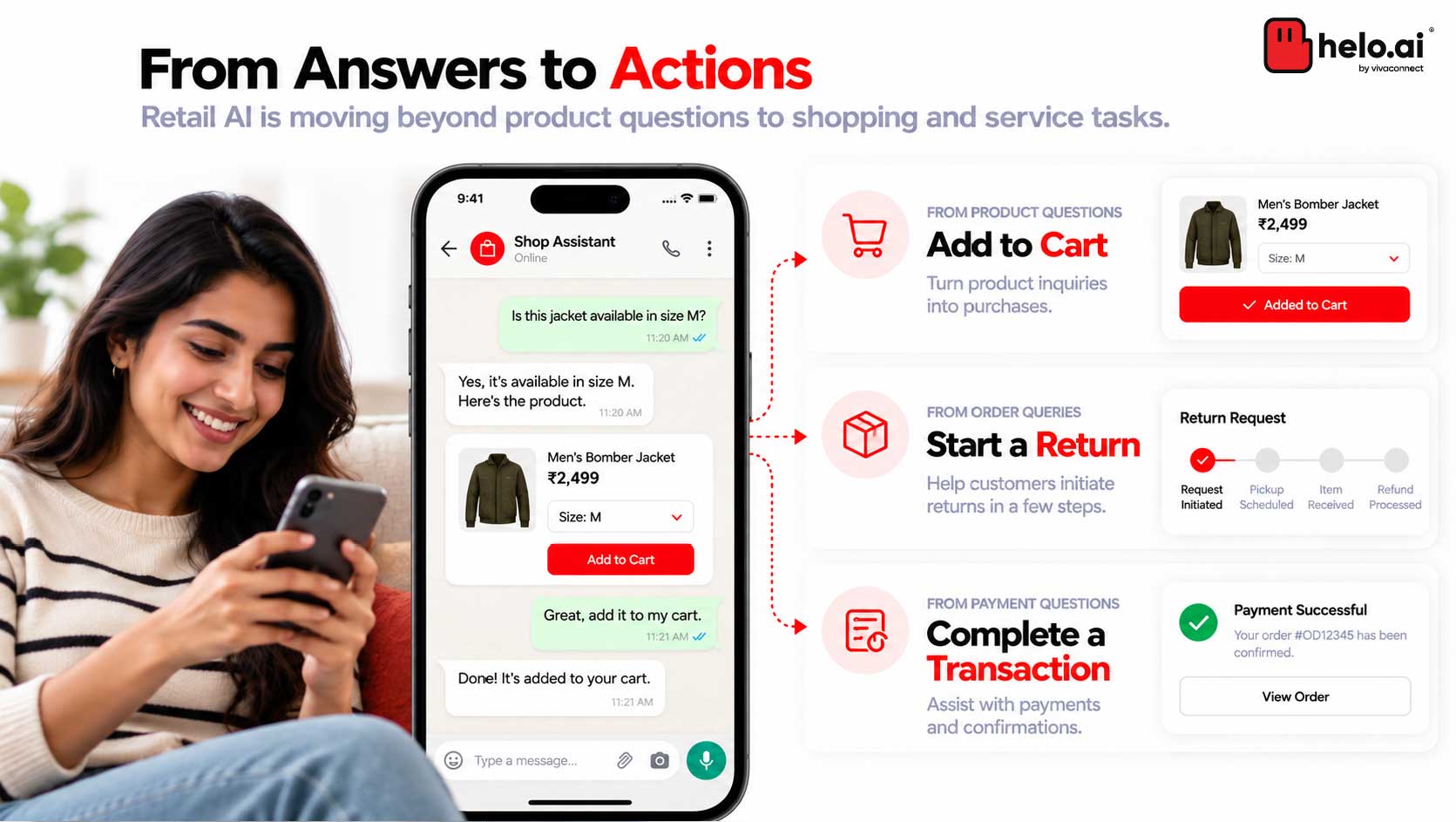


A customer asks an AI assistant to find a product. The assistant compares options, explains the differences and recommends what to buy. Useful, certainly. But the customer still needs to complete the purchase.
Now imagine the assistant can add the right items to a cart, place an authorised order, check an existing purchase or help initiate a return. The conversation is no longer just about providing information. It is helping complete a task.
Retailers are beginning to explore this shift from conversational AI to AI that can act within shopping and customer-service workflows. But how much progress have they made, and what does the available evidence actually tell us?
Examples from Amazon, Walmart, Klarna and Nykaa illustrate different stages of this change. Their published figures measure different things, from shopping-assistant usage to customer-service chat handling. Understanding those differences matters as much as the technology itself.
1. What the available data tells us
Before comparing individual companies, it helps to look at what they have actually reported.
Company | Reported evidence | What it measures | What it does not establish |
Amazon | More than 250 million customers used Rufus during 2025, according to an Amazon Web Services article published in November 2025 | Shopping-assistant adoption | The number of purchases completed autonomously |
Klarna | Its AI assistant handled 80% of customer-service chats during 2025, according to its annual report | Share of customer-service chats handled by AI | The percentage of all service requests fully resolved without human intervention |
Nykaa | Approximately 1.6 million unique conversations in the first 30 days, according to an IndiaAI case study published in September 2021 | Conversation volume during an automation deployment | The number of refunds, returns or other requests fully completed by AI |
Walmart | Announced Agent Profiles and an Agent Gateway in October 2026, with some components planned or entering beta | Development of infrastructure for AI-led shopping | Broad availability or the number of transactions already completed through these features |
These measures cannot be ranked against one another. They represent different outcomes, were reported in different periods and come from different types of sources.
Still, they reveal a useful distinction: adoption, conversations handled and transactions completed are three different measures of progress.
Sources: Amazon Web Services, Klarna's 2025 annual report, IndiaAI's Nykaa case study and Walmart's announcement.
2. Amazon: moving shopping assistance towards purchase actions
Amazon's shopping assistant demonstrates how conversational product discovery can be connected to actions within the shopping experience.
In an article published on 20 November 2025, Amazon Web Services reported that more than 250 million customers had used Rufus during 2025. It also said customers who used the assistant during a shopping journey were 60% more likely to complete a purchase.
Amazon has described capabilities that include searching for products based on a customer's needs, adding items to a cart, reordering products and automatically purchasing eligible items at a set price. Auto-buy is for Prime members, who can cancel within 24 hours.
The company subsequently renamed Rufus Alexa for Shopping on 13 May 2026, so that is the current name to use when referring to the shopping experience.
Sources: Amazon Web Services: How Rufus scaled conversational shopping and Amazon's shopping-assistant feature update.
The data needs careful interpretation. The 250 million figure measures customers who used the assistant, not customers who completed an AI-led transaction. The 60% figure is a company-reported comparison between customers who used the assistant and those who did not; it does not independently establish that the assistant caused the difference.
What this demonstrates: shopping assistants can be designed to support actions as well as recommendations. However, adoption and purchase likelihood are not substitutes for a measured rate of successful, autonomous transaction completion.
3. Walmart: building the infrastructure for AI-led shopping
Walmart's approach addresses a different part of the problem: how external AI agents can interact with a retailer's commerce systems.
On 21 October 2026, Walmart announced Agent Profiles, the Walmart Agent Gateway and new terms governing AI agents. The initiatives are intended to help authorised agents shop on behalf of customers while keeping customers in control. By default, customers must approve agent purchases.
According to Walmart's announcement, Agent Profiles are designed to provide visibility into agent-made purchases and support customer-defined approval preferences and spending limits. The Agent Gateway is intended to give agents a more reliable way to interact with Walmart's systems.
The announcement described Agent Profiles as launching in the following month and the gateway as beginning with a beta for companies and developers. Those details matter: an announcement of planned or beta-stage infrastructure is not proof that a capability is already available to every shopper.
What this demonstrates: enabling AI to transact requires more than a conversational interface. Retailers need ways to authenticate agents, apply customer permissions and control how actions are executed within their systems.
The evidence here is about infrastructure and planned capabilities, rather than a published measure of completed agent-led purchases.
4. Klarna: using AI for customer-service work
Shopping continues after checkout. Customers may need to check a payment, understand an order, manage a return or request a refund.
Klarna's AI assistant, launched with OpenAI in February 2024, was designed to handle customer-service tasks as well as shopping and payment queries.
In its 2025 annual report, Klarna reported that its assistant handled 80% of customer-service chats during the year, based on internal service chat logs. The company also said internal satisfaction surveys showed no drop in consumer satisfaction levels since the assistant's introduction.
Klarna describes the assistant as managing tasks that include customer service, refunds and returns. However, the 80% figure measures the share of chats handled by AI. It does not mean that 80% of all refund and return requests were completed autonomously.
This distinction is important because a service conversation can involve several steps: retrieving an order, checking eligibility, explaining a policy, requesting additional information and executing an action. An assistant may handle some of these steps while still relying on a human or another system to complete the process.
What this demonstrates: customer-service automation can be measured through workload handled, but businesses should separately measure successful resolution, repeat contacts, escalation and whether the requested action was actually completed.
5. Nykaa: automating high-volume e-commerce support
Nykaa provides an Indian example of AI being applied to repetitive customer-service interactions.
An IndiaAI case study describes Nykaa's work with Verloop.io to automate routine support conversations. The documented use cases included cancellations, returns, shipping enquiries, replacements, refunds and payment issues. The case study is dated 12 September 2021, so its figures are older than the others in this article.
The case study reports approximately 1.6 million unique conversations in the first 30 days and says more than 90% of customers participating in the relevant conversations rated the bot favourably or as excellent.
These are case-study figures, not independently audited industry benchmarks. Conversation volume shows the scale of interactions handled, while customer ratings indicate reported sentiment among the participating users. Neither figure, by itself, establishes the percentage of service requests completed end-to-end without human assistance.
The example nevertheless highlights an important operational opportunity. When a customer asks about an existing order, a useful service experience should do more than repeat a policy. It should help the customer make progress towards a resolution, using the relevant order information and escalation path.
What this demonstrates: automating common service conversations can support high volumes of customer interactions. To understand the actual business outcome, retailers need separate reporting on task completion, accuracy, escalation and repeat contact.
6. The metrics retailers should look beyond
The examples show why a single adoption or activity metric cannot describe how effectively AI is completing work.
A retailer evaluating its own AI implementation should distinguish between the following measures.
Metric | What it tells the business | Why it matters |
Assistant adoption | How many customers use the assistant | Indicates reach, not task completion |
Conversations handled | How much customer interaction AI manages | Shows workload handled, not necessarily resolution |
Task completion rate | How often the requested action is completed successfully | Directly measures the intended outcome |
First-contact resolution | How often a request is resolved without requiring another contact | Helps identify whether the customer actually received a resolution |
Human escalation rate | How often a person needs to take over | Helps identify gaps in automation or policy coverage |
Repeat-contact rate | How often customers return about the same issue | Can indicate unresolved requests or unclear outcomes |
Error and reversal rate | How often actions are incorrect, cancelled or reversed | Helps measure the reliability and risk of execution |
These metrics need consistent definitions. For example, a completed return request may mean that the return has been authorised, while the physical return, refund and payment settlement may still be pending. Retailers should define exactly which event counts as completion for each workflow.
The same principle applies to purchases. Adding a product to a cart is not the same as placing an order, and placing an order is not necessarily the same as successful payment and fulfilment.
The most meaningful measure is the one that matches the customer's intended outcome.
Need metrics for AI-led customer conversations? The CPaaS KPI Handbook covers 50+ WhatsApp, SMS and RCS metrics, with formulas and worked examples.
7. What retailers need before AI can take action
A capable language model alone is not enough to execute a reliable retail workflow. The AI needs access to the right information, clear rules and an authorised way to perform the action.
Access to relevant systems
An assistant needs accurate information about orders, inventory, payments, shipping or return status to do more than provide general guidance. The systems it can access determine which tasks it can meaningfully support.
Clear permissions and business rules
Different actions carry different levels of risk. Adding an item to a cart, changing a delivery address and issuing a refund should not automatically be treated as equivalent. Each workflow needs appropriate eligibility checks, permissions and confirmation requirements.
Human handoff for exceptions
Disputed payments, suspected fraud, unusual refund requests and policy exceptions may require human review. Customers should be able to understand when an action is being taken, when they need to approve it and when a person is handling the case.
Outcome-based reporting
Retailers should measure whether tasks are completed correctly, how often intervention is required, whether the customer has to repeat the request and whether the action follows the applicable policy. These measures reveal more about operational performance than conversation volume alone.
The goal is not to automate every interaction. It is to automate appropriate tasks reliably while keeping customers informed and providing a clear path to human support when necessary.
What this means for conversational AI in retail
The examples from Amazon, Walmart, Klarna and Nykaa show different parts of the move from conversational assistance towards operational action. They do not establish that every retailer has reached fully autonomous commerce.
For businesses considering this shift, the next question is what happens after the AI understands the customer's request. Can it access the relevant systems? Can it follow the business rules? Can it perform the authorised action, confirm the result and hand off exceptions appropriately?
Helo Convo is positioned around building AI agents from prompts. For retail workflows involving orders, returns or payments, the specific integrations, permissions and execution capabilities would need to be validated against the business's requirements before making claims about end-to-end task completion.
Want to test a retail workflow with an AI agent? Helo Convo offers a free 30-minute working session where the team builds your use case live.
Ultimately, the strongest measure of retail AI is not how many conversations it can hold. It is whether it helps customers complete the task they came to do, accurately and with the right controls in place.
Frequently asked questions
What is the difference between a chatbot and an AI agent in retail?
A chatbot answers questions. An AI agent can act, such as adding items to a cart or checking an order, within the permissions and business rules a retailer sets.
Can AI agents handle returns and refunds?
Klarna says its assistant handled 80% of customer-service chats in 2025. That figure measures chats handled, not refunds or returns completed without a person.
How should retailers measure AI task completion?
Track task completion rate, first-contact resolution, human escalation, repeat contact and error or reversal rate. Define which event counts as completion for each workflow.