


⚠️ Beta Notice: The max-price feature and reach estimation tool described in this post are upcoming features, not yet available to all businesses. Meta has confirmed a Limited Beta starting mid-May 2026. Access to the beta requires acceptance of a separate testing agreement. Plans and timelines are subject to change. |
TL;DR
- WhatsApp has introduced a max-price feature that lets you control how much you pay per message
- This shifts WhatsApp from fixed pricing → performance-based marketing channel
- You can now optimise for cost, reach, and ROI like paid ads
- Early adopters will benefit from lower costs and better delivery
- To scale effectively, you need both strategy (pricing) and execution (right platform)
.png)
Quick Summary: Meta has introduced a max-price feature on the Marketing Messages API for WhatsApp (MM API for WhatsApp) that lets businesses set a per-message delivery price ceiling. This gives marketers direct control over spend, reach, and ROI for the first time on WhatsApp and it changes how you should plan campaigns from mid-May 2026 onwards.
What's in this post: What the MM API for WhatsApp is → What the max-price feature does → Reach estimation → Strategies → Rollout timeline → Implementation → FAQ
What Is the WhatsApp Marketing Messages API (MM API for WhatsApp)?
The Marketing Messages API for WhatsApp (MM API) is Meta's next-generation solution for businesses running outbound marketing campaigns on WhatsApp. Launched in 2025, it was built as a direct upgrade over the standard Cloud API — designed specifically for performance marketers who want better delivery, better measurement, and better creative output from their WhatsApp campaigns.
Unlike the Cloud API, the WhatsApp MM API includes:
- Automatic delivery optimisation — Meta's system prioritises message delivery to users most likely to engage
- Automatic creative optimisations (currently in testing) — applies treatments like image animation and filtering for more engaging messages
- Richer media formats — native GIF support as a standalone format option
- Time-to-live controls — prevent irrelevant delivery of time-sensitive messages after they expire
- Performance benchmarks — see how your message performed compared to similar businesses
- Tailored recommendations — actionable campaign improvement suggestions
Why Use a Platform Like Helo.ai?
While the Marketing Messages API introduces powerful new pricing and delivery controls, how you access and manage it makes a significant difference.
Using a WhatsApp API platform like Helo.ai removes the complexity of direct API integration and gives you access to:
- Faster setup without engineering dependency
- Built-in campaign tools (segmentation, automation, analytics)
- Better visibility into pricing, delivery, and performance
- Pre-built workflows to scale campaigns faster
Instead of just accessing the API, you get a system designed to maximise ROI from day one.
The New Pricing Features: Max-Price Explained
In 2026, Meta is adding a major new layer to the MM API: pricing control.
What is the max-price feature?
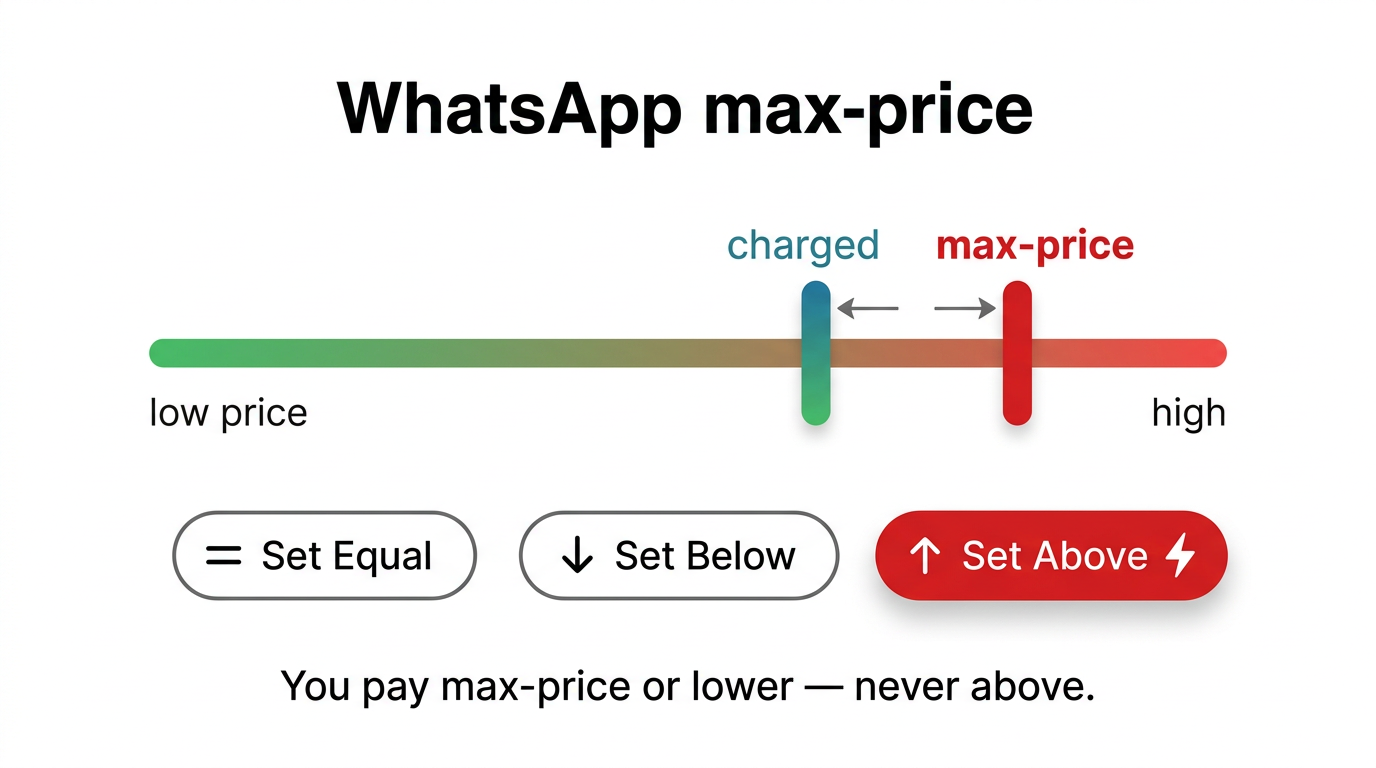
The max-price feature lets businesses set a maximum price per marketing message delivery on the WhatsApp MM API. When you set a max-price, your campaigns operate within that limit giving you control over costs while staying within your defined ceiling.
This is the first time WhatsApp has offered a cost-control mechanism for marketing message delivery. It moves the channel away from fixed published rates and toward a model where your budget ceiling directly influences reach and delivery prioritisation.
💡 Simple framing: You decide the maximum you're willing to pay per delivered message. Meta's system works within that limit to deliver as many messages as possible. |
⚠️ Availability note: The max-price feature is not available in Europe and certain other regions at launch. Availability may vary by geography and will expand over time.
What This Actually Means for Your Marketing ROI
At first glance, the max-price feature looks like a simple pricing update. In reality, it directly impacts how efficiently you acquire and engage customers on WhatsApp.
Here’s the business impact:
- Better Cost Control (Lower CAC)
You can now define how much you're willing to pay per message. This prevents overspending during high-demand periods and keeps your customer acquisition cost predictable.
- Smarter Budget Allocation
Instead of sending messages blindly, you can prioritise high-value campaigns—like abandoned cart recovery or reactivation—where ROI is higher.
- Improved Campaign Efficiency
With AI-led delivery optimisation, your messages are more likely to reach users who are active and responsive, improving open rates and conversions.
- Performance-Like Marketing on WhatsApp
WhatsApp is no longer just a communication channel—it’s evolving into a performance-driven marketing channel where cost, reach, and outcomes can be optimised.
In simple terms:
You’re moving from fixed-cost messaging to controlled, performance-oriented spending.
The Reach Estimation Tool
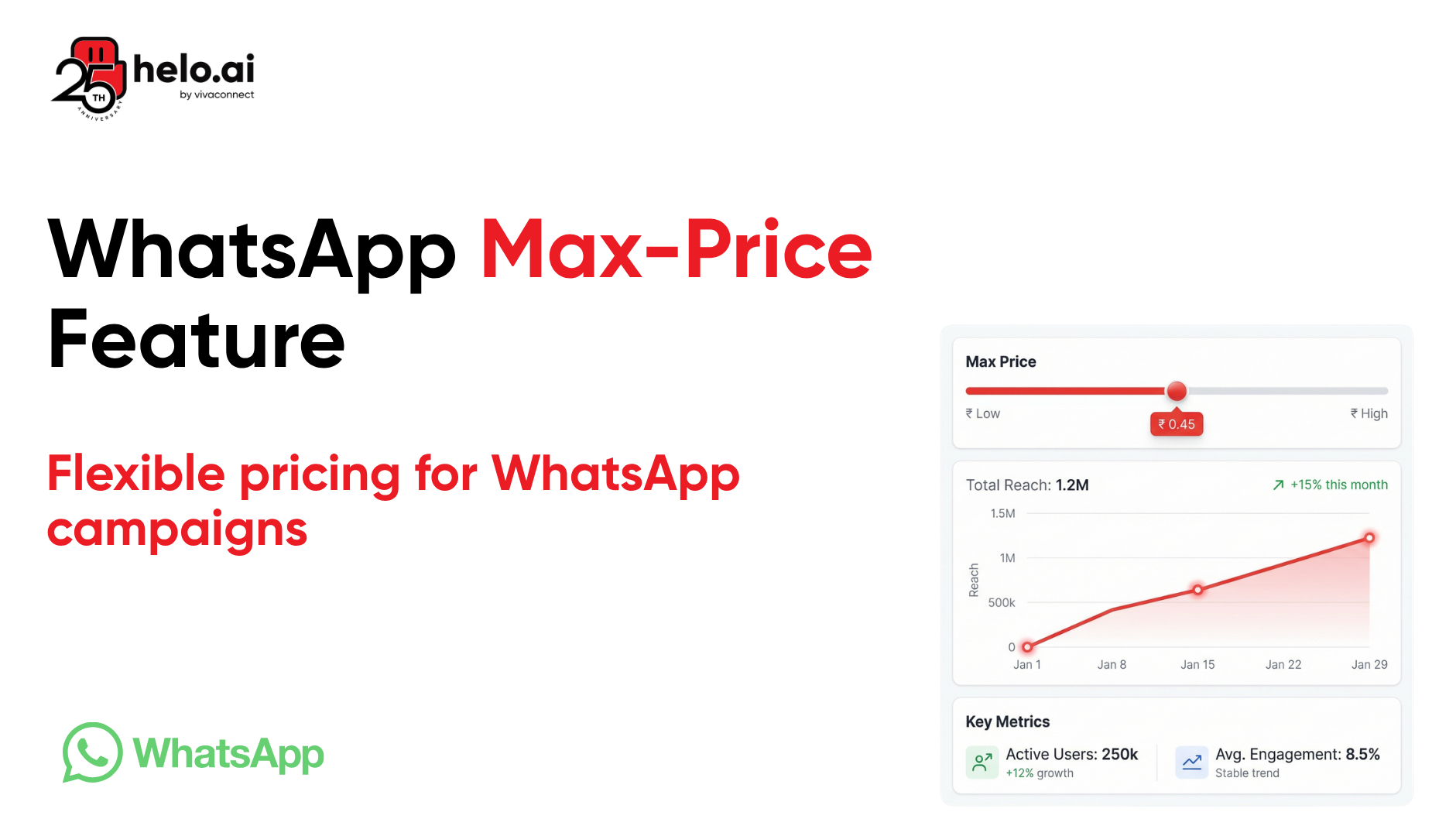
Alongside the max-price feature, Meta is introducing a reach estimation tool that shows you the projected delivery volume and estimated cost at different max-price settings — before you send.
This matters for campaign planning:
- Model budget-vs-reach trade-offs in advance
- Find the price point that hits your volume target without overspending
- Reduce guesswork during high-demand periods like festivals and seasonal sales
The reach estimation tool and the max-price feature are designed to be used together. Use the tool to model your price point, set your ceiling, and let MM API's delivery optimisation handle the rest.
Note: Specific details on how to access the reach estimation tool will be available when the Limited Beta launches in mid-May 2026. |
Three Ways to Use Max-Price Strategically
The max-price feature can be used in different ways depending on your campaign goals. Here are three practical approaches:
Strategy 1 — Lower costs, maintain delivery rates
How: Set max-price equal to published rates.
What happens: Meta charges that rate or lower. You maintain delivery performance comparable to current campaigns while potentially reducing your average per-message cost.
Best for: Always-on re-engagement campaigns, regular promotional sends, transactional follow-ups.
Strategy 2 — Reach a broader audience at lower cost
How: Set max-price below published rates.
What happens: You expand reach to a broader range of customer cohorts at reduced spend. There is a trade-off — some delivery performance is exchanged for cost efficiency.
Best for: Top-of-funnel campaigns, prospecting new segments, cost-sensitive sends.
Strategy 3 — Maximise delivery during peak periods
How: Set max-price above published rates.
What happens: Delivery is prioritised during high-competition windows — when more businesses are competing and per-user marketing template message limits are more likely to come into effect.
Best for: Festival campaigns, flash sales, product launches, end-of-year retention drives.
⚠️ Important context on Strategy 3: WhatsApp enforces per-user marketing template message limits to protect users from message fatigue. According to Meta's, setting a higher max-price is expected to be most relevant for businesses already impacted by these per-user limits, particularly during peak sales periods. |
.png)
Key Rollout Dates: Beta → Open Beta → GA
Here is the confirmed rollout timeline for the WhatsApp max-price feature and reach estimation tool based on the latest product updates:
Phase | Date | What You Can Do |
Limited Beta | Mid-May 2026 | → Available to selected partners
→ Feature testing and early performance validation |
Open Beta | October 2026 | Any partner can enable max-price for all their clients. |
General Availability (GA) | Q2 2027 | Max-price becomes required in eligible geographies. Fixed published rates will only apply on Cloud API from this point. |
Note: Businesses must accept a separate beta testing agreement to access these features during the Limited Beta phase. |
What Happens If You Don’t Adapt?
As WhatsApp shifts towards a dynamic pricing and optimisation model, staying on the old approach comes with hidden costs.
- Higher Messaging Costs Over Time
As more businesses adopt max-price strategies, competition for user attention will increase—driving up effective costs for those not optimising.
- Lower Delivery Priority
Messages without pricing signals may get deprioritised during peak sending windows, reducing reach and impact.
- Missed Early-Mover Advantage
Early adopters typically benefit from lower competition, better delivery rates, and more predictable performance.
- Inefficient Campaign Spending
Without cost controls and optimisation, budgets can get wasted on low-performing audiences or poor timing.
In short, continuing with a “set and forget” messaging strategy will make your campaigns less competitive in 2026.
Choosing the Right Setup Approach
There are two ways to get started with the WhatsApp Marketing Messages API:
Option 1: Direct Integration (Cloud API)
Best suited for teams with strong technical resources who can build and manage messaging infrastructure internally.
Option 2: Platform-Based Setup (e.g., Helo.ai)
Ideal for businesses that want to launch faster, optimise campaigns efficiently, and manage performance without engineering dependency.
With Helo.ai, you can:
- Set up and launch campaigns without complex development
- Apply pricing strategies like max-price with ease
- Monitor delivery, cost, and engagement in one place
- Scale campaigns faster with built-in automation
For most growing businesses, the platform approach reduces time, effort, and operational complexity significantly.
Ready to migrate to the WhatsApp MM API?
Helo.ai is a certified Meta Business Partner with 25 years of enterprise communication experience. We help businesses across BFSI, retail, and e-commerce onboard to, migrate to, and optimise their WhatsApp Business API campaigns.
Frequently Asked Questions
1. How does the max-price feature impact my marketing ROI?
The max-price feature gives you direct control over how much you spend per message. This helps reduce unnecessary costs, prioritise high-performing campaigns, and improve overall ROI by aligning spend with expected outcomes.
2. Should I increase my max-price to get better results?
Not always. A higher max-price can improve delivery during high-demand periods, but the right strategy depends on your campaign goal. For performance campaigns, it’s better to test and optimise pricing based on results rather than always increasing spend.
3. How should I decide the right max-price for my campaigns?
Start by defining your objective—cost efficiency, reach, or conversions. Use the reach estimation tool to model different price points, test across campaigns, and gradually optimise based on performance data.
4. Is WhatsApp now becoming a performance marketing channel?
Yes. With pricing control, delivery optimisation, and better measurement, WhatsApp is evolving from a communication tool into a performance-driven marketing channel similar to paid ads platforms.
5. How does this change my overall WhatsApp marketing strategy?
You need to move from a “send and forget” approach to a more structured strategy that includes pricing experiments, audience segmentation, and performance tracking.
6. Do I need a platform to manage this effectively?
While it’s possible to manage campaigns directly, most businesses benefit from using a platform to simplify execution, optimise pricing strategies, and track performance in one place—especially as campaigns scale.

.png&w=828&q=75)

-1.png&w=828&q=75)