.jpeg)


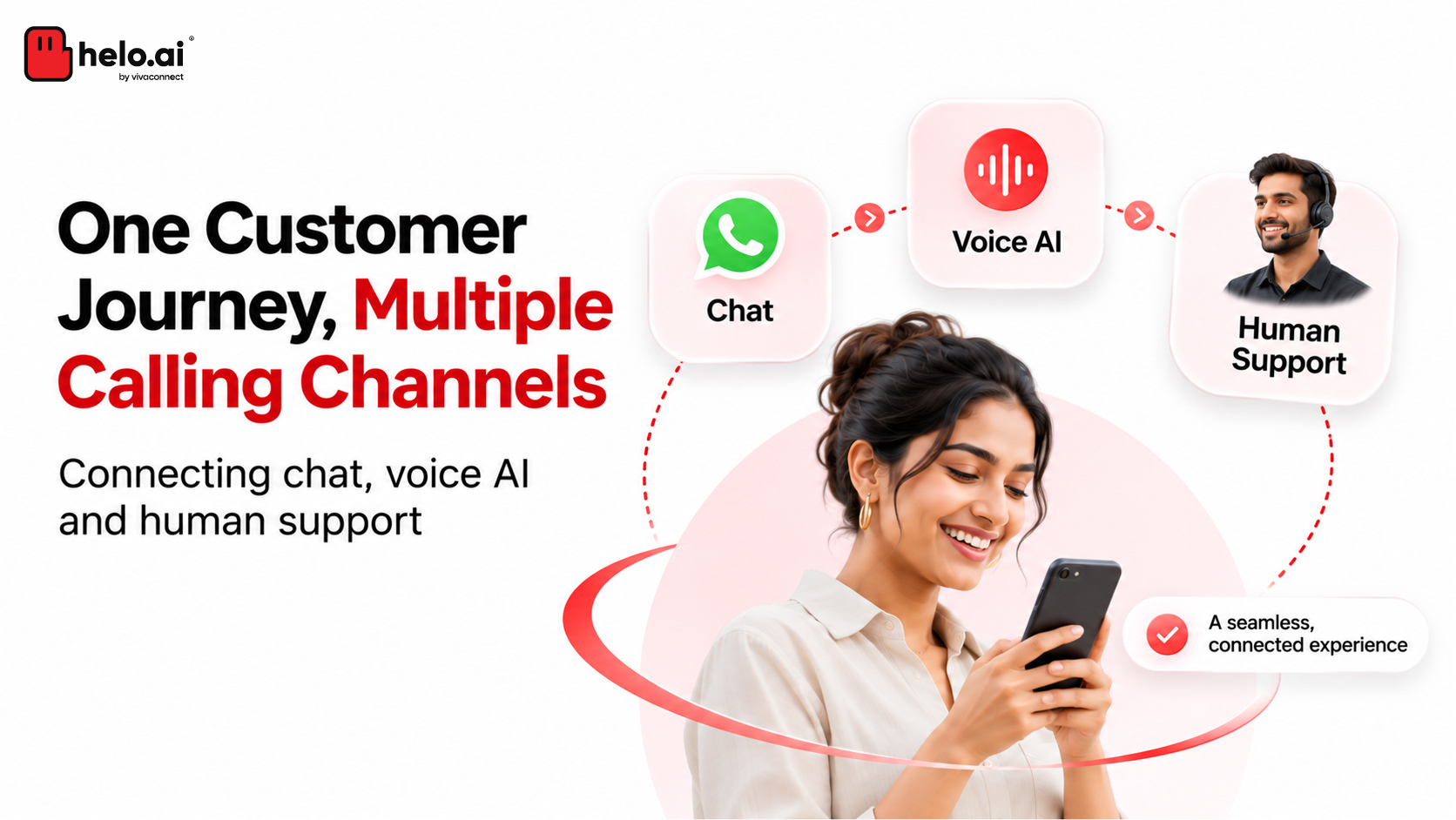
A customer starts a conversation with your business on WhatsApp. They have a question about a loan, an order or a service request. A few messages later, they want to speak to someone.
Another customer prefers calling your support number directly. Your internal team, meanwhile, needs a reliable way to communicate across offices and departments.
These interactions involve voice, but they do not necessarily need the same technology.
WhatsApp Business Calling, cloud telephony and Voice over Internet Protocol (VoIP) all support internet-based voice communication in some form. However, they differ in how customers connect, how businesses manage calls and what infrastructure is required.
For Indian businesses, choosing between them also involves practical considerations such as customer reach, call routing, integrations, costs and applicable telecom requirements.
This guide explains how each option works, where it fits and when a combination makes more sense.
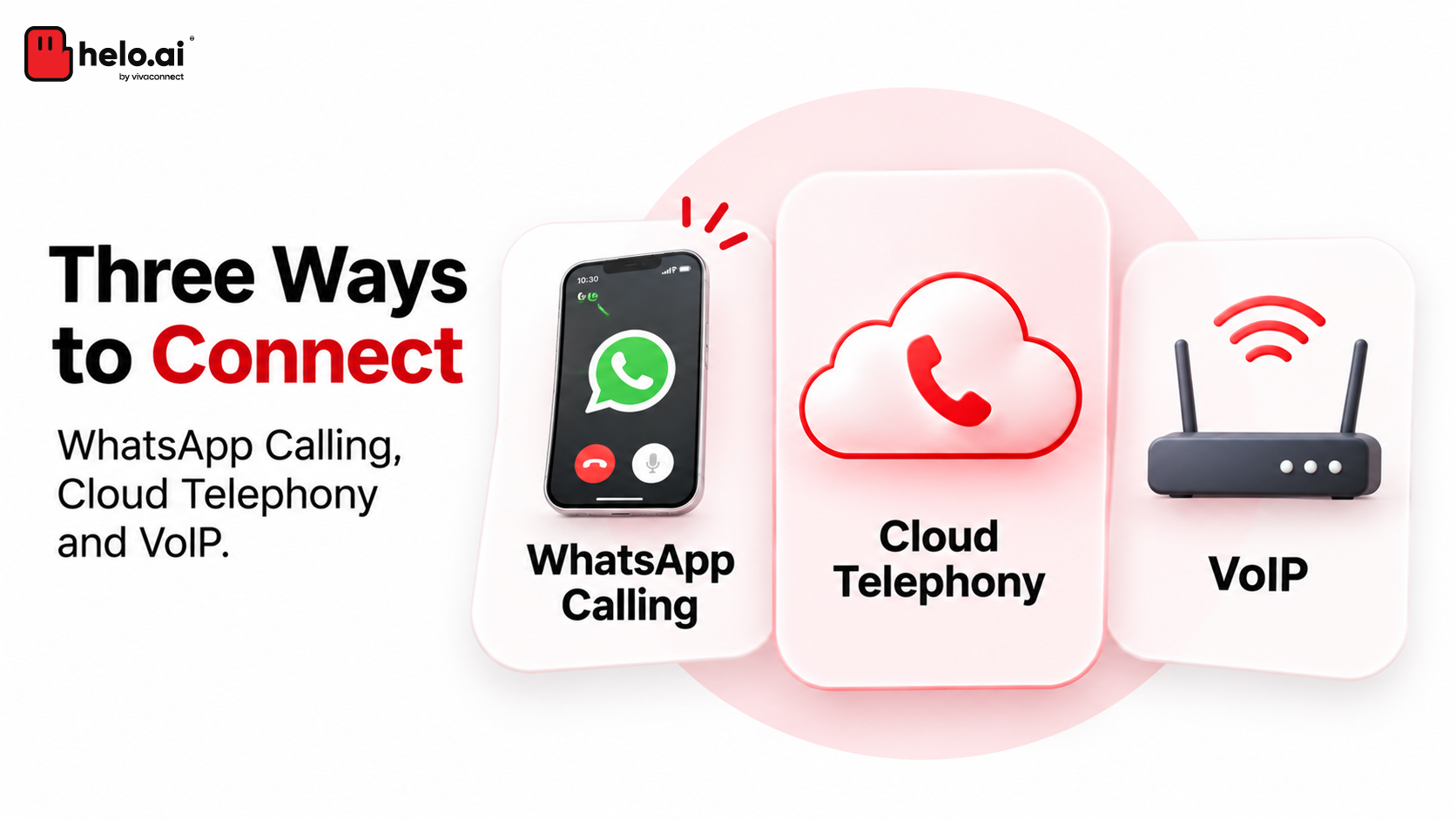
WhatsApp Business Calling adds voice to WhatsApp chats. Cloud telephony is a hosted business phone system, and VoIP is the technology that carries voice over IP networks. Choose by customer reach, call routing, integrations and cost, and combine them where needed.
WhatsApp Business Calling vs Cloud Telephony vs VoIP: Quick Comparison
| Factor | WhatsApp Business Calling | Cloud Telephony | VoIP |
|---|---|---|---|
| What it is | Voice calling within WhatsApp | A hosted business phone system | Technology for carrying voice over IP networks |
| Customer access | WhatsApp users | Regular phone numbers and supported endpoints | Depends on the connected network and setup |
| Calling | Inbound and business-initiated, subject to Meta permissions | Inbound and outbound, subject to provider and telecom arrangements | Depends on endpoints and telephony connectivity |
| Call management | Depends on the WhatsApp integration and connected platform | IVR, queues, routing and agent management, depending on provider | Requires a PBX, application or other call-management layer |
| Number requirements | WhatsApp Business phone number | Business numbers or other provider-supported numbers | IP endpoints, SIP identities or connected telephone numbers |
| Best suited for | WhatsApp-first customer conversations | Business support and contact-centre operations | Flexible IP-based voice connectivity |
| Main consideration | Meta eligibility and calling permissions | Provider capabilities and calling costs | Network quality, configuration and connectivity |
An important distinction: VoIP is the underlying technology, not always a separate product competing with cloud telephony. A cloud phone system can use VoIP internally, while WhatsApp Business Calling also carries voice over an internet connection within WhatsApp.
The more useful question is not which technology is universally better. It is which setup fits the way your customers and teams communicate.
What Is WhatsApp Business Calling?
WhatsApp Business Calling allows businesses to make and receive voice calls through the WhatsApp Business Platform.
It brings voice into a channel customers may already use to ask questions, request assistance or interact with a business.
For example, a customer enquiring about a personal loan may start by messaging a bank. If the customer needs a detailed explanation of eligibility or repayment options, the conversation can move to a WhatsApp voice call.
The customer does not need to switch to a separate phone application.
How does it work?
There are two main calling directions:
- Customer-initiated calls: A customer calls the business through WhatsApp. The business can receive the call through a supported WhatsApp Business Platform integration.
- Business-initiated calls: A business requests permission to call a WhatsApp user. The customer must grant the required permission before the business can place the call.
An inbound call or an existing messaging conversation should not be treated as unlimited permission for future outbound calls. Businesses must follow Meta's current calling permission, eligibility and usage rules.
Calling also needs to be enabled for the relevant WhatsApp Business phone number, and the business needs a compatible integration to manage call events and connect the interaction to its workflows.
Meta’s calling requirements: Per Meta’s documentation, the number must be on Cloud API rather than the WhatsApp Business app, with calling enabled and a daily messaging limit of at least 2,000 unique recipients. Business-initiated calling is unavailable for business numbers with US, Canada, Egypt, Vietnam or Nigeria country codes. India is not on that list.
How call permission works: Meta’s call permission rules allow one permission request per 24 hours and two per 7 days. A temporary permission lasts 7 days and a permanent one stays until the user revokes it. Four consecutive unanswered calls revoke a permission automatically.
Where does WhatsApp Business Calling work well?
- Banking: Discuss loan enquiries, account-related questions and service requests.
- Insurance: Help customers understand policy details, renewals and claim processes.
- E-commerce: Resolve order, return and payment-related queries.
- Healthcare: Handle appointment-related enquiries and consultations where appropriate.
- Sales: Speak to prospects who have already engaged with the business on WhatsApp.
What should businesses consider?
WhatsApp Business Calling is not a general-purpose telephone replacement.
It is designed for calls between WhatsApp users and businesses on the platform. It does not automatically let a business dial any mobile or landline number.
Businesses should also assess whether their chosen provider supports the required call handling, agent interface, reporting, customer context and integrations. These capabilities are not identical across all WhatsApp solution providers.
What Is Cloud Telephony?
Cloud telephony is a business phone system hosted by a service provider rather than maintained entirely through on-premises telephone infrastructure.
Employees can handle calls through supported desktop applications, web dashboards, mobile devices or connected contact-centre systems.
Depending on the provider, a cloud telephony platform may include:
- Inbound and outbound calling
- IVR and call menus
- Call queues and agent routing
- Business numbers and virtual numbers
- Call recording and reporting
- CRM and helpdesk integrations
- SIP connectivity
How does it work?
A customer calls a business number. The call reaches the provider's telephony infrastructure, where it can be routed to an IVR, a queue or an available agent.
For example, a bank may use cloud telephony to direct customers to different teams for card services, loan enquiries and account support.
The system can also connect to a CRM so agents can access relevant customer information while handling a call.
Where does cloud telephony work well?
- Customer support and service desks
- Banking and financial services contact centres
- Collections and payment follow-ups
- Sales and lead qualification
- Appointment confirmations
- Multi-location business operations
What should businesses consider?
Cloud telephony is a stronger fit when customers need to reach the business through regular telephone networks.
However, the features and costs vary by provider. A basic hosted phone system may not include advanced contact-centre capabilities such as skill-based routing, detailed agent reporting or workforce management.
Businesses should also check number availability, carrier connectivity, call recording policies, concurrency limits, integrations and support arrangements before choosing a provider.
What Is VoIP?
Voice over Internet Protocol, or VoIP, is a technology that carries voice communication over an IP network instead of relying entirely on traditional circuit-switched telephone connections.
It can support internal employee calls, SIP-based communication, internet calling applications and enterprise voice systems.
VoIP describes how voice travels. It does not, by itself, define the complete phone system or the features available to users.
Common VoIP setups
IP phones and softphones
Employees use IP desk phones or software-based phones on computers and mobile devices to communicate over an IP network.
SIP trunking
Session Initiation Protocol (SIP) connects a business's PBX or compatible voice platform to a telephony provider. It can link an existing phone system to external telephone networks through an appropriate provider.
Application-based calling
Businesses can add voice calling to websites, mobile applications or enterprise platforms using compatible voice technologies.
Where does VoIP work well?
- Internal communication across offices
- Distributed and remote teams
- SIP-connected contact centres
- Existing PBX infrastructure
- Voice-enabled applications
- Businesses that need flexible voice connectivity
What should businesses consider?
VoIP is not automatically a complete contact-centre solution. Businesses may still need a PBX, call-routing platform, carrier connectivity, monitoring tools and customer-management integrations.
Call quality depends on network conditions, configuration, endpoint quality, available bandwidth and the infrastructure carrying the call.
A further distinction matters for businesses in India: internet-based voice does not automatically mean every type of calling arrangement has the same regulatory treatment. The service being provided and the provider's role must be assessed separately.
The Key Differences That Matter When Choosing
Definitions explain what each technology is. Business requirements help determine which one to use.
Customer reach
WhatsApp Business Calling is suitable when customers already use WhatsApp and are comfortable speaking through it.
Cloud telephony supports calls through regular telephone networks, making it useful when a business needs to reach customers who may not use WhatsApp.
VoIP reach depends on the configuration. Internal IP calls may be limited to connected users, while SIP-connected systems can reach external telephone networks through an appropriate provider.
Decision: Choose WhatsApp Business Calling for WhatsApp-first interactions. Choose cloud telephony when regular phone reach is important. Use VoIP according to the network and endpoints your business needs to connect.
Call routing and team management
Cloud telephony platforms are generally designed around structured business calling workflows. Depending on the provider, they can support IVR, call queues, agent assignment and call distribution.
WhatsApp Business Calling brings voice into a WhatsApp interaction. The agent interface, routing, reporting and team-management features depend on the platform connected to the Calling API.
VoIP provides voice connectivity, but features such as queues and skill-based routing require a PBX or another call-management system.
Decision: Contact centres should evaluate the complete call-management platform, not just the technology that carries the voice.
Customer context and integrations
WhatsApp Business Calling can help preserve continuity when a customer moves from a WhatsApp conversation to a voice call.
Cloud telephony can integrate with CRM, ticketing and contact-centre systems so agents can access customer records during calls.
VoIP systems can connect with business applications through APIs and compatible infrastructure, but the integration layer needs to be planned.
Decision: Prioritise systems that give agents the customer's relevant interaction history and information before they respond.
AI automation and human handoff
AI voice agents can be connected to different calling environments, but the implementation depends on the underlying platform.
Cloud telephony can connect with AI voice agents for inbound support, outbound campaigns, lead qualification and customer follow-ups.
VoIP and SIP connectivity can provide the voice infrastructure through which an AI agent communicates with callers.
WhatsApp Business Calling can bring voice into an existing WhatsApp customer journey. However, connecting an AI voice agent to the WhatsApp Calling API requires a supported implementation. It should not be assumed just because a platform supports WhatsApp messaging or voice notes.
Decision: Businesses planning AI-led calling should evaluate the voice agent, telephony connectivity, integration architecture and human handoff together.
Reliability and call quality
The customer experience depends on more than the technology name.
For WhatsApp calls, internet connectivity and the supported WhatsApp calling environment matter.
For cloud telephony, businesses should assess provider infrastructure, carrier connectivity, routing and redundancy.
For VoIP, network quality, latency, packet loss, jitter and endpoint configuration can affect the conversation.
Decision: Test real calls across the networks, locations and devices your customers use. Ask providers for measurable service commitments and a clear escalation process.
Cost Comparison: What Should Businesses Budget For?
There is no universal cost winner. The total expense depends on call volumes, duration, integrations, infrastructure and the features required.
| Cost component | WhatsApp Business Calling | Cloud Telephony | VoIP |
|---|---|---|---|
| Setup | API integration and platform configuration | Onboarding, numbers and system configuration | PBX, endpoints or SIP setup |
| Platform | WhatsApp solution provider or integration costs | Subscription or platform fees | Software or infrastructure costs |
| Calling | Applicable Meta calling charges and provider costs | Number rental and call usage charges | Network, carrier or SIP charges where applicable |
| Integrations | CRM, inbox and calling workflow integration | CRM, contact-centre and helpdesk integration | PBX, application and API integration |
| Scaling | Calling capacity and provider limits | Concurrent channels and platform capacity | Bandwidth, endpoints and infrastructure |
| Operations | Monitoring and integration support | Provider support and system management | Network maintenance and technical support |
A practical way to compare vendor proposals
Before selecting a provider, calculate the expected cost over a common period, preferably three years.
Include:
- Initial setup and integration.
- Monthly platform or licence fees.
- Expected inbound and outbound call usage.
- Number rental, SIP and carrier charges.
- Additional concurrency or capacity.
- Recording, reporting and storage.
- Maintenance, support and network costs.
- Migration and exit costs.
Also compare the cost per completed conversation or resolved interaction, not just the cost per minute.
A cheaper call may not deliver better value if customers have to call again, wait in queues or repeat their information.
What Should Indian Businesses Know About Calling Regulations?
Indian businesses should evaluate the regulatory position based on the actual communication service being used.
The distinction between telecom-based commercial voice calls and WhatsApp in-app calling is important.
Designated number series for applicable commercial calls
TRAI's commercial communication framework uses designated number series for different categories of telecom-based commercial voice calls.
- 140xx: Used for promotional voice calls.
- 1600xx: Designated for service and transactional calls by specified regulated BFSI entities and government-to-citizen communication.
- 1601xx: Introduced for service and transactional calls by eligible entities in specified sectors, including utilities and logistics/delivery.
The 1600 series is not a general-purpose business number for every company. Eligibility and applicable timelines depend on the relevant regulatory directions.
Businesses should confirm their category, use case and current allocation requirements with their telecom provider before launching commercial calling campaigns.
What about WhatsApp Business Calling?
WhatsApp in-app calls are not the same as calls placed through a regular telecom number series.
Businesses should not assume that the 140xx or 1600xx requirements apply identically to WhatsApp Calling. The relevant platform rules, business permissions and applicable legal requirements need to be assessed for the actual communication arrangement.
What about cloud telephony and VoIP providers?
The Department of Telecommunications has an Enterprise Communication Service Authorisation covering specified services such as audio conferencing, audiotex, cloud-based EPABX/CPaaS and voicemail on a commercial basis.
The authorisation framework is relevant to providers offering these services. It does not mean every enterprise customer buying a hosted phone system must independently obtain the same authorisation.
DoT source: The Enterprise Communication Service Authorisation page lists audio conferencing, audiotex, cloud-based EPABX (including CPaaS) and voice mail as the covered services.
Businesses should verify that their provider is operating under the appropriate authorisation or arrangement for the service it offers. Providers must also ensure they do not offer services outside the scope of their authorisation.
For BFSI organisations, the assessment should also cover customer permissions, call disclosures, data access, retention, auditability and applicable sector-specific requirements.
Can Businesses Combine WhatsApp Calling, Cloud Telephony and VoIP?
Yes. These technologies do not have to be mutually exclusive.
A business can use different calling channels for different customer needs, provided the systems and workflows are properly integrated.
Consider a bank that serves customers through WhatsApp and a regular customer-care number.
- A customer starts an enquiry through WhatsApp.
- The support team responds through messaging.
- If the customer needs a detailed explanation, the interaction can move to a WhatsApp voice call, where the required Calling API integration is available.
- A customer who prefers a regular phone call contacts the bank's support number.
- An AI voice agent handles eligible routine calls or routes the customer to a human agent.
- The business connects relevant interaction details to its CRM or customer-service platform.
In this setup, WhatsApp Business Calling serves customers who prefer in-app voice conversations. Cloud telephony handles calls through regular telephone networks. VoIP may support the underlying connectivity of the phone system or its internal endpoints.
The objective is to let customers use the channel they prefer without making employees manage disconnected systems.
Before implementing a hybrid model, confirm that the platforms support the required integrations, customer context, routing, reporting and human handoff.
Explore Helo Voice
See how Helo Voice connects phone calls to AI agents with live handoff to your team.
How to Choose the Right Calling Setup
Use the following decision table as a starting point.
| Your business requirement | What to evaluate first | Why |
|---|---|---|
| Customers already engage through WhatsApp | WhatsApp Business Calling | Adds voice to an existing WhatsApp journey |
| Large inbound customer-support operation | Cloud telephony | Supports structured call routing and agent management |
| Outbound service or collections calls | Cloud telephony with suitable automation | Supports regular telephone reach, subject to applicable rules |
| Internal calls across offices | VoIP | Supports IP-based communication between teams |
| Existing PBX or SIP infrastructure | VoIP and SIP trunking | Connects existing systems with compatible voice services |
| WhatsApp-first sales and support | WhatsApp Calling with an integrated customer inbox | Helps connect messaging and voice workflows |
| AI-led customer support across phone channels | Cloud telephony with a compatible voice AI platform | Connects automated conversations with phone infrastructure |
| AI-powered conversations across digital and voice channels | Integrated conversational AI platform | Helps teams manage multiple customer touchpoints with shared context |
A checklist before signing with a provider
- Map your call requirements. Separate inbound support, outbound sales, collections, service calls and internal communication.
- Understand customer preferences. Check how many customers prefer WhatsApp, regular phone calls or application-based calling.
- Confirm integration capabilities. Evaluate CRM connectivity, APIs, webhooks, SIP compatibility and existing contact-centre systems.
- Test real call performance. Run calls across different networks, locations, devices and levels of concurrency. Measure connection success, audio quality, response time and dropped calls.
- Review security and compliance. Check access controls, data retention, recording policies, audit logs, consent workflows and provider responsibilities.
- Compare the full cost. Include setup, platform fees, usage, numbers, integrations, support and ongoing maintenance.
- Test human handoff. If AI agents are involved, confirm that a live agent receives the conversation context when a call is transferred.
Where Helo.ai Fits Into a Voice AI Strategy
Choosing a calling channel is only one part of the decision. Businesses also need to decide how customer conversations will be handled after a call connects.
AI voice agents can help manage routine enquiries, qualify leads, support collections, answer service questions and route complex cases to human teams.
Helo.ai offers two related but distinct platforms for these requirements.
Helo Voice is an enterprise voice AI platform for inbound and outbound calling. It supports native SIP, WebRTC and PSTN connectivity, multilingual conversations, integrations with business systems, live human handoff and call-level reporting.
It is suited to businesses looking to automate phone-based interactions while retaining control over telephony connectivity and escalation to human agents.
Helo Convo brings AI-powered chat and voice capabilities into a shared conversational platform. It supports customer interactions across WhatsApp, web and app, with a shared inbox and human handoff. Its role is to help businesses manage conversational journeys across digital touchpoints.
Voice and chat: On the Helo Convo page, voice refers to voice notes within chat conversations. Phone calls are handled by Helo Voice.
The right configuration depends on the channels, integrations and operating model your business needs. WhatsApp messaging support should not be treated as confirmation of a specific WhatsApp Business Calling API integration; that capability needs to be confirmed for the intended deployment.
If your business is evaluating a new calling setup or exploring voice AI, speak with the Helo.ai team to discuss the architecture that fits your requirements.
Talk to an expert
Discuss the calling architecture that fits your channels, integrations and operating model.
Frequently Asked Questions
What is the difference between WhatsApp Business Calling and cloud telephony?
WhatsApp Business Calling enables voice calls within WhatsApp. Cloud telephony provides a hosted business phone system for managing calls through regular telephone networks, with capabilities such as IVR, routing and agent management.
Is WhatsApp Business Calling a VoIP service?
WhatsApp Business Calling uses internet-based voice communication. However, it operates within WhatsApp and does not function as a general-purpose service for calling regular mobile or landline numbers.
Can WhatsApp Business Calling replace a cloud telephony system?
Not in every situation. It can support customers who prefer WhatsApp voice conversations, but businesses that need regular telephone reach, extensive call routing or existing contact-centre workflows may still require cloud telephony.
Can VoIP connect to regular mobile and landline numbers?
It depends on the setup and the service provider. SIP-based systems can connect to public telephone networks through compatible carrier or telephony services. Not every VoIP application supports this.
Can AI voice agents work with cloud telephony?
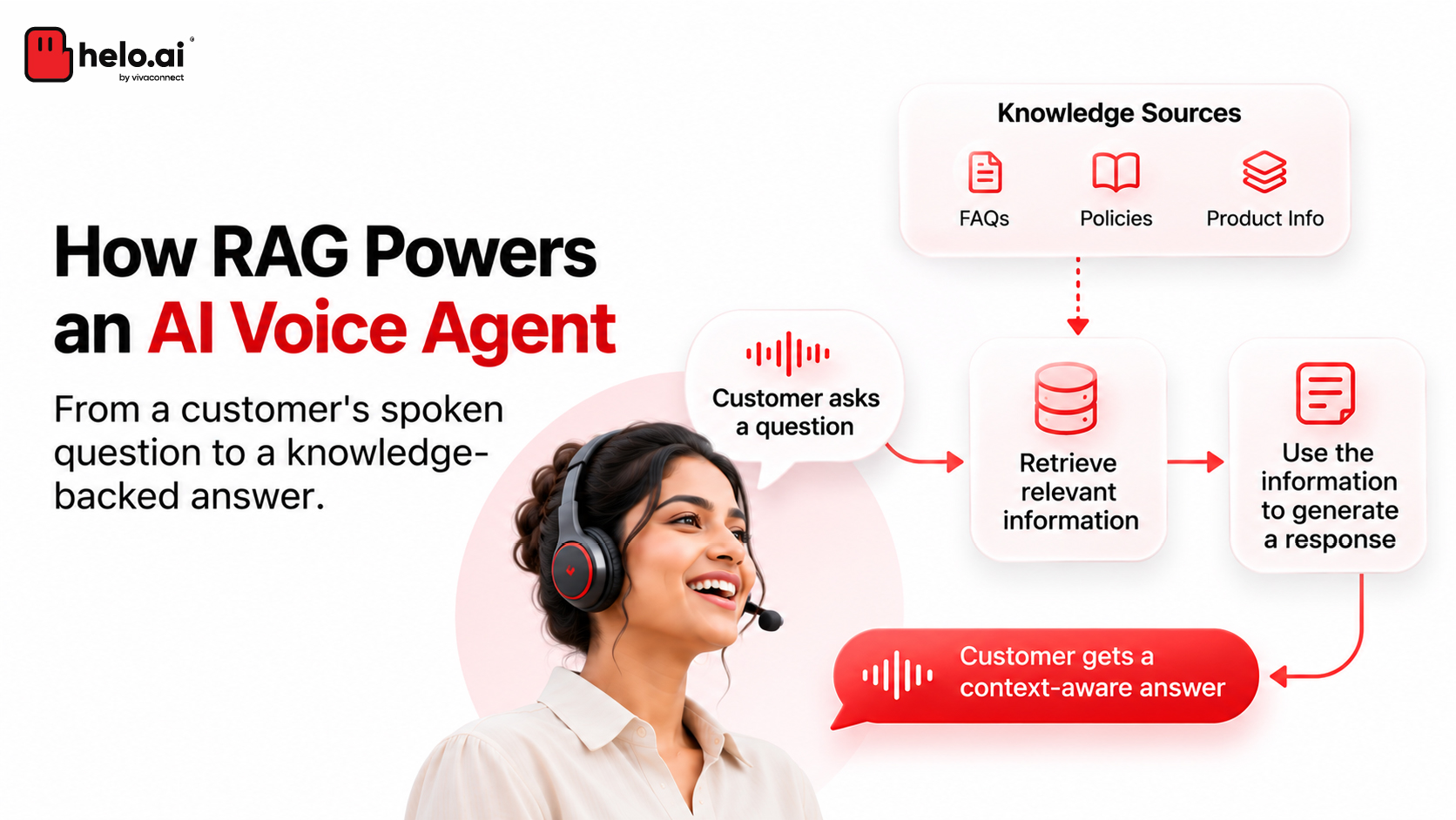
Yes. AI voice agents can connect with compatible telephony systems to handle inbound and outbound conversations, retrieve business information and transfer calls to human agents. The available capabilities depend on the platform and integration.
Is WhatsApp Business Calling suitable for banks and NBFCs?
It can support customer-service and product-enquiry conversations where WhatsApp is an appropriate channel. Financial institutions should assess customer permissions, data handling, audit requirements and applicable regulatory obligations before deployment.
Can a business use WhatsApp Calling and regular phone calls together?
Yes. A business can use WhatsApp Business Calling for customers who prefer in-app conversations and cloud telephony for customers who use regular phone numbers. An integrated platform can help teams manage these interactions with better customer context.
Is cloud telephony the same as VoIP?
No. Cloud telephony is a hosted business phone service. VoIP is the technology that carries voice over IP networks. A cloud telephony platform may use VoIP as part of its infrastructure.
Final Takeaway
WhatsApp Business Calling, cloud telephony and VoIP solve different parts of business communication.
WhatsApp Business Calling is useful when voice needs to become part of an existing WhatsApp conversation. Cloud telephony is suited to structured business calling across telephone networks. VoIP provides the technology for flexible IP-based voice connectivity.
For many Indian businesses, the strongest setup may combine these options. The decision should come down to customer reach, call workflows, integrations, compliance and the experience your teams need to deliver.
The right calling setup is not simply the one that connects a call. It is the one that helps your business handle the conversation from start to resolution.
Note. Helo.ai makes Helo Voice and Helo Convo, mentioned above. WhatsApp calling rules and DoT authorisation points were checked against Meta and DoT pages on 21 November 2026.