

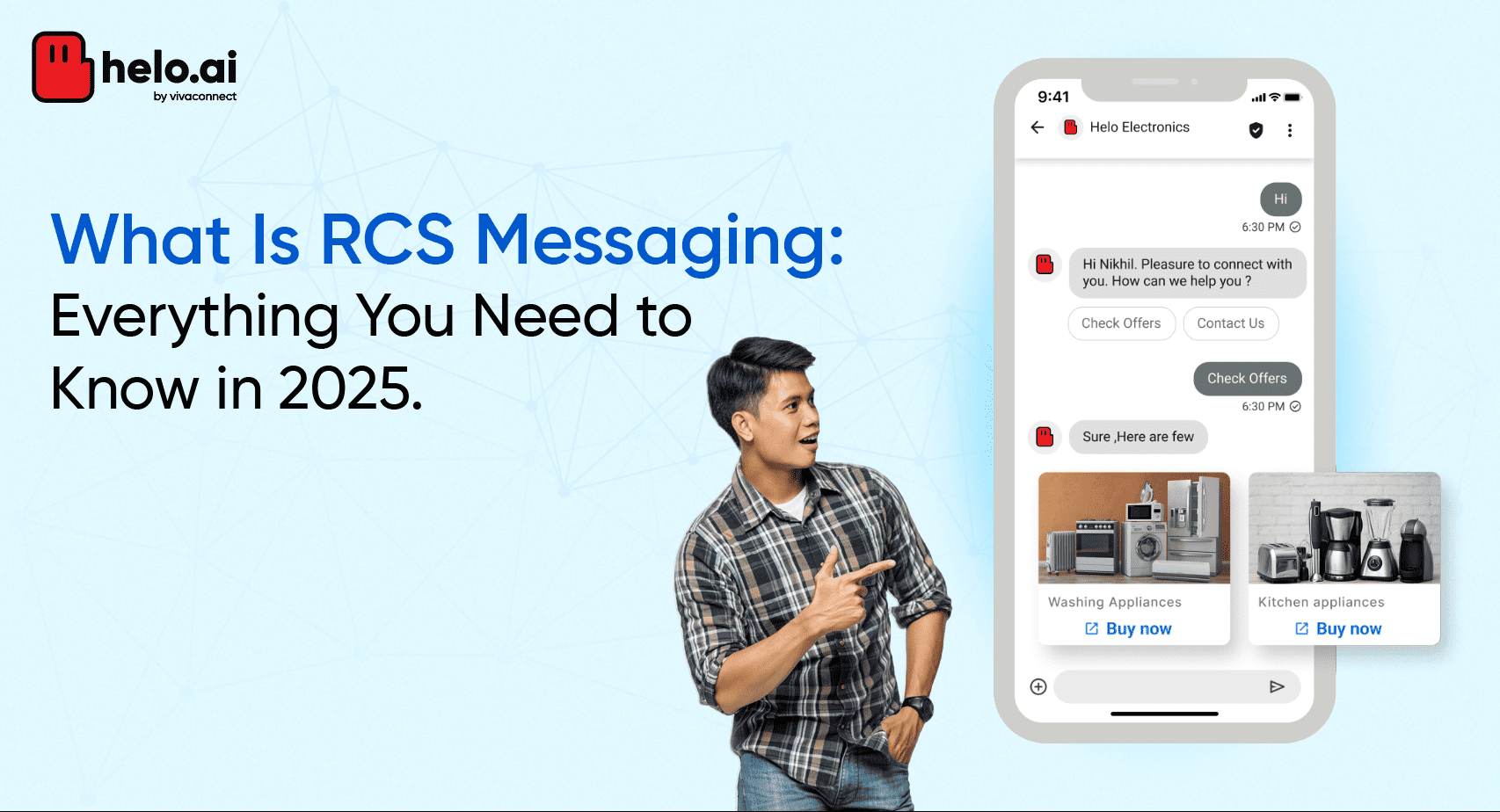


Traditional SMS and MMS have served businesses well for decades. SMS messages boast a 98% open rate, making them one of the most reliable channels for customer communication. However, as customer expectations evolve, businesses need messaging solutions that deliver rich, interactive experiences. The answer is Rich Communication Services, or RCS messaging.
RCS represents a significant advancement in mobile messaging, introducing capabilities like branded sender IDs, rich media, and interactive elements such as scrollable carousels, quick replies, and CTA buttons. It's designed to provide a more engaging and trustworthy experience for customers, all within their native messaging app.
For businesses, adopting RCS messaging opens new opportunities to connect with customers more meaningfully. As RCS rapidly becomes a major channel for customer communication, leveraging its capabilities will position you to capture the next generation of consumers.
In this guide, we will explore what RCS is, how it differs from traditional messaging channels, and why it's quickly becoming essential for businesses looking to build trust and improve engagement.
What is RCS messaging?
RCS, full form Rich Communication Services, is an advanced messaging protocol developed by the GSMA (Global System for Mobile Communications Association) as the natural evolution of SMS. An RCS message supports rich chat features like high-resolution images and videos, interactive buttons, branded sender information, and real-time indicators like typing notifications and read receipts.
The key advantage of RCS messaging is that it delivers these interactive experiences directly to users' native mobile messaging inboxes on Android and Apple devices. Unlike OTT apps such as WhatsApp or Facebook Messenger, RCS doesn't require users to download a third-party application or create a new account.
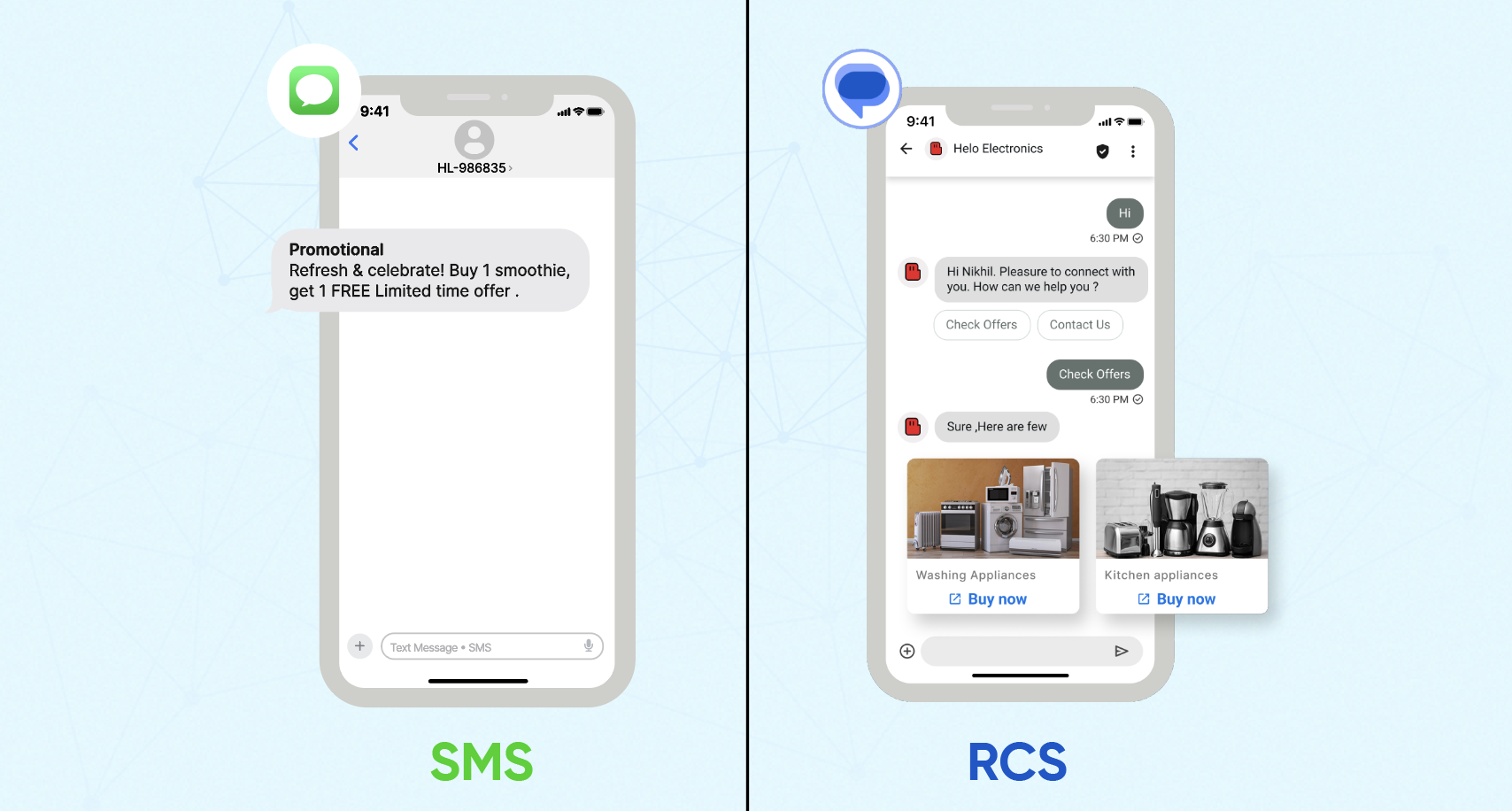
Key features of RCS messaging
- Company branding and verification: RCS business messaging allows companies to attach their name, brand logo, tagline, and a verified badge to every message. Customers instantly recognize who's reaching out, building trust and reducing concerns about spam or phishing.
- Enhanced media support: Send large media files including high-quality photos, videos, and GIFs. This capability far exceeds the limited media support of SMS and MMS.
- Interactive elements: RCS supports dynamic features like buttons, carousels, and other interactive components. This includes suggested replies and call-to-action buttons that streamline customer interactions.
- Longer messages: RCS messages support up to 8,000 characters without splitting them into segmented texts, compared to SMS's 160-character limit.
- Rich analytics: Unlike SMS, RCS provides delivery receipts, read receipts, and typing indicators, giving businesses valuable insights into message performance and customer engagement.
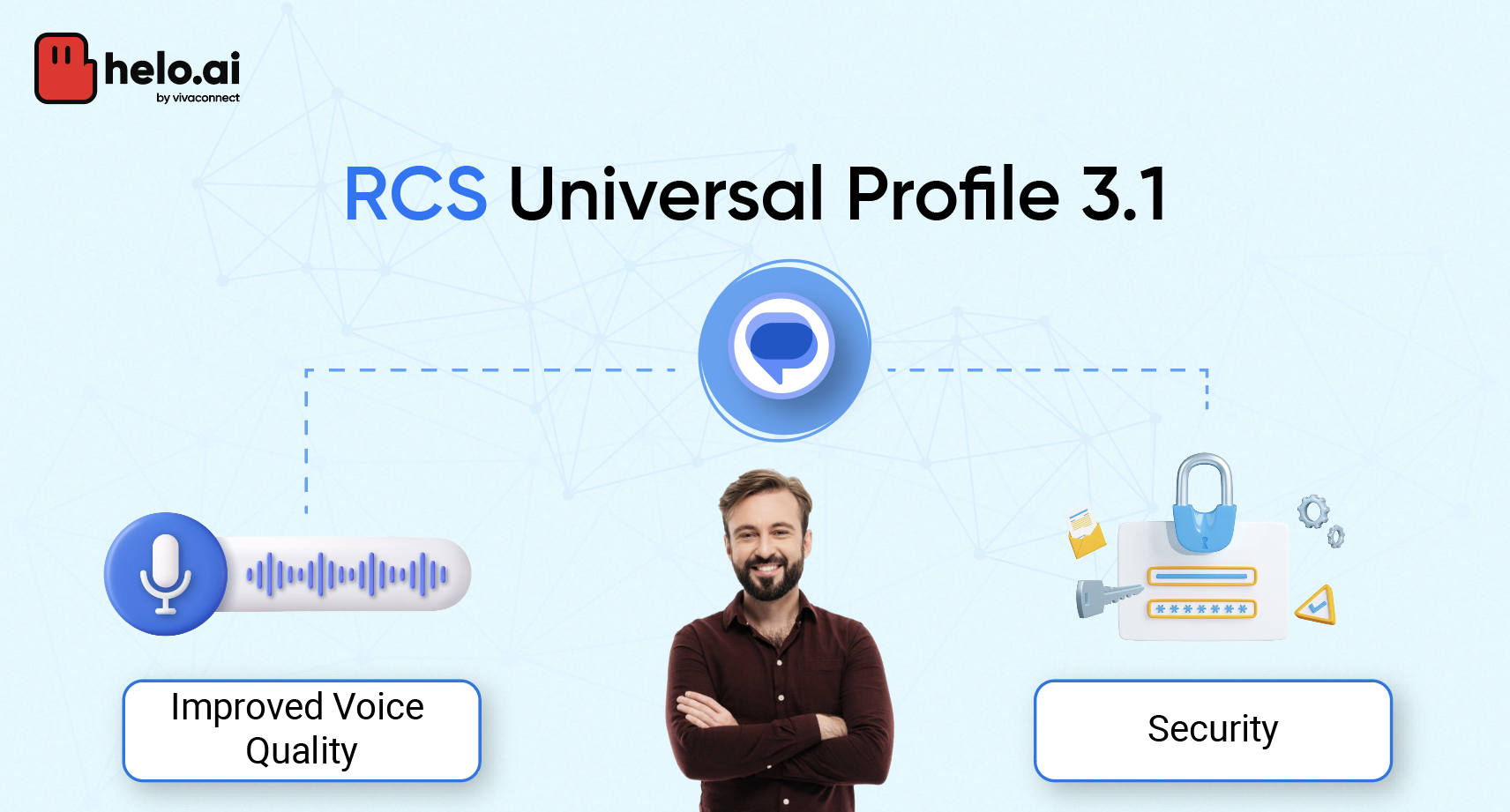
- Security: RCS Business Messaging supports encryption between the sender and Google, as well as between Google and the end user. This makes RCS more secure than traditional SMS, with end-to-end encryption planned for 2025.
The evolution of RCS messaging
RCS messaging was first proposed in 2007 as an upgrade to the traditional SMS protocol, which had remained largely unchanged since the 1990s. Initially developed by the GSMA in collaboration with mobile network operators, RCS was envisioned as a more interactive and multimedia-rich alternative to SMS and MMS.
Adoption was slow in the early years due to technical challenges, lack of widespread carrier support, and competition from OTT services like WhatsApp. However, in 2016, Google gave RCS a significant boost by integrating it into its Android Messages app, dramatically increasing adoption since Android holds a large share of the global smartphone market.
The GSMA established a common set of features and standards through the Universal Profile, ensuring RCS messages would be compatible across different networks and devices. Since 2016, major carriers in the US have rolled out RCS support, and international carriers continue to follow suit.
RCS messaging availability in 2025
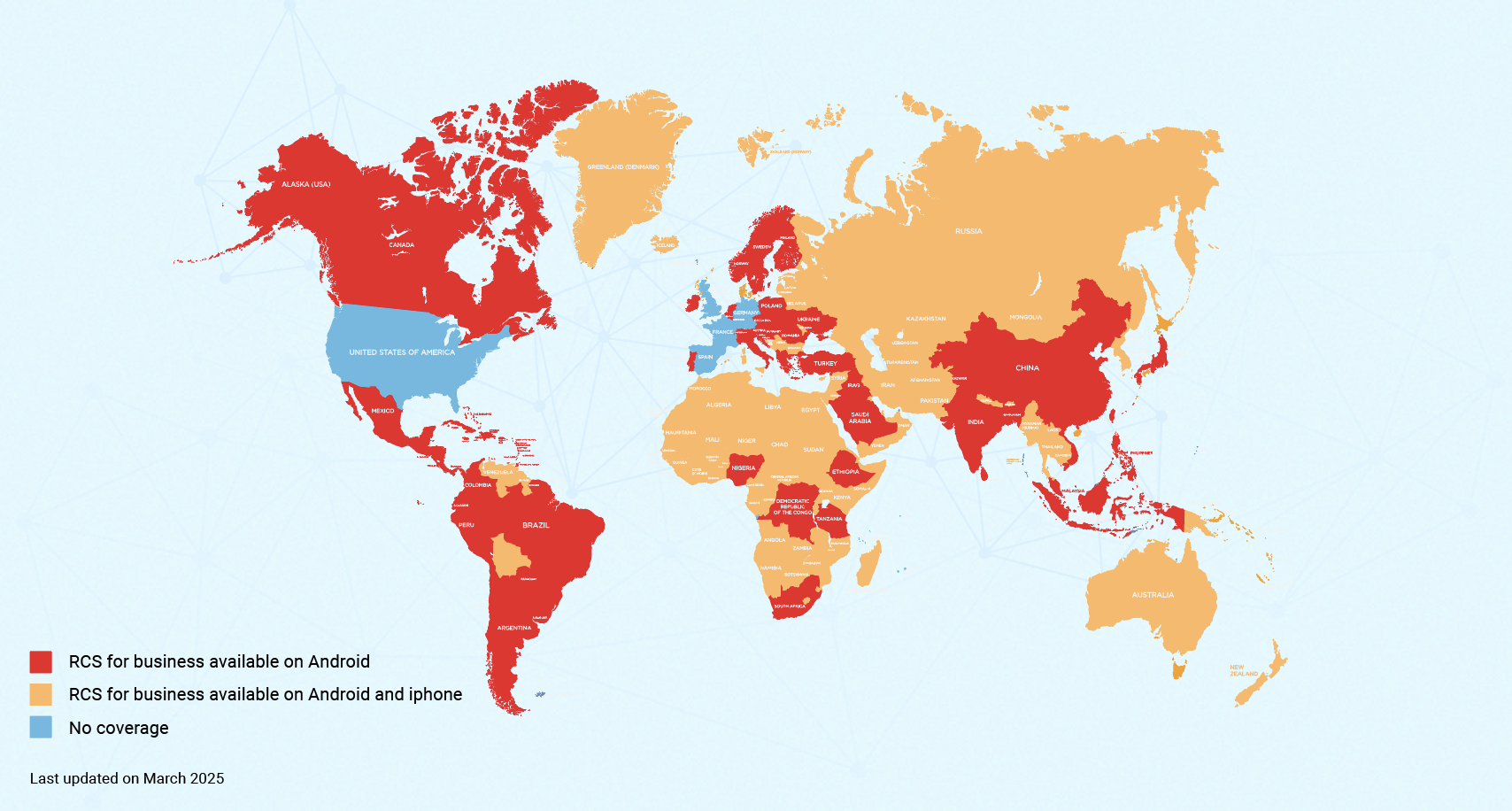
RCS has full coverage in Canada, Mexico, Brazil, the United Kingdom, Germany, France, Spain, Italy, and India. Other countries offer full support via Google's RCS services or partial support through select local mobile operators.
As of October 2024, 17 countries have launched RCS for A2P (application-to-person) business messaging, with that number continuing to grow. While person-to-person RCS messaging is widely available, carriers are implementing business messaging capabilities at a measured pace to ensure trust and prevent spam.
Global adoption statistics
In 2025, RCS has over 1.5 billion monthly active users globally. Business RCS messaging grew 52% year-over-year in 2025, with over 50 billion business messages sent. In the United States specifically:
- RCS users grew from 64 million to 121 million iOS users in recent months (89% growth)
- 70% of US businesses are now approved for RCS messaging
- 1 in 7 US messages are now sent via RCS
RCS vs SMS vs MMS vs OTT: Understanding the differences
To understand the innovation RCS brings, it's helpful to compare it to existing messaging technologies:
SMS (Short Message Service): The foundational form of text messaging, allowing messages up to 160 characters. SMS is universally supported but lacks rich media and interactive features.
MMS (Multimedia Messaging Service): Enables sending multimedia content like images, videos, and audio. MMS supports longer text messages than SMS but has limited media quality (typically compressed to 300KB).
RCS (Rich Communication Services): Combines the universal reach of SMS/MMS with the rich features of OTT apps. Supports high-quality media, interactive buttons, carousels, and branded sender information.
OTT (Over-The-Top): Messaging services that run over the internet rather than traditional phone networks. Examples include WhatsApp Business Platform and Facebook Messenger. These offer extensive features like end-to-end encryption, video calls, and file transfers but require app downloads.
Key comparison table
Feature | SMS | MMS | RCS Messaging |
Character limit | 160 | 1,600 | 8,000+ |
Media quality | None | Compressed (300KB) | High-res (up to 100MB) |
Interactive buttons | No | No | Yes |
Carousels | No | No | Yes |
Read receipts | No | No | Yes |
Typing indicators | No | No | Yes |
Verified sender | No | No | Yes |
Requires data | No | No | Yes |
Will RCS replace SMS?
Not entirely. RCS requires a mobile data connection or Wi-Fi to function. SMS, on the other hand, works on cellular networks without requiring internet access. This means SMS will continue to serve as a reliable fallback when data connections are unavailable, similar to how iMessage falls back to SMS when needed.
RCS Messaging Features.
What does RCS do better than SMS? Well, just about everything! RCS transforms the basic text box into a rich, interactive, and trustworthy application environment all within the user's native messaging app.
RCS goes far beyond simple text, offering a suite of features that revolutionize both Person-to-Person (P2P) and Application-to-Person (A2P) communication.
Verified Sender Profile : Build Instant Trust. Display your official Brand Name, Logo, and a Verified Badge.
Interactive Buttons : Drive Immediate Conversions. Add single-tap options like "Buy Now" or "Track Order."
Media Carousels : Present Multiple Offers. Allow customers to swipe through up to 10 distinct, interactive cards.
Rich Media Cards : Showcase Products Visually. Send high-resolution images, videos, and detailed product listings.
Read Receipts : Get Actionable Analytics. Know exactly when your customer has opened and viewed your message.
Typing Indicators : Enable Real-Time Support. See when the user is actively responding for fluid conversation.
Long Message Support : Communicate Completely. Eliminate the 160-character limit; send detailed instructions in one piece.
Automatic SMS Fallback : Guarantee 100% Delivery. If RCS fails, the message is instantly delivered as a standard SMS.
Location Sharing : Guide Users Instantly. Send a clickable map link to your nearest store or event location.
Document Sharing : Finalize Transactions. Send PDFs, e-tickets, and invoices directly to the message thread.
End-to-End Encryption : Ensure Security. Protect sensitive one-on-one customer data during transmission.
Apple's RCS Support
In September 2024, Apple released iOS 18 with RCS support for person-to-person messaging, starting in select markets with carriers like AT&T, T-Mobile, and Verizon. iOS 18.1 expanded support for application-to-person (A2P) RCS Business Messaging in select markets.
This development is significant. If iOS 18 adoption matches previous versions, this could translate to over one billion additional RCS users by summer 2025. Android already accounts for over 70% of the global smartphone market, meaning RCS now reaches the vast majority of mobile users worldwide.
How to Enable RCS on iPhone: 5 Direct Steps for iOS 18 or Later
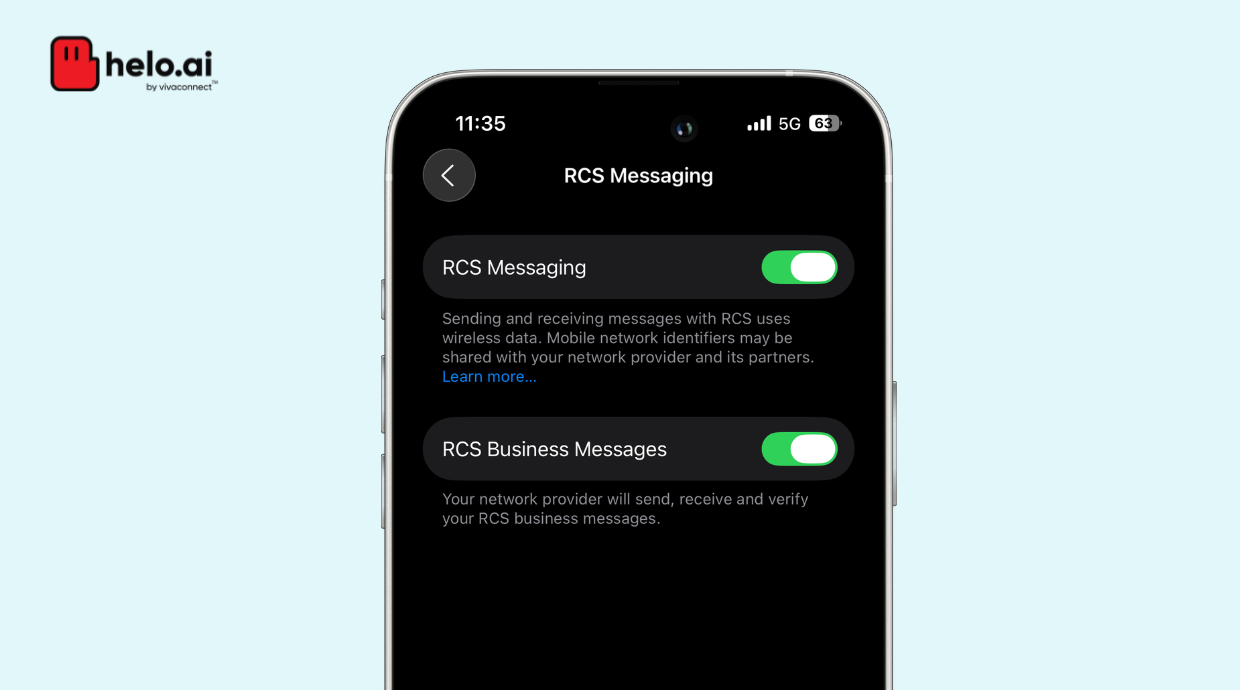
1.Update to iOS 18 or later
RCS support is introduced in iOS 18.
2.Check carrier support
Even with iOS 18, RCS only works if your mobile carrier has enabled it for iPhones.
3.Open Settings → Apps → Messages
Go to your iPhone’s Settings, then scroll and tap Apps, and then Messages.
4.Toggle “RCS Messaging” on
If supported in your region and by your carrier, you will see a switch labelled RCS Messaging under the Messages settings. Turn it on.
5.Wait or restart if needed
The feature sometimes takes a few minutes or a device restart to fully activate.
Start a new conversation
New message threads with Android users are more likely to use RCS, though old SMS threads may not automatically upgrade.
Benefits of RCS messaging for business
RCS messaging provides several transformative benefits for business communication:
1. Enhanced branding and trust
RCS allows businesses to send messages with their company's brand name, logo, and verified badge. This creates a professional appearance in customers' message inboxes, increasing brand recognition and trust. Verified sender badges help customers instantly identify legitimate business communications, reducing concerns about phishing and spam.
2. Increased customer engagement
RCS, the next-gen SMS, uses rich media and interactive buttons for an app-like experience. This drives significantly higher performance: 3x to 7x higher Click-Through Rates and conversion rates 35% to over 70% higher than traditional SMS.
3. Boosted read and response rates
RCS messages are more interactive and visually appealing, leading to higher read and response rates. The immediacy and richness of content in RCS can result in more effective promotions, faster customer service resolutions, and higher customer satisfaction.
4. Elevated analytics and insights
RCS provides detailed delivery and read receipts, allowing businesses to track and analyze message effectiveness. This data is crucial for optimizing communication strategies and understanding customer preferences.
5. Seamless customer experience
Because RCS messages are delivered directly to users' default messaging apps, adoption rates are naturally high. Customers don't need to download new applications or create accounts, eliminating app fatigue and reducing friction in the customer journey.
6. Cost-effective engagement
While RCS messages may cost slightly more than SMS (typically $0.01-0.10 per message depending on volume), the return on investment is significantly higher. One company doubled their ROI using RCS compared to traditional channels. The higher engagement rates and conversion lift justify the marginal cost difference.
5 Ways RCS Improves Business Communication.
Rich Communication Services (RCS) is fundamentally transforming how businesses connect with their audience. Moving far beyond the limitations of plain-text SMS, RCS delivers an interactive, app-like experience directly within the customer's native messaging app.
For businesses aiming for serious growth, this isn't just an upgrade—it's the new standard. Here are five powerful ways RCS messaging will help your brand out-engage and out-convert the competition.
1. Boost Engagement Rates with Rich Media and Interactive Carousels
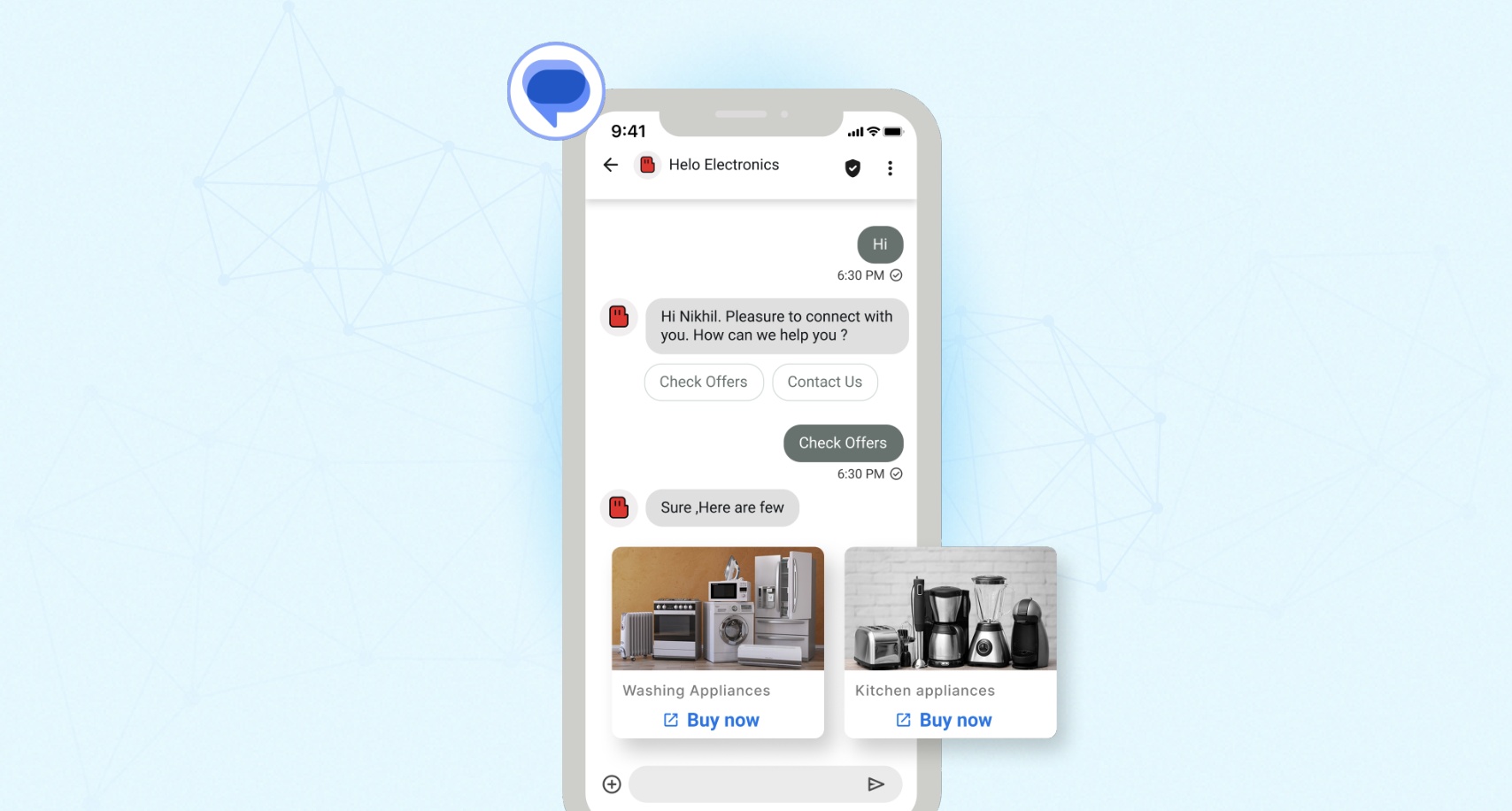
The core limitation of traditional SMS is its lack of visual appeal, often resulting in low click-through rates (CTRs) for marketing campaigns. RCS obliterates this barrier.
It allows you to embed high-resolution images, videos, GIFs, and interactive product carousels right into the conversation thread. This capability allows for genuine visual storytelling, letting customers see your product or service in action.
Why this drives growth: A rich media message is instantly more captivating than a text link. When a customer can swipe through a carousel of your latest products or watch a 10-second explainer video directly in their inbox, the friction to engagement drops dramatically. This visual experience leads to significantly higher open and click-through rates compared to generic SMS.
2. Establish Instant Trust Using Verified Sender Profiles and Branding
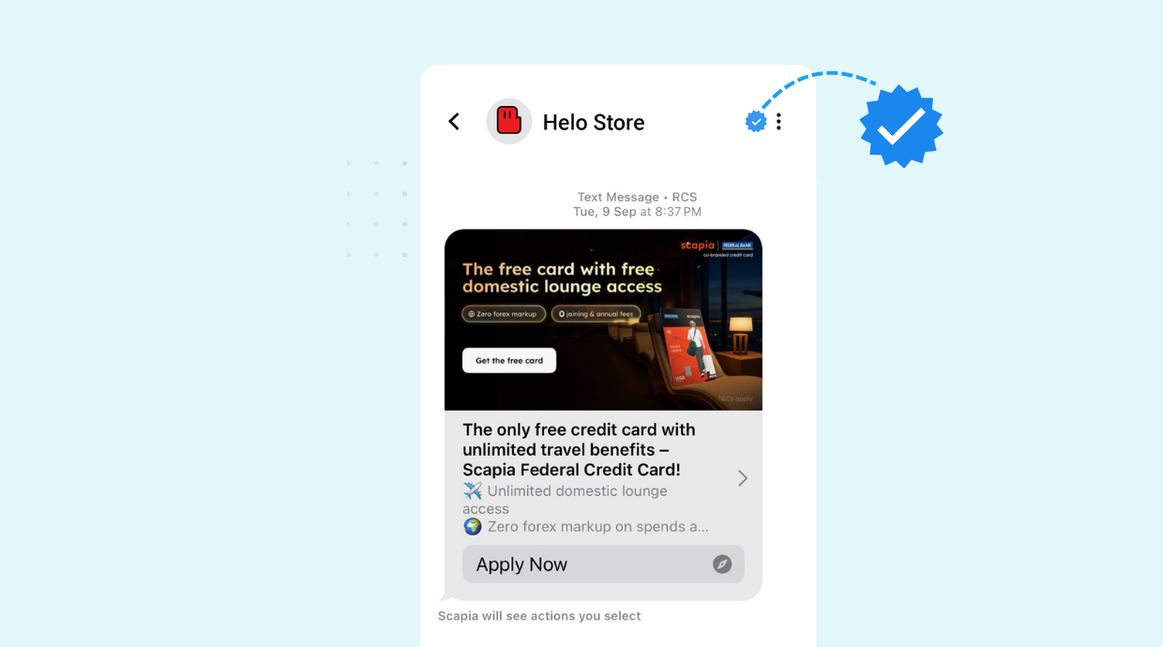
In an era where consumers are constantly wary of phishing and spam, establishing immediate trust is non-negotiable for business growth. SMS messages often arrive from a random, unidentifiable number, creating uncertainty.
RCS solves this by enforcing Verified Sender Profiles. Every message sent comes from an authenticated business account that displays your company's official logo, brand colors, and a clear verification badge.
Why this drives growth: This professional, branded presence builds customer confidence from the first glance. Consumers are far more likely to open and interact with a message that is clearly and verifiably from your brand. It elevates your communications from a generic alert to a trusted, professional interaction, directly strengthening brand loyalty and reducing the likelihood of your messages being marked as spam.
3. Streamline Conversational Commerce and Service
RCS transforms a one-way notification into a two-way, actionable conversation. This is the foundation of conversational commerce, which simplifies the customer journey from inquiry to purchase.
You can include Suggested Actions and Quick Reply buttons that allow customers to take immediate steps like:
- "Track Order"
- "Reschedule Appointment"
- "View Product Catalog"
- "Speak to an Agent"
Why this drives growth: By eliminating the need to leave the messaging app, search for a website, or call a helpline, RCS drastically reduces customer effort and friction. A customer can complete an entire micro-transaction (like a bill payment or re-ordering a favorite item) directly within the chat. This immediate actionability leads to a faster sales cycle and improved customer satisfaction metrics.
4. Enhance Personalization to Drive Higher Conversions
Modern consumers expect messages to be tailored to their needs and purchase history. RCS allows for a level of personalization that makes every interaction feel like a one-on-one dialogue.
By integrating RCS with your Customer Relationship Management (CRM) platform, you can send triggered, highly relevant content such as:
- Abandoned cart reminders with a rich media photo of the exact item.
- Personalized sales based on past purchases or browsing behavior.
- Timely appointment reminders with a one-tap 'Add to Calendar' button.
Why this drives growth: Personalized messages have been proven to generate significantly higher conversion rates. By delivering the right information to the right person at the right time, complete with engaging visuals and a simple call-to-action, RCS ensures your message cuts through the noise and compels the customer to act.
5. Gain Deeper Insight with Powerful Analytics
Unlike traditional SMS, which often only confirms delivery, RCS provides the same robust analytics you'd expect from a modern digital channel.
This crucial data includes read receipts and detailed reporting on which interactive elements (buttons, carousels) customers are clicking.
Why this drives growth: This level of insight allows your marketing and service teams to perform essential A/B testing and campaign optimization. You can instantly see what content, offers, or calls-to-action are performing best. By continually refining your approach based on real-time customer behavior, you can maximize your ROI, improve message performance, and ensure every communication directly contributes to your overall business objectives.
RCS messaging use cases for business
Enhanced customer service
RCS enables more interactive customer support experiences. Features like rich media, typing indicators, read receipts, and quick-reply suggestions streamline service interactions. For example, customers can send images of product issues, receive video tutorials for troubleshooting, and use quick-reply options to schedule service appointments.
Promotional campaigns and offers
Create visually appealing and interactive marketing campaigns that go beyond plain text. Use high-resolution images, videos, QR codes, and product carousels. A retail business could send promotional messages with swipeable product galleries, making it easy for customers to browse and purchase.
Personalized recommendations
Use customer data like purchase history, browsing behavior, and preferences to send tailored recommendations. A clothing retailer can leverage RCS to send personalized product suggestions with interactive carousels, increasing relevance and conversion rates.
Real-time updates and notifications
Facilitate real-time order tracking, appointment reminders, and delivery updates with interactive elements. Customers can receive order confirmations with tracking buttons, appointment reminders with one-tap rescheduling options, and delivery notifications with live location sharing.
Transactional messaging
Send branded fraud alerts, payment confirmations, account notifications, and service reminders directly to customers' native messaging inboxes. For example, a fintech company can send payment confirmations with receipts attached and quick-action buttons for customer support.
Event management
For businesses organizing events, RCS provides an interactive way to send reminders, updates, and relevant information. Include Google Maps links to venues, speaker bios, real-time updates about schedule changes, and interactive RSVP buttons.
Customer feedback and surveys
Gather feedback and conduct surveys in more engaging ways. The ability to incorporate interactive elements and rich media increases response rates. Customers can rate experiences with stars or emojis, answer multiple-choice questions with quick replies, and provide detailed feedback through conversation flows.
Real-world RCS success stories
Retail: Cart recovery campaign
An online fashion retailer used RCS for abandoned cart recovery:
Strategy: Send RCS messages 2 hours after cart abandonment with product carousels showing cart items and one-click purchase buttons.
Results:
- Cart recovery rate increased from 8% (SMS) to 19% (RCS)
- ROI improved by 137%
- Customer satisfaction scores increased by 24%
Financial services: Account onboarding
A digital bank streamlined KYC verification using RCS:
Strategy: Guide customers through verification with video instructions, document upload prompts, and instant feedback on submissions.
Results:
- Completion rate increased from 60% to 88%
- Average completion time reduced from 3 days to 18 hours
- Customer drop-off reduced by 47%
Insurance: Customer re-engagement
French insurance company Macif used RCS for two-way conversations with policyholders:
Results:
- Click-through rate increased by 100%
- Customer engagement significantly improved
- Re-engaged dormant contacts effectively
Parking services: Real-time alerts
EasyPark Group uses RCS to send parking alerts and notifications:
Implementation: Real-time parking alerts with logo and verified check mark, automatic fallback to SMS for unsupported devices.
Impact:
- Improved customer trust through verified branding
- Reduced support tickets with self-service options
- Enhanced user experience across their global customer base
How to Create RCS messaging strategy.
1. Understand your audience
Use customer data and segmentation to understand what problems you're solving. Divide your audience based on demographics, purchase behavior, and engagement history. Personalize messages to fit the needs of each segment. For example, frequent shoppers might appreciate early access offers, while new customers need welcome messages and guides.
2. Create engaging content
Take full advantage of RCS's rich media capabilities. Use high-resolution images, videos, or carousels based on your segmented audience. Leverage interactive elements like quick-reply buttons, suggested actions, and embedded forms to create seamless experiences.
3. Use insights from past campaigns
Enhance successful SMS or email campaigns with RCS features. Ensure your RCS messaging aligns with wider marketing strategies, providing a consistent brand experience across all channels.
4. Focus on customer experience
Ensure RCS messaging is intuitive and user-friendly. Use conversational flows that guide customers naturally through interactions. Leverage real-time communication capabilities to offer immediate customer support when needed.
5. Analyze and optimize
Monitor key performance indicators like delivery rates, open rates, click-through rates, and conversion rates regularly. Use this data to continuously optimize campaigns. Run A/B tests to determine the most effective message formats, timing, and media variations.
6. Ensure compliance and security
Comply with relevant marketing regulations and data privacy laws. Always obtain explicit opt-in consent before sending messages and provide easy opt-out mechanisms. Implement strong security measures to protect customer data.
Technical implementation considerations.
Getting started with RCS
To send RCS business messages, you'll need to work with a communications platform that supports RCS capabilities. Platforms like Helo.ai make integration straightforward, often bringing RCS to existing messaging APIs without requiring significant code changes.
Onboarding process
Brand registration: Submit your business information, logo, and use case to the RCS platform provider.
Carrier approval: Carriers review your brand and use case (typically takes 1-2 weeks).
Integration: Connect the RCS API to your existing CRM or application through REST APIs or SDKs.
Testing: Conduct thorough testing to ensure messages display correctly and fallback mechanisms work properly.
Launch: Start with a small segment to validate performance before scaling.
Fallback strategy
Since RCS requires mobile data, it's essential to implement automatic fallback to SMS when RCS delivery isn't possible. Leading platforms handle this detection and fallback automatically, ensuring messages always reach customers regardless of device or network capability.
Analytics and monitoring
Track key metrics including:
- Delivery rate (percentage successfully sent)
- Open rate (percentage read)
- Click-through rate (percentage who interacted)
- Conversion rate (percentage who completed desired action)
- Fallback rate (percentage downgraded to SMS)
- Response time (how quickly users reply)
Challenges and considerations.
Device and carrier fragmentation
Not all devices and carriers support RCS yet. Coverage is growing but remains incomplete in some regions. Mitigation: Always implement SMS fallback and monitor fallback rates by region to adjust strategy accordingly.
iOS support limitations
While Apple now supports RCS Business Messaging in select markets with iOS 18+, coverage isn't universal. Mitigation: Target Android-heavy markets first and use feature detection for iOS users.
Compliance requirements
Regulations like TCPA (US), GDPR (EU), and TRAI (India) require explicit consent for marketing messages. Mitigation: Build robust consent capture mechanisms, store proof of consent, and provide easy opt-out options in every message.
Cost considerations
RCS can be more expensive than SMS, especially for small volumes. Mitigation: Start with high-value use cases that drive clear ROI, measure results rigorously, and negotiate volume discounts with providers.
You've listed the RCS challenges—we engineered the solutions.
Helo.ai eliminates fragmentation with intelligent SMS fallback, manages global compliance effortlessly, and turns cost into proven ROI. We deliver a branded, app-less experience that drives 10X engagement and a 30% conversion lift.
Ready for RCS that guarantees results?
The future of RCS messaging.
End-to-end encryption
Apple has confirmed that end-to-end encrypted RCS messaging will be available in a future iOS update, potentially with iOS 19 in September 2025. According to the GSMA, this would make RCS the "first large-scale messaging service to support interoperable E2EE between client implementations from different providers.
Enhanced spam protection
Google is applying learnings from Gmail's spam protection to keep RCS chats secure. Features like an "Unsubscribe" option are being added to give users more control over business messaging.
Continued adoption growth
Research indicates that 42% of business leaders consider RCS a strategic investment for 2025. delivered over one billion RCS Business messages by mid-November 2024, before the holiday season peak.
Advanced features on the horizon
Expected enhancements include:
- Interactive forms for surveys and applications
- Payment integration for in-message purchases
- Live location sharing for deliveries
- Augmented reality features for product visualization
How Helo.ai enables RCS messaging.
Helo.ai provides a comprehensive platform for businesses to leverage RCS messaging as part of their customer communication strategy:
Simplified integration: Seamlessly integrate RCS into existing communication strategies with minimal changes to your setup. Helo.ai's straightforward integration empowers businesses of all sizes to adopt RCS quickly.
Omnichannel orchestration: Manage RCS alongside SMS, WhatsApp, and email in a single platform. Helo.ai intelligently routes messages through the best channel for each customer.
Automatic fallback: If RCS delivery fails, messages automatically downgrade to SMS without manual intervention, ensuring delivery continuity.
AI-powered personalization: Create dynamic, personalized RCS campaigns using customer data, behavioral triggers, and predictive recommendations.
Compliance built-in: Handle GDPR, TCPA, and regional requirements automatically with built-in consent management and opt-out mechanisms.
Global carrier partnerships: Benefit from established relationships with major carriers for faster approvals and better deliverability across regions.
Real-time analytics: Track delivery, engagement, and conversion metrics in comprehensive dashboards to optimize campaign performance.
Conversational AI integration: Build sophisticated multi-step RCS journeys with AI-powered chatbots and natural language understanding.
Getting started with Helo.ai

Frequently asked questions about RCS messaging.
1.What does RCS stand for?
RCS stands for Rich Communication Services. It's a messaging protocol developed by the GSMA as the evolution of SMS.
2.How is RCS different from SMS?
RCS supports high-resolution media, interactive buttons, carousels, read receipts, typing indicators, and verified sender branding. SMS is limited to 160 characters of plain text with no interactive elements or rich media.
3.Does RCS work on iPhone?
Yes, starting with iOS 18 in September 2024, Apple added RCS support for person-to-person messaging. iOS 18.1 expanded support for RCS Business Messaging in select markets with certain carriers.
4.Is RCS secure?
RCS currently supports encryption between senders and Google, as well as between Google and end users. End-to-end encryption is planned for 2025, which will make RCS as secure as WhatsApp for person-to-person messaging.
5.Will RCS replace SMS?
Not entirely. RCS requires a mobile data connection, while SMS works on cellular networks without internet access. SMS will remain as a reliable fallback option when data connections are unavailable.
6.How much does RCS messaging cost?
RCS business messaging typically costs $0.01-0.10 per message depending on volume and provider. While slightly more expensive than SMS, RCS delivers significantly higher engagement and conversion rates.
7.What countries support RCS?
RCS has full coverage in Canada, Mexico, Brazil, the UK, Germany, France, Spain, Italy, and India. As of October 2024, 17 countries support A2P RCS Business Messaging, with more launching regularly.
8.How do I enable RCS on my phone?
For Android: Open Google Messages, go to Settings > Chat features, and toggle on. For iPhone: Ensure you have iOS 18+ and that your carrier supports RCS. It will activate automatically in supported regions.
9.Can RCS messages fall back to SMS?
Yes, if a recipient's device doesn't support RCS, messages automatically fall back to SMS. Leading platforms handle this fallback transparently.
10.How do businesses get verified for RCS?
Businesses register with an RCS platform provider, submit brand information (logo, name, use case), and undergo carrier vetting. Once approved (typically 1-2 weeks), messages display with verified badges and branded sender information.
11.What are the best use cases for RCS?
Top use cases include cart recovery, order confirmations, appointment reminders, customer support, promotional campaigns, personalized recommendations, event management, and transactional alerts.
12.How does RCS compare to WhatsApp?
WhatsApp requires users to download an app and has 2 billion+ users globally with end-to-end encryption. RCS works in native messaging apps without downloads and is growing rapidly with over 1.5 billion users. WhatsApp is better for markets where it's dominant; RCS offers native-app convenience and cross-platform reach.
Conclusion: Embrace the future of business messaging
RCS messaging represents the most significant advancement in mobile communication since the introduction of SMS. With support from Android, major carriers worldwide, and now Apple, RCS is positioned to become the default standard for rich, interactive business messaging.
The benefits are clear: higher engagement rates, improved customer trust, better analytics, and enhanced brand presentation. Early adopters are already seeing conversion rates 15-35% higher than SMS, with some companies achieving 200% increases in engagement.
As RCS adoption accelerates toward one billion additional users in 2025, the opportunity window for early competitive advantage is closing. Businesses that implement RCS now will be positioned to deliver superior customer experiences before it becomes table stakes.
Whether you're looking to improve transactional messaging, enhance marketing campaigns, or provide better customer support, RCS messaging offers the capabilities to transform your customer communication strategy.
Ready to get started with RCS Service? Helo.ai makes implementation straightforward with simplified integration, automatic fallback, global carrier partnerships, and comprehensive analytics.
Contact our team today to learn how RCS can elevate your customer engagement strategy.


-2.webp&w=828&q=75)
.png&w=828&q=75)