.jpeg)


A customer calls your business to enquire about a product. Another wants an update on an order. Someone else needs help with a payment or an ongoing service request.
If all these calls go to one personal mobile number, managing them becomes difficult as the business grows. Calls can be missed, customer conversations become harder to track, and teams have limited visibility into who handled each enquiry.
A virtual phone number for business offers a more organised way to manage these conversations.
It allows businesses to receive and route calls through a cloud-based phone system without depending on a telephone line installed at one particular office. Depending on the setup, calls can be forwarded to employees, routed through an Interactive Voice Response (IVR) system or connected to a contact centre.
In India, businesses use virtual numbers and cloud telephony for customer support, sales, banking, logistics, retail and other operations that depend on phone communication.
This guide explains what a virtual phone number is, the different number arrangements available to businesses, how much they cost, and how they work with IVR, call routing and number masking.
A virtual phone number is a business number managed through a cloud-based phone system instead of one physical line. Common types are DID, toll-free and shared-cost numbers. Cost varies by provider, call volume and features. Check calling-series rules before outbound calling.
What Is a Virtual Phone Number for Business?
A virtual phone number is a business telephone number managed through a virtual or cloud-based telephony setup rather than being tied to one physical telephone line or handset.
It allows a business to receive calls through a compatible phone system, cloud platform or configured forwarding destination.
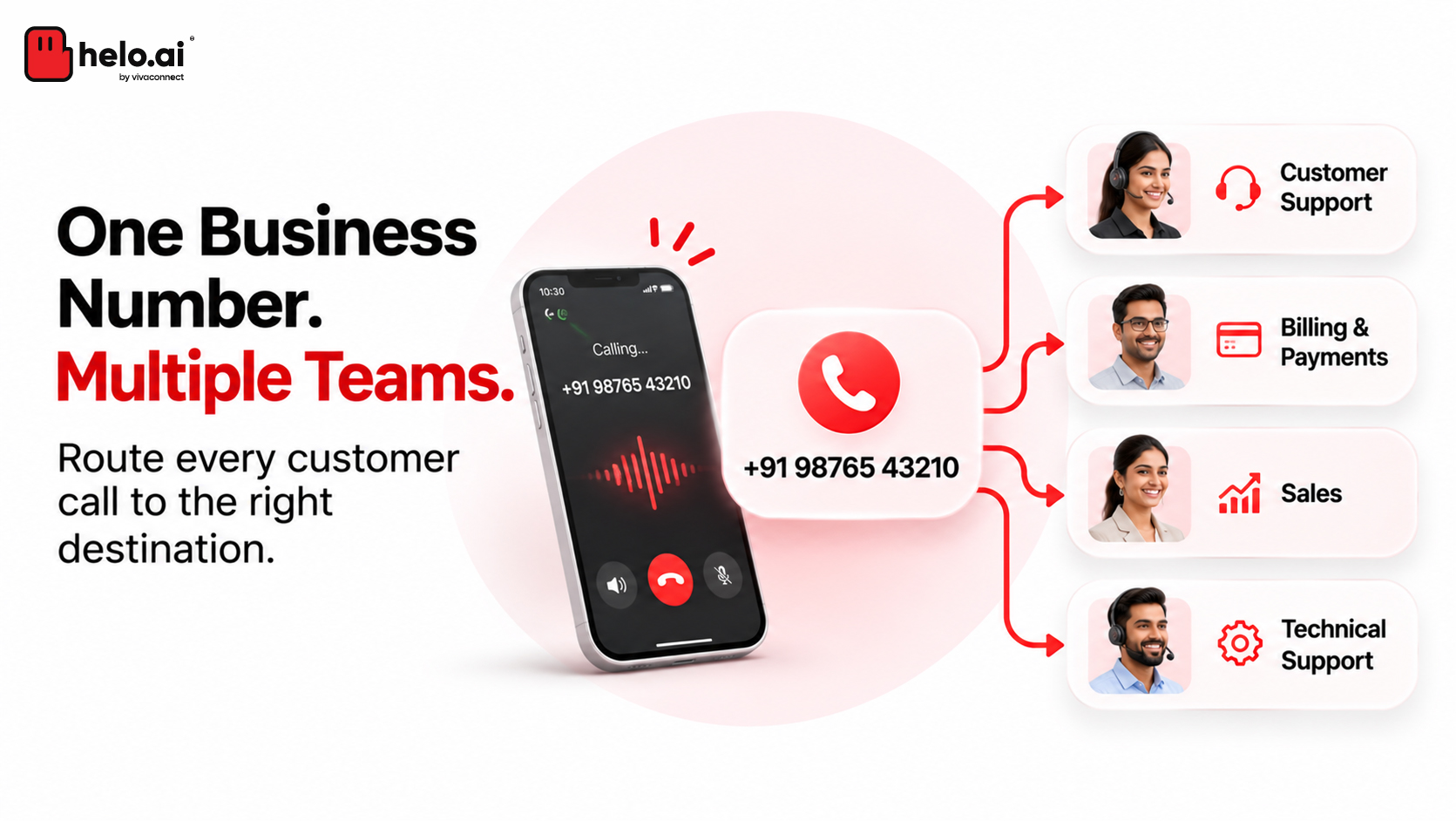
For example, a company can publish one customer support number on its website. When a customer calls, the system can route the call to the right department or an available agent.
The team can manage calls from different locations without requiring every employee to sit beside a traditional office telephone.
Depending on the number arrangement and telephony platform, businesses may be able to use features such as:
- Incoming call routing
- IVR menus
- Call forwarding
- Call queues
- Business-hours routing
- Call recording, where enabled and appropriate
- Call reporting and analytics
- CRM and helpdesk integrations
- Number masking, through a supported proxy-number arrangement
The exact features depend on the underlying number, telecom provider and cloud telephony platform.
An important distinction: A virtual phone number is not a separate, unrestricted category of telephone number under India's numbering plan. It generally refers to a telephone number made available through a telecom or authorised service provider and managed through a virtual or cloud-based system.
How Does a Virtual Phone Number Work?
A virtual number connects a customer's incoming call to a business's configured telephony setup.
The basic process looks like this:
A customer dials the business number
The customer calls the number displayed on the business website, advertisement, invoice or other communication.
The call reaches the telecom provider
The underlying telecom network delivers the call to the provider or authorised telephony infrastructure managing the number.
The system follows the configured call flow
The system checks the business's routing rules.
For example, it may:
- Play an IVR greeting.
- Ask the caller to select a department.
- Route the call to an available agent.
- Place the caller in a queue.
- Forward the call to another configured destination.
- Play an after-hours announcement.
The call reaches the right destination
The call is connected to the relevant employee, department or contact-centre team.
The business reviews call activity
Depending on the platform, authorised users can review call logs, missed calls, call duration, recordings and other available reports.
This gives businesses more control over incoming calls than a single mobile number typically provides.
Types of Business Phone Numbers in India
The term virtual number is often used alongside DID, toll-free and shared-cost numbers. However, these terms describe different number arrangements. Cloud telephony, on the other hand, describes how the calls are managed.
Understanding this distinction helps businesses select the right setup.
Geographic and DID Numbers
A Direct Inward Dialing (DID) number allows incoming calls to reach a specific business phone system, extension or destination without requiring the caller to go through a central operator.
Geographic numbers are associated with a particular numbering area or location.
Businesses can use them to create a local calling presence or route calls to different teams through a cloud telephony system.
Common use cases:
- Local business offices
- Regional customer support teams
- Sales offices
- City-specific service centres
- Multi-location organisations
For example, a business with offices in Mumbai and Pune may use separate numbers or routing configurations to manage enquiries for each location.
Number availability, geographic allocation and permitted use depend on the underlying provider and applicable telecom rules.
Toll-Free Numbers (1800 Series)
A toll-free number allows customers to call a business without paying the normal call charge for that call. The business bears the applicable incoming call cost under its service arrangement.
In India, 1800 numbers are commonly used for customer support and helplines.
They are useful when a business wants to make it easier for customers across different locations to contact its support team.
Common use cases:
- Customer care helplines
- Banking support
- Insurance assistance
- Product support
- National service centres
For example, an insurance company can publish a toll-free number on its website and policy documents so customers can call for assistance.
The business should check the provider's tariff, coverage, routing and call-volume conditions before selecting a plan.
Shared-Cost Numbers (1860 Series)
Shared-cost numbers are designed so that the cost of a call is shared between the caller and the business according to the applicable tariff arrangement.
In India, 1860 numbers are commonly associated with this model.
They may be considered by businesses that want a central contact number without necessarily taking on the full cost of every incoming call.
Common use cases:
- Customer information lines
- Service enquiries
- Corporate helplines
- Support desks
The actual charges depend on the telecom operator, calling plan and number arrangement. Businesses should confirm the current tariff and availability with their provider before choosing this option.
Cloud-Hosted Business Numbers
A cloud-hosted business number is managed through a cloud telephony platform.
The number may use an underlying DID or another supported telecom number, while the call-handling features are configured through the provider's platform.
This setup allows businesses to manage calls without maintaining a traditional PBX system at every office.
Depending on the provider, features may include IVR, call forwarding, queues, agent routing, reporting and integrations.
Common use cases:
- Startups and growing businesses
- Distributed sales teams
- Customer support operations
- Multi-location organisations
- Contact centres
Cloud-hosted describes how the calling service is managed. It is not a separate numbering series.
Virtual Number vs DID vs Toll-Free vs Cloud Telephony
These terms are often used together, but they do not mean the same thing.
| Term | What it describes |
|---|---|
| Virtual phone number | A business number managed through a virtual or cloud-based phone system |
| DID number | A number that allows calls to reach a specific destination or extension |
| Toll-free number | A number arrangement where the business pays the applicable incoming call charges |
| Shared-cost number | A number arrangement where call charges are shared |
| Cloud telephony | The platform and infrastructure used to manage business calls |
| IVR | An automated menu and call-routing feature |
| Number masking | A feature that connects participants through a proxy number instead of exposing their personal numbers |
A business can combine these arrangements. For example, a toll-free number can be connected to a cloud telephony platform with IVR and call routing.
The number arrangement determines how callers reach and pay for the call. The cloud platform determines how the business handles it.
How Much Does a Virtual Phone Number Cost in India?
There is no single price for a virtual phone number in India.
The cost depends on the number arrangement, provider, calling volume, routing requirements and features included in the plan.
A basic number subscription may cost less than a full contact-centre setup with multi-level IVR, recording, analytics and CRM integrations.
What Makes Up the Cost?
| Cost component | What the business pays for |
|---|---|
| Number rental | Monthly or annual subscription for the number |
| Setup charges | Initial configuration, onboarding or activation |
| Incoming calls | Charges based on the number type and provider's tariff |
| Outgoing calls | Per-minute or bundled calling charges |
| IVR | Basic or advanced menu and routing functionality |
| Agent licences | Charges based on the number of users or seats, if applicable |
| Call recording | Recording, storage and retrieval, where charged separately |
| Integrations | CRM, helpdesk, API or custom system integration |
| Additional features | Analytics, monitoring, number masking and other add-ons |
| Taxes | Applicable taxes, including GST |
Some providers use a per-agent subscription model. Others charge for number rental and call usage separately. Enterprise arrangements may depend on expected call volume, concurrency, integrations and support requirements.
An Example of Provider-Specific Pricing
MSG91's published voice-service pricing information lists a yearly rental of ₹20,000 for its virtual number subscription, with voice calling charges billed separately.
This is an example of one provider's published pricing, not an industry-wide rate or a guaranteed quote. Businesses should reconfirm the amount, plan inclusions, applicable taxes and call charges directly with the provider before purchasing.
MSG91 – Pricing and Service Deductions
Price check: MSG91’s service deductions page lists “Yearly rental: ₹20,000” under Number Subscription and says a virtual number must be subscribed to use voice services. Its voice pricing page lists outgoing call charges separately. Both were checked on 21 November 2026.
How to Estimate Your Business Calling Cost
Before choosing a plan, estimate the following:
- How many calls does the business receive each month?
- What is the average duration of each call?
- How many agents need to answer calls?
- How many calls may arrive at the same time?
- Does the business need a DID, toll-free or another number arrangement?
- Does it need IVR, recording, reporting or CRM integration?
- Will it make outbound calls as well as receive incoming calls?
For example, a business receiving 10,000 calls per month may need a different plan from a small office receiving 500 calls.
The total cost should account for actual call minutes, number rental, platform fees, agent licences and additional features. Comparing only the advertised monthly subscription can give an incomplete picture.
What Is IVR and How Does It Work with a Virtual Number?
An Interactive Voice Response system, or IVR, is an automated phone menu that helps callers reach the right department or service.
When a customer calls a business number, an IVR can play a greeting and offer options.
For example:
- Press 1 for Sales.
- Press 2 for Customer Support.
- Press 3 for Billing.
- Press 4 to speak to an agent.
The system uses the caller's selection to route the call.
A business number connected to an IVR system can help manage multiple departments through one published contact number.
Common IVR Setups
Single-level IVR
The caller hears a short menu and selects the required department.
This works well for smaller businesses with a limited number of support teams.
Multi-level IVR
The caller moves through multiple menu levels to reach a specific service.
For example, a bank may offer:
- Press 1 for Account Services.
- Press 2 for Cards.
- Press 3 for Loans.
Under Cards, the caller may be offered options for blocking a card, checking an application or speaking to an agent.
Time-based IVR
The call flow changes depending on the time or day.
During business hours, calls may be routed to available agents. Outside business hours, callers may hear an announcement with operating hours or another support option.
Queue-based routing
If all agents are busy, callers can be placed in a queue rather than receiving an unanswered call. Depending on the setup, they may hear wait information or be offered a callback.
IVR or AI Voice Agent: Which Should a Business Choose?
Traditional IVR works well when callers need to select from a small, predictable set of options.
An AI voice agent offers a different interaction. Instead of navigating a fixed menu, callers can explain what they need in natural language.
For example, rather than pressing several options to ask about a loan application, a caller could say, “I want to check my loan application status.”
The voice agent can understand the request and, when connected to the relevant business system, retrieve information or complete an action.
The two approaches serve different needs. A business may use IVR for straightforward routing and AI voice agents for conversations that require understanding, information retrieval or task completion.
See Helo Voice in action
Explore how AI voice agents handle inbound and outbound calls with live handoff to your team.
What Is Number Masking in Business Calling?
Number masking is a calling feature that helps protect the personal phone numbers of customers, employees or delivery partners.
Instead of displaying one participant's personal number to the other, the system uses an assigned proxy number to connect the call.
For example, a customer booking a delivery may need to speak to the delivery partner. The platform can connect them through a masked number so neither participant has to see the other's personal number.
The proxy number is used for the permitted communication period or workflow, depending on the provider's configuration.
How Number Masking Works
- A customer and service provider need to communicate.
- The platform requests a call connection through its masking setup.
- The system assigns or selects an available proxy number.
- The call is connected through that number.
- The participants communicate without directly sharing their personal numbers.
Common Use Cases for Number Masking
- Logistics and delivery: Connect customers with delivery partners without exposing personal numbers.
- Ride-hailing: Allow passengers and drivers to coordinate a pickup.
- Healthcare: Connect patients with service staff while limiting exposure of personal contact details.
- Marketplaces: Let buyers and sellers communicate through a controlled calling workflow.
- Field services: Connect customers with technicians or service personnel.
Number masking is not the same as changing or spoofing caller ID. It uses legitimate, provider-supported number resources to create a two-way communication channel.
It also does not make a call anonymous to the telecom provider or platform. Call records and other required operational information may still be maintained.
Read our guide to number masking to understand the process and its business applications.
Virtual Phone Number vs Traditional Business Phone Line
Both options allow customers to call a business, but they differ in how the calling system is managed.
| Feature | Traditional phone line | Virtual number with cloud telephony |
|---|---|---|
| Infrastructure | May depend on physical phone-line or PBX equipment | Managed through provider infrastructure |
| Location | Often associated with a fixed installation | Can support distributed teams, subject to configuration |
| Call routing | Depends on the installed phone system | Configurable routing through the platform |
| IVR | Requires a compatible phone system | Often available as a platform feature |
| Scaling | May require additional equipment or lines | Can be adjusted through provider capacity and plan |
| Call reporting | Depends on the installed system | May include centralised logs and analytics |
| Integrations | May require additional integration work | APIs and integrations may be available |
A traditional phone line can still work well for a small office with straightforward calling needs.
A virtual number is worth considering when the business needs centralised call management, remote teams, IVR or more visibility into call activity.
Business Use Cases for Virtual Phone Numbers in India
Virtual numbers are useful wherever customers need to contact a business or speak to a team.
Banking and Financial Services
Banks and financial institutions handle enquiries related to accounts, cards, loans, payments and other services.
A business number connected to an IVR or contact-centre system can help route customers to the relevant team.
For example, a caller selecting the card-services option can be routed to the appropriate support queue.
Regulated entities must also use the applicable designated calling arrangements for covered outbound service, transactional and promotional calls. A general inbound customer-care number should not automatically be treated as a substitute for the required outbound calling series.
E-commerce and Retail
Retailers receive calls about product availability, orders, deliveries, returns and refunds.
A central business number can direct customers to sales or support teams based on their requirements.
Businesses operating across multiple cities can also configure location-specific routing where supported.
Logistics and Delivery
Delivery businesses need to coordinate calls between customers, delivery partners and operations teams.
Number masking can help connect participants without disclosing personal numbers.
A cloud-based calling setup can also route incoming enquiries to the relevant delivery or regional team.
For businesses that generate enquiries through missed calls, a follow-up workflow can help continue the conversation through another channel. Read our guide to missed call marketing to understand how businesses can respond to missed calls and continue customer engagement.
Healthcare
Hospitals, clinics and diagnostic centres receive calls for appointments, test information, billing and general enquiries.
A business number with IVR can help separate these enquiries and direct callers to the right department.
Education
Educational institutions receive calls from students, parents and prospective applicants.
A business number can route calls to admissions, fees, academic support or administration.
Customer Support and Contact Centres
Contact centres often handle large volumes of incoming and outgoing calls.
A virtual number connected to a cloud telephony or voice platform can support call distribution, agent handoff, reporting and automated conversations.
This is particularly useful for businesses that need to manage multiple teams or customer interactions across locations.
Business Virtual Numbers and India's Calling Regulations
Choosing a virtual number is not just a matter of selecting a provider and activating a subscription. Businesses must also understand the rules governing the underlying telecom number and the purpose of their calls.
A virtual number does not exempt a business from applicable telecom requirements.
Understand the 140, 1600 and 1601 Numbering Series
India has designated numbering series for different categories of commercial voice calls.
| Number series | Purpose |
|---|---|
| 140xx | Promotional commercial voice calls |
| 1600xx | Service and transactional voice calls by specified regulated BFSI entities to existing customers, and government-to-citizen communication |
| 1601xx | Service and transactional voice calls by eligible entities in specified sectors, including utilities and logistics/delivery |
The series are not interchangeable with ordinary business numbers.
For example, the 1600 series is intended for covered service and transactional calls by entities regulated by RBI, SEBI, IRDAI and PFRDA, as well as government-to-citizen communication. It is not a general-purpose number that every business can obtain for customer support.
The 1601 series was introduced for eligible service and transactional calling in specified non-BFSI sectors, including utilities and logistics/delivery. Eligibility and allocation depend on the applicable directions and provider process.
The 140 series is designated for promotional commercial voice calls. Businesses should not assume that a regular ten-digit business number can be used instead for covered promotional calling.
A business should confirm its eligibility and required number arrangement with its telecom provider before starting a calling programme.
Series sources: TRAI’s 10 August 2026 direction covers the 1601 series for its first phase and names utilities and courier or logistics firms. It also says the series must never be used for promotional voice calls. The 1600 series is described in TRAI’s 19 November 2025 direction as allocated to government and BFSI entities.
Separate Promotional Calls from Service and Transactional Calls
The purpose of a call matters.
A promotional call communicates an offer, advertisement or sales proposition. A service or transactional call relates to an existing customer relationship or a relevant service transaction.
Businesses should not mix promotional content into a call made under a service or transactional calling arrangement.
For example, a bank calling an existing customer about a service update should not use that call as an opportunity to add an unrelated promotional pitch under the same classification.
The business should define the purpose of each calling workflow and ensure that its number series, registration and customer preferences align with the applicable requirements.
Declare Automated Calling Where Required
TRAI's directions cover the use of autodiallers and robocalls.
Senders must notify the originating access provider in advance about the use of autodiallers or robocalls and the intended objective of those calls, as required under the applicable directions.
This is relevant to businesses using automated platforms, prerecorded messages or AI voice systems for outbound calling.
Using a cloud telephony platform or AI voice agent does not remove the sender's responsibility to follow applicable telecom requirements.
Check the declaration rule: Under TRAI’s Third Amendment text, senders must declare A2P calls, including autodialled and pre-recorded ones, to their originating access provider in advance, with their CLI ranges. Calls made without a declaration are treated as unsolicited commercial communication. The regulation text does not itself list the call objective, and the rule starts sixty days after Gazette publication. TRAI’s 18 September 2026 release summarises it.
Use Legitimate Caller ID Information
Businesses should use valid numbers assigned or authorised for their calling arrangement.
They should not manipulate caller ID or use an unallocated, invalid or unauthorised number to make calls.
Number masking should also be implemented through a legitimate provider-supported setup, not through caller-ID spoofing.
Check the Provider's Authorisation
Businesses purchasing cloud telephony or CPaaS services should check that the provider has the relevant authorisation for the services it offers.
The Department of Telecommunications' Enterprise Communication Service Authorisation covers specified services provided commercially, including audio conferencing, audiotex, cloud-based EPABX/CPaaS and voicemail.
The authorisation is tied to its defined scope. It should not be interpreted as permission to provide every type of telecom service.
When evaluating a provider, businesses should ask which entity supplies the underlying number, which entity operates the calling platform, and what authorisation or telecom arrangement applies to the service being purchased.
DoT – Enterprise Communication Service Authorisation
Check the scope: The DoT authorisation page lists four services: audio conferencing, audiotex, cloud-based EPABX and voice mail. It does not name CPaaS, so ask your provider which authorisation covers the exact service you are buying.
How to Choose the Right Virtual Phone Number Provider
The provider you choose will affect how reliably your business handles calls as volumes grow.
Before subscribing, evaluate these factors.
Number Availability and Coverage
Check which number arrangements are available for your business, including DID, toll-free and other supported options.
Confirm geographic coverage, documentation, eligibility and whether the number can be retained if you change providers.
Call Routing and IVR
Check whether the provider supports the routing features your business needs.
A small team may only need basic forwarding, while a bank or contact centre may need multi-level IVR, queues and department-wise routing.
Call Capacity
Ask how many simultaneous calls the system can support and what happens during peak traffic.
The number of agents and the number of concurrent calls are different requirements. A provider should explain both clearly.
Integrations
If calls need to connect with a CRM, ticketing platform or business application, check the availability of APIs, webhooks and supported integrations.
Call information should be easy for authorised teams to access without creating disconnected records.
Reporting and Monitoring
Look for call logs, missed-call reports, duration data and other reporting features relevant to your operations.
If call recording is required, confirm its availability, access controls, storage arrangements and applicable consent or notice requirements.
Security and Support
Review access controls, data handling, retention, auditability and incident support.
For BFSI and other regulated businesses, involve the relevant compliance and security teams before selecting a provider.
How Helo.ai Supports Business Calling and Voice Automation
A business phone number is the starting point. The next requirement is making sure incoming calls reach the right team and customers receive useful responses.
Helo Voice helps enterprises manage inbound and outbound calling through AI-powered voice agents.
It supports native SIP, WebRTC and PSTN connectivity and can connect with SIP-compatible telephony providers. This allows businesses to work with existing telephony arrangements rather than treating the number and voice application as separate, disconnected systems.
With Helo Voice, enterprises can:
- Handle inbound customer calls through AI voice agents.
- Run outbound calling workflows.
- Support multilingual conversations and language switching.
- Connect calls with business systems and APIs.
- Transfer active calls to human agents with conversation context.
- Review transcripts, call activity and stage-level latency information.
For businesses looking to improve how they manage incoming enquiries, Helo Voice can bring conversational automation into the phone channel.
Helo Voice is an AI voice platform, not a claim that every DID, toll-free number, IVR menu or number-masking service is provisioned directly by Helo.ai. The number, carrier, IVR and masking arrangements should be scoped according to the business's existing telecom setup and the services required.
Explore Helo Voice or talk to our team about your business calling requirements.
FAQs
What is a virtual phone number for business?
A virtual phone number is a business number managed through a virtual or cloud-based telephony system. It allows calls to be routed to employees, departments or contact-centre teams without relying on one physical telephone line.
Can I get a virtual phone number for my business in India?
Yes. Businesses can obtain supported numbers through telecom operators and service providers offering business telephony or cloud telephony services. The available number arrangement, documentation, eligibility and pricing depend on the provider and applicable telecom requirements.
What is the difference between a virtual number and a toll-free number?
A virtual number describes how a business number is managed through a virtual phone system. A toll-free number describes a calling arrangement in which the business bears the applicable incoming call charges. A toll-free number can also be managed through a cloud telephony platform.
What is the difference between a virtual number and a DID number?
A virtual number is a broad term for a number managed through a virtual telephony setup. DID refers to a number that allows incoming calls to reach a specific destination, extension or phone system. A DID number may be used as part of a virtual business phone setup.
How much does a virtual phone number cost in India?
The cost depends on number rental, provider subscription, call charges, IVR features, agent licences and integrations. Some providers charge an annual rental, while others offer monthly or usage-based plans. Businesses should compare the total cost rather than only the number rental.
Can multiple employees use one virtual business number?
Yes, depending on the provider's platform and configuration. Incoming calls can be routed to multiple agents or departments through call queues, extensions or forwarding rules. Concurrent-call limits and agent licences should be checked before subscribing.
Can a virtual number support IVR?
Yes. A virtual number can be connected to an IVR system that plays an automated greeting, offers menu options and routes callers to the relevant department or agent.
What is number masking in business calling?
Number masking allows two parties to communicate through a proxy number instead of directly sharing their personal phone numbers. It is commonly used in delivery, ride-hailing, marketplaces and field-service operations.
Is a virtual phone number the same as a WhatsApp virtual number?
No. A business voice number is used to make and receive telephone calls through a telephony setup. A number used for WhatsApp Business Platform onboarding is associated with a separate messaging-channel setup and Meta's eligibility and verification requirements. One number may sometimes be configured for multiple purposes, but that does not make the services interchangeable.
Can a virtual number be used for outbound calls in India?
Outbound calling is subject to applicable telecom and commercial communication requirements. Businesses must use legitimate, authorised calling arrangements and follow designated numbering-series requirements where applicable. A standard virtual DID or toll-free number should not automatically be assumed suitable for every outbound commercial call.
What is the difference between an IVR and an AI voice agent?
An IVR generally guides callers through a fixed menu using keypad selections or predefined options. An AI voice agent can understand natural-language requests, hold a conversation and, when connected to business systems, retrieve information or complete tasks. Businesses can choose either approach or use them for different parts of the calling journey.
Meta number requirements: Meta’s phone number documentation says a number used with the WhatsApp Business Platform must be able to receive voice calls or SMS for verification. Numbers already in use with WhatsApp must be deleted first, and numbers behind an IVR that cannot receive registration calls are not supported.
Final Takeaway
A business phone number is more than a contact detail. It is part of how customers reach your teams, get support and complete important conversations.
A virtual number connected to cloud telephony can help businesses manage calls through IVR, routing, forwarding and reporting. Features such as number masking can also protect personal contact details in workflows where customers and service providers need to speak directly.
The right setup depends on the number arrangement, call volume, business requirements and applicable telecom rules.
Before choosing a provider, look beyond the rental price. Evaluate call capacity, routing, integrations, reporting, security and the total cost of running your phone channel.
Plan your business calling setup
Talk to the Helo.ai team about call routing, voice automation and your existing telecom arrangements.
Note. Helo.ai makes Helo Voice, mentioned above. MSG91, DoT, TRAI and Meta pages were checked on 21 November 2026, and prices and rules change often.