.jpeg)
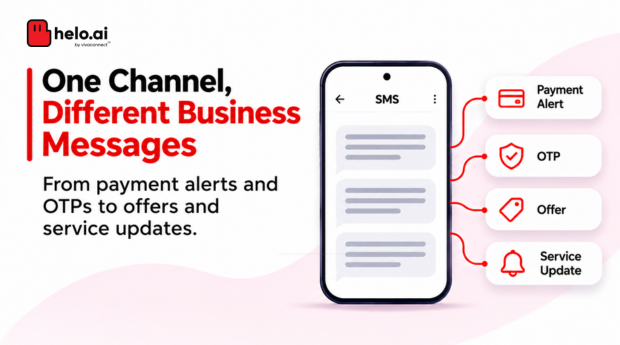


Businesses use SMS for different purposes: confirming payments, sharing delivery updates, verifying logins and announcing offers. Each message serves a different purpose, so choosing the right type matters.
Understanding the different types of messaging also helps businesses plan campaigns, manage customer communication and follow India's applicable DLT requirements.
Here's a quick guide to the main types of business SMS, when to use them and what businesses should know before sending.
Choose a business SMS type by the purpose of the message: transactional confirms a customer-initiated transaction, service shares non-promotional product or service information, promotional markets an offer, and OTP verifies an identity or action.
- Flash-sale SMS is promotional, even when the offer is urgent.
- OTP is a use case. Its classification depends on context.
- Flash SMS (Class 0) is a display format, not a marketing category.
- An offer added to a transactional or service message makes the whole message promotional.
What Are the Different Types of Business SMS?
The most common types of business SMS include transactional, promotional, service, OTP and flash-sale messages. Flash SMS (Class 0) is a separate technical format, rather than another marketing category.
| SMS type | Main purpose | Example |
|---|---|---|
| Transactional SMS | Confirm or communicate a qualifying customer-initiated transaction | Payment confirmation |
| Promotional SMS | Advertise a product, service or offer | Seasonal discount |
| Service SMS | Share relevant non-promotional service information | Delivery update |
| OTP SMS | Verify an identity or action | Login verification code |
| Flash-sale SMS | Promote a limited-period offer | Midnight sale announcement |
| Flash SMS (Class 0) | Display a message immediately on a compatible device | Immediate on-screen alert |
These are practical business-use descriptions, not six separate regulatory categories under India's DLT framework. In particular, OTP is a use case whose classification depends on context, and flash-sale SMS is promotional communication.
Business SMS Types Explained
Transactional SMS
Transactional SMS communicates information in response to a qualifying customer-initiated transaction. Businesses use it for payment confirmations, transaction alerts and other important updates related to an action taken by the customer.
Example SMSYour payment of Rs. 2,500 has been received successfully. Transaction ID: 849205.
Common use cases: Banking alerts, payment confirmations, order confirmations and transaction updates.
Read more: Transactional SMS: Meaning, Use Cases and Business Benefits
Promotional SMS
Promotional SMS is used to market products, services, offers and events. Businesses send these messages to create awareness, attract customers and encourage purchases or other actions.
Example SMSGet 20% off on your next order. Shop the latest collection today: [Link].
Common use cases: Discounts, festive campaigns, product launches, event invitations and special offers.
Read more: Promotional SMS Guide 2026: Types, Examples & TRAI Rules
Service SMS
Service SMS provides relevant, non-promotional information about a product or service a customer uses or has purchased. It helps businesses keep customers informed about updates, service activity and important information.
Example SMSYour order has been dispatched and is expected to reach you by 12 November. Track your delivery here: [Link].
Common use cases: Delivery updates, warranty information, product recalls, safety notifications and service-related alerts.
Important: A service message should not be used to carry an advertisement. Adding promotional content can change the message's regulatory classification.
OTP SMS
An OTP (One-Time Password) SMS contains a temporary code used to verify a customer's identity or confirm an action. It is commonly used during logins, registrations, password resets and eligible transactions.
Example SMSYour verification code is 482913. It is valid for 5 minutes. Do not share this code with anyone.
Common use cases: Login verification, account registration, password resets and transaction authentication.
Important: OTP is a messaging use case, not automatically a separate DLT category. Its classification depends on the purpose and circumstances in which it is sent. Keep OTP messages focused on verification and avoid adding promotional content.
For more on how OTP SMS works, see Helo.ai's explainer on SMS verification.
Flash-Sale SMS
Flash-sale SMS is a promotional message that announces an offer available for a limited period or while stocks last. It encourages customers to act before the offer expires.
Example SMSFlash Sale! Get up to 40% off on selected styles until midnight. Shop now: [Link].
Common use cases: Limited-period discounts, weekend sales, early-access offers, clearance sales and festive promotions.
Important: A flash-sale message is promotional communication. Calling an offer urgent or time-sensitive does not make it transactional or service communication.
Flash SMS (Class 0)
Flash SMS, also known as Class 0 SMS, is a technical message format designed to display immediately on a compatible mobile device's screen rather than being automatically stored like a conventional SMS.
It may be considered for specific alerting scenarios, but device and network support can vary. Businesses should confirm availability with their provider before planning around it.
Remember: Flash SMS is not the same as flash-sale SMS. The former describes how a message is displayed; the latter describes a time-sensitive promotional campaign.
Transactional vs Promotional vs Service SMS
These three categories are often confused because businesses may use all of them to communicate with the same customer. The main difference is the purpose and context of the message.
| Factor | Transactional SMS | Promotional SMS | Service SMS |
|---|---|---|---|
| Purpose | Respond to a qualifying customer-initiated transaction | Market a product, service or offer | Provide relevant non-promotional information |
| Typical message | Payment confirmation | Discount announcement | Delivery update |
| Customer context | Linked to a qualifying transaction | Sent according to applicable preferences and consent | Linked to a product, service or qualifying ongoing transaction |
| Promotional content | Not permitted | Primary purpose | Not permitted |
The classification must reflect the actual message and applicable TRAI definitions. A business should not choose a category simply because it appears to offer more favourable delivery conditions.
One rule matters most here. TRAI's February 2025 amendment says that if promotional content is mixed with any type of transactional or service message, the message is treated as a promotional message. Read the amended regulation for the exact definitions.
How to Choose the Right SMS Type
Start with the purpose of the communication rather than the message format.
| If your business needs to... | Consider... |
|---|---|
| Confirm a qualifying customer-initiated payment | Transactional SMS |
| Announce a discount or new product | Promotional SMS |
| Share a delivery or service update | Service SMS |
| Verify a login or eligible transaction | OTP SMS, classified according to context |
| Announce a limited-time sale | Promotional / flash-sale SMS |
| Display an immediate alert on a compatible device | Flash SMS (Class 0), where supported |
Before sending, check three things:
This helps marketing, operations and technical teams select the right message type before creating templates or configuring an SMS workflow.
DLT Compliance for Business SMS in India
Businesses sending applicable commercial SMS in India must follow the relevant requirements under TRAI's Telecom Commercial Communications Customer Preference Regulations (TCCCPR), 2018, and subsequent directions.
The DLT framework helps identify the sender, the registered message header, the approved content template and applicable consent information.
Depending on the communication, businesses need to consider the following:
A promotional message should not be submitted as transactional or service communication to bypass applicable restrictions. Likewise, adding an offer to an otherwise informational message can change its classification.
For official guidance, refer to TRAI's Advice to Senders and the TCCCPR regulations.
For help with headers and templates, see Helo.ai's DLT management service.
Get your headers and templates right
Talk to the Helo.ai team about the right category, headers and templates for each of your messages.
Managing Different Types of Business SMS at Scale
A business may use several types of SMS to communicate with the same customer.
For example, a bank may send OTPs, transaction alerts, service notifications and promotional offers. An e-commerce company may send payment confirmations, order updates, delivery notifications and sale announcements.
Managing these messages requires a setup that connects business events, customer data and messaging workflows.
When evaluating an SMS platform, look for:
For developers, the typical workflow is straightforward: a business event triggers an API request, the platform submits the message through the configured route, and delivery updates are returned through reports or webhooks where supported. The API acceptance response should not be treated as confirmation that the recipient has received the message.
For reporting detail, see Helo.ai's guide to SMS API analytics. For a broader setup guide, see how to send bulk SMS.
How Helo.ai Supports Business SMS Communication
Helo.ai helps enterprises manage customer communication across channels, including SMS. Businesses planning promotional campaigns and transactional notifications can explore messaging solutions based on their communication needs, integrations and compliance requirements.
Helo.ai's SMS API page lists bulk and transactional messaging, DLT registration and template checks, and CRM and system integrations.
When evaluating a business SMS setup, teams should consider:
- Promotional and transactional messaging requirements.
- Applicable DLT and content-template configuration.
- Integration with existing business systems.
- Delivery reporting and campaign monitoring.
- Coordination across SMS and other customer communication channels.
Planning your next business SMS campaign?
Talk to the Helo.ai team about your messaging requirements, integration needs and approach to managing customer communication.
Business SMS Planning Checklist
Before launching a campaign or notification workflow, check that you have:
- Identified the purpose of each message.
- Selected the appropriate message category.
- Checked whether the content includes promotional material.
- Completed applicable Principal Entity and header registration.
- Registered the relevant content templates.
- Collected and recorded consent where required.
- Checked customer preferences and opt-out requirements.
- Tested message variables and links.
- Confirmed the sending route and available delivery reports.
- Set up monitoring for failed and rejected messages.
Frequently Asked Questions
What are the different types of business SMS?
Common business SMS use cases include transactional, promotional, service and OTP messages. Flash-sale SMS is a promotional use case, while Flash SMS (Class 0) is a separate technical message format.
What is the difference between transactional and promotional SMS?
Transactional SMS responds to a qualifying customer-initiated transaction and provides related information. Promotional SMS advertises or markets a product, service or offer. Their classification affects applicable compliance requirements.
Is OTP SMS transactional or service SMS?
It depends on the context. An OTP sent in response to a qualifying customer-initiated transaction can fall under the transactional definition. Other OTP scenarios should be classified according to their purpose and the applicable requirements.
What is service SMS used for?
Service SMS provides relevant, non-promotional information about a product or service a customer uses or has purchased. Examples include delivery updates, warranty information, product recalls and safety notifications.
What is the difference between flash-sale SMS and Flash SMS?
Flash-sale SMS is a promotional message announcing a limited-time offer. Flash SMS (Class 0) is a technical message format designed to display immediately on a compatible device. They are not the same thing.
Can a transactional SMS contain an offer?
No. Under the amended TRAI framework, promotional content mixed with a transactional or service message can cause the entire message to be treated as promotional. Keep marketing content separate from essential customer notifications.
Is DLT registration required for business SMS in India?
Businesses sending applicable commercial communication must fulfil relevant DLT requirements. These may include Principal Entity, header and content template registration, as well as consent-related requirements where applicable.
How can businesses track SMS delivery?
Businesses can use delivery reports (DLRs) provided by their messaging platform or telecom provider. These reports show the available delivery status, but a delivered status does not necessarily mean that the recipient has read the message.
Can an OTP SMS include a promotion?
No. Keep OTP messages focused on verification. Under TRAI's amended rules, promotional content mixed into a transactional or service message makes it a promotional message.
Is a delivery update a service SMS or a transactional SMS?
Usually a service SMS. TRAI's definition of a service message lists information regarding delivery of goods or services among its examples, provided the message is not promotional.
Final Takeaway
Different types of business SMS serve different purposes. Transactional messages confirm customer actions, promotional messages support marketing campaigns, service messages keep customers informed and OTPs help verify identities. Flash-sale SMS creates urgency around an offer, while Flash SMS refers to a different technical format.
The important part is to choose the right message type, keep the content aligned with its purpose and follow applicable DLT requirements.
When these basics are in place, SMS becomes easier to manage across customer notifications, marketing campaigns and everyday business communication.
Disclaimer. This article is general information, not legal or compliance advice. TRAI definitions, DLT requirements and operator rules can change, so confirm the right category for each message with your compliance advisers and messaging provider. Examples are illustrative, not approved templates. Helo.ai is the publisher and offers messaging products; capabilities depend on your setup. Sources were last checked in November 2026.