.jpeg)


If you receive a call from a bank, insurance company or financial services provider, the number displayed on your phone can tell you something about the purpose of that call.
That is the idea behind TRAI's designated business calling number series. Instead of allowing every type of commercial call to originate from ordinary ten-digit numbers, the framework assigns specific number series for promotional and service-related communication.
For businesses, this is more than a change in caller ID. It affects which number series they can use, how they classify calls, how they work with telecom service providers and how they manage automated calling systems.
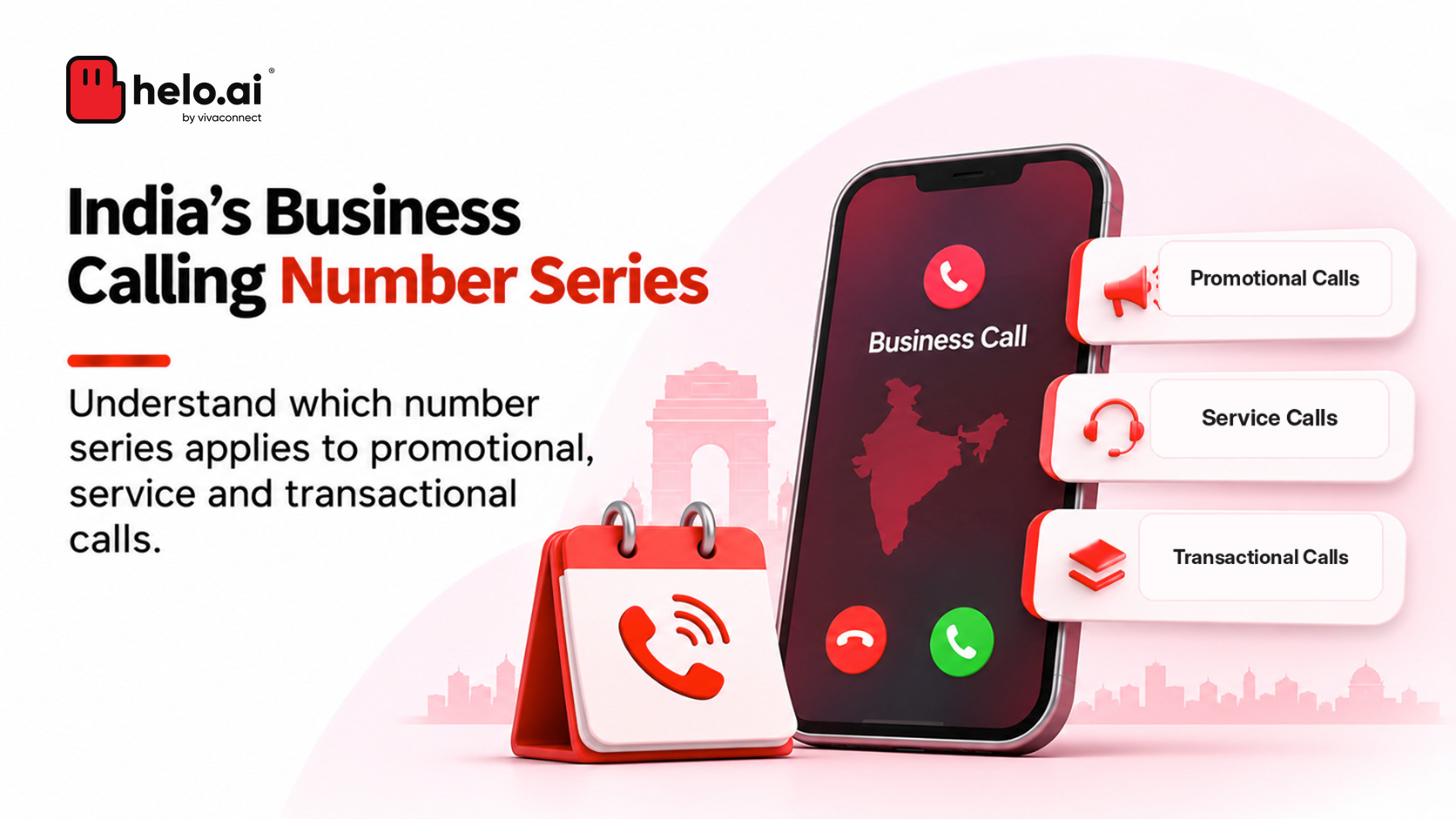
India now has three important designated series to understand:
- 140xx: For promotional voice calls across sectors.
- 1600xx: For service and transactional voice calls by eligible BFSI entities and government entities.
- 1601xx: For service and transactional voice calls by eligible entities in specified non-BFSI sectors, currently utilities and logistics/courier services under Phase I.
The rules have also evolved through TRAI directions and amendments issued in 2025 and 2026. This guide explains what each series is for, who can use it, the adoption requirements and what businesses should check before making calls.
Regulatory position reviewed as of 16 November 2026. Businesses should check the latest TRAI directions and their telecom service provider's implementation instructions before acting.
The 140 series is for promotional voice calls. The 1600 series is for service and transactional calls by eligible BFSI and government entities, and 1601 covers utilities and logistics under Phase I. Classify each call by purpose first, then confirm eligibility and number allocation with your telecom provider.
140, 1600 and 1601: What is the difference?
The first thing to understand is that these are designated business calling number series, not ordinary geographic area codes.
The phrase "160 area code" is often used in searches, but 1600xx and 1601xx are special numbering series introduced for specific categories of commercial voice calls.
Here is how they differ:
| Number series | Purpose | Who can use it? |
|---|---|---|
| 140xx | Promotional voice calls | Registered entities across sectors, subject to TCCCPR requirements |
| 1600xx | Service and transactional voice calls | Eligible BFSI entities regulated by RBI, SEBI, IRDAI and PFRDA, and government entities for government-to-citizen communication |
| 1601xx | Service and transactional voice calls | Eligible non-BFSI, non-government entities in the sectors covered under Phase I, including utilities and logistics/courier services |
The distinction is based on the purpose of the call and the eligibility of the organisation making it. A company cannot choose a number series simply because it wants its calls to appear more trustworthy.
What is the 140 series?
The 140 series is designated for promotional voice calls by entities across sectors.
A business using voice calls to advertise a product, introduce an offer, generate leads or encourage a customer to make a purchase must follow the applicable promotional calling requirements.
For example:
- A bank calling customers to promote a personal loan.
- An insurance company calling prospects about a new policy.
- A retailer announcing a sale or discount.
- A real estate company calling potential buyers about a new project.
- A financial services company promoting an investment product.
These are promotional conversations, even when the recipient is already a customer.
Who can use 140 numbers?
Entities that want to make promotional calls using the 140 series must register with their Telecom Service Provider (TSP) under the TCCCPR framework and comply with the applicable requirements.
Using a 140 number does not remove the need to follow customer preferences, registration requirements or other applicable calling rules.
How does DND affect 140 calls?
Customers can manage promotional calling preferences through the Do Not Disturb (DND) registry.
They can choose to allow or block promotional calls from particular sectors or from all sectors. If a customer has blocked promotional calls from a particular sector, calls originating from the 140 series for that sector are blocked in accordance with the registered preference.
Customers can register or modify their preferences through the TRAI DND App, their telecom operator's app or website, or the prescribed 1909 channels.
TRAI's July 2026 clarification also addressed how these calls are treated by tagging and filtering systems. Tagging or filtering of 140-series calls is not permitted, except for blocking based on the customer's DND preference.
This matters because a customer who has chosen to receive promotional calls from a sector should not have those calls incorrectly labelled or filtered as spam by a blanket mechanism.
What is the 1600 series?
The 1600 series is designated for service and transactional voice calls by eligible BFSI entities and government entities.
For BFSI organisations, the series is intended to give customers a recognisable calling identity for important communications from regulated institutions.
It is relevant to organisations regulated by:
- Reserve Bank of India (RBI)
- Securities and Exchange Board of India (SEBI)
- Insurance Regulatory and Development Authority of India (IRDAI)
- Pension Fund Regulatory and Development Authority (PFRDA)
Government entities also use the series for government-to-citizen communication.
Which BFSI organisations must adopt 1600 numbers?
TRAI introduced phased adoption deadlines for RBI-, SEBI- and PFRDA-regulated entities through its direction dated 19 November 2025. IRDAI-regulated entities were covered by a separate direction dated 16 December 2025.
The adoption schedule for the categories specified in the RBI, SEBI and PFRDA direction was:
| Regulator | Category | Mandatory adoption deadline |
|---|---|---|
| RBI | Commercial banks, including public, private and foreign banks | 1 January 2026 |
| RBI | Large NBFCs (asset size above ₹5,000 crore), payments banks and small finance banks | 1 February 2026 |
| RBI | Remaining NBFCs (asset size up to ₹5,000 crore), cooperative banks and regional rural banks, among other covered entities | 1 March 2026 |
| SEBI | Mutual funds and asset management companies | 15 February 2026 |
| SEBI | Qualified stockbrokers identified by stock exchanges | 15 March 2026 |
| PFRDA | Central Recordkeeping Agencies and Pension Fund Managers – Point of Presence | 15 February 2026 |
| IRDAI | IRDAI-regulated entities | 15 February 2026 |
The direction specifies that covered entities cannot initiate service or transactional voice calls from numbers other than those allocated under the 1600 series after their respective mandatory adoption dates. This applies even where the customer has given explicit or inferred consent.
Not every organisation associated with financial services automatically falls into the same category. For example, the November 2025 direction provides for voluntary adoption, for the time being, by SEBI-registered intermediaries outside the specified mandatory phases.
Businesses should check the exact category applicable to them rather than assuming that every financial services company has the same deadline.
Can 1600 calls be tagged or blocked as spam?
This is an important part of the framework.
In its clarification dated 10 July 2026, the Ministry of Communications stated that under TCCCPR, tagging, blocking or filtering calls originating from the 1600 series is not permitted.
Source check: TRAI's Press Release No. 91 of 2026, dated 10 July 2026, carries this clarification. It also says 140-series calls may be blocked only on the customer's DND registration.
The September 2026 TCCCPR amendment also introduced restrictions on blanket blocking, filtering and spam tagging by Call Management Applications (CMAs) for designated commercial calling series, including 1600xx and 1601xx.
There is an important distinction here: restrictions on blanket actions by call-management applications do not take away an individual's ability to block or filter calls on their own device.
The objective is to avoid legitimate designated business calls being automatically misclassified as spam while preserving individual control over incoming calls.
What is the 1601 series?
The 1601 series extends designated service and transactional calling to eligible entities outside the BFSI and government sectors.
TRAI issued the direction for 1601 numbering on 10 August 2026. Under Phase I, the series covers specified entities in:
Utilities
- Electricity distribution companies
- Water utilities
- City gas distribution companies
- LPG-related utilities and other eligible utility services
Logistics and delivery
- Courier companies
- Express logistics providers
- Parcel delivery businesses
- Eligible freight and logistics companies involved in the delivery of consignments
The series is intended for service and transactional voice calls, not promotional campaigns.
Who can get a 1601 number?
The direction provides for direct allocation to eligible entities after verification by the Telecom Service Provider.
An aggregator or intermediary cannot simply obtain a 1601 number and use it on behalf of multiple unrelated businesses. The allocation is intended for the eligible principal entity that makes the qualifying calls.
The TSP also obtains an undertaking that the allocated number will be used exclusively for service and transactional voice calls.
Check with your provider: TRAI's 10 August 2026 direction refers to eligible principal entities and does not address aggregators. Its sector examples are illustrative, not formal definitions.
What was the 1601 implementation timeline?
TRAI's direction was issued on 10 August 2026 and provided a 90-day period for onboarding and migration.
| Milestone | Date |
|---|---|
| TRAI direction issued | 10 August 2026 |
| 90-day onboarding and migration period ends | 8 November 2026 |
| Access Providers' final compliance report due within 15 days after the implementation period | 23 November 2026 |
How the dates are worked out: The direction sets a 90-day period from 10 August 2026 and a final report within 15 days after it. The calendar dates in the table are calculated from those periods.
As of 16 November 2026, the 90-day implementation period has ended, but the final reporting deadline has not yet arrived.
This does not mean every eligible organisation has completed migration. Each business should confirm its own allocation and operational status with its TSP.
The September 2026 TCCCPR amendment also restricts blanket spam tagging, filtering and blocking by call-management applications for designated series, including 1601xx. Individual customers retain the ability to manage calls on their own devices.
Service, transactional and promotional calls: How should businesses classify them?
Having the correct number series is only one part of compliance. Businesses must also understand what kind of call they are making.
A common mistake is to classify every call to an existing customer as a service or transactional call. That is not how the rules work.
Under the TCCCPR Second Amendment Regulations, 2025, the distinction depends on the purpose and timing of the communication.
Transactional voice calls
A transactional voice call is made in response to a transaction initiated by the customer, within 30 minutes of that transaction.
Examples include:
- An OTP call following a customer-initiated transaction.
- A transaction confirmation call.
- An immediate balance alert after a completed transaction.
- A refund-related update connected to a customer-initiated transaction within the prescribed period.
The call must not contain promotional content.
A call made several hours or days after a transaction does not automatically qualify as transactional simply because it relates to that transaction.
Service voice calls
A service voice call provides information about a product or service that the customer already uses or has purchased. It must not be promotional in nature.
Examples include:
- A product warranty update.
- A product recall or safety notification.
- A software upgrade alert.
- A security-related communication.
- A periodic balance alert.
- An update about the delivery of goods or services.
The regulations also cover calls that facilitate or complete an ongoing commercial transaction involving a product or service, where explicit consent has been obtained. That consent is limited to seven days or another period specified by the Authority.
Promotional voice calls
A promotional voice call contains advertising or promotional material for a product or service.
Examples include:
- A new loan offer.
- An insurance policy promotion.
- A credit card upgrade offer.
- A sale announcement.
- A cross-sell or upsell pitch.
Promotional calls must follow the applicable 140-series and customer preference requirements.
What happens when a service call includes a promotion?
The entire call is treated as promotional if promotional content is mixed into another type of commercial voice call.
For example, consider a bank calling a customer to provide an account-related service update. If the agent then uses the same call to promote a personal loan, the call is no longer purely a service communication.
This distinction is particularly important for BFSI organisations. A service call should not become a sales call halfway through the conversation while continuing to use the service-call classification.
| Example | Likely classification | What businesses should check |
|---|---|---|
| OTP call immediately after a customer-initiated transaction | Transactional | The customer-initiated transaction and 30-minute window |
| Account security alert | Service | Whether it relates to the customer's existing product or service and contains no promotion |
| Loan offer to an existing bank customer | Promotional | Promotional calling requirements |
| EMI or repayment reminder | Depends on the circumstances | Purpose, timing, regulatory category and applicable consent requirements |
| Policy renewal information | Depends on the content | Whether it is a service update or includes a sales pitch |
| Delivery status update | Service | Whether it relates to an existing order or delivery |
| Delivery update followed by an unrelated offer | Promotional | Promotional content changes the classification of the call |
Important: A payment reminder, collection call or renewal call is not automatically transactional. Businesses should have their compliance teams classify each use case against the actual regulatory definitions and applicable sector-specific directions.
What should businesses do to adopt the correct number series?
The process begins with understanding the organisation's eligibility and the purpose of its calls. A business should not start by choosing a number and then trying to fit its calling activity into that category.
A practical adoption process looks like this.
Step 1: Identify the organisation's eligibility
Determine whether the organisation falls under the BFSI, government, utilities or logistics categories covered by the relevant directions.
For BFSI organisations, identify the applicable regulator and mandatory adoption deadline.
For entities outside BFSI and government, check whether the organisation is covered by the current 1601 Phase-I scope. Do not assume that all non-BFSI businesses are eligible.
Step 2: Classify every calling use case
Prepare a list of calls made by the organisation and classify each one as promotional, service or transactional.
Include calls made by:
- Customer support teams
- Collections teams
- Sales teams
- Operations teams
- Automated IVR systems
- AI voice agents
- Outsourced contact-centre partners
This exercise helps identify situations where a call's actual content may not match the category assigned to it.
Step 3: Contact the Telecom Service Provider
Approach the TSP to understand the applicable registration, eligibility verification, documentation and number allocation process.
For 1600 and 1601, confirm the specific requirements for the eligible entity, including any undertaking and provisioning requirements.
The process and documentation may differ depending on the category and service provider. Do not rely on an old onboarding checklist without checking the latest instructions.
Step 4: Review automated calling arrangements
If the organisation uses autodiallers, robocalls or automated calling platforms, review the applicable TCCCPR requirements.
The 2025 amendment requires the Sender to notify the Originating Access Provider in advance, in writing, about the use of autodiallers or robocalls and the intended objective of the calls.
TRAI's September 2026 Third Amendment also introduced an express definition of Application-to-Person (A2P) calls, covering calls initiated by an application, software system or automated platform without direct human dialling, including autodialling, robocalls and prerecorded or artificial voice technologies.
Businesses using automated calling should check the current requirements with their TSP and compliance teams, including any additional declaration or operational steps applicable to their setup.
What the September 2026 amendment adds: TRAI's press release of 18 September 2026 says A2P users must declare this use to their telecom provider in advance, with the numbers they will use. It says undeclared A2P calls are treated as unsolicited commercial communication. The release states no effective date, so confirm timing with your provider.
Step 5: Check the calling setup before going live
Before launching or migrating a calling programme, confirm:
- The number has been allocated to the eligible entity.
- The number is provisioned for the intended calling purpose.
- The calling use case matches the approved category.
- Promotional content is not mixed into service or transactional calls.
- Automated calling arrangements have been notified as required.
- Agents and outsourced partners understand which calls they can make from the allocated number.
- Call logs and operational records are available for internal review.
Step 6: Review the process regularly
Calling programmes change. New campaigns, revised scripts, additional customer journeys and new automation workflows can alter the purpose of a call.
Review call scripts, agent training material, automated workflows and vendor arrangements periodically. A number allocation should not be treated as permanent approval for every future calling use case.
What do the new number-series rules mean for AI voice agents?
Businesses are increasingly using AI voice agents to handle customer support, reminders, enquiries, collections and other high-volume calling workflows.
These systems can make and receive calls, understand customer responses, share information and transfer conversations to human agents when needed.
But the use of AI does not change the underlying calling rules.
An AI voice agent making a promotional call is still making a promotional call. A voice agent handling a qualifying service or transactional call must still operate within the applicable category and number-series requirements.
For organisations using AI voice agents, this means:
- Classify the purpose before automating it. A customer support workflow and a sales campaign should not be treated as the same type of call.
- Use the appropriate calling identity. The number series must match the organisation's eligibility and the purpose of the call.
- Keep automated calling arrangements in view. Autodiallers, robocalls and A2P calling workflows must be reviewed against the applicable TCCCPR requirements.
- Train the system around approved scripts and boundaries. An AI agent should not turn a service conversation into a promotional pitch unless the business has deliberately designed and approved a compliant promotional journey.
- Keep a record of what happened. Call outcomes, transfers, customer responses and campaign details help teams review performance and investigate complaints.
For businesses evaluating enterprise voice automation, Helo Voice supports inbound and outbound voice workflows, integrations and live handoff to human teams. It can form part of a broader calling operation, but the business remains responsible for its regulatory eligibility, number allocation and calling compliance.
Explore Helo Voice
See how Helo Voice handles inbound and outbound calls with live handoff to your team.
Common mistakes businesses should avoid
A designated number series is useful only when the business uses it correctly. These are some mistakes worth checking for:
Treating 1600 and 1601 as interchangeable
The two series have different eligibility requirements. The 1600 series covers eligible BFSI and government communication, while 1601 is intended for specified non-BFSI sectors under its current Phase-I scope.
Using 140 for service calls
The 140 series is designated for promotional voice calls. It should not be used as a general-purpose business calling number.
Assuming every existing-customer call is a service call
The customer's relationship with the business does not determine the call category on its own. The purpose and content matter.
Calling a payment reminder transactional by default
A payment reminder may relate to an earlier transaction, but that does not automatically satisfy the regulatory definition of a transactional voice call.
Adding an offer to a service conversation
Promotional content can change the classification of the entire call. Keep service and promotional journeys separate.
Assuming a number series guarantees trust
A designated number helps identify the category of a business call. It does not prove that every caller is genuine or that every request made during a call is safe. Customers should continue to verify sensitive requests independently and never share OTPs, PINs or passwords.
Assuming an AI voice platform handles telecom compliance
Voice automation software does not allocate a regulated number or make an organisation eligible for a particular series. Businesses must coordinate with their TSP and compliance teams.
Frequently asked questions
What is the 160 area code in India?
The phrase "160 area code" generally refers to India's designated 1600 business calling series. It is not a geographic area code like those used to identify a city or region. The 1600 series is intended for service and transactional calls by eligible BFSI entities and government entities.
What is the difference between 140 and 1600 numbers?
The 140 series is used for promotional voice calls by registered entities across sectors. The 1600 series is designated for service and transactional calls by eligible BFSI-regulated entities and government entities.
What is the difference between 1600 and 1601 numbers?
The 1600 series is intended for eligible BFSI and government service and transactional calls. The 1601 series is intended for eligible non-BFSI, non-government entities in specified sectors, currently utilities and logistics/courier services under Phase I.
Can a bank use a 140 number to promote a loan?
A loan promotion is a promotional voice call. The 140 series is the designated series for promotional calls, subject to registration and applicable TCCCPR requirements. The 1600 series should not be used for promotional campaigns.
Are all banks required to use 1600 numbers?
TRAI has prescribed phased mandatory adoption for specified RBI-regulated entities, including commercial banks, payments banks, small finance banks and NBFC categories. The applicable deadlines differ by category. Banks and other financial entities should verify their specific coverage and implementation status.
Can an organisation use 1601 for customer support calls?
Only if the organisation is eligible under the 1601 direction and the calls qualify as service or transactional calls. The series is not available to every business that provides customer support.
Can AI voice agents make calls using 1600 or 1601 numbers?
AI voice agents can be part of an eligible organisation's calling setup, subject to the applicable number allocation, calling-purpose and telecom requirements. The business must also review the rules for autodiallers, robocalls and A2P calls with its TSP.
Does a 1600 or 1601 number guarantee that a call is genuine?
No. A designated series helps identify the type of commercial communication and the category of entity using it. Customers should still be cautious about requests for OTPs, passwords, PINs or sensitive financial information.
Can customers block calls from 140, 1600 or 1601 numbers?
Customers can register DND preferences to block promotional calls from 140 numbers by sector or across sectors. TRAI's July 2026 clarification restricts tagging, blocking and filtering of 1600 calls under TCCCPR, while the September 2026 amendment restricts blanket blocking and spam tagging by call-management applications across designated series. Individual customers retain the ability to block or filter calls on their own devices.
What should a business do before migrating to a designated number series?
It should confirm its eligibility, classify its calling use cases, contact its TSP, complete the applicable registration and allocation process, review automated calling requirements and test the calling setup before going live.
A clearer calling identity starts with the right classification
The 140, 1600 and 1601 series give businesses a more structured way to make commercial calls in India. But choosing the right number is only the beginning.
Businesses need to understand who is eligible to use each series, classify their calls correctly and make sure their agents, automated systems and telecom partners follow the same rules.
For BFSI organisations in particular, the distinction between a service update, a transaction-related call and a promotional pitch needs to be clear before a calling workflow goes live. Getting that right helps protect customers, gives contact-centre teams a more consistent process and reduces the risk of using a designated number for the wrong purpose.
Related resource
Business Calling Number-Series & Compliance Checklist
A practical checklist covering number-series eligibility, call classification, TSP coordination, automated calling notifications and pre-launch checks.
Further reading
- DPDP & TRAI Compliance Checklist for Customer Calls in India
- TRAI: Telecom Commercial Communications Customer Preference Regulations
- TRAI: Mandatory adoption of 1600-series numbers by RBI, SEBI and PFRDA entities
- TRAI: Allocation and operationalisation of the 1601 numbering series
Plan your calling setup with Helo.ai
Talk to the Helo.ai team about voice automation, call workflows and live handoff for your business.
This article is intended as a business information guide, not legal advice. Organisations should confirm their specific obligations with their telecom service provider and legal or compliance team.
Helo.ai offers an AI voice product, Helo Voice, mentioned above. Regulatory points were checked against TRAI documents on 21 November 2026.