.jpeg)
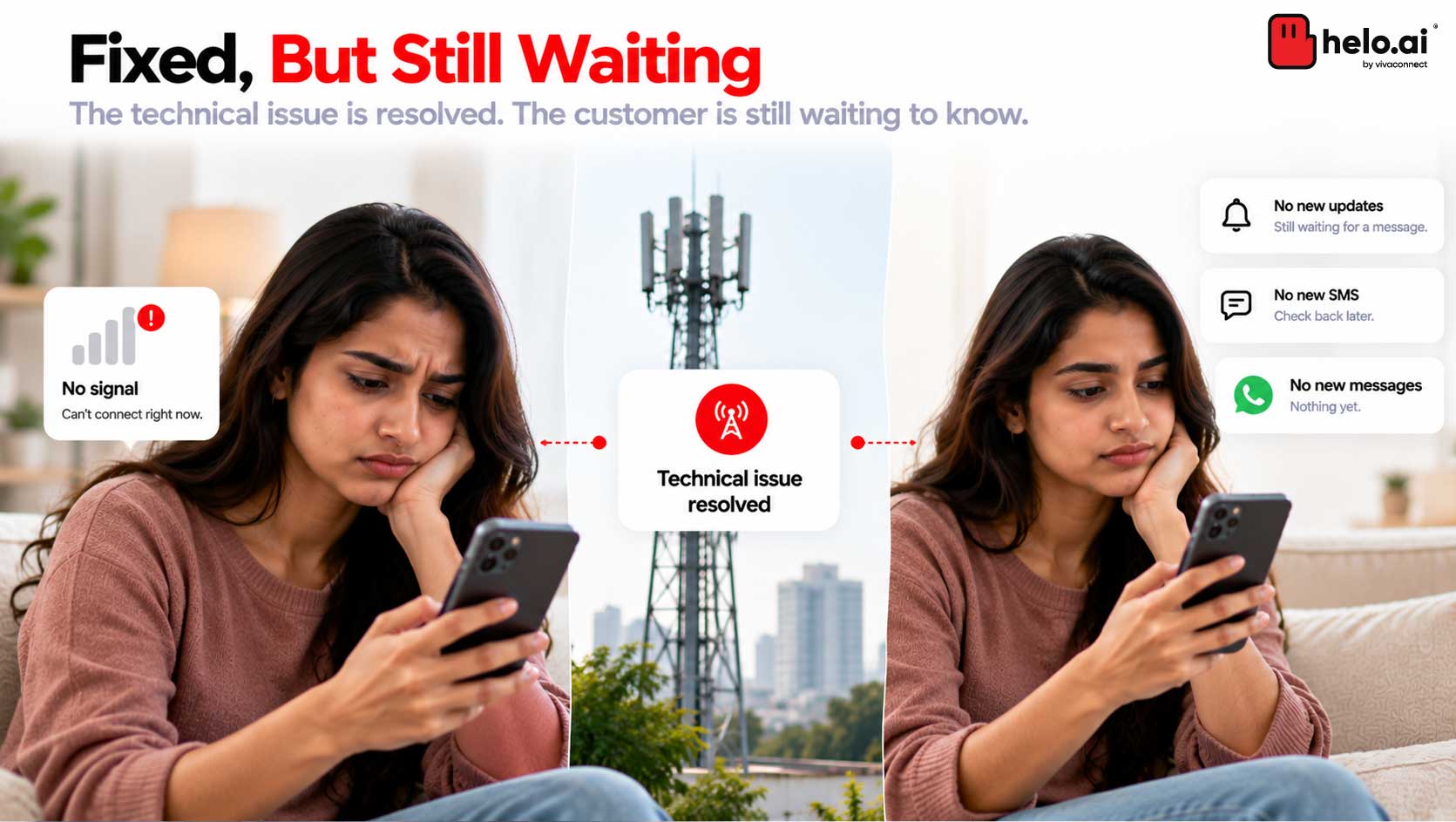


A telecom operator fixes a network issue and closes the support ticket. But the customer is still waiting for confirmation.
They may restart their phone, contact support again or continue believing the problem has not been fixed. The technical team considers the job complete; the customer does not have the information needed to know that.
A technically resolved issue and a resolved customer experience are not the same thing.
For telecom operators, the difference lies in what happens after the repair: whether customers receive accurate, timely information about the outcome.
1. Technical resolution vs customer-perceived resolution
Technical resolution | Customer-perceived resolution |
The fault has been fixed. | The customer knows service has been restored. |
The support ticket is closed. | The customer understands the outcome. |
The technical team has completed its task. | The customer knows what to do if the issue continues. |
The internal system records completion. | The customer has received a clear update. |
The gap emerges when an operator measures success through ticket closure alone.
For example, if connectivity is restored but the customer receives no update, they may contact support again. This creates avoidable effort even though the original technical problem has been fixed.
The solution is not to replace technical resolution with notifications. It is to connect the two: the operator verifies the repair, then communicates the outcome clearly.
2. Why does the customer-facing outcome matter?
KPMG India's India CX Report '25 identifies integrity and resolution as important dimensions of customer experience. Its framework associates integrity with keeping customers informed and resolution with addressing disappointing experiences and taking ownership of problems.
The report's network-operator findings also discuss how poor service and unresolved complaints can affect customer trust. In that segment, 44% of customers said they may switch operators if expectations are not met.
Source: KPMG India - India CX Report '25: Network Operators.
Separate evidence from LocalCircles highlights the wider complaint-resolution challenge. In a survey published on 29 December 2025, 47% of respondents who had filed complaints with their mobile service provider over the preceding three years reported that most or all of their complaints remained unresolved. Of those, 33% said all remained unresolved and 14% said most did.
The resolution-status question received 14,072 responses. The wider survey covered more than 48,000 responses across 349 Indian districts.
Source: LocalCircles - Mobile subscriber grievances and complaint resolution.
This finding concerns respondents' reported complaint outcomes, not specifically missing updates after a technical repair. It nevertheless reinforces why operators should consider the customer's experience alongside internal closure records.
3. What should operators measure differently?
The distinction between technical and customer-perceived resolution should also appear in performance measurement.
Measure | What it tells the operator |
Technical resolution time | How long it takes to fix the fault |
Customer notification time | How soon the customer is informed after verified restoration |
Repeat contact rate | Whether customers contact support again about the same issue |
Notification delivery status | Whether the update reached the intended channel |
Customer satisfaction after resolution | Whether the customer understood and accepted the outcome |
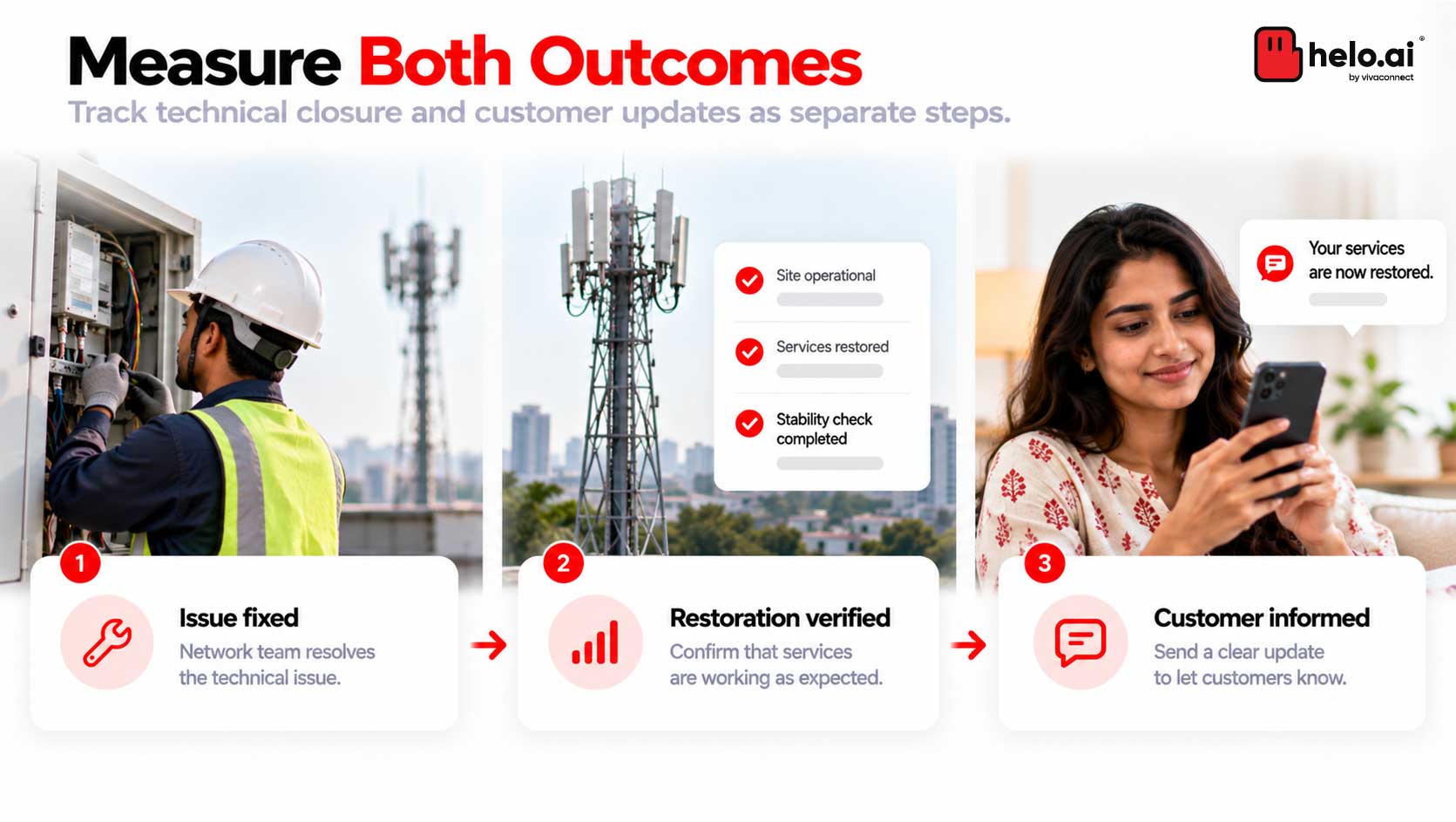
These measures should be interpreted together. A delivered notification does not prove that the customer read it, just as a closed ticket does not prove the customer knows the issue has been resolved.
Practical steps include acknowledging the initial report, providing realistic timelines when available, confirming verified restoration and offering a clear next step if the problem persists.
Tracking notification time and repeat contacts? The CPaaS KPI Handbook covers 50+ WhatsApp, SMS and RCS metrics, with formulas and worked examples.
The goal is to reduce uncertainty without sending unnecessary messages or presenting unverified restoration status as fact.
4. How Helo.ai can support connected customer experiences
Telecom customers experience the operator as one business, even when network operations, support and customer engagement are handled by different teams.
Helo.ai helps businesses connect with customers through AI-powered, omnichannel engagement. For telecom operators, this approach can support more connected customer journeys, including relevant service updates and assistance across customer touchpoints, subject to validated workflows and integrations. Its channels include SMS, WhatsApp, RCS and voice.
Helo.ai does not repair network faults or independently verify restoration. The operator's systems and teams must establish the status. Helo.ai's role is to support the customer-facing experience once reliable information is available.
Planning customer updates for your telecom network? Talk to the Helo.ai team about SMS, WhatsApp and voice updates.
What telecom operators should take away
Technical closure tells an operator that work has been completed. A clear customer update helps the customer understand the outcome.
Measuring both gives telecom operators a more complete view of service resolution, helps identify avoidable follow-up contacts and keeps the customer experience connected to operational performance.
Fix the issue. Confirm the outcome. Make sure the customer knows what happened.
Frequently asked questions
Why should telecom operators notify customers when a network issue is resolved?
Closing a ticket does not tell the customer that service is back. Without an update, customers may contact support again or assume the problem continues.
What is the difference between ticket closure and customer resolution?
Ticket closure means the internal system records completion. Customer resolution means the customer knows service is restored, understands the outcome and knows what to do if the issue continues.
How can telecom providers reduce repeat contacts after an outage?
Acknowledge the report, give realistic timelines, confirm verified restoration and offer a clear next step if the problem persists. Track repeat contact rate alongside notification time.