.jpeg)
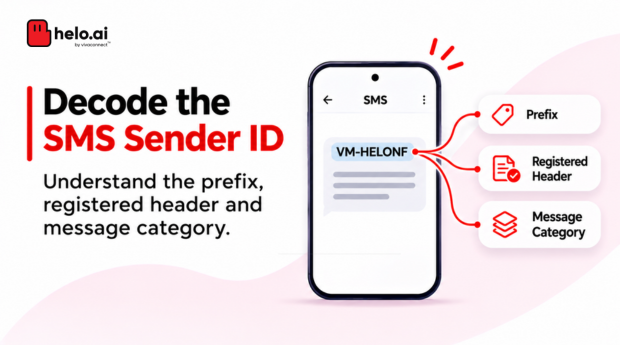


Ever received an SMS from AD-AXISBK, VM-ICICIB or JX-MSG91 and wondered what the extra letters mean?
These characters are not random. They help identify the telecom access provider and service area associated with the message route. The letters at the end, such as -P, -S, -T and -G, indicate the category of the message.
Understanding these SMS sender ID prefixes and suffixes makes it easier to recognise business messages, understand how SMS headers work in India and manage sender IDs under the DLT framework.
Let's break down the format with examples, including VM-NICSMS, AX-ECISMS and AD-ECISMS.
An Indian business SMS sender ID such as AD-AXISBK-P has three parts: a two-letter prefix for the originating access provider and service area, a registered header for the sender, and a suffix for the message category.
- In the prefix, the first letter is the access provider and the second is the service area. AD is Airtel, Delhi.
- The suffixes are -P promotional, -S service, -T transactional and -G government.
- The same registered header can appear with different prefixes, depending on the route.
- A familiar sender ID is not proof that a message is genuine.
What Is an SMS Sender ID Prefix?
An SMS sender ID prefix is the two-letter code that appears before a registered business header in many Indian commercial SMS messages.
For example:
Example sender IDAD-AXISBK
It has two parts:
- AD is the prefix associated with the originating telecom access provider and service area.
- AXISBK is the registered sender header identifying the business.
The prefix is part of the SMS routing and identification structure. It is not the company's brand name or the sender ID it independently chooses.
Under TRAI's published header structure, the first character identifies the originating access provider, while the second identifies its originating Licensed Service Area (LSA). The registered header follows after the hyphen.
If you are looking for an SMS codes list, it is important to understand that the prefix and registered header are different. One identifies the originating route; the other identifies the sender.
For a broader explanation of registered sender identities, see our SMS Sender ID glossary.
How to Read an Indian SMS Sender ID
A typical commercial SMS header can appear in this format:
FormatXX-HEADER-Y
For example:
Example sender IDAD-AXISBK-P
| Part | Example | Meaning |
|---|---|---|
| First two characters | AD | Originating access provider and service area |
| Registered header | AXISBK | Sender or business identity |
| Final suffix | -P | Message category: promotional |
There are three things to remember:
- The prefix identifies the originating access provider and service area.
- The registered header identifies the sender.
- The suffix indicates the message category.
The prefix can vary depending on the originating route. The same registered header may therefore appear with different prefixes when messages are delivered through different originating access providers or service areas.
TRAI's prefix document writes a header as XY-ABCDEF. It describes six characters as the current standard for the header, although the regulations allow up to 11 characters.
What Do AD-, VM- and JX- Mean?
The first character represents the telecom service provider, and the second represents the service area code.
Here are some commonly seen examples based on TRAI's published prefix reference:
| Prefix | First character | Second character | Common interpretation |
|---|---|---|---|
| AD | A – Airtel | D – Delhi | Airtel, Delhi service area |
| AX | A – Airtel | X – Karnataka | Airtel, Karnataka service area |
| VM | V – Vodafone Idea | M – Mumbai | Vodafone Idea, Mumbai service area |
| JX | J – Reliance Jio | X – Karnataka | Jio, Karnataka service area |
| JD | J – Reliance Jio | D – Delhi | Jio, Delhi service area |
| VD | V – Vodafone Idea | D – Delhi | Vodafone Idea, Delhi service area |
Check before relying on it: These examples explain the published code structure. They should not be treated as a live list of every active operator assignment or route. Telecom arrangements and prefix references can change, so check the latest available TRAI information when investigating a specific message.
What does each letter represent?
| Code | Telecom provider |
|---|---|
| A | Bharti Airtel |
| B | BSNL |
| J | Reliance Jio |
| M | MTNL |
| V | Vodafone Idea |
Some older code lists also contain codes for operators that have since exited, merged or changed their operations. These should not automatically be treated as current network assignments.
Common service area codes
The second character is the service area code. The codes below follow the published list.
- A Andhra Pradesh
- B Bihar
- D Delhi
- G Gujarat
- H Haryana
- I Himachal Pradesh
- J Jammu & Kashmir
- X Karnataka
- L Kerala
- K Kolkata
- Y Madhya Pradesh
- Z Maharashtra
- M Mumbai
- N North East
- O Odisha
- P Punjab
- R Rajasthan
- T Tamil Nadu
- E UP-East
- W UP-West
- V West Bengal
- S Assam
A useful distinction: M represents Mumbai, while Z represents Maharashtra in the published service-area code list. They should not be used interchangeably.
These codes relate to the originating provider's service area. They do not reliably identify the recipient's current physical location.
What Does VM-NICSMS Mean?
VM-NICSMS combines a telecom prefix with a registered sender header.
It can be read as:
- VM: Vodafone Idea, Mumbai service area, according to the published prefix structure.
- NICSMS: A sender header listed in TRAI's compiled header records in association with National Informatics Centre Services Inc.
NIC stands for National Informatics Centre. NICSI stands for National Informatics Centre Services Inc.
So, when someone searches for the VM NICSMS full form, the important distinction is that NICSMS is the sender header, while VM is the telecom prefix.
The same registered header may appear with a different prefix if the originating access provider or service area changes.
Verification note: Sender-header ownership and current registration status should be checked in the live TRAI Header Information Portal. A historical listing is useful for understanding an example, but should not replace a current lookup.
What Does AX-ECISMS or AD-ECISMS Mean?
AX-ECISMS and AD-ECISMS follow the same format. The prefix changes, but the sender header remains the same.
| SMS sender ID | Prefix meaning | Sender header |
|---|---|---|
| AX-ECISMS | Airtel, Karnataka | ECISMS |
| AD-ECISMS | Airtel, Delhi | ECISMS |
ECISMS is a sender header publicly associated with the Election Commission of India (ECI) in published sender-header listings.
The distinction is useful when searching for the AX ECISMS full form or AD ECISMS:
- AX and AD identify different originating service-area codes.
- ECISMS identifies the sender header.
The prefix does not change the organisation represented by the header.
For current registration and ownership information, search the sender header in the TRAI Header Information Portal before relying on the association.
What Do -S, -P, -T and -G Mean in SMS?
The letters at the end of an SMS sender ID indicate the category of the message.
TRAI's 2025 amendment to the Telecom Commercial Communications Customer Preference Regulations introduced these suffixes to help recipients identify the type of commercial communication.
| Suffix | Message category | Typical example |
|---|---|---|
| -P | Promotional | Offers, discounts and marketing campaigns |
| -S | Service | Delivery updates, warranty and safety information |
| -T | Transactional | Qualifying transaction alerts and OTPs |
| -G | Government | Government messages sent under the applicable framework |
-P: Promotional SMS
The -P suffix identifies a promotional message containing advertising or promotional material.
Examples include discounts, product launches, marketing campaigns and promotional event invitations.
Example formatAD-BRAND1-P
-S: Service SMS
The -S suffix identifies a service message. These messages provide relevant, non-promotional information about a product or service used or purchased by the customer.
Examples include delivery updates, warranty information, product recalls, software upgrade alerts and safety notifications.
Example formatVM-BRAND1-S
-T: Transactional SMS
The -T suffix identifies a transactional message sent in response to a qualifying customer-initiated transaction.
Examples include transaction confirmations, payment alerts, refund notifications and qualifying banking or non-banking OTPs.
Example formatJX-BRAND1-T
-G: Government SMS
The -G suffix identifies government messages sent under the applicable regulatory framework by the Central Government, State Government, a body established under the Constitution or an agency expressly authorised by TRAI.
Example formatAD-GOVMSG-G
TRAI's February 2025 amendment says recipients can identify the type of communication from the header format, by suffixing -P, -S, -T and -G. Its explanatory memorandum says the access provider should add the suffix. Read the amended regulation for the exact wording.
Important: These examples illustrate the format. The suffix must reflect the applicable message category and registered template. Businesses should not manually add a suffix to their sender ID or select one simply to influence how a message is treated.
For the category rules behind each suffix, see Helo.ai's guides to promotional SMS and transactional SMS.
How the Complete SMS Sender ID Format Works
Let's put the prefix, registered header and suffix together.
| Example sender ID | Prefix | Header | Suffix | What it illustrates |
|---|---|---|---|---|
| AD-AXISBK-P | AD | AXISBK | P | Promotional message format |
| VM-ICICIB-T | VM | ICICIB | T | Transactional message format |
| JX-MSG91-S | JX | MSG91 | S | Service message format |
| AD-GOVMSG-G | AD | GOVMSG | G | Government message format |
These are illustrative examples to explain the structure. They do not confirm that each sample combination is currently registered to the named organisation or that the specific route is active.
The most useful way to read a sender ID is to look at all three parts together rather than interpreting the first two or final characters in isolation.
Why Do SMS Sender ID Prefixes Change?
You may receive messages from the same business with different two-letter prefixes.
For example, one message may appear as AD-BRAND1, while another appears as JX-BRAND1.
This does not necessarily mean that the sender has changed.
The prefix is associated with the originating access provider and service area used for delivery. Different routing arrangements can therefore result in different prefixes for the same registered sender header.
For businesses, this is one reason why the registered header and the delivery route should be understood separately.
How Can Businesses Manage SMS Sender IDs Under DLT?
For businesses sending bulk commercial SMS in India, the sender header is part of a wider compliance and delivery process.
The main steps include:
The registered sender header identifies the business. The prefix reflects the originating access provider and service area. The suffix indicates the message category. All three play different roles in the SMS ecosystem.
Businesses can refer to TRAI's Advice to Senders for registration requirements and use the TRAI Header Information Portal to look up sender details.
For help with headers and templates, see Helo.ai's DLT management service.
Get your sender IDs and templates right
Talk to the Helo.ai team about registering headers and content templates under the right category.
Can You Trust an SMS Just by Looking at Its Sender ID?
A familiar-looking sender ID can help you recognise a message, but it should not be treated as proof that the message is genuine.
Be careful if a message:
- Asks you to share an OTP, password, PIN or banking details.
- Includes an unexpected payment or account-verification link.
- Creates urgency by threatening account suspension or financial loss.
- Claims to come from a known organisation but directs you to an unfamiliar website.
- Requests that you install an application or share personal information.
Do not click suspicious links or share confidential information. Verify unexpected requests through the organisation's official website, app or customer support channel.
If you suspect a fraudulent communication, report it through the appropriate telecom or government reporting channel. The sender ID format is one clue, not a guarantee of authenticity.
How Helo.ai Helps Businesses Manage SMS Sender IDs and Delivery
For enterprises sending high volumes of promotional, transactional and service messages, managing sender IDs, DLT templates and delivery information can involve multiple teams and systems.
Helo.ai supports enterprise messaging requirements across SMS and other communication channels. Businesses evaluating an SMS setup can discuss their requirements around:
- Sender ID and DLT registration workflows.
- Message template and category management.
- Bulk and transactional SMS integration.
- Delivery reporting and campaign monitoring.
- Coordination between messaging workflows and business systems.
Helo.ai's SMS API page lists bulk and transactional messaging, DLT registration and template checks, and CRM and system integrations. For reporting detail, see the guide to SMS API analytics, and for a setup guide, how to send bulk SMS.
Specific registration, management and reporting capabilities should be confirmed with the Helo.ai team based on the intended implementation.
Managing multiple SMS campaigns and sender IDs?
Speak with the Helo.ai team about your DLT management, SMS integration and delivery-reporting requirements.
SMS Sender ID Prefix and Suffix Checklist
Use this quick checklist when reviewing an SMS sender ID:
- Identify the two-letter prefix.
- Check the originating access provider code.
- Check the service area code.
- Identify the registered sender header.
- Read the final suffix, if present.
- Confirm the sender against TRAI's Header Information Portal.
- Check whether the message content matches its stated category.
- Do not treat the sender ID alone as proof of authenticity.
- Report suspicious or unsolicited messages through the appropriate channel.
Frequently Asked Questions
What does AD mean in an SMS sender ID?
AD generally represents Airtel as the originating access provider and Delhi as the originating service area in TRAI's published prefix structure. It is a routing prefix, not the business's sender name.
What does VM mean in an SMS?
VM represents Vodafone Idea as the originating access provider and Mumbai as the service area in the published prefix structure. The registered sender header appears after the hyphen.
What does JX mean in an SMS sender ID?
JX represents Reliance Jio as the originating access provider and Karnataka as the service area in the published prefix structure.
What is the VM-NICSMS full form?
NICSMS is a sender header listed in TRAI's compiled records in association with National Informatics Centre Services Inc. VM is the Vodafone Idea–Mumbai prefix. NIC stands for National Informatics Centre. Check the live TRAI Header Information Portal for current registration details.
What is the AX-ECISMS full form?
AX represents Airtel–Karnataka, while ECISMS is a sender header publicly associated with the Election Commission of India. The current registration and ownership should be checked in TRAI's Header Information Portal.
What does AD-ECISMS mean?
AD represents Airtel–Delhi, and ECISMS is a sender header publicly associated with the Election Commission of India. The prefix identifies the originating service area; it does not form part of the organisation's name.
What do -P, -S, -T and -G mean in an SMS?
They identify the message category:
- -P: Promotional
- -S: Service
- -T: Transactional
- -G: Government
Why does the same sender ID appear with different prefixes?
The prefix depends on the originating access provider and service area used for the message route. The same registered business header may therefore appear with different prefixes.
Does the SMS sender ID prefix identify the recipient's location?
No. The second character identifies the originating access provider's Licensed Service Area, not necessarily the recipient's current location.
What does "via SMS" mean?
"Via SMS" simply means that something was sent or received through the Short Message Service (SMS) channel. It does not identify the sender, telecom operator or message category by itself.
Where can I check whether an SMS sender ID is genuine?
You can use TRAI's Header Information Portal to search for registered headers and associated sender information. However, a registered sender name alone does not guarantee that an individual message is genuine. Verify unexpected requests through the organisation's official website or customer support.
Who adds the -P, -S, -T or -G suffix?
TRAI's explanatory memorandum says the access provider should add the suffix. Businesses register their header and content templates under the right category, and should not add a suffix manually.
Final Takeaway
The extra letters in an Indian business SMS are there for a reason. The prefix identifies the originating access provider and service area, the registered header identifies the sender, and the suffix indicates the message category.
So the next time you see AD-, VM- or JX- at the beginning of an SMS, you can understand what the prefix represents. And when you see -P, -S, -T or -G at the end, you know what type of message it indicates.
For businesses, understanding this format is a useful starting point for managing sender IDs, DLT compliance and SMS delivery.
Disclaimer. This article is general information, not legal or compliance advice. TRAI prefix references, header registrations and operator arrangements can change, so check the TRAI Header Information Portal and your provider before relying on an example. Sender IDs shown are illustrative, not confirmed registrations. Helo.ai is the publisher and offers messaging products; capabilities depend on your setup. Sources were last checked in November 2026.