.jpeg)
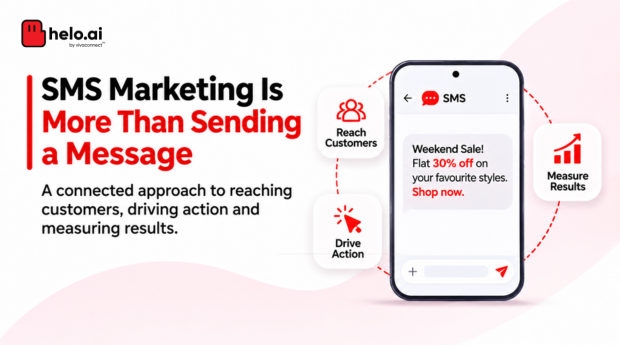


SMS remains one of the most direct ways for a business to communicate with its customers. A message can announce an offer, confirm an order, remind someone about an appointment or bring an interested customer back to a purchase.
But effective SMS marketing is not simply about sending messages to a large contact list. Businesses need to reach the right audience, choose the right message category, follow India's telecom regulations and understand whether their campaigns are delivering business results.
For marketing and operations teams, this means getting several things right: DLT registration, customer preferences and consent, message content, campaign timing, delivery tracking and performance measurement.
This guide explains how to plan SMS marketing in India, with practical templates, compliance considerations, campaign workflows and a framework for measuring ROI.
SMS marketing in India means sending promotional, service or transactional texts through DLT-registered headers and templates. Classify each message correctly, collect consent where required, add an opt-out to promotions, test send times against customer preferences, and judge results by conversions and ROI, not delivery alone.
What Is SMS Marketing?
SMS marketing is the use of text messages to communicate with customers or prospects for marketing, engagement and relevant service-related purposes.
Businesses use SMS to promote products, announce offers, share updates, remind customers about important actions and maintain communication after a purchase.
Common examples include:
- A retail brand announcing a seasonal sale.
- A bank sharing information about a relevant product or service.
- An e-commerce business confirming an order.
- A healthcare provider reminding a patient about an appointment.
- A financial services company notifying a customer about a payment due date.
The purpose and trigger of a message matter. A promotional offer, a payment confirmation and an appointment reminder may all be sent through SMS, but they do not necessarily fall under the same regulatory category.
Understanding this difference is the first step towards building an effective SMS programme.
Why Do Businesses Use SMS Marketing?
SMS is widely accessible and does not require customers to have an internet connection or install a particular application. This makes it useful for both marketing campaigns and important customer updates.
Businesses use it in several ways.
1. Reach customers directly
SMS gives businesses a direct communication channel to reach customers on their mobile numbers. It can be useful for time-sensitive information, offers and reminders.
2. Support campaign engagement
A short message with a relevant offer and a clear action can encourage customers to visit a website, explore a product or redeem a benefit.
3. Personalise communication
Businesses can use relevant customer information, such as purchase history, location or membership status, to make messages more useful. Personalisation should always respect applicable data protection, consent and communication requirements.
4. Automate routine updates
SMS can be triggered by events such as an order being placed, a payment being recorded or an appointment approaching. This helps teams manage recurring communication without manually sending every update.
5. Complement other communication channels
SMS can work alongside email, WhatsApp and voice communication. For example, a business may use SMS for a short notification and use another channel when a more detailed interaction is needed.
The objective is to choose the channel based on the communication need, not to repeat the same message everywhere.
Types of SMS Messages Used by Businesses in India
Before creating a campaign, identify the purpose of the communication. Under India's Telecom Commercial Communications Customer Preference Regulations (TCCCPR), the message category affects how the communication is treated and what requirements apply.
The following distinctions reflect the TRAI framework, including its 2025 amendment.
Promotional SMS
Promotional messages contain advertising or promotional material about a product or service.
Examples:
- A discount or seasonal sale announcement.
- A new product launch.
- A membership or loyalty offer.
- An invitation to an event.
Promotional messages are subject to applicable customer preferences and consent requirements. The 2025 amendment also requires an opt-out mechanism in the promotional message.
"The Sender shall give an opt-out mechanism to the Recipient in the same Message, as may be specified by the Authority."
If promotional content is mixed into a service or transactional message, the communication is treated as promotional.
Service SMS
Service messages provide specified information about a product or service. The regulatory definition covers communications such as warranty information, product recalls, software upgrade alerts, safety or security information, periodic balance alerts and delivery information.
The definition also covers certain communications that facilitate or complete an ongoing commercial transaction, subject to the applicable explicit-consent conditions.
Examples may include:
- A product safety or recall notification.
- A warranty update.
- A delivery update.
- A relevant account or service notification.
The classification depends on the actual purpose and circumstances of the message. A business should not label promotional content as a service message to avoid promotional communication requirements.
Transactional SMS
A transactional message is sent in response to a customer-initiated transaction within 30 minutes of that transaction. The message must not contain promotional content.
Examples include:
- An OTP following a customer action.
- A transaction alert.
- A transaction confirmation.
- A balance alert after a completed transaction.
- Refund information relating to a customer-initiated transaction.
Not every order confirmation or payment-related update automatically qualifies as transactional. The customer-initiated transaction and the 30-minute condition matter.
For the detailed differences and examples, read What Is Promotional SMS? Types, Examples & Compliance Guide.
Understanding DLT Registration for SMS Marketing in India
India's TCCCPR framework establishes requirements for managing commercial communications and protecting subscribers from unsolicited messages.
For businesses sending bulk SMS, DLT registration and the related telecom requirements are an essential part of the sending process.
What is DLT?
Distributed Ledger Technology (DLT) provides a shared, standardised record of registered entities, message headers, content templates and related communication information.
In practical terms, it helps telecom operators identify the sender and validate the registered details associated with a message.
What does a business need before sending bulk SMS?
TRAI's sender guidance lists the following requirements for Principal Entities sending bulk messages:
- Principal Entity registration: Register the business with an access provider.
- Header registration: Obtain a registered sender header.
- Content template registration: Register the message structure, including its fixed and variable portions.
- Consent template registration, where applicable: Register the template used to acquire customer consent.
- Consent acquisition, where applicable: Obtain and maintain consent in accordance with the relevant requirements.
- Correct message submission: Pass the required Principal Entity ID, header and Content ID when submitting messages to telecom service providers.
These requirements apply to bulk communications across relevant categories, including OTP, transactional, service and commercial messages. Consent requirements vary according to the message category and applicable circumstances.
TRAI lists these steps for senders in its advice to senders. Helo.ai's DLT management service supports registration and template mapping.
What are DLT-approved SMS templates?
A DLT content template is the registered structure of a message. It contains fixed text and permitted variable fields.
For example:
EXAMPLE DLT CONTENT TEMPLATEHello {#var#}, your appointment with {#var#} is scheduled for {#var#}. For assistance, contact {#var#}. – {#var#}
The actual message submitted for delivery must match the registered template structure and applicable variable rules. A message that does not pass the required checks may be blocked.
What are SMS header suffixes?
The 2025 amendment introduced standardised category identifiers for message headers:
These identifiers help recipients distinguish the category of communication they receive.
What about customer consent and DND preferences?
Having a customer's mobile number does not automatically give a business permission to send marketing messages.
Before running a promotional campaign, check the applicable consent and customer preference requirements. TRAI's framework allows subscribers to manage preferences by communication category, mode, time band and day.
Maintain reliable records of:
- How and when consent was acquired.
- The purpose and scope of consent.
- The applicable customer preferences.
- Any withdrawal or change in consent.
Remember: DLT registration is not a substitute for customer consent or preference compliance. A registered sender must still follow the requirements applicable to the message and recipient.
Consent timing: The 2025 amendment says a sender can re-acquire consent from a customer who revoked it only after 90 days from the date of revocation. For transaction-linked service messages, explicit consent lasts seven days unless TRAI directs otherwise (TRAI regulation). Build both rules into your CRM.
For current requirements, refer to TRAI's Advice to Senders, Manage Your Consent and Customer Preference Registration.
Keep up with regulatory changes
TRAI's framework continues to evolve. The 2026 third amendment introduces further provisions relating to suspected unsolicited commercial communication, sender and telemarketer accountability, consent and misuse of headers and content templates. Some provisions have staggered commencement dates.
TRAI also published a fourth amendment to TCCCPR on November 4, 2026. Businesses should review the latest notification and its commencement provisions with their access provider and compliance team before changing their sending processes.
You can check the latest regulations on TRAI's regulations page, and TRAI's press release on the third amendment summarises the sender accountability and misuse provisions.
Do not rely on an old DLT checklist as a permanent compliance reference. Review the latest TRAI regulations and amendments as part of your campaign governance process.
When Should You Send SMS Marketing Messages?
The right time to send a message depends on the audience, campaign objective and applicable delivery restrictions.
There are two considerations: regulatory requirements and customer behaviour.
Follow customer preferences and delivery restrictions
TRAI's Customer Preference Registration Facility allows subscribers to select preferences for commercial communication by category, mode, time band and day.
The available time bands include different periods throughout the day, rather than one universal window for every subscriber. Businesses must account for applicable preferences and delivery restrictions when scheduling promotional campaigns.
Do not assume that a message can be sent simply because it falls within a commonly used business-hours window. Confirm current requirements and delivery controls with your access provider.
Daytime window for promotions: Providers commonly cite the TCCCPR 2018 limit that promotional SMS can be sent only between 9 a.m. and 9 p.m. IST, with transactional and service messages not subject to it. Subscriber preferences can narrow the window further, so confirm current rules and delivery controls with your access provider.
See TRAI's Customer Preference Registration Facility for the available choices.
Choose campaign timing based on customer behaviour
Once compliance requirements are accounted for, test timing based on the campaign and audience.
Retail offers
Timing to testLate morning or early evening, where permittedWhy it may work: Customers may have time to explore an offer
Food and restaurant promotions
Timing to testBefore common meal periods, where permittedWhy it may work: The message arrives closer to a purchase decision
Event promotions
Timing to testIn advance of the eventWhy it may work: Gives customers time to plan
Appointment reminders
Timing to testBefore the scheduled appointmentWhy it may work: Allows time to confirm or reschedule
Loyalty campaigns
Timing to testAround relevant purchase or reward milestonesWhy it may work: Connects the message to customer activity
These are starting points for testing, not guaranteed performance benchmarks. Review campaign results and customer response before deciding on a schedule.
6 SMS Marketing Templates Businesses Can Use
Templates help teams maintain consistent communication. The examples below are illustrative drafts, not pre-approved DLT content templates. Each must be reviewed, classified and registered under the applicable requirements before sending.
The intended category depends on the purpose, trigger and circumstances of the communication. Do not use the labels below as a substitute for compliance review.
1. Promotional offer
Intended use: Advertising a discount or offer. Treat as promotional communication.
SAMPLE SMS[Brand Name]: Enjoy [Offer]% off on your next purchase. Explore the collection before [Date]: [Approved URL]. To opt out, [Applicable Opt-out Instruction].
2. New product launch
Intended use: Promoting a new product or service. Treat as promotional communication.
SAMPLE SMS[Brand Name]: Meet our latest [Product Name]. Explore its features and find out more here: [Approved URL]. To opt out, [Applicable Opt-out Instruction].
3. Seasonal campaign
Intended use: Promoting a festive or seasonal collection. Treat as promotional communication.
SAMPLE SMSCelebrate the season with [Brand Name]. Explore our [Collection / Offer] and find something special: [Approved URL]. To opt out, [Applicable Opt-out Instruction].
4. Loyalty reward
Intended use: Depends on the message. A promotional reward or redemption offer may be promotional; a non-promotional account or service update may qualify differently under the applicable definition.
SAMPLE SMS[Brand Name]: You have [Reward Details] available in your account. Check the applicable terms and view your reward through [Official Channel].
5. Order confirmation
Intended use: Classification depends on the customer action and timing. A message sent in response to a customer-initiated transaction within 30 minutes, without promotional content, may qualify as transactional.
SAMPLE SMS[Brand Name]: Your order [Order ID] has been confirmed. You can check the latest order details here: [Approved URL].
6. Appointment reminder
Intended use: Classification depends on the service relationship and applicable conditions. Confirm whether it falls under the relevant service-message provision before sending.
SAMPLE SMS[Brand Name]: A reminder that your appointment is scheduled for [Date] at [Time]. For assistance or changes, contact [Official Support].
Keep promotional and operational templates separate. If promotional content is added to a service or transactional message, the communication may be treated as promotional under the applicable regulations.
Turn these drafts into approved templates
Helo.ai's DLT management service supports header registration and content template mapping, so each draft above can be reviewed, classified and registered before sending.
How to Run an Effective SMS Marketing Campaign
A successful campaign starts before the message is written. The audience, objective, compliance checks and measurement plan should be clear first.
Step 1: Define the campaign objective
Decide what the message needs to achieve.
Possible objectives include:
- Generate product enquiries.
- Increase visits to a store or website.
- Promote a new product.
- Encourage repeat purchases.
- Remind customers about an upcoming event.
A clear objective makes it easier to choose the audience, message and success metric.
Step 2: Build the right audience
Use relevant customer information to identify who should receive the communication.
Useful segmentation criteria may include:
- Purchase history.
- Product or service interest.
- Location.
- Customer lifecycle stage.
- Membership or loyalty status.
- Applicable consent and communication preferences.
Avoid sending every campaign to the entire database. Segment the audience only where the data and communication permissions allow it.
Step 3: Write a clear message
A good SMS communicates one main idea.
Keep the copy:
- Short and easy to understand.
- Relevant to the recipient.
- Clear about the offer or information.
- Specific about the next action.
- Consistent with the registered content template.
Where appropriate, include the brand name and an approved URL. Avoid misleading urgency, vague claims and unnecessary promotional language.
Mind the character count: A standard SMS in the GSM-7 character set holds 160 characters, or 153 per part when a long message is split. Messages that use Unicode characters, which typically include Indian-language scripts, hold 70 characters, or 67 per part. A longer message can therefore be billed and delivered as several parts.
Step 4: Prepare the campaign
Before submitting messages, check the recipient list, message category, registered template, sender header and schedule.
Also confirm that the URL meets applicable registration or whitelisting requirements and that the campaign follows customer preferences and consent requirements.
Links in SMS: TRAI's 20 August 2024 direction bars non-whitelisted URLs, APK links, OTT links and call-back numbers in SMS from 1 September 2024. Use a registered, whitelisted domain you control, and check with your access provider before using a public link shortener, because a shared domain generally cannot be whitelisted as yours.
Step 5: Test before sending at scale
Run a controlled test with permitted test numbers. Check how the message appears on different devices and whether the links, variables and sender identity are correct.
A small test can help catch errors before they affect a larger audience.
Step 6: Track and improve
Review the campaign after sending. Look at delivery, clicks, conversions, opt-outs and complaints where those measurements are available.
Use the findings to improve the next campaign rather than repeating the same message and audience approach.
For a detailed walkthrough of campaign setup and sending, read How to Send Bulk SMS: The Ultimate Step-by-Step Guide.
What Developers Should Check When Integrating an SMS API
For businesses integrating SMS into CRM, e-commerce or other business systems, the API workflow should account for more than the message submission itself.
A practical implementation checklist includes:
- Receive the trigger: Identify the event that should initiate communication, such as a campaign schedule, order event or account update.
- Validate the recipient: Check the customer record and relevant communication preferences or consent status before sending.
- Identify the message category: Determine whether the communication is promotional, service or transactional based on its purpose and trigger.
- Map the registered template: Select the correct DLT content template and sender header for the communication.
- Submit required identifiers: Pass the PE ID, header and Content ID as required by the provider's integration process.
- Handle the API response: Record whether the message submission was accepted or rejected. Submission acceptance is not proof of delivery.
- Process delivery updates: Capture delivery-status updates where the provider makes them available.
- Maintain suppression and audit controls: Prevent inappropriate repeat sends, respect opt-outs and maintain records of the campaign, template and delivery events.
Retries should be designed carefully. A failed or delayed response should not automatically lead to duplicate customer messages. Use appropriate status checks and idempotency controls where supported by the integration.
The exact API fields, callback structure and retry mechanisms depend on the SMS provider. Confirm them against the provider's technical documentation before implementation.
Helo.ai's guides to what an SMS gateway is and SMS API pricing in India cover the integration and cost questions in more detail.
How to Measure SMS Marketing ROI
Sending a large number of messages does not automatically mean a campaign has performed well. The important question is whether the campaign contributed to the intended business outcome.
Start by measuring these metrics.
A simple SMS ROI formula
A practical way to calculate campaign ROI is:
SMS ROI (%) = (Attributed revenue − Campaign cost) ÷ Campaign cost × 100
For example, suppose a campaign costs ₹10,000 and generates ₹35,000 in revenue that can reasonably be attributed to it.
ROI = (35,000 − 10,000) ÷ 10,000 × 100 = 250%
This is an illustrative calculation, not an industry benchmark. It assumes the revenue is genuinely attributable to the campaign and the campaign cost includes the relevant expenses.
For a more complete view, include discounts, message costs, platform charges, creative and operational expenses where relevant. If SMS is one of several channels in a customer journey, use a consistent attribution method to avoid counting the same conversion more than once.
Open rates are not available: SMS has no open event, so any quoted open rate is an estimate. To see what the campaign added, send to most of the audience and hold back a random group of recipients who are not messaged. Compare conversions between the two groups, and credit the campaign only with the difference.
How to improve campaign ROI
- Improve audience relevance: Send messages based on customer needs and behaviour.
- Test message variations: Compare offers, calls to action and copy within approved templates.
- Use tracked links: Measure clicks through campaign-specific or appropriately tagged URLs.
- Control campaign frequency: Avoid unnecessary repeat communication.
- Review conversion quality: Look beyond clicks to understand whether the campaign generated meaningful actions.
Common SMS Marketing Mistakes to Avoid
Even a well-planned campaign can underperform if basic controls are overlooked.
Sending without checking consent and preferences
A customer database is not automatically a marketing list. Check the applicable consent and preference requirements before sending.
Mixing promotional and operational content
Adding an offer to a service or transactional message can change its regulatory classification. Keep message purposes and templates separate.
Using the same message for every customer
A generic message may not address different customer interests or lifecycle stages. Segment the audience where useful and permitted.
Ignoring DLT template matching
A message that does not match the registered content template may be blocked. Check variable values and template mapping before submission.
Overlooking URLs
Use links that meet the applicable registration and whitelisting requirements. Avoid unfamiliar or unverified shortened URLs.
Measuring only delivery
Delivery is not the same as engagement or conversion. A delivered message does not prove that the recipient read it or acted on it.
Sending too frequently
Too many messages can frustrate customers and increase opt-outs and complaints. Set frequency controls and make each communication useful.
How Helo.ai Supports Enterprise SMS Communication
For businesses sending SMS at scale, the sending platform is an important part of the campaign process.
Helo.ai works in enterprise communication across SMS and other channels. Businesses evaluating an SMS solution should consider how the platform fits their messaging requirements, DLT workflow, system integrations and reporting needs.
Helo.ai's SMS page lists scheduling, behaviour and time-zone triggers, delivery tracking, and DLT registration support with template checks. For channel choice, see Helo.ai's comparison of WhatsApp vs SMS notifications.
When assessing a provider, marketing, operations and technology teams should look at:
- Support for the applicable DLT registration and template workflow.
- Domestic SMS routing requirements.
- Message submission and delivery-status visibility.
- Integration options for existing business systems.
- Support for bulk and event-triggered messaging.
- The ability to coordinate SMS with other communication channels.
The right setup should fit the business's message volumes, use cases, integration needs and compliance processes.
Planning an SMS programme for your business?
Speak with the Helo.ai team about your campaign and integration requirements.
Frequently Asked Questions About SMS Marketing in India
What is SMS marketing?
SMS marketing is the use of text messages to communicate with customers or prospects for marketing, engagement and relevant service purposes. Common examples include promotional offers, product announcements, reminders and transaction updates.
Is DLT registration mandatory for bulk SMS in India?
Businesses sending bulk messages through telecom resources must follow the applicable TCCCPR requirements. These include Principal Entity registration, header and content template registration, and consent-related requirements where applicable.
What is the difference between promotional, service and transactional SMS?
Promotional messages contain advertising or promotional material. Service messages provide specified information about a product or service under the applicable service-message provisions. Transactional messages respond to a customer-initiated transaction within 30 minutes and must not contain promotional content.
What is the best time to send SMS marketing messages in India?
There is no single campaign schedule that should be assumed to apply to every subscriber. Businesses need to account for applicable delivery restrictions and customer preferences, including selected time bands and days. Campaign timing should then be tested against audience behaviour.
How do businesses measure SMS marketing ROI?
Compare the revenue or value attributed to the campaign with its total cost. Track delivery, clicks, conversions, cost per conversion, opt-outs and complaints to understand both business performance and customer response.
Can SMS marketing be automated?
Yes. Businesses can connect SMS sending to events in systems such as CRM, e-commerce platforms and other business applications. Automation can support campaign scheduling, customer updates and event-triggered communication, provided the correct message category, template and consent requirements are followed.
What do the -P, -S, -T and -G header suffixes mean?
They show the message category: -P for promotional, -S for service, -T for transactional and -G for government messages. TRAI introduced the suffixes in its 2025 amendment so recipients can identify the type of commercial communication from the header.
Can promotional SMS be sent at night?
Providers commonly cite a TCCCPR 2018 limit that promotional SMS can be sent only between 9 a.m. and 9 p.m. IST. Transactional and service messages are not subject to that window. Check current rules and subscriber preferences with your access provider.
Can I use bit.ly or other short links in SMS?
Generally not without checking. TRAI bars non-whitelisted URLs in SMS, and a shared public shortener domain usually cannot be whitelisted as yours. Use a registered domain you control and confirm the setup with your access provider.
How many characters fit in one SMS?
A GSM-7 message holds 160 characters, or 153 per part when split. A Unicode message, typical for Indian-language scripts, holds 70 characters, or 67 per part, so the same text can use more parts.
Should I use SMS or WhatsApp for marketing?
Use SMS for short, broad-reach messages and WhatsApp when customers need rich, two-way conversations. Many businesses use both with clear rules for which message goes where. See Helo.ai's comparison of WhatsApp vs SMS notifications.
The Takeaway
SMS marketing works best when it is treated as a planned communication channel rather than a one-time bulk send.
Start with a clear objective, identify the right audience, use the correct message category, complete the required DLT setup and account for customer preferences when scheduling messages. Then measure what happens after the message reaches the customer.
When businesses connect compliant sending with relevant communication and meaningful measurement, SMS can become a useful part of their wider customer engagement strategy.
Disclaimer. This article is general information, not legal, regulatory or compliance advice. The SMS examples are illustrative, not approved DLT templates. TRAI rules, including recent amendments, change and vary by message category, so check current requirements with your access provider and compliance advisers. Helo.ai is the publisher and offers SMS and other messaging products. Sources were last checked in November 2026.