.jpeg)
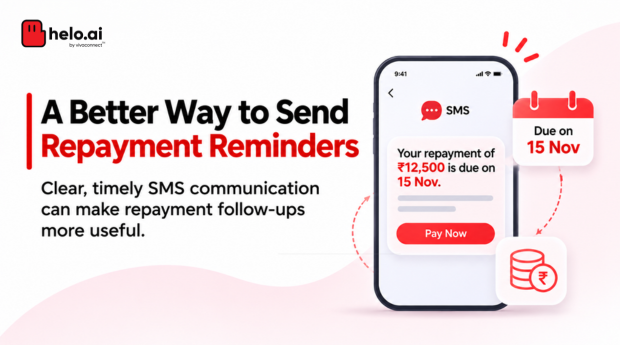


A missed EMI does not always mean a borrower is unwilling to pay. They may have overlooked the due date, missed a notification or faced a failed transaction. A timely reminder can help them take the next step before the situation becomes more difficult.
For lenders and financial institutions, SMS remains a practical channel for repayment reminders. It is direct, works without an internet connection and can reach customers on basic mobile phones.
But debt collection messages need more care than ordinary promotional communication. The sender must follow applicable telecom requirements, respect borrower privacy and avoid language that could be interpreted as threatening or misleading.
This guide covers how to use SMS for debt collection in India, with practical reminder templates, compliance considerations and an escalation workflow for collections teams.
Yes, lenders in India can use SMS for repayment reminders if the message follows TRAI DLT rules, RBI recovery conduct norms and borrower privacy. Use registered templates, send only verified account details, check payment status before every overdue reminder, and route disputes to official support instead of sending more messages.
Why SMS Still Matters in Debt Collection
SMS gives lenders a direct way to communicate important repayment information throughout the loan lifecycle.
It can help teams:
- Remind borrowers before the due date: Give customers time to arrange funds and avoid missing a payment.
- Notify customers about overdue instalments: Send a clear reminder when a payment has not been received.
- Confirm successful payments: Reduce uncertainty by acknowledging that a repayment has been recorded.
- Share important account updates: Communicate relevant information, such as an authorised recovery agent's details where applicable.
- Direct borrowers to support: Give customers a way to raise a query or report a payment issue.
SMS is particularly useful for short, time-sensitive updates. It should not replace a proper conversation when a borrower disputes an amount, needs assistance or wants to discuss repayment difficulties.
What Makes a Debt Collection SMS Compliant in India?
A collection message is not compliant simply because it is short or uses polite language. Lenders need to consider both telecom messaging rules and the applicable RBI requirements.
1. Follow TRAI's DLT requirements
Under India's Telecom Commercial Communications Customer Preference Regulations (TCCCPR), businesses sending bulk communications through telecom resources must follow the applicable registration and message-template requirements.
Depending on the communication and its classification, this can include:
- Registering as a Principal Entity (PE).
- Using an assigned and registered sender header.
- Registering the message content template.
- Passing the required PE ID, header and Content ID when submitting messages.
- Following applicable consent requirements.
The classification of a debt collection message should not be assumed. Whether a message falls under a particular category depends on its purpose and the applicable telecom rules. Lenders should confirm the correct classification, registration and consent requirements with their telecom service provider before launching a campaign.
A registered template also does not make every message automatically compliant. The actual message must match the approved template and applicable requirements. TRAI's official website provides the relevant regulatory resources.
TRAI lists the registration steps for senders in its advice to senders, and Helo.ai's DLT management service supports registration and template mapping.
2. Respect RBI's fair recovery practices
RBI-regulated lenders are responsible for ensuring that their employees and recovery agents follow fair practices.
RBI's recovery guidance prohibits conduct such as:
- Intimidation, harassment or public humiliation.
- Intruding into the privacy of borrowers, their family members or friends.
- Sending inappropriate messages through mobile phones or social media.
- Making threatening or anonymous calls.
- Making persistent calls, including calls before 8 a.m. or after 7 p.m., under the applicable directions.
- Making false or misleading representations about the amount due or consequences of non-payment.
"Do not resort to intimidation or harassment of any kind, either verbal or physical."
An important distinction: the 8 a.m.–7 p.m. restriction in the earlier general recovery guidance is framed around calls. It should not be inaccurately described as a universal SMS-only time restriction. However, lenders should establish sensible daytime SMS scheduling policies, avoid repeated reminders and follow any stricter rules that apply to their loan category or institution.
Timing is changing from 1 January 2027: The point above about calls reflects RBI's 2022 instructions. RBI's recovery amendment directions of 6 August 2026 take effect on 1 January 2027. As reported for the commercial-bank text, employees and recovery agents may contact or visit a borrower only between 8 am and 7 pm, and this covers all contact, not calls alone. Reports also say written communication from a recovery agent needs the lender's prior approval and must show the sender's name and contact details. Keep recovery SMS inside that window and read the direction for your lender category on RBI's website.
Microfinance loans have separate recovery provisions and should not automatically be treated under the same timing guidance. Lenders should check the directions applicable to their specific lending category. RBI's official website is the source for current directions.
3. Notify borrowers about recovery agents where required
For digital loans covered by RBI's Digital Lending Directions, 2025, when a recovery agent is assigned or changed in a case of default, the details of the authorised agent must be communicated to the borrower through email or SMS before the agent contacts them.
The message should identify the lender and provide the relevant authorised agent details. It should not create confusion about who is contacting the borrower or imply that an unassigned person has authority to collect repayment.
This requirement is specific to the digital lending directions; do not assume that the same provision applies identically to every type of loan. Refer to RBI's Digital Lending Directions, 2025.
The August 2026 amendments go further, according to reports. Lenders must tell a borrower which agency has been assigned at least one day before the first in-person visit, by SMS or email where contact details exist, and must tell the borrower at once if the agency changes.
4. Protect borrower information
Collection messages should contain only the information needed for the communication.
Avoid including:
- Full account numbers or sensitive personal information.
- Details of the borrower's loan shared with family members or other third parties.
- Unnecessary information about financial hardship.
- Publicly accessible or unsecured payment links.
Use verified customer contact details and lender-controlled payment destinations. Where a digital loan is covered by RBI's Digital Lending Directions, repayment should be made directly to the regulated entity's bank account rather than an LSP's or third party's pass-through account.
For the wider data-protection picture, see Helo.ai's note on the DPDP Act and AI conversations.
Payment links: TRAI's 20 August 2024 direction bars non-whitelisted URLs, APK links, OTT links and call-back numbers in SMS from 1 September 2024. Register the lender-controlled payment domain through your provider before it appears in a template, and check current TRAI rules.
5. Keep upcoming RBI changes on your compliance calendar
RBI issued new amendment directions on the conduct of regulated entities in loan recovery and engagement of recovery agents on August 6, 2026. These directions are scheduled to take effect on January 1, 2027, across the relevant categories of regulated entities.
The amendments address borrower treatment, employee and recovery-agent conduct, due diligence, training, codes of conduct and technology-based recovery mechanisms involving financed mobile devices.
Collections teams should review the directions applicable to their institution and update internal policies before the effective date. Do not treat upcoming provisions as though they are already in force. Check the latest RBI notifications before implementation.
7 SMS Templates for Debt Collection
The following examples are starting points for collections teams. They are illustrative copy, not pre-approved DLT templates or legal notices. Adapt them to the lender's approved content templates, communication classification, consent requirements and internal compliance policies.
Use placeholders only after verifying the relevant customer and payment information.
1. Pre-due EMI reminder
Purpose: Give borrowers advance notice of an upcoming instalment.
SAMPLE SMSReminder: Your EMI of Rs. [Amount] for loan account ending [XXXX] is due on [Date]. Please ensure sufficient funds are available. For assistance, contact [Official Support Number]. – [Lender Name]
2. EMI due today
Purpose: Notify the borrower that the scheduled payment is due.
SAMPLE SMSYour EMI of Rs. [Amount] is due today, [Date]. You can make the payment through [Official Payment Channel]. If you have already paid, please ignore this reminder. – [Lender Name]
3. First overdue reminder
Purpose: Inform the borrower that the payment has not been recorded.
SAMPLE SMSOur records indicate that your EMI of Rs. [Amount], due on [Date], is yet to be received. Please check your payment status or contact [Official Support Number] if you need assistance. – [Lender Name]
4. Follow-up on an outstanding repayment
Purpose: Follow up when the overdue status remains unresolved.
SAMPLE SMSThis is a follow-up regarding your outstanding EMI of Rs. [Amount] for loan account ending [XXXX]. Please review the payment status through [Official Channel]. For any discrepancy or assistance, contact [Official Support Number]. – [Lender Name]
5. Payment received confirmation
Purpose: Acknowledge a repayment and reduce unnecessary follow-ups.
SAMPLE SMSWe have received your payment of Rs. [Amount] on [Date] towards your loan account ending [XXXX]. Thank you. For any queries, contact [Official Support Number]. – [Lender Name]
6. Payment status or dispute assistance
Purpose: Give borrowers a clear route to resolve a payment discrepancy.
SAMPLE SMSHave you already made your EMI payment? If it is not reflected in your loan account, please contact [Official Support Number] or raise a request through [Official Channel] with your payment reference. – [Lender Name]
7. Recovery-agent assignment notification
Purpose: Inform the borrower about an authorised recovery agent where the applicable RBI directions require advance communication.
SAMPLE SMS[Lender Name] has authorised [Agent Name / Agency Name] to contact you regarding your loan account ending [XXXX]. Official contact details: [Verified Contact Details]. For confirmation or assistance, contact [Lender Support Number].
Important: Use the seventh template only after confirming the agent's authorisation and the applicability of the relevant notification requirement. The message should be sent before the agent contacts the borrower where the Digital Lending Directions require it.
Typing tip: Type the dash before the lender name as a plain hyphen. A character outside the GSM-7 set, such as an en dash, switches the SMS to Unicode, where a single message holds 70 characters instead of 160 and long messages are split into 67-character parts. Check how your provider counts segments.
See how SMS fits your collections workflow
Helo.ai SMS supports bulk and transactional sends with DLT-ready template mapping. Review the product page, then map each template above to your own approved content.
How to Build an SMS-Based Collection Escalation Workflow
A useful collection workflow is not about sending more messages. It is about sending the right communication at the right stage and stopping when the borrower has resolved the issue.
A practical workflow can look like this:
Step 1: Send a pre-due reminder
Send an advance reminder before the EMI date. Include the amount, due date and an official payment route.
Step 2: Send a due-date notification
If the payment is scheduled for that day, send a concise reminder. Avoid sending another message if the payment has already been recorded.
Step 3: Check payment status before following up
If the payment is not reflected, verify the latest status before sending an overdue message. Account for processing delays and payment reconciliation issues.
Step 4: Provide a route for questions and disputes
If the borrower reports a failed payment, incorrect amount or other discrepancy, direct the query to the lender's official support process. Do not continue sending automated overdue reminders without accounting for the open issue.
Step 5: Communicate recovery-agent details where applicable
When a recovery agent is assigned or changed in a digital lending default case covered by RBI's directions, communicate the authorised agent's details through the required channel before the agent makes contact.
Step 6: Stop or update the communication after resolution
Once payment is confirmed, suppress further overdue reminders and send a payment acknowledgement where appropriate. If the account remains unresolved, follow the lender's approved escalation and grievance-handling process.
The timing and frequency of these steps should be defined by the lender's policy and applicable regulations. They should not be presented as a mandatory RBI-prescribed SMS schedule.
Managing SMS Collection Campaigns at Scale
For lenders handling large customer volumes, manual messaging can make it difficult to maintain consistency and track what has been communicated.
An integrated SMS workflow can help collections and technology teams manage the process more systematically.
Helo.ai's SMS product page covers bulk and transactional sending. Lenders weighing SMS against WhatsApp for alerts can also read Helo.ai's guide to WhatsApp vs SMS notifications.
A few operational controls matter:
- Connect SMS to the loan management system: Use relevant repayment events and account status to trigger the right message.
- Map approved templates: Select the appropriate registered template and sender details for each communication.
- Verify payment status before sending: Check the latest available repayment information to avoid reminders after successful payment.
- Track message delivery: Record submission and delivery status where the provider makes these available. A delivered SMS does not prove that the borrower has read or acted on it.
- Manage customer responses: Route disputes, payment issues and support requests to the right team.
- Maintain communication records: Keep an auditable record of message content, timestamps, template identifiers, delivery status and relevant account events.
- Apply frequency and timing controls: Set internal rules to prevent excessive or unnecessary reminders.
A simple SMS API workflow for collections teams
For developers integrating an SMS API, the workflow can be organised around six events:
- Trigger: A due-date, overdue or payment-status event is received from the loan management system.
- Validate: Check the borrower record, amount, due date and latest payment status.
- Select: Map the event to the correct approved DLT template and sender header.
- Submit: Send the message through the SMS API with the required registration identifiers.
- Track: Capture the provider's response and available delivery-status updates.
- Suppress or escalate: Stop further overdue reminders after payment confirmation, or route unresolved cases to the appropriate support or collections process.
This structure helps keep message delivery connected to the actual account status rather than relying on a fixed list of scheduled messages.
When Should Lenders Use WhatsApp or AI Voice Alongside SMS?
SMS works well for short reminders and account updates. But not every collections interaction can be resolved through a text message.
A borrower may need to ask about an outstanding amount, report a payment failure or understand the next steps. That is where another communication channel may be more useful.
A practical channel mix could look like this:
- SMS: Due-date reminders, overdue notifications, payment acknowledgements and short account updates.
- WhatsApp: Conversations that benefit from a richer interaction, such as answering queries or guiding customers through an approved support journey.
- AI Voice: Routine voice interactions where customers need to hear or respond to information, with a clear route to human assistance when required.
The choice should depend on the purpose of the communication, customer preference, applicable consent and channel-specific rules. Adding more channels should not mean repeating the same reminder everywhere.
For a broader view of how lenders can coordinate communication across channels, read Loan Repayment Reminders: Using Digital Channels for Lenders.
For voice-led collection workflows, see AI Voice Bot for EMI Reminders and Loan Collections: A BFSI Guide. For WhatsApp, see Helo.ai's guides to EMI collection chatbots on WhatsApp and WhatsApp Business API for banking.
How Helo.ai Can Support Repayment Communication
Managing repayment communication at scale requires more than sending messages. Lenders need reliable channel integration, consistent workflows and visibility into communication activity.
Helo.ai supports enterprise communication across SMS, WhatsApp and Voice. These channels can be considered as part of a broader repayment communication strategy, with each serving a different customer interaction.
Explore Helo.ai SMS, WhatsApp and Voice to understand the available communication options for your business.
Planning a repayment communication workflow?
Speak with the Helo.ai team about your SMS requirements and how different channels could fit into your collections process.
Frequently Asked Questions
Is SMS allowed for debt collection in India?
Lenders can use SMS for legitimate repayment communication, provided they follow applicable telecom requirements, RBI directions and borrower privacy obligations. The communication must not be threatening, misleading, harassing or otherwise inappropriate.
Is DLT registration required for debt collection SMS?
Businesses sending bulk messages through telecom resources must follow applicable TCCCPR requirements. These can include Principal Entity registration, registered headers, content templates and consent requirements, depending on the communication's classification and purpose. Confirm the correct setup with your telecom service provider.
Can lenders send debt collection SMS after 7 p.m.?
The earlier RBI recovery guidance's 8 a.m.–7 p.m. restriction is framed around calls, not as a universal SMS-only time restriction. However, lenders should follow the rules applicable to their institution and loan category, along with internal policies designed to prevent excessive or inappropriate communication. From 1 January 2027, RBI's amendment directions are reported to limit all recovery contact to 8 a.m. to 7 p.m., so plan SMS inside that window.
Should a lender send an SMS when a recovery agent is assigned?
For digital loans covered by RBI's Digital Lending Directions, 2025, the borrower must receive the authorised recovery agent's details by email or SMS before the agent contacts them, when an agent is assigned or changed in a default case. Other lending categories should be assessed under their applicable directions.
What should a debt collection SMS include?
A useful reminder generally identifies the lender, states the relevant repayment information, provides an official support or payment route and explains what the borrower can do next. It should avoid unnecessary personal information, misleading statements, threats and unverified payment links.
Are EMI reminder SMS transactional or promotional?
TRAI classifies messages by purpose and consent. Its transactional category covers messages triggered by the subscriber's own transaction within 30 minutes, which a due-date reminder may not meet, so confirm the category and template with your telecom provider before launch.
When do RBI's new recovery rules start?
RBI issued the recovery amendment directions on 6 August 2026 and they take effect on 1 January 2027. Each category of lender has its own direction, so read the one that applies to you.
Can a collection SMS include a payment link?
It can if the link is controlled by the lender and allowed under your telecom setup. TRAI's August 2024 direction bars non-whitelisted URLs in SMS, so register the payment domain through your provider first and avoid public or unsecured links.
The Takeaway
SMS can make repayment communication more timely and consistent, but an effective collections strategy is not measured by how many reminders a lender sends.
It depends on accurate account information, appropriate message timing, clear language, privacy safeguards and a reliable process for handling borrower queries. When SMS is connected to payment status and supported by the right escalation workflow, lenders can make repayment communication more useful for both customers and collections teams.
Disclaimer. This article is general information, not legal, regulatory or compliance advice. The SMS examples are illustrative, not approved DLT templates or legal notices. RBI and TRAI rules vary by lender category and change, so check current directions and consult qualified advisers. Helo.ai is the publisher and offers SMS, WhatsApp and voice products. Sources were last checked in November 2026.