.jpeg)
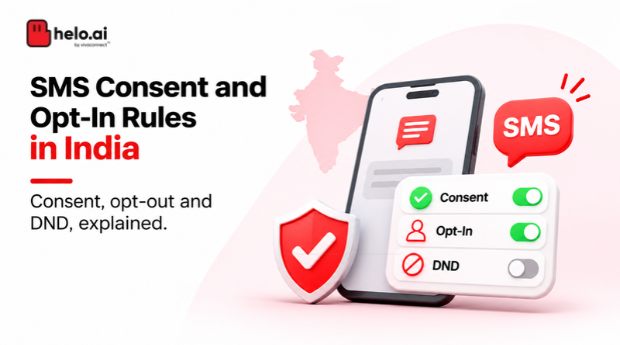


A customer shares their mobile number while placing an order. Can the business start sending them promotional SMS? Not necessarily.
Having someone's phone number does not automatically mean they have agreed to receive offers, advertisements or marketing messages. Businesses need to understand the purpose for which a number was collected, the applicable consent requirements and the customer's communication preferences.
In India, SMS consent is governed by the Telecom Commercial Communications Customer Preference Regulations (TCCCPR), 2018, issued by the Telecom Regulatory Authority of India (TRAI), along with subsequent amendments and directions.
These regulations cover how businesses register consent templates, acquire customer permission, respect Do Not Disturb (DND) preferences and handle opt-out requests.
This guide explains SMS consent and opt-in rules in India, with practical examples of consent language, DLT consent templates, SMS opt-out text examples and the latest regulatory requirements.
In India, a business needs valid consent and a preference check before sending promotional SMS. TRAI's 2025 amendment requires an opt-out in every promotional message and a 90-day wait before re-asking after an opt-out. Mixed content is treated as promotional. A DLT consent template is not customer consent.
What is SMS consent?
SMS consent is the permission or applicable authorisation that allows a business to send a particular type of message to a customer.
For example, a customer may provide their mobile number to receive an order confirmation. That does not automatically mean the business can use the same number to send promotional offers.
The business needs to follow the applicable rules for each type of communication.
For promotional SMS, this involves checking the customer's registered preferences and obtaining valid consent where required. The relevant consent must be acquired and managed through the prescribed process.
The distinction is simple: collecting a mobile number and obtaining permission for promotional communication are two different things.
What is SMS opt-in?
SMS opt-in is the process through which a customer agrees to receive a particular type of communication from a business.
A customer might provide permission through a website, mobile application, registration form or another permitted consent acquisition process.
Examples include:
- Selecting a clearly worded checkbox to receive promotional SMS.
- Submitting a form requesting updates about a particular product or service.
- Completing an applicable digital consent process.
A good opt-in process tells customers who will contact them, what kind of messages they can expect and how they can withdraw their permission.
Opt-in for text messages: What information should businesses record?
When collecting permission for promotional SMS, businesses should maintain records that help establish the customer's consent and its scope.
These should include:
- Customer's mobile number.
- Name of the business or brand.
- Purpose and category of communication.
- Consent language presented to the customer.
- Date and time consent was obtained.
- Method or source of consent.
- Relevant consent template and registration details, where applicable.
- Current consent status, including any subsequent withdrawal.
These records help businesses verify whether a recipient is eligible for a particular campaign.
SMS consent rules in India: What does TRAI require?
The main regulatory framework is TCCCPR, 2018. It governs commercial communication through telecom networks and sets out requirements for businesses, telecom operators and registered telemarketers.
The February 2025 Second Amendment introduced important changes to promotional opt-out, consent revocation and message classification.
Here are the main requirements businesses should understand.
1. Register as a Principal Entity
Businesses sending applicable commercial SMS must register as a Principal Entity (PE) with an authorised telecom operator's DLT platform.
The registration establishes the identity of the business sending the communication.
2. Register sender headers and content templates
Businesses must use the applicable registered sender headers and approved content templates.
The message submitted for delivery must match the registered template and carry the required identifiers.
3. Register consent templates where applicable
When seeking consent through the prescribed DLT process, businesses need to register the relevant consent template.
The template defines how the business requests permission and identifies the purpose of the communication.
4. Respect customer preferences and consent status
Businesses must check whether a recipient has blocked the applicable category of communication or has given valid consent under the regulations.
The 2025 amendment clarifies how explicit digital consent interacts with registered promotional preferences.
5. Include an opt-out mechanism in promotional SMS
A promotional message must provide an opt-out mechanism in the same message, in the manner specified by TRAI.
This is an important requirement when preparing promotional content templates and campaign workflows.
6. Maintain consent and withdrawal records
Businesses should maintain reliable records of consent acquisition, changes in consent status and withdrawal requests.
They must also ensure that withdrawal is respected in subsequent promotional communication.
For the regulatory details, refer to TRAI's guidance for senders and telemarketers.
What is a DLT consent template?
A DLT consent template is a registered format used by a business to request a customer's permission to receive commercial communication.
It helps identify the business and explain the purpose of the consent request.
For example, a bank may want permission to send promotional SMS about credit cards, loans or other financial products. Its consent request should clearly identify the bank and explain the type of communication the customer is agreeing to receive.
Consent template vs customer consent: What is the difference?
These two terms are often confused, but they refer to different things.
| DLT consent template | Customer consent |
|---|---|
| A registered format used to request permission | The permission actually given by the recipient |
| Identifies the sender and purpose of the request | Connects the recipient to the permitted communication |
| Prepared and registered by the Principal Entity | Acquired through the prescribed process |
| Does not itself prove that a customer agreed | Must be recorded and managed by the business |
Registering a consent template does not mean every customer has agreed to receive promotional messages. The business still needs to acquire and record the applicable consent.
Text message opt-in language: Examples businesses can use
Consent language should be clear about the sender and the purpose of communication. Customers should not have to guess whether they are agreeing to service updates or promotional messages.
The following are illustrative customer-facing examples, not approved DLT consent templates.
Example 1: Retail promotional SMS
"Would you like to receive promotional SMS from [Brand Name] about product launches, offers and seasonal sales? You can withdraw your consent through the available opt-out facility."
Example 2: Banking product updates
"I agree to receive promotional SMS from [Bank Name] about eligible banking products, services and offers. I can withdraw my consent through the available opt-out facility."
Example 3: Education and course updates
"I agree to receive promotional SMS from [Institute Name] about courses, admissions, events and related offers. I can withdraw my consent through the available opt-out facility."
Before using any of these examples, the business must check the applicable consent acquisition process, registered template requirements and operator instructions.
Opt-in text examples: Good and poor practices
The wording and placement of a consent request can affect whether customers understand what they are agreeing to.
| Situation | Better practice | Avoid |
|---|---|---|
| Website checkout | Use a separate, clearly worded promotional SMS opt-in | Treat every checkout phone number as promotional consent |
| Account registration | Explain the type of messages the customer will receive | Hide marketing consent in general terms |
| Lead form | Identify the business and purpose of follow-up | Use a vague or preselected promotional checkbox |
| Event registration | Distinguish event-related updates from future marketing | Assume event registration means consent to unrelated offers |
| Existing customer | Follow the applicable consent or inferred-consent basis | Treat an existing relationship as unlimited marketing permission |
Where promotional consent is being requested, keep it distinct from permissions needed to complete an order or provide an essential service.
Promotional, service and transactional SMS: What is the difference?
Correct message classification is central to SMS compliance. A business cannot decide a message category simply by labelling it transactional or service-related. The actual content and purpose matter.
The 2025 amendment clarified the definitions of promotional, service and transactional messages.
Promotional SMS
A promotional message contains advertising or promotional material about a product or service.
Examples include:
- Sale announcements and discount offers.
- New product launches.
- Credit card and loan promotions.
- Promotional event invitations.
- Marketing campaigns for existing or prospective customers.
Promotional messages must follow applicable registered preference and consent requirements. They must also provide an opt-out mechanism in the same message.
Service SMS
Service messages provide information about a product or service used or purchased by the customer, provided the communication is not promotional.
Examples include:
- Warranty information.
- Product recall notices.
- Software upgrade alerts.
- Product safety and security information.
- Periodic balance alerts.
- Delivery information.
The 2025 amendment distinguishes service messages sent to an existing customer under the applicable inferred-consent basis from messages facilitating or completing an ongoing transaction that require explicit consent. The latter category is subject to a seven-day period, or another period directed by TRAI.
Transactional SMS
Transactional messages are sent in response to a customer-initiated transaction within 30 minutes, provided they are not promotional in nature.
Examples include:
- Banking OTPs.
- Login verification codes.
- Transaction confirmations.
- Payment and refund confirmations.
- Balance alerts following a transaction.
A transactional message should relate to the customer's transaction. It should not be used as a convenient way to send unrelated promotional content.
Important classification rule: If promotional content is mixed into a transactional or service message, the entire message is treated as promotional under the 2025 amendment.
For example, adding a discount offer to an order confirmation can change the message's classification.
Refer to the TRAI Second Amendment Regulations, 2025 for the updated definitions.
SMS opt-out: Rules and text examples
SMS opt-out is the process through which a recipient stops receiving a particular type of communication or withdraws their consent.
Under the 2025 amendment, promotional messages must provide an opt-out mechanism in the same message, in the manner specified by TRAI.
This means businesses need to consider opt-out while designing their promotional templates, not just after a customer complains.
SMS opt-out text example
The following examples show how an opt-out instruction might appear in a promotional message. The wording is illustrative; the actual mechanism must follow the applicable TRAI directions and the implementation supported by the telecom operator.
Example 1: Retail offer
"Weekend sale: Get up to 30% off on selected products at [Brand]. To stop promotional messages, use [approved opt-out method]."
Example 2: Banking promotion
"Explore eligible offers on [Bank Product]. Terms apply. To stop promotional messages, use [approved opt-out method]."
Example 3: Education promotion
"Admissions are open at [Institute Name]. Explore our latest courses. To stop promotional messages, use [approved opt-out method]."
Do not assume that writing "Reply STOP" will work for every Indian business SMS sender ID. A reply-based keyword is not a universal substitute for the prescribed opt-out mechanism.
The business should confirm the approved implementation with its telecom operator or SMS provider before sending campaigns.
What should a business do after a customer opts out?
A customer's opt-out should update their promotional communication status, not simply disappear into an inbox or customer service ticket.
Businesses should:
- Record the request and the time it was received.
- Update the customer's consent status.
- Stop the affected promotional communication.
- Synchronise the change with relevant campaign and customer databases.
- Exclude the recipient from future campaigns for which they are no longer eligible.
- Retain an appropriate record of the withdrawal.
This is particularly important when customer data is shared across CRM systems, campaign platforms and different business teams.
What is DND in SMS?
DND stands for Do Not Disturb. In India, subscribers can register their communication preferences through the telecom preference framework.
Customers can choose to block promotional communication in particular categories or across the applicable categories.
Businesses need to consider these preferences when deciding whether a promotional message can be sent.
How can customers register DND preferences?
Customers can manage their preferences through available telecom operator channels, including:
- SMS to 1909.
- IVRS by calling 1909.
- USSD options.
- Approved digital channels provided by telecom operators.
The 2025 amendment includes the following SMS preference commands:
| Customer preference | SMS to 1909 |
|---|---|
| Block promotional communication across all categories | BLOCK PROMO or 50 |
| Fully block applicable commercial communication | FULLY BLOCK or 0 |
| Banking, insurance, financial products and credit cards | BLOCK 1 |
| Real estate | BLOCK 2 |
| Education | BLOCK 3 |
| Health | BLOCK 4 |
| Consumer goods and automobiles | BLOCK 5 |
| Communication, broadcasting, entertainment and IT | BLOCK 6 |
| Tourism and leisure | BLOCK 7 |
| Food and beverages | BLOCK 8 |
These are customer preference controls. They are not a substitute for a business's own promotional opt-out process.
The current instructions and availability should be checked with the recipient's telecom operator.
FULLY BLOCK: Under TRAI's regulation, FULLY BLOCK covers all categories except transactional and service messages sent under inferred consent, and government messages. TRAI's preference registration page lists the other ways to register preferences.
Official reference: TRAI TCCCPR and related directions.
DND preference vs business SMS opt-out
Both mechanisms help customers control commercial communication, but they work differently.
| DND preference | Business SMS opt-out |
|---|---|
| Managed through the telecom preference framework | Provided by the sender in its promotional message |
| Can block communication by category or broader preference | Allows the recipient to stop promotional communication from the sender through the provided mechanism |
| Applies through the recipient's telecom preference settings | Must be processed by the business and its messaging setup |
| Helps determine whether promotional messages can be delivered | Helps the sender honour a recipient's withdrawal request |
A customer opting out from a business's campaigns does not automatically mean their DND preference has changed. Likewise, a DND preference does not remove the sender's responsibility to process a direct opt-out request.
Can promotional SMS be sent to a DND number?
The 2025 amendment clarifies that promotional messages can be delivered to subscribers who have not blocked the applicable category in the Preference Register or who have provided explicit digital consent under the regulations.
This is not a general exemption from DND or consent requirements. The sender must have valid consent acquired through the prescribed process, and the relevant consent must be properly recorded.
Businesses should not treat an old customer list, an unchecked form or a mobile number collected during checkout as proof of explicit digital consent.
Sending promotional SMS in India?
Check consent, preferences and templates before you launch. See how Helo.ai SMS delivery fits into your setup.
What changed under the 2025 TRAI amendment?
The Telecom Commercial Communications Customer Preference (Second Amendment) Regulations, 2025 introduced several changes that affect how businesses acquire, manage and withdraw SMS consent.
When it applied: TRAI notified the Second Amendment on 12 February 2025. Most provisions took effect 30 days after publication, and some after 60 days.
1. Promotional messages need an opt-out mechanism
A promotional SMS must give the recipient an opt-out mechanism in the same message, as specified by TRAI.
2. Promotional content cannot be hidden in other message categories
If promotional material is mixed into a transactional or service message, the communication is treated as promotional.
This makes accurate message classification essential for businesses using automated messaging journeys.
3. Inferred consent has defined limits
The amendment clarifies that inferred consent does not extend beyond the duration or discharge of the contract between the sender and recipient.
The communication must remain within the scope of the applicable relationship and the purpose of the message.
4. Customers can revoke consent and opt in again
The amendment allows a customer who has revoked consent to opt in again at their own will.
However, there is an important distinction:
- The customer is free to opt in again.
- The sender must wait 90 days from the date of revocation or opt-out before reacquiring that customer's consent through its consent-seeking process.
The restriction applies to the sender's reacquisition of consent, not to the customer's freedom to express their preference.
5. Consent-seeking messages have additional safeguards
The amendment provides for consent-seeking messages to be sent using short code 127xxx, or another code prescribed by TRAI.
It also requires access providers to develop SMS, IVR or online facilities through which customers can register their unwillingness to receive consent-seeking messages initiated by a Principal Entity.
This means businesses should not repeatedly approach customers who have indicated that they do not wish to receive consent-seeking messages.
How should businesses manage SMS consent and opt-outs?
A compliant process needs to cover the entire customer communication lifecycle, from the first consent request to a later withdrawal.
Here are seven practical steps for marketing and compliance teams.
1. Separate promotional and service communication
Maintain separate message categories and campaign lists. Do not combine promotional content with a transactional or service message to increase campaign reach.
2. Make opt-in language specific
Identify the business and explain the type of communication the customer is agreeing to receive. Avoid vague statements that do not make the promotional purpose clear.
3. Maintain consent records
Record how and when consent was obtained, the scope of permission and the relevant template details. Make sure the information can be retrieved when needed.
4. Keep opt-out information updated
When a customer withdraws consent, update the central record and synchronise the change with relevant campaign systems.
5. Check DND preferences and consent eligibility
Before sending promotional SMS, check the applicable preference and consent status. Do not assume that every number in a CRM is eligible for marketing.
6. Review promotional templates
Check that promotional messages include the required opt-out mechanism and match their registered content templates.
7. Maintain an audit trail
Keep records of consent requests, consent acquisition, changes in status, opt-outs and campaign eligibility checks. This helps teams investigate complaints and demonstrate that they followed the applicable process.
SMS consent compliance checklist
Before launching an SMS campaign in India, review these points:
- Register the business as a Principal Entity on an authorised DLT portal.
- Obtain the required sender header.
- Register the relevant SMS content templates.
- Register consent templates where applicable.
- Use clear, purpose-specific opt-in language.
- Record the date, source and scope of customer consent.
- Follow the prescribed consent acquisition process.
- Check DND preferences and applicable consent status.
- Include the required opt-out mechanism in promotional SMS.
- Process consent withdrawal and opt-out requests.
- Respect the 90-day restriction on reacquiring consent after revocation or opt-out.
- Keep promotional content out of transactional and service messages.
- Maintain records for compliance reviews and complaint investigations.
How Helo.ai helps with DLT management and SMS delivery
Managing SMS consent involves more than adding an opt-in checkbox to a website. Businesses need to coordinate their DLT registration, sender headers, content templates, consent templates and messaging setup.
Helo.ai helps businesses with DLT registration, including entity, header and template registration, alongside their SMS delivery requirements.
This gives teams a single provider relationship for managing the registration process and their business SMS setup.
For businesses preparing to launch SMS communication or reviewing their existing arrangements, getting the registration and message configuration right is an important first step.
Need help with DLT registration and business SMS? Explore Helo.ai's DLT Management service.
Frequently asked questions about SMS consent and opt-in in India
What is opt-in for text messages?
Opt-in for text messages means a customer has agreed to receive a particular type of SMS communication from a business. The purpose and scope of permission should be clear, and the applicable consent acquisition requirements must be followed.
Is SMS consent mandatory in India?
Requirements depend on the category and purpose of the message. Promotional communication must follow the applicable consent and registered preference rules. Certain transactional and service messages may be sent under the specific consent or inferred-consent provisions defined by TCCCPR.
What is a DLT consent template?
A DLT consent template is a registered format used by a business to request customer permission for commercial communication. It identifies the sender and explains the purpose of the consent request. Registering the template does not mean a customer has automatically given consent.
What is an opt-out text example?
An opt-out text example is a line in a promotional SMS that tells the recipient how to stop receiving promotional messages. For example: "To stop promotional messages, use [approved opt-out method]." The actual method must follow the applicable TRAI requirements.
What is the difference between SMS opt-in and opt-out?
SMS opt-in is the process through which a customer gives permission to receive messages. SMS opt-out is the process through which the customer withdraws permission or stops the relevant communication.
How can a customer stop promotional SMS in India?
Customers can use the opt-out mechanism provided in a promotional message. They can also manage their telecom communication preferences through options such as SMS or a call to 1909, subject to the applicable preference categories.
What is the difference between DND and SMS opt-out?
DND allows customers to manage commercial communication preferences through the telecom preference framework. A sender's opt-out mechanism allows recipients to stop promotional messages from that business. Both need to be handled appropriately.
Can a business send promotional SMS to a DND number?
The 2025 amendment provides for promotional messages to be delivered to subscribers who have not blocked the applicable category or who have provided valid explicit digital consent under the regulations. The consent must be properly acquired and recorded.
Can a customer give consent again after opting out?
Yes. A customer can opt in again at their own will. However, the sender cannot reacquire that customer's consent until 90 days after the date of revocation or opt-out.
Can promotional content be added to a transactional SMS?
No. Under the 2025 amendment, promotional material mixed into a transactional or service message makes the communication promotional. Businesses should keep promotional offers in separate, correctly classified messages.
Does a business need a registered consent template for every SMS?
Consent templates are required where applicable to the consent acquisition process. Not every individual SMS is a consent-seeking message. Businesses should distinguish between registering a content template for a message and registering a consent template for requesting permission.
Final takeaway
SMS consent is not just about collecting a mobile number or adding a checkbox to a form. Businesses need to understand what customers have agreed to receive, maintain the right records, respect DND preferences and make it possible to withdraw consent.
The 2025 TRAI amendment makes promotional opt-out, consent revocation and message classification particularly important. Getting these details right helps businesses avoid preventable compliance issues and manage their messaging more responsibly.
For teams setting up business SMS in India, DLT registration, consent management and delivery configuration should be planned together.
Plan consent and delivery together
Tell the Helo.ai team how you collect consent and which message types you send, and they can help you plan registration and delivery.
Note. This article is an editorial guide and general information, not legal advice. TRAI rules and operator implementations change, so check the current regulation and your operator's instructions. Helo.ai is a CPaaS provider and publishes this guide. Facts were checked on 16 November 2026.